GOLDWIND(002202)

Search documents
金风科技曹志刚:以“度电价值成本”重构风电逻辑
中国能源报· 2025-10-24 06:16
Core Viewpoint - The wind power industry is transitioning from a focus on "price selection" to "value selection" by 2025, driven by policy and market changes, particularly the implementation of the National Energy Administration's "Document 136" [3][6][8]. Group 1: Industry Transformation - The traditional logic of "high electricity output = high profit" is no longer valid, as the industry faces challenges related to electricity price fluctuations and wind resource mismatches [6][8]. - The concept of "cost of electricity value" is introduced to replace the long-standing "cost of electricity," emphasizing the dual variables of electricity price and generation volume for value assessment [6][8]. - The strategy includes optimizing power generation based on real-time electricity price predictions, allowing for increased generation during high-value periods and reduced output during low-value periods [6][7]. Group 2: Technological Innovation - Hardware and software innovations are crucial for implementing the new strategy, with the launch of the GWH204-Ultra series wind turbines and the "Tianji Cloud Power Trading Platform" enhancing generation capabilities and predictive accuracy [7][11]. - The lifespan of onshore wind turbines is extended from 20 to 25 years, and offshore turbines from 25 to 30 years, improving annual generation hours and reducing investment costs per kilowatt [7][11]. Group 3: Competitive Landscape - Future competition will shift from individual machine capacity to comprehensive system solutions, with a focus on data analysis and lifecycle services becoming increasingly important [11][12]. - The industry is moving away from merely increasing turbine size to enhancing existing product platforms, which alleviates pressure on the supply chain and promotes sustainable development [11][12]. Group 4: Global Expansion - The internationalization of Chinese wind power companies, exemplified by Goldwind's experience, emphasizes the importance of building trust and long-term relationships in foreign markets [15][16]. - The integration of local supply chains and the provision of comprehensive solutions, including logistics and installation, are critical for success in international markets [15][16]. - The global expansion of Chinese wind power companies not only addresses domestic growth limitations but also contributes significantly to global energy transition efforts [15][16].



傲鲨外骨骼机器人落地金风科技
Bei Jing Shang Bao· 2025-10-24 04:40
Core Insights - The article highlights the launch of a wind power industry application case by Aoshark Intelligent, featuring the deployment of their exoskeleton robot in the production environment of Goldwind Technology [1] Company Overview - Goldwind Technology has maintained its position as the leading wind turbine manufacturer in China for 14 consecutive years and has been ranked first globally for the past three years, accounting for nearly 50% of China's total wind turbine exports [1] Industry Challenges - The wind power industry faces significant challenges, including the need for workers to frequently handle heavy components, leading to substantial physical strain. High-altitude and confined space operations are common, increasing the risk of occupational injuries due to the physical demands and the need for precision and concentration [1] Product Application - The Aoshark exoskeleton robot, specifically the FIT-HV PRO model, provides crucial support in the factory's main production processes. It offers an additional 30 kg of assistance for the repetitive handling of heavy materials, effectively reducing over 60% of the lumbar load and lowering peak lumbar disc pressure by approximately 40% [1] - The robot also mitigates impacts on the thigh and ankle joints, providing comprehensive dynamic protection for key areas, which helps prevent occupational injuries while simultaneously enhancing production efficiency [1]
金风科技涨2.03%,成交额4.94亿元,主力资金净流出569.69万元
Xin Lang Cai Jing· 2025-10-24 02:01
Core Viewpoint - Jinpeng Technology's stock has shown significant growth this year, with a 52.70% increase, reflecting strong market performance and investor interest [1][2]. Financial Performance - For the first half of 2025, Jinpeng Technology achieved a revenue of 28.537 billion yuan, representing a year-on-year growth of 41.26%. The net profit attributable to shareholders was 1.488 billion yuan, with a year-on-year increase of 7.26% [2]. - The company has distributed a total of 11.683 billion yuan in dividends since its A-share listing, with 1.521 billion yuan distributed in the last three years [3]. Stock Market Activity - As of October 24, Jinpeng Technology's stock price was 15.56 yuan per share, with a market capitalization of 65.742 billion yuan. The stock has seen a trading volume of 4.94 billion yuan and a turnover rate of 0.96% [1]. - The stock has been active in the market, with a net inflow of 56.969 million yuan in principal funds, and significant buying and selling activity from large orders [1]. Shareholder Structure - As of June 30, 2025, the number of shareholders for Jinpeng Technology was 197,100, a decrease of 11.65% from the previous period. The average circulating shares per person remained at 0 [2]. - The top ten circulating shareholders include Hong Kong Central Clearing Limited and Southern CSI 500 ETF, with notable changes in their holdings [3].
风电行业景气度有望持续攀升 万亿级市场空间可期
Huan Qiu Wang· 2025-10-24 01:30
Core Insights - The wind power industry is expected to maintain a rising trend in the fourth quarter, driven by the acceleration of large-scale projects like the "Shage Desert" base [1] - Key component manufacturers in the wind power sector have reported significant growth in their third-quarter earnings, while the midstream wind turbine manufacturing segment is still in a recovery phase [2][3] Company Performance - Xinqianglian, a leading bearing manufacturer, reported a revenue of 3.618 billion yuan for the first three quarters, a year-on-year increase of 84.10%, and a net profit of 664 million yuan, up 1939.50% [2] - Zhongcai Technology achieved a revenue of 8.369 billion yuan in the third quarter, reflecting a year-on-year growth of 33.47%, with a net profit increase of 234.84% [2] - Guangda Materials reported total revenue of 3.775 billion yuan for the first three quarters, a 27.56% increase, and a net profit of 249 million yuan, up 213.65% [3] Industry Trends - The demand for wind turbine blades is currently outstripping supply, with leading companies experiencing full order books, indicating a continuation of high demand into the fourth quarter [2] - The average gross margin for midstream turbine manufacturers was around 11% in the first half of the year, showing a decline of over 3 percentage points year-on-year [3] - The wind power industry is projected to see an annual average investment exceeding 250 billion yuan during the "14th Five-Year Plan" period, with core components expected to capture about 60% of the market share [6] Market Opportunities - China's new energy targets aim for wind and solar power generation capacity to reach six times that of 2020 by 2035, suggesting a doubling of annual new installations in the next five years [4] - Major projects like the 19 million kW capacity in Xinjiang, which includes 4 million kW of wind power, are set to drive demand [5] - The exploration of new business models such as wind power hydrogen production is expanding market boundaries, with significant investments in integrated projects [5]



风机:国内盈利能力修复,出海打开成长天花板 | 投研报告
Zhong Guo Neng Yuan Wang· 2025-10-24 01:08
Core Viewpoint - The wind power equipment industry is experiencing a turning point in profitability, driven by strong domestic and international demand, with significant growth expected in both onshore and offshore wind installations from 2025 to 2030 [2][4]. Group 1: Domestic Market Dynamics - Domestic wind power demand remains stable, supported by the "dual carbon" goals and the plan to reach 3.6 billion kilowatts of wind and solar installations by 2035 [2]. - The bidding volume for complete wind turbine units in the first three quarters of 2025 increased by 5% year-on-year, indicating a solid foundation for future installations [2]. - The average bidding price for onshore wind turbines, including towers, increased by 13% in the first eight months of 2025 compared to 2024, signaling a recovery in pricing and profitability for domestic manufacturers [2][3]. Group 2: International Market Opportunities - The Global Wind Energy Association forecasts that from 2025 to 2030, the total new installed capacity for onshore wind outside of China will reach 367 GW, with a compound annual growth rate (CAGR) of 12.4%, while offshore wind is expected to grow at a CAGR of 15.8% [4]. - Domestic wind turbine manufacturers are accelerating their international expansion, investing in factories in Brazil, Europe, and Central Asia, transitioning from mere product exports to localized operations [4]. - In the first three quarters of 2025, domestic manufacturers secured a record 19.28 GW in overseas orders, reflecting a year-on-year increase of 187.8%, with higher order prices and better profitability [4][6]. Group 3: Future Outlook - The wind power sector is expected to maintain high installation levels domestically, with a recovery in bidding prices leading to improved profitability for wind turbine manufacturers as orders from the price recovery phase are delivered starting in Q4 2025 [3][6]. - The combination of stable domestic demand and rising international orders is anticipated to drive significant growth in profitability for domestic wind turbine companies, with a focus on key players such as Goldwind Technology, Yunda Co., Mingyang Smart Energy, and SANY Heavy Energy [6].


碳中和系列报告七:航运减碳大势所趋,重视生柴、RNG及绿色甲醇
Shenwan Hongyuan Securities· 2025-10-23 08:46
Investment Rating - The report indicates a positive investment outlook for the shipping decarbonization sector, emphasizing the importance of biofuels, RNG, and green methanol as key areas for investment opportunities [3]. Core Insights - The shipping industry is entering a critical phase of decarbonization, driven by frequent policies from the IMO and the EU. The global shipping fuel consumption is approximately 300 million tons, corresponding to carbon emissions exceeding 1 billion tons, with the EU accounting for about 18% of this [3][8]. - The demand for low-carbon fuels is expected to outstrip supply in the short term, with significant compliance costs driving the need for zero or near-zero emissions fuels (ZNZ) [3][36]. - Biofuels are identified as a core measure for existing vessels, with a notable increase in biofuel bunkering at ports like Singapore [3][36]. - The report highlights the potential for biogas, particularly RNG, to significantly reduce emissions and improve energy security, with ambitious production targets set for 2030 in both China and the EU [3][36]. - Green methanol is projected to see rapid growth in demand, with a current estimate of 406 methanol vessels corresponding to a demand exceeding 800,000 tons [3][36]. Summary by Sections 1. Decarbonization Policies - The report outlines the increasing frequency of decarbonization policies from the IMO and the EU, marking a significant acceleration in the implementation of these measures [3][11][18]. 2. Low-Carbon Fuel Demand - There is a broad demand space for low-carbon fuels, with a short-term supply shortage anticipated. The report notes that the compliance costs associated with EU regulations are higher than those of the IMO, which will further stimulate demand for low-carbon fuels [3][36]. 3. Biofuels - Biofuels are highlighted as a critical decarbonization measure for existing vessels, with a significant increase in biofuel bunkering observed at ports like Singapore. The global production of biodiesel is approximately 52 million tons, with expectations for increased usage in shipping as electric vehicles proliferate [3][36]. 4. Biogas - The report emphasizes the growing demand for LNG vessels and the potential for RNG to drive significant growth in the sector, supported by a green premium that could lead to an industry explosion [3][36]. 5. Green Methanol - The report notes a rapid increase in methanol vessels, with a projected demand of over 800,000 tons. However, the global production capacity for green methanol is expected to be only 1.24 million tons by the end of 2025, indicating a supply-demand imbalance [3][36]. 6. Investment Recommendations - The report suggests focusing on companies involved in biofuels, RNG, and green methanol production, including notable firms such as卓越新能, 山高环能, 维尔利, and 中国天楹, among others [3][36].




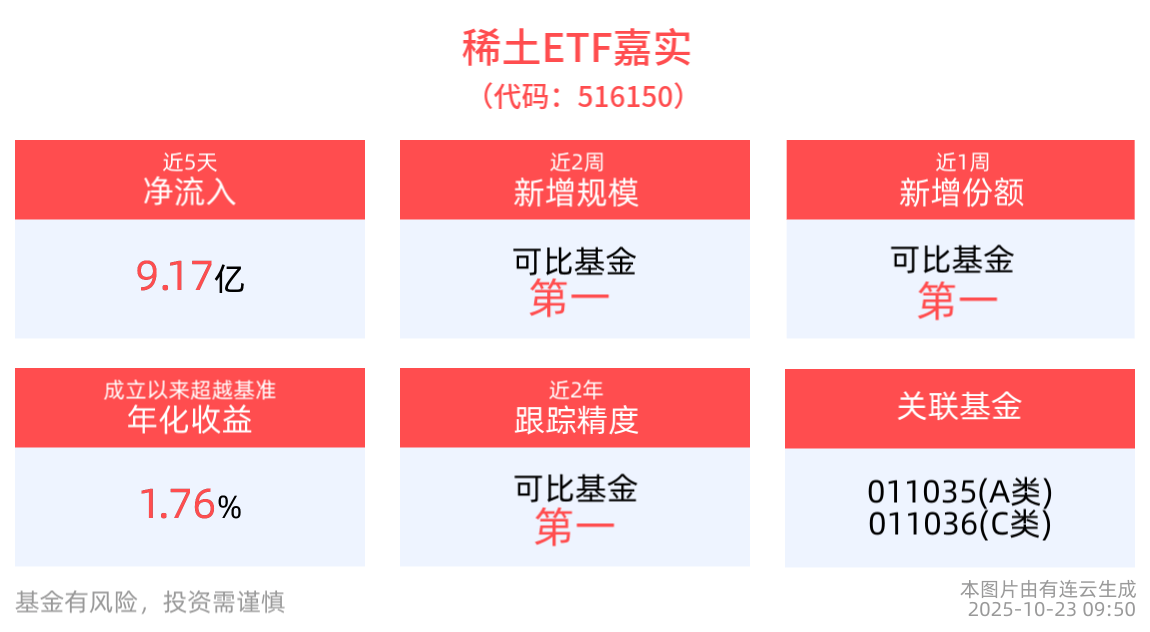
稀土行业供需格局有望迎来拐点,稀土ETF嘉实(516150)近2周规模增长超26亿元同类居首!
Sou Hu Cai Jing· 2025-10-23 02:10
Group 1: Liquidity and Performance of Rare Earth ETF - The liquidity of the Rare Earth ETF managed by Jiashi reached a trading volume of 97.241 million yuan [3] - Over the past two weeks, the scale of the Rare Earth ETF increased by 2.632 billion yuan, marking significant growth and ranking first among comparable funds [3] - In terms of shares, the ETF saw an increase of 10.7 million shares in the past week, also ranking first among comparable funds [3] - In the last five trading days, there were net inflows on three days, totaling 917 million yuan [3] - As of October 22, the net value of the Rare Earth ETF has risen by 88.51% over the past two years, ranking 88th out of 2358 index equity funds, placing it in the top 3.73% [3] - The highest monthly return since inception was 41.25%, with the longest consecutive monthly increase being four months and a maximum increase of 83.89% [3] Group 2: Market Dynamics and Policy Impact - The Ministry of Commerce, in conjunction with the General Administration of Customs and other departments, has issued multiple export control policies, highlighting the strategic nature of rare earth resources [4] - The combination of regulatory constraints and declining imports has strengthened the rigidity of rare earth supply [4] - Demand from sectors such as new energy vehicles, consumer electronics, variable frequency air conditioners, and wind power is expected to continue rising, providing strong support for rare earth prices [4] - Emerging fields like robotics, low-altitude economy, and industrial motors are anticipated to open up long-term demand growth opportunities [4] - The supply-demand dynamics in the rare earth industry are expected to reach a turning point, with a continued recommendation for strategic allocation in the rare earth industry chain [4] Group 3: Top Weighting Stocks in Rare Earth Industry - The top ten weighted stocks in the China Rare Earth Industry Index account for 61.96% of the index, including Northern Rare Earth, Wolong Electric Drive, Lingyi Technology, China Rare Earth, Shenghe Resources, Gree Environmental, Goldwind Technology, Baotou Steel, Xiamen Tungsten, and China Aluminum [3]





风能展解读及十五五风电展望
2025-10-22 14:56
Summary of Wind Power Industry Conference Call Industry Overview - The wind power equipment industry has entered a mature phase, with companies adopting more stable strategies and no longer showcasing large components on a large scale. The competitive landscape is stable, with companies like United Power and XJ Electric exiting the market, indicating no imminent large-scale eliminations in the short term [1][5] - Wind turbine prices are steadily increasing, with the State Power Investment Corporation's bidding results showing a year-on-year price increase of 200-300 RMB/kW for 6-8 MW products. The possibility of significant price reductions is low due to rising raw material costs and the trend towards larger products [1][5] Market Projections - It is expected that by 2026, China's wind power equipment exports will see significant growth, with a substantial increase in equipment delivery volumes [1][6] - The delivery scale for 2025 is projected to be between 120-130 GW, with approximately 10 GW from offshore wind. For 2026, the overall delivery level may adjust to 100-110 GW, with offshore contributions of about 12-15 GW [1][9] Technological Developments - Key component quality issues are gradually being resolved, which helps reduce costs for large, high-tower wind turbines and promotes the application of offshore wind turbines rated at 12-15 MW and above [1][7][8] - Innovations in component technology focus on sliding bearings, new materials, and domestic bearings, with high tower technology also receiving attention [1][23] Regional Insights - Zhejiang and Shandong provinces are leading in offshore wind development, with significant projects expected to be operational by 2025-2026. Coastal provinces are projected to meet 10% of their electricity demand from offshore wind by the end of 2027 [1][15][16] Economic Factors - The VAT refund policy significantly impacts cash flow for offshore wind companies, effectively raising electricity prices and aiding in technology optimization and scale expansion [1][20][21] - The pricing for various wind turbine models is as follows: 6.25 MW mixed tower turbines are priced at approximately 2,100-2,200 RMB/kW, while 10 MW turbines are around 1,200 RMB/kW, and offshore turbines rated at 12-16 MW are about 2,800 RMB/kW [1][11][12] Challenges and Opportunities - The offshore wind sector faces challenges such as military and navigation issues, but demonstration projects are gradually addressing these concerns. Local government negotiations with developers can also slow progress [1][19] - Chinese wind power companies are adopting localized manufacturing strategies to mitigate trade barriers and government demands, which helps maintain profit margins despite rising local labor costs [1][13] Future Outlook - The theoretical turning point for offshore wind power commercialization is expected by 2028, with significant advancements in cost, construction capacity, and average turbine capacity anticipated by then [1][18] - The competition in offshore wind primarily affects coastal economic provinces, with limited impact on land-based wind competition [1][22] Conclusion - The wind power industry is poised for growth, driven by technological advancements, stable pricing, and increasing export opportunities. However, challenges remain in terms of local regulations and market dynamics that will need to be navigated for sustained success [1][24][30]

CWP2025新品首发引领全球风电新风潮
中国能源报· 2025-10-22 10:14
Core Viewpoint - The article highlights the advancements and innovations in the wind energy sector showcased at the Beijing International Wind Energy Conference and Exhibition (CWP2025), emphasizing China's leading position in wind power technology globally. Group 1: Turbine Innovations - Goldwind Technology introduced a trading-type wind turbine that shifts from a passive to an active generation model, potentially increasing project returns by 2% to 2.5% over its lifecycle [3] - Mingyang Smart Energy launched the world's first 50MW wind turbine, significantly increasing the maximum capacity of wind turbines and designed for deep-sea applications [7] - SANY Heavy Energy presented the SI-242 series wind turbine, capable of operating efficiently across a wide range of wind speeds, with a rotor diameter of 242 meters [8] - Envision Energy unveiled the first AI-integrated wind-storage unit, merging wind turbines, storage, and AI to enhance operational efficiency [5] Group 2: Component Innovations - Luozhou showcased the world's first 16MW offshore wind turbine main bearing, designed for large-scale wind turbine stability [23] - Pangu Intelligent launched a hydraulic motor yaw system that improves reliability and lifespan compared to traditional systems [25] - TBEA New Energy introduced the upgraded TSVG6.0 product, enhancing reliability and operational efficiency through advanced design and technology [27] Group 3: Comprehensive Solutions - China CRRC presented a comprehensive energy solution integrating wind, solar, hydrogen, and AI technologies, aimed at achieving sustainable development goals [11] - Shanghai Electric highlighted its integrated projects, including green hydrogen production and floating wind-fish integration, showcasing its capabilities in the renewable energy sector [13] - XBL Wind Power signed a strategic partnership with Multi Engineering Group to develop a dual-head floating wind power solution, focusing on cost efficiency and system performance [19]


风电设备板块10月22日涨3.12%,电气风电领涨,主力资金净流入6.97亿元
Zheng Xing Xing Ye Ri Bao· 2025-10-22 08:26
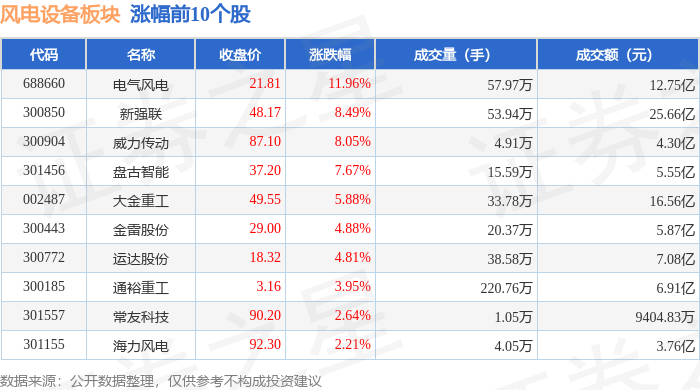
Core Insights - The wind power equipment sector experienced a significant increase of 3.12% on October 22, with Electric Wind Power leading the gains [1] - The Shanghai Composite Index closed at 3913.76, down 0.07%, while the Shenzhen Component Index closed at 12996.61, down 0.62% [1] Wind Power Equipment Sector Performance - Electric Wind Power (688660) saw a closing price of 21.81, with a remarkable increase of 11.96% and a trading volume of 579,700 shares [1] - New Strong Union (300850) closed at 48.17, up 8.49%, with a trading volume of 539,400 shares [1] - Other notable performers included: - Weili Transmission (300904) at 87.10, up 8.05% [1] - Fugu Intelligent (301456) at 37.20, up 7.67% [1] - Daikin Heavy Industry (002487) at 49.55, up 5.88% [1] Capital Flow Analysis - The wind power equipment sector saw a net inflow of 697 million yuan from institutional investors, while retail investors experienced a net outflow of 768 million yuan [2] - Key stocks with significant capital flow included: - Goldwind Technology (002202) with a net inflow of 256 million yuan from institutional investors [3] - New Strong Union (300850) with a net inflow of 70.77 million yuan [3] - Electric Wind Power (688660) with a net inflow of 55.72 million yuan [3]