
GOLDWIND(002202)

Search documents
港股金风科技跌超4%
Mei Ri Jing Ji Xin Wen· 2026-02-05 01:52
(文章来源:每日经济新闻) 每经AI快讯,金风科技(02208.HK)跌超4%,截至发稿,跌4.22%,报13.17港元,成交额5616.29万港 元。 ...
港股异动 | 金风科技(02208)再跌超4% 欧盟对金风科技启动FSR调查
智通财经网· 2026-02-05 01:40
消息面上,2月3日,欧盟委员会宣布,依据《外国补贴条例》(FSR)对金风科技在欧盟境内的风力发电 机组生产、销售及相关服务活动,启动深入调查。这项始于2024年4月的审查,预计将持续至2027年秋 季。 智通财经APP获悉,金风科技(02208)再跌超4%,截至发稿,跌4.22%,报13.17港元,成交额5616.29万 港元。 ...
金风科技再跌超4% 欧盟对金风科技启动FSR调查
Zhi Tong Cai Jing· 2026-02-05 01:39
消息面上,2月3日,欧盟委员会宣布,依据《外国补贴条例》(FSR)对金风科技在欧盟境内的风力发电 机组生产、销售及相关服务活动,启动深入调查。这项始于2024年4月的审查,预计将持续至2027年秋 季。 金风科技(002202)(02208)再跌超4%,截至发稿,跌4.22%,报13.17港元,成交额5616.29万港元。 ...
A股开盘:沪指跌0.66%、创业板指跌1.02%,银行股高开,黄金、有色金属及光伏概念股集体调整
Jin Rong Jie· 2026-02-05 01:39
Market Overview - The A-share market opened lower on February 5, with the Shanghai Composite Index down 27.18 points, a decrease of 0.66%, closing at 4075.03 points [1] - The Shenzhen Component Index fell by 135.43 points, a decline of 0.96%, closing at 14020.84 points [1] - The CSI 300 Index decreased by 33.94 points, down 0.72%, closing at 4664.75 points [1] - The ChiNext Index dropped by 33.79 points, a decline of 1.02%, closing at 3277.72 points [1] - The STAR 50 Index fell by 29.82 points, down 2.05%, closing at 1423.66 points [1] Sector Performance - The photovoltaic equipment sector experienced a pullback, with major stocks like Aotewi down over 10% and Junda Co. and Jincheng Co. both down over 9% [1] - The precious metals sector opened lower, with Hunan Silver down over 6% and other stocks like Sichuan Gold and Xiaocheng Technology also declining [1] - The banking sector was active at the start, with Qilu Bank rising nearly 3% and other banks like Chongqing Bank and Jiangyin Bank also seeing gains [1] Company News - The EU has announced an investigation into Goldwind Technology due to concerns about government subsidies distorting market competition [3] - The Chinese Foreign Ministry criticized the EU's unilateral trade measures as discriminatory and damaging to the EU's image [3] - Market rumors suggest that Elon Musk's team visited several Chinese photovoltaic companies, but confirmed that no cooperation agreements have been signed [3][7] - Companies like Jingsheng Mechanical and Dualgood Energy stated that the "space photovoltaic" application is still in the exploratory stage and has not impacted their current performance [4] - Long光华芯 faced issues with false information regarding a supposed investment from Huawei, which the company strongly condemned [4] Industry Developments - The AI industry is entering a critical phase, with a focus on the integration of AI into manufacturing and the development of key technologies [8][15] - The commercial aerospace sector is seeing new opportunities with the establishment of satellite launch technology facilities, which could enhance launch efficiency and reduce costs [9] - The coal market is facing changes due to Indonesia's proposed production cuts, which may impact China's coal supply [12]





从“大佬”到深陷收割争议 游资界顶流陈小群在A股的这三年
Xin Lang Cai Jing· 2026-02-05 01:21
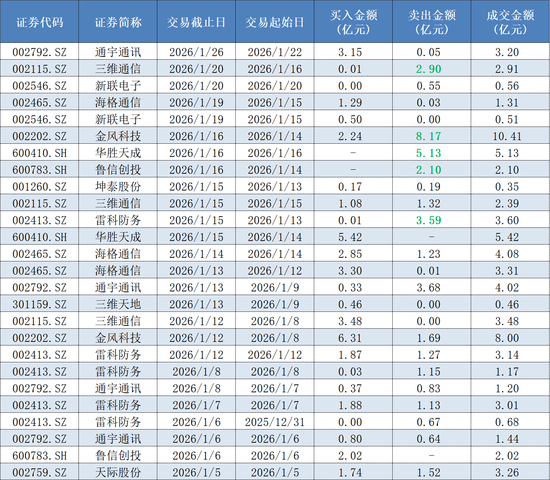
Core Viewpoint - The article discusses the downfall of prominent investor Chen Xiaoqun, who has faced increasing scrutiny and allegations of manipulating the market through "internet trading strategies" after a significant sell-off in mid-January 2026 [1][28]. Group 1: Chen Xiaoqun's Trading Activities - Chen Xiaoqun's trading seat at China Galaxy Securities in Dalian has been frequently involved in selling large amounts of popular stocks, including Jin Feng Technology and Hua Sheng Tian Cheng, leading to significant price drops [1][28]. - In January 2026, the Dalian Huanghe Road seat recorded a cumulative transaction amount of 77.18 billion yuan, with major stocks like Jin Feng Technology and Lei Ke Defense contributing significantly to this figure [44][17]. - The trading patterns of the Dalian Huanghe Road seat and Guotai Junan Securities in Chongqing have raised suspicions of coordinated actions to profit from retail investors [31][30]. Group 2: Market Reactions and Speculations - Following a wave of concentrated selling, many investors began questioning Chen Xiaoqun's credibility and the legitimacy of his trading strategies, leading to a surge in negative sentiment [1][28]. - The article highlights the emergence of various rumors regarding Chen Xiaoqun, including allegations of market manipulation and his response to these claims through social media [9][39]. - The trading activities of the Dalian Huanghe Road seat have been linked to a broader trend of "internet trading strategies," which are criticized for creating volatility and misleading retail investors [21][24]. Group 3: Historical Context and Performance - Chen Xiaoqun's rise to prominence is attributed to his association with the Dalian Huanghe Road seat, which has seen a dramatic increase in trading activity, surpassing previous years in both the number of stocks traded and total transaction amounts [43][16]. - In 2024, the Dalian Huanghe Road seat recorded a total transaction amount of 92.97 billion yuan, indicating a significant shift in trading dynamics within the market [43][16]. - The article notes that the Dalian Huanghe Road seat has become synonymous with Chen Xiaoqun, further amplifying his influence in the market [45][47].


操盘必读:影响股市利好或利空消息_2026年2月5日_财经新闻
Xin Lang Cai Jing· 2026-02-05 00:41
Industry News - The Ministry of Culture and Tourism announced the resumption of travel for Shanghai residents to Kinmen and Matsu to normalize cross-strait exchanges and benefit both sides [26] - Reports indicate that Musk's team has been exploring the Chinese photovoltaic industry chain, with orders signed with heterojunction equipment manufacturers [26][17] - The National Medical Insurance Administration issued a notice to strengthen management of designated medical institutions for mental illnesses and combat illegal use of medical insurance funds [26] - The 16th General Assembly of the China Artificial Intelligence Industry Development Alliance was held, focusing on breakthroughs in key technologies such as computing power chips and industrial models [26] - The Guangdong Province issued opinions to accelerate the high-quality construction of a digital society, expanding the operational area for autonomous public transport and smart transportation services [27] - An expert seminar on the "14th Five-Year" development plan for the gold industry emphasized the need to focus on key technological bottlenecks and enhance the integration of production, education, and research [27] - The China Electronics Technology Group announced the successful delivery of the first domestically produced 12-inch silicon carbide wafer thinning equipment, marking a breakthrough in large-size silicon carbide processing [27][28] Company News - JinkoSolar announced that it has not engaged in any cooperation with Musk's team [30] - The Shanghai Stock Exchange issued a regulatory warning to Woge Optoelectronics for inaccurate and incomplete information related to "commercial space" and "brain-computer interface," which may mislead investors [31] - The company Guo Sheng Technology stated that it is not involved in the space photovoltaic business [39] - Jingsheng Mechanical and Electrical announced that the application scenarios for "space photovoltaic" are still in the exploratory stage [39] - Tiantong Co., Ltd. stated that it does not produce commercial satellites or optical module products [39] - Shuangliang Energy announced that it has not yet engaged in space photovoltaic-related business [39] - Chang'an Automobile plans to repurchase company shares worth between 1 billion to 2 billion yuan [48]


【早报】央行部署2026年信贷市场工作;多只光伏概念股密集回应相关业务情况
财联社· 2026-02-04 23:15
早 报 精 选 1、央行:不断加强对重大战略、重点领域和薄弱环节的优质金融服务。 2、中国光伏行业协会:太空光伏技术仍处于探索和验证的初期阶段。 3、文化和旅游部:近期恢复上海居民赴金门马祖旅游。 4、欧盟宣布调查金风科技,外交部:敦促欧方停止滥用单边经贸工具。 5、工信部:突破算力芯片、工业大模型等关键技术,做优应用生态。 宏 观 新 闻 1、2月4日晚,国家主席习近平同美国总统特朗普通电话。习近平指出,今年中美两国各自都有不少重要议程,中国"十五五"开局起 步,美国将迎来建国250周年,两国将分别主办亚太经合组织领导人非正式会议、二十国集团领导人峰会。双方要按照我们达成的共 识,加强对话沟通,妥善管控分歧,拓展务实合作,不以善小而不为,不以恶小而为之,一件事一件事去做,不断积累互信,走出一 条正确相处之道,让2026年成为中美两个大国迈向相互尊重、和平共处、合作共赢的一年。习近平强调,台湾问题是中美关系中最 重要的问题。台湾是中国的领土,中方必须捍卫国家主权和领土完整,永远不可能让台湾分裂出去。美方务必慎重处理对台军售问 题。特朗普表示,美国和中国都是伟大的国家,美中关系是世界上最重要的双边关系。我乐见中 ...

金风科技(002202.SZ):主营业务不包括商业航天或太空光伏
Ge Long Hui· 2026-02-04 13:48
格隆汇2月4日丨金风科技(002202.SZ)在互动平台表示,公司深度聚焦风电行业,同时关注可再生能源 相关领域的技术与市场机会,公司主营业务不包括商业航天或太空光伏。 ...
欧盟宣布对中国一家风电巨头公司展开调查,外交部:中方坚定维护中国企业正当合法权益
Bei Jing Qing Nian Bao· 2026-02-04 12:26
2月4日,外交部发言人林剑主持例行记者会。 文 | 北京青年报记者 董鑫 编辑 | 杜小溪 有记者提问,欧盟日前宣布对中国风电巨头金风科技股份有限公司展开调查,原因是担忧该公司从政府补贴中获益,扭曲欧盟市场竞争。中方对此有何评 论? "你问到的具体情况建议向中方的主管部门了解。"林剑指出,欧盟频繁动用单边经贸工具,对中国企业采取歧视性限制性的措施,发出的是保护主义信 号、损害的是欧盟形象、影响的是中国企业赴欧投资的信心。 林剑强调,我们敦促欧方恪守市场开放承诺和公平竞争原则,停止滥用单边经贸工具,为各国企业提供公平透明、非歧视的营商环境。中方坚定维护中国 企业的正当合法权益。 ...

中国千亿风电巨头遭欧盟调查,“担忧该公司从政府补贴中获益”,外交部回应!港股尾盘股价跳水,跌7%
Mei Ri Jing Ji Xin Wen· 2026-02-04 09:43
Group 1 - The European Union has initiated an investigation into Goldwind Technology Co., Ltd. due to concerns that the company benefits from government subsidies, potentially distorting competition in the EU market [1] - The Chinese Foreign Ministry criticized the EU's unilateral trade measures against Chinese companies, labeling them as discriminatory and protectionist, which could harm the EU's image and affect Chinese investment confidence in Europe [1] - The Chinese government urged the EU to adhere to commitments of market openness and fair competition, and to stop abusing unilateral trade tools to ensure a fair, transparent, and non-discriminatory business environment for all companies [1] Group 2 - Goldwind Technology's A-shares rose by 0.44%, with a share price of 27.28 yuan and a total market capitalization of 103.6 billion yuan [2] - In contrast, Goldwind Technology's Hong Kong shares experienced a significant decline, closing down by 7.25% at a price of 13.68 HKD [3] - The company's main business activities include wind turbine manufacturing, wind power services, investment and development of wind farms, as well as water services and other operations [3]
