
GOLDWIND(002202)

Search documents
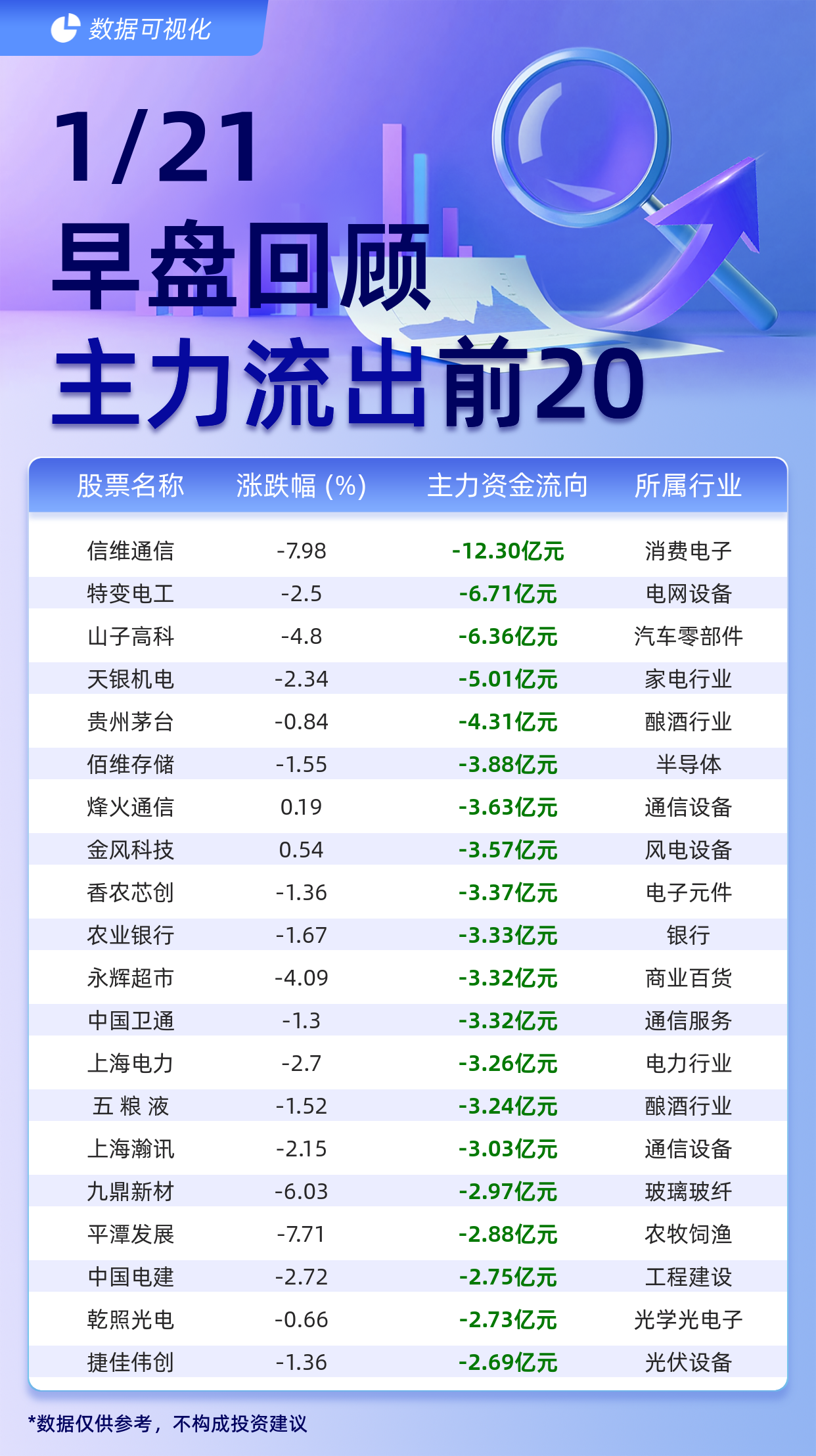
主力个股资金流出前20:信维通信流出12.30亿元、特变电工流出6.71亿元
Jin Rong Jie· 2026-01-21 04:04
Core Viewpoint - The data indicates significant outflows of capital from various stocks, with notable declines in share prices across multiple sectors, suggesting a bearish sentiment in the market. Group 1: Major Stocks with Capital Outflows - Xinyi Communication experienced a capital outflow of 1.23 billion, with a price drop of 7.98% [1][2] - Tebian Electric witnessed a capital outflow of 671 million, with a price decline of 2.5% [1][2] - Shanzi Gaoke had a capital outflow of 636 million, with a decrease of 4.8% [1][2] - Tianyin Electromechanical saw an outflow of 501 million, with a drop of 2.34% [1][2] - Kweichow Moutai experienced a capital outflow of 431 million, with a decline of 0.84% [1][2] Group 2: Additional Stocks with Notable Outflows - Baiwei Storage had a capital outflow of 388 million, with a price drop of 1.55% [1][2] - Fenghuo Communication saw an outflow of 363 million, with a slight increase of 0.19% [1][2] - Goldwind Technology experienced a capital outflow of 357 million, with a price increase of 0.54% [1][2] - Shannon Chip Creation had an outflow of 337 million, with a decline of 1.36% [1][2] - Agricultural Bank saw a capital outflow of 333 million, with a drop of 1.67% [1][2] Group 3: Further Stocks with Capital Outflows - China Satellite Communications experienced a capital outflow of 332 million, with a decline of 1.3% [3] - Shanghai Electric saw an outflow of 326 million, with a price drop of 2.7% [3] - Wuliangye experienced a capital outflow of 324 million, with a decline of 1.52% [3] - Shanghai Hanxun had an outflow of 303 million, with a drop of 2.15% [3] - Jiuding New Materials saw a capital outflow of 297 million, with a significant decline of 6.03% [3]




未知机构:①近1个月来化工行业迎来一场全球性涨价潮巴斯夫陶氏亨斯迈等-20260121
未知机构· 2026-01-21 02:00
Summary of Key Points from Conference Call Records Industry Overview - The chemical industry has experienced a "global price surge" in the past month, with major companies like BASF, Dow, and Huntsman implementing price increases across Europe, Asia, and the Middle East [1][1][1] - Significant price increases have been noted for certain chemical products, with propylene oxide prices rising by 7.9% week-over-week [2][2][2] Companies Mentioned - Companies involved in the chemical sector include: - Xinxiang Chemical Fiber - Cangzhou Dahua - Weiyuan Co. - Shandong Heda - Hongbaoli - Hongbai New Materials - Red Wall Co. - Zhongyida - Zanyu Technology - China National Chemical - Jiangtian Chemical - Meibang Technology [2][2][2] Core Insights and Arguments - The recent price increases in the chemical market are attributed to a combination of supply chain pressures and increased demand for chemical products globally [1][1][1] - The government has introduced new policies to support urban renewal and stimulate the economy, which may further impact the demand for chemical products [2][2][2] Additional Important Information - The National Energy Administration reported that national electricity load has reached a historical winter high, exceeding 1.4 billion kilowatts for the first time, indicating strong energy demand [2][2][2] - The investment in new power systems is expected to grow significantly, with a projected 40% increase in investment during the 14th Five-Year Plan period [2][2][2] - The chemical industry is likely to benefit from these macroeconomic trends, as increased urban development and energy demands will drive further consumption of chemical products [1][1][1]



两只公募REITs终止发行,新规后首现“清退”效应
第一财经· 2026-01-20 14:32
Core Viewpoint - The public REITs market in China has witnessed its first case of a failed issuance during the exchange review stage, highlighting the impact of new regulatory guidelines introduced at the end of 2025 [3][4]. Group 1: Case Studies of Failed Issuance - Jin Feng Technology announced the termination of its public REITs application on January 19, 2026, due to long-standing failure to respond to exchange feedback, aligning with new regulatory requirements [4]. - Similarly, Electronic City also withdrew its public REITs project application on the same day, indicating a trend of stalled projects under the new guidelines [5]. Group 2: Regulatory Changes and Market Impact - The new guidelines issued by the Shanghai and Shenzhen Stock Exchanges on December 31, 2025, aim to enhance transparency and efficiency in the review process for public REITs, defining specific circumstances under which applications can be terminated [5]. - The guidelines list seven conditions for termination, including failure to respond to feedback within the stipulated time and the expiration of financial data and asset evaluation reports [5]. - As of the end of 2025, there are several projects in the review stage that have not progressed, raising concerns about their compliance and operational status [5]. Group 3: Future Market Trends - A head of REITs business at a leading fund company noted that the new regulations necessitate enhanced due diligence before application submissions, shifting the focus from issuance to compliance and operational management [6]. - The public REITs market is transitioning towards favoring projects with stable cash flows and sound operational management, as indicated by the Jin Feng Technology case [6]. - According to Wind statistics, by the end of 2025, there were 79 public REITs listed with a total issuance scale exceeding 210 billion yuan, reflecting a growing market [6]. - A report from China International Capital Corporation suggests that the public REITs market is entering a new phase of normalized issuance, with expectations for continued growth in scale, asset diversity, and improved investor structure in 2026 [6].



两只公募REITs终止发行,新规后首现“清退”效应
Di Yi Cai Jing· 2026-01-20 12:00
Core Viewpoint - The recent regulatory changes have led to the first case of a public REIT failing to issue after entering the exchange review stage, highlighting the impact of new guidelines aimed at preventing projects from remaining unresolved for extended periods [1][2]. Group 1: Regulatory Changes - The new guidelines from the Shanghai and Shenzhen Stock Exchanges, effective by the end of 2025, explicitly define circumstances under which public REIT applications can be terminated, aiming to enhance transparency and efficiency in the review process [2][3]. - The guidelines list seven specific scenarios for application termination, including failure to respond to exchange feedback within the stipulated timeframe [2]. Group 2: Company-Specific Cases - Jin Feng Technology announced the termination of its public REIT application, which began in September 2021 and had not progressed due to a lack of response to feedback from the exchange [1]. - Similarly, Electronic City plans to withdraw its infrastructure public REIT project application, which was submitted in May 2025, due to a lack of progress following initial feedback [2]. Group 3: Market Implications - The implementation of the new regulations is expected to shift the focus of public REITs from merely issuing to emphasizing operational compliance and management capabilities, favoring projects with stable cash flows [3]. - As of the end of 2025, there are 79 public REITs listed in the market, with a total issuance scale exceeding 210 billion yuan, indicating a growing market despite recent challenges [3].
首例终止 金风科技撤回公募REITs申报
Xin Lang Cai Jing· 2026-01-20 10:20
Core Viewpoint - The company, Goldwind Technology, has announced the termination of its public REITs application process, which was initiated in 2021 for three wind power projects, later adjusted to focus on one project [1] Group 1: Company Actions - The board of directors of Goldwind Technology has approved the decision to halt the public REITs application for infrastructure [1] - The initial plan included three wind power projects: Quan Nan Tian Pai Shan, Chong Yi Long Gui, and Chong Yi Tian Xing, but was later revised to focus solely on the Quan Nan Tian Pai Shan project [1] - The application materials were submitted to the China Securities Regulatory Commission and the Shenzhen Stock Exchange in September 2023 and were accepted [1] Group 2: Reasons for Termination - The termination of the REITs application is attributed to the need for resource integration and optimization of operational management [1] - The company has stated that this decision will not impact its operational and financial performance [1]
商业航天第一波人赚钱了
投资界· 2026-01-20 08:21
Core Viewpoint - The commercial space industry is experiencing a significant surge, with multiple companies preparing for IPOs, indicating a potential boom in investment opportunities in this sector [2][9]. Group 1: IPO Developments - Blue Arrow Aerospace's IPO application was accepted in just 156 days, setting a new record for the Sci-Tech Innovation Board [2]. - Several commercial space companies, including Blue Arrow Aerospace and Zhongke Aerospace, are in the process of preparing for IPOs, with around 10 companies aiming for listings [2][9]. - The anticipated IPOs are expected to raise substantial capital, with Blue Arrow Aerospace planning to raise 7.5 billion yuan [4]. Group 2: Investment Opportunities - Jin Feng Technology's investment in Blue Arrow Aerospace has resulted in a significant increase in market value, with Jin Feng's market capitalization rising by over 60 billion yuan in just six trading days [5][6]. - Jin Feng Technology initially invested 150 million yuan in Blue Arrow Aerospace, which has now appreciated to a book value of 812 million yuan, indicating a substantial return on investment [4]. - The commercial space sector has seen a wave of stock price increases, with several companies experiencing significant gains, reflecting the wealth effect from the upcoming IPOs [6][9]. Group 3: Market Sentiment - There is a growing sense of urgency among investors to capitalize on the upcoming IPOs in the commercial space sector, with many expressing concerns about missing out on potential gains [8][10]. - The market is witnessing increased activity in secondary share transactions, as investors seek to acquire stakes in companies with strong IPO prospects [7][8]. - The sentiment in the investment community is that the commercial space sector could be the next major wave of IPOs, similar to the recent surge in GPU-related listings [9].

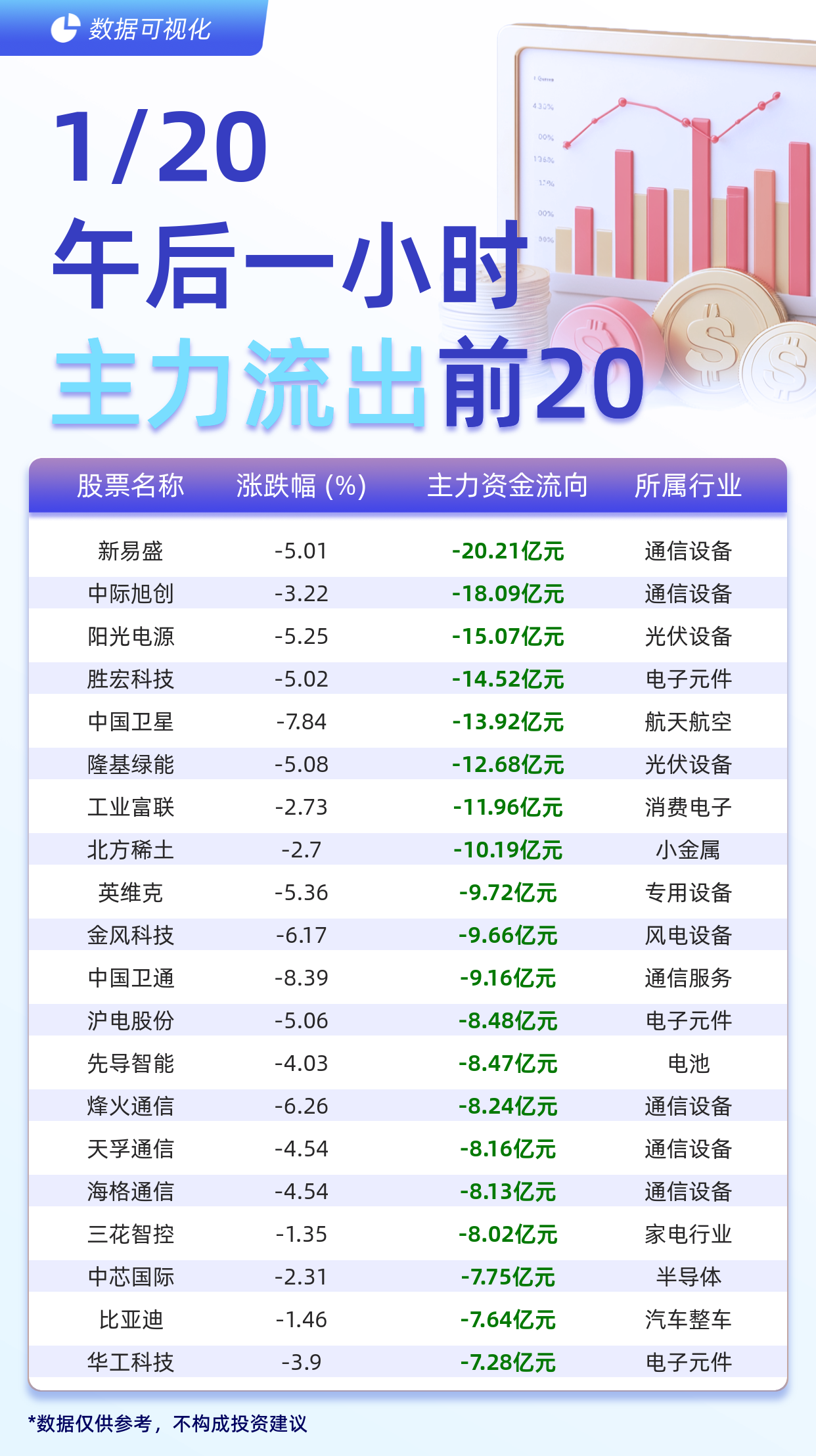
主力个股资金流出前20:新易盛流出20.21亿元、中际旭创流出18.09亿元
Jin Rong Jie· 2026-01-20 06:26
Core Viewpoint - The data indicates significant outflows of main funds from various stocks, particularly in the communication equipment and renewable energy sectors, suggesting a potential shift in investor sentiment and market dynamics [1][2][3] Group 1: Stock Performance and Fund Outflows - The top stock with the largest fund outflow is Xinye Technology, with a decrease of 20.21 billion yuan and a drop of 5.01% [2] - Zhongji Xuchuang follows with an outflow of 18.09 billion yuan and a decline of 3.22% [2] - Yangguang Electric Power experienced an outflow of 15.07 billion yuan, with a decrease of 5.25% [2] - Shenghong Technology saw a fund outflow of 14.52 billion yuan and a drop of 5.02% [2] - China Satellite had an outflow of 13.92 billion yuan, with a significant decline of 7.84% [2] Group 2: Sector Analysis - The communication equipment sector is notably affected, with multiple companies like Xinye Technology, Zhongji Xuchuang, and Fenghuo Communication experiencing substantial fund outflows [2][3] - The photovoltaic equipment sector, represented by Yangguang Electric Power and Longi Green Energy, also shows significant outflows, indicating potential challenges in this industry [2][3] - The electronic components sector, including Shenghong Technology and Huadian Co., is facing similar trends with notable fund withdrawals [2][3]





中国风电 - 2026 年需求韧性强,利润率全面回升-China Wind-Resilient demand with broad-based margin recovery in 2026
2026-01-20 03:19
Summary of the Conference Call on China Wind Industry Industry Overview - The focus is on the **China Wind Industry**, particularly during the **15th Five-Year Plan (FYP)**, with a positive outlook on wind installations and offshore deep-sea developments [2][3][4][22]. Key Points Wind Installation Demand - **Forecast for Wind Installations**: Expected to reach **110-120 GW** annually from **2026 to 2030**, with onshore installations stabilizing at approximately **90 GW** and offshore installations between **15-20 GW** per year from **2027 to 2030** [3][22]. - **Investment Appeal**: Wind power is seen as more attractive compared to solar energy post-Document No.136, supported by national energy transition targets [3][24]. Offshore Deep-Sea Developments - **Acceleration of Projects**: Significant progress is anticipated in offshore deep-sea projects, with a preliminary pipeline of **~100 GW** and expected annual installations starting at over **10 GW** during the 15th FYP [4][23]. - **Policy Support**: Clearer policy guidance is expected to be announced, enhancing the development of deep-sea offshore wind [4][24]. European Market Dynamics - **Contracts for Difference (CfD)**: The UK's recent **AR7 CfD** auction awarded **8.4 GW** of offshore wind capacity, a **58% increase** from the previous round, indicating strong demand and export opportunities for Chinese suppliers [5][43]. - **Export Opportunities**: The expanding European offshore wind market is expected to drive demand for Chinese components, including wind turbine parts and submarine cables [5][43]. Company Preferences and Ratings - **Component Suppliers Preferred**: Preference is given to component suppliers like **ZTT**, **Sinoma S&T**, and **Riyue** due to their strong earnings growth outlook and margin recovery potential [6][14][15]. - **OEMs Outlook**: The business turnaround for wind turbine OEMs has largely been priced in, with expectations of stable onshore WTG prices and slight declines in offshore prices [15][37]. Market Performance - **Stock Performance in 2025**: Wind equipment stocks rallied between **3.6% to 177.8%**, outperforming market indices, attributed to an industry turnaround after a down cycle [12][17]. - **Future Expectations**: Key component players are expected to outperform OEMs in 2026 due to ongoing margin improvements and favorable raw material costs [13][17]. Competitive Landscape - **Market Consolidation**: The onshore wind market has become more consolidated, with the top three players increasing their market share from **44.3%** in 2024 to **48.2%** in 2025 [30][31]. - **Fragmentation in Offshore Market**: The offshore market remains fragmented, with new entrants gaining market share, leading to a decline in the combined market share of the top three players from **80.0%** to **53.4%** [32]. Additional Insights - **Tendering Trends**: Public WTG tenders fell by **14.3%** in 2025, but new installations remained robust, with a **59.4% YoY increase** in the final year of the 14th FYP [20][25]. - **Price Trends**: Onshore WTG prices increased by **5-10% YoY**, while offshore prices saw a decline of **4-7% YoY** due to a more fragmented competitive landscape [36][38]. This summary encapsulates the key insights and forecasts regarding the China wind industry, highlighting the positive outlook for installations, the importance of offshore developments, and the dynamics of the European market that favor Chinese suppliers.
港股异动 | 商业航天概念跌幅居前 亚太卫星(01045)跌近9% 金风科技(02208)跌超4%
智通财经网· 2026-01-20 02:38
Core Viewpoint - The commercial aerospace sector is experiencing significant declines, with several listed companies facing sharp drops in stock prices, indicating a period of adjustment and risk warnings within the industry [1] Group 1: Stock Performance - JunDa Co., Ltd. (02865) fell by 9.13%, trading at 21.5 HKD [1] - Asia-Pacific Satellite (01045) decreased by 6.68%, trading at 3.77 HKD [1] - Goldwind Technology (02208) dropped by 3.58%, trading at 14.54 HKD [1] - AVIC Industry (02357) declined by 2.75%, trading at 4.25 HKD [1] Group 2: Market Context - The commercial aerospace sector has seen a concentrated release of clarifications and risk warnings from related listed companies, marking the most intense period of risk alerts since the sector's recent rally began in December of the previous year [1] - Commentary from China National Radio suggests that regulatory "cooling" is not about stifling the market but rather about eliminating bubbles and directing funds towards quality assets [1] - Economic Daily emphasizes the importance of avoiding speculative trading that could mislead the commercial aerospace sector [1] Group 3: Policy Support - Longcheng Securities notes that despite the adjustments in the commercial aerospace sector, there is clear support from national policies for the industry [1] - On January 17, the IPO guidance status of leading commercial aerospace company CASIC was updated to "guidance acceptance," making it the second commercial rocket company to initiate the IPO process under the fifth set of standards of the Sci-Tech Innovation Board, following Blue Arrow Aerospace [1] - This recent development may serve as a driving force for the sector [1]
商业航天概念跌幅居前 亚太卫星跌近9% 金风科技跌超4%
Zhi Tong Cai Jing· 2026-01-20 02:36
Core Viewpoint - The commercial aerospace sector is experiencing significant declines, with several companies facing sharp drops in stock prices amid a wave of clarifications and risk warnings from listed firms [1] Group 1: Stock Performance - JunDa Co., Ltd. (002865) has seen a decline of 9.13%, trading at 21.5 HKD [1] - Asia Pacific Satellite (01045) dropped by 6.68%, now at 3.77 HKD [1] - Goldwind Technology (002202) fell by 3.58%, currently at 14.54 HKD [1] - AVIC Industry (02357) decreased by 2.75%, trading at 4.25 HKD [1] Group 2: Market Sentiment and Regulatory Environment - The commercial aerospace sector is undergoing a significant adjustment, with the highest frequency of risk warnings since the sector's last surge in December [1] - Central media outlets suggest that regulatory "cooling" is aimed at eliminating speculation and directing funds towards quality investments rather than suppressing the market [1] - Economic Daily emphasizes the importance of avoiding speculative practices that could mislead the commercial aerospace sector [1] Group 3: Policy Support and Future Outlook - Longcheng Securities (002939) notes that despite the recent adjustments, there is clear policy support from the government for the industry [1] - On January 17, the IPO guidance status for leading commercial aerospace company CASIC was updated to "guidance acceptance," marking it as the second commercial rocket company to initiate an IPO process under the STAR Market's fifth set of standards [1] - This development is expected to potentially drive the sector forward in the near future [1]
