
HIKVISION(002415)

Search documents
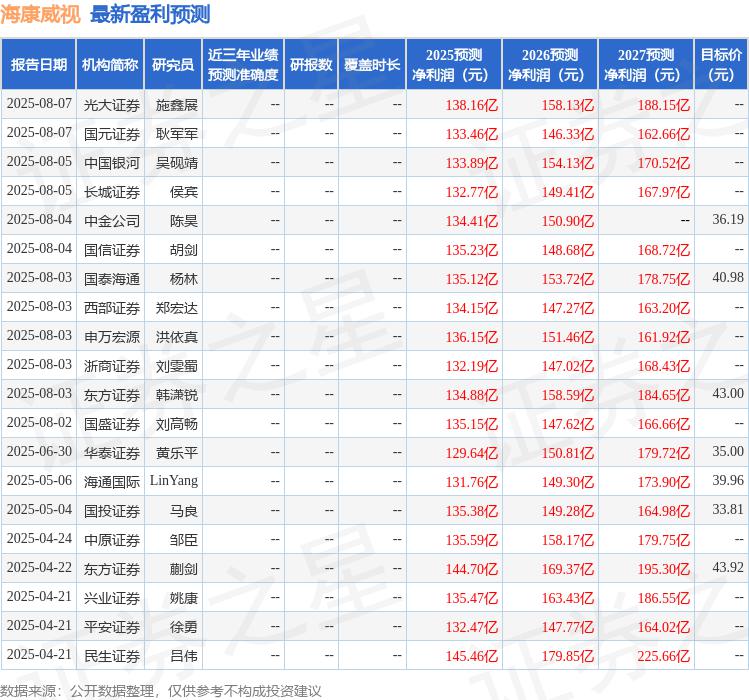
民生证券:给予海康威视买入评级
Zheng Quan Zhi Xing· 2025-08-08 10:25
Core Viewpoint - Hikvision's 2025 semi-annual report shows steady revenue growth and improved profit quality, with a buy rating from Minsheng Securities [1][2]. Financial Performance - In the first half of 2025, Hikvision achieved revenue of 41.818 billion yuan, a year-on-year increase of 1.48% [2]. - The net profit attributable to shareholders was 5.657 billion yuan, reflecting a year-on-year growth of 11.71% [2]. - The overseas main business and innovative business both showed positive growth, contributing to a sustainable development strategy [2]. Business Segments - PBG business revenue was 5.573 billion yuan, down 2.11% year-on-year [2]. - EBG business revenue was 7.462 billion yuan, down 0.36% year-on-year [2]. - SMBG business revenue was also 7.462 billion yuan, down 0.36% year-on-year [2]. - Overseas main business revenue reached 12.231 billion yuan, up 6.90% year-on-year, accounting for 29.25% of total revenue [2]. - Innovative business revenue was 11.766 billion yuan, up 13.92% year-on-year, making up 28.14% of total revenue [2]. Strategic Developments - The company is focusing on AIoT multi-modal large model technology, enhancing its technological foundation [3]. - A new "integrated large model platform" was launched, improving industry application intelligence [3]. - Strategic adjustments have led to significant cash flow improvements, with net cash flow from operating activities at 5.343 billion yuan [3]. Investment Outlook - Despite global economic uncertainties, Hikvision demonstrates resilience through prudent management strategies [4]. - Future revenue projections for 2025, 2026, and 2027 are 105.6 billion yuan, 121.5 billion yuan, and 141.0 billion yuan respectively [4]. - Expected EPS for the same years are 1.58 yuan, 1.95 yuan, and 2.44 yuan respectively [4].


海康威视(002415):业务多元化进展顺利,盈利质量持续提升
Minsheng Securities· 2025-08-08 10:22
Investment Rating - The report maintains a "Recommended" rating for Hikvision [5] Core Views - In the first half of 2025, Hikvision achieved operating revenue of 41.818 billion yuan, a year-on-year increase of 1.48%, and a net profit attributable to shareholders of 5.657 billion yuan, up 11.71% year-on-year [1] - The company's overseas main business and innovative business both achieved positive growth in 2025, with overseas revenue accounting for 29.25% of total revenue [1] - The innovative business generated revenue of 11.766 billion yuan, a year-on-year increase of 13.92%, representing 28.14% of total revenue [2] - The company is focusing on AIoT multi-modal large model technology, enhancing its technological foundation through continuous innovation and product development [2] - Strategic adjustments have led to significant improvements in cash flow, with net cash flow from operating activities reaching 5.343 billion yuan in the first half of 2025 [2] - The report forecasts revenues of 105.6 billion yuan, 121.5 billion yuan, and 141 billion yuan for 2025, 2026, and 2027 respectively, with EPS of 1.58 yuan, 1.95 yuan, and 2.44 yuan for the same years [3][4] Summary by Sections Business Performance - The PBG business reported revenue of 5.573 billion yuan, down 2.11% year-on-year [1] - The EBG and SMBG businesses both reported revenue of 7.462 billion yuan, down 0.36% year-on-year [1] - The overseas main business achieved revenue of 12.231 billion yuan, a year-on-year increase of 6.90% [1] Innovation and Technology - The company is advancing AIoT multi-modal large model technology and has launched a "large model integrated platform" to enhance industry application intelligence [2] Financial Forecast - The projected operating revenues for 2025, 2026, and 2027 are 105.584 billion yuan, 121.453 billion yuan, and 141.019 billion yuan respectively, with corresponding net profits of 14.546 billion yuan, 17.962 billion yuan, and 22.543 billion yuan [4][9]
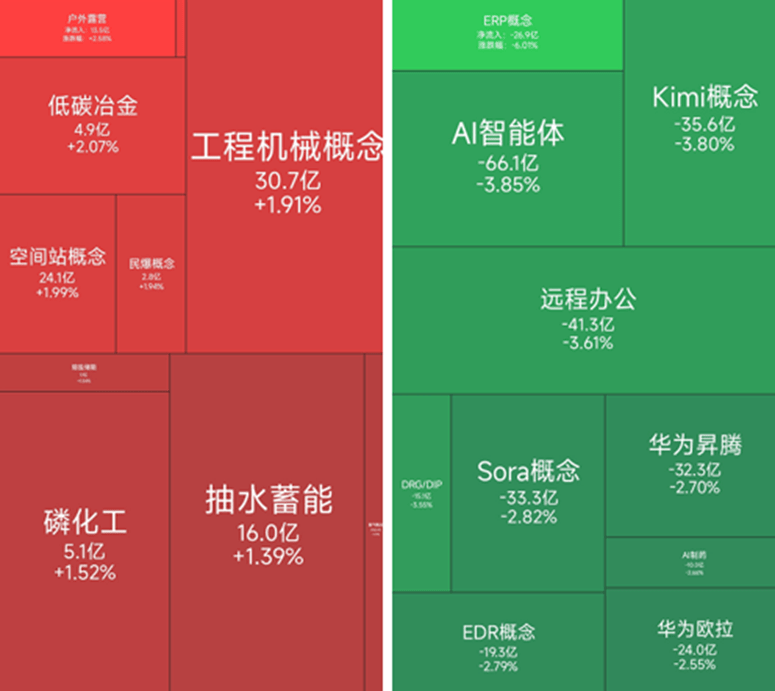
工程机械概念走高,21位基金经理发生任职变动
Sou Hu Cai Jing· 2025-08-08 07:27
Market Performance - On August 8, A-shares' three major indices collectively closed lower, with the Shanghai Composite Index down 0.12% at 3635.13 points, the Shenzhen Component Index down 0.26% at 11128.67 points, and the ChiNext Index down 0.38% at 2333.96 points [1] Fund Manager Changes - In the past 30 days (July 9 to August 8), a total of 477 fund products experienced changes in fund managers, with 29 fund products announcing manager departures on August 8 alone [3] - The reasons for the changes include three managers leaving due to job changes, two due to personal reasons, and three due to product expiration [3] Fund Manager Details - Notable fund manager departures include Wang Gang from the招商丰泽混合A fund, which has an asset scale of 6.385 billion yuan and achieved a return of 71.45% over 8 years and 13 days [4] - New fund managers include Zhao Ming, who started managing 中海合嘉增强收益债券A and C funds, and Ren Dongxuan, who took over 嘉合锦荣混合C and 蒸合棉束温合A funds [6][5] Fund Company Research Activity - In the past month, 博时基金 conducted the most company research, engaging with 56 listed companies, followed closely by 富国基金 and 华夏基金, each with 51 companies [7] - The most researched industry was communication equipment, with 307 instances, followed by specialized equipment with 246 instances [7] Individual Stock Research - 德福科技 was the most researched stock in the past month, with 79 fund management companies participating in the research, followed by 中际旭创 and 中宠股份 with 75 and 71 respectively [9] - In the past week (August 1 to August 8), 中宠股份 was the most researched stock, receiving attention from 71 fund institutions [8]


海康威视–A 股_需求前景喜忧参半:维持中性评级-Hangzhou HikVision Digital Technology Co., Ltd - A_ Demand outlook remains a mixed bag; maintain Neutral
2025-08-08 05:02
Summary of Hangzhou HikVision Digital Technology Co., Ltd - A Conference Call Company Overview - **Company**: Hangzhou HikVision Digital Technology Co., Ltd - **Ticker**: 002415.SZ - **Industry**: Technology - **Current Price**: Rmb29.11 (as of August 1, 2025) - **Price Target**: Rmb31.00 (June 2026) Key Financial Highlights - **2Q25 Results**: - **Sales**: Rmb23.3 billion, flat growth (+0% YoY, +26% QoQ) [1][12] - **Net Profit**: Rmb3.6 billion, up 15% YoY and 78% QoQ [1][12] - **Net Margin**: Expanded to 16%, an increase of 2.1 percentage points YoY and 4.5 percentage points QoQ [7][12] Core Insights - **Demand Outlook**: Remains mixed, with expectations of lukewarm demand leading to intensified competition and suppressed margin improvement [1][12]. - **Sales and Earnings Growth**: Projected sales and earnings CAGR of 11% and 20% respectively from 2025 to 2027 [1][12]. - **Profitability Drivers**: - Resilient overseas market with higher margins [7][12]. - Restructuring of low-margin products and segments [7][12]. - Improved operational expense control [7][12]. - **Market Dynamics**: Key domestic players are expanding into emerging markets, which may lead to a decline in gross margins compared to previous developed markets [1][12]. Financial Forecasts - **Adjusted EPS**: - 2025E: Rmb1.54 - 2026E: Rmb1.88 - 2027E: Rmb2.25 [3][31] - **Revenue Growth**: - 2025E: Rmb97.69 billion (+5.6% YoY) - 2026E: Rmb110.38 billion (+13.0% YoY) - 2027E: Rmb125.78 billion (+14.0% YoY) [11][31] Valuation - **Price Target Methodology**: Based on a 15x one-year forward P/E, reflecting a 10% discount to the historical average [1][13][28]. Risks to Outlook - **Upside Risks**: - Stronger-than-expected government spending in China [29]. - Lower-than-expected increases in raw material costs [29]. - Positive developments regarding US restrictions on China-based suppliers [29]. - **Downside Risks**: - Weaker-than-expected domestic macroeconomic recovery [29]. - Negative surprises in trade discussions [29]. - Rapid increases in operational expenses due to competition [29]. Additional Insights - **Market Performance**: The stock has shown a year-to-date decline of 5.2% and a relative underperformance of 11.4% [10]. - **Shareholder Metrics**: Free float stands at 38.6%, with a market cap of approximately $37.37 billion [10]. This summary encapsulates the key points from the conference call, providing a comprehensive overview of Hangzhou HikVision Digital Technology Co., Ltd's current financial status, market outlook, and potential risks.
光大证券晨会速递-20250808
EBSCN· 2025-08-08 00:17
Group 1: Macroeconomic Insights - In July, China's exports showed strong growth due to diversification strategies, resilient demand from emerging markets, and continued "export grabbing" effects, leading to indirect exports [2] - The increase in imports was driven by domestic demand growth, but short-term export growth may face downward pressure as "export grabbing" effects fade [2] - Expanding trade with non-US regions is crucial for maintaining steady export growth in the future [2] Group 2: Company Research - Hikvision - In Q2 2025, Hikvision's revenue decreased by 0.5% year-on-year, while net profit increased by 14.9%, indicating high-quality growth [3] - The overall gross margin for the first half of 2025 was 45.19%, up by 0.35 percentage points year-on-year, reflecting strong performance in core business [3] - The company is embracing AI large models, with new growth points beginning to emerge, maintaining a "buy" rating with a projected PE of 19X, 17X, and 14X for 2025-2027 [3] Group 3: Company Research - Ezviz - In Q2 2025, Ezviz achieved revenue of 1.447 billion yuan, a year-on-year increase of 7.48%, and a net profit of 164 million yuan, up 4.95% year-on-year [4] - The company is launching competitive products and services while optimizing its business structure, leading to steady revenue growth [4] - The current market valuation corresponds to PE ratios of 45X, 38X, and 31X for 2025-2027, maintaining an "accumulate" rating [4] Group 4: Company Research - AsiaInfo Technologies - In the first half of 2025, AsiaInfo's revenue was under pressure due to cost reductions in the telecom sector, but annual revenue is expected to remain stable [5] - The net profit forecast for 2025-2027 has been adjusted to 455 million, 691 million, and 759 million yuan, reflecting a year-on-year decrease of 17% in 2025, followed by increases of 52% and 10% in subsequent years [5] - The company is optimistic about the future growth of AI large model applications and delivery services, maintaining a "buy" rating [5] Group 5: Company Research - Shunmei Holdings - Shunmei Holdings reported a strong performance in the first half of 2025, with expected revenue of 4.09 to 4.11 billion yuan, a year-on-year increase of 16.8% to 17.3% [6] - The net profit is projected to be between 540 million and 560 million yuan, reflecting a year-on-year growth of 30.9% to 35.8% [6] - The profit forecast for 2025-2027 has been raised to 1.16 billion, 1.46 billion, and 1.76 billion yuan, with a PE ratio of 27 for 2025, maintaining a "buy" rating [6] Group 6: Company Research - Hisense Home Appliances - Hisense Home Appliances is experiencing short-term pressure in domestic sales but is expanding its presence in overseas emerging markets [8] - The profit forecast for 2025-2027 has been adjusted to 3.6 billion, 4 billion, and 4.5 billion yuan, reflecting a downward revision of 5%, 6%, and 4% respectively [8] - The current market valuation corresponds to PE ratios of 10, 9, and 8 for the respective years, maintaining an "accumulate" rating [8]


【海康威视(002415.SZ)】25Q2延续高增长,毛利率验证高质量增长——跟踪报告之五(刘凯/施鑫展/王之含)
光大证券研究· 2025-08-07 23:03
Core Viewpoint - The company continues to demonstrate high-quality growth in Q2 2025, with a slight decline in revenue but significant profit growth, indicating resilience in its business model [4]. Segment Performance in H1 2025 - PBG segment revenue was 5.57 billion, down 2.1% year-on-year, but the decline has narrowed compared to the previous year [5]. - EBG segment revenue was 7.46 billion, down 0.4% year-on-year, showing signs of stabilization and improvement [5]. - SMBG segment revenue was 4.07 billion, down 29.8%, marking it as the largest drag on overall performance [5]. - Overseas main business revenue reached 12.23 billion, up 6.9% year-on-year, indicating growth in international markets [5]. - Innovative business revenue was 11.77 billion, up 13.9% year-on-year, with high growth potential as it now accounts for 57% of total revenue alongside overseas business [5]. Gross Margin and Cost Management - The overall gross margin for H1 2025 was 45.19%, an increase of 0.35 percentage points year-on-year, with the main business gross margin at 48.52%, up 2.19 percentage points [6]. - The company is reducing low-margin product sales and focusing on delivering product value rather than competing solely on price [6]. - The gross margin for innovative business was 38.28%, down 3.70 percentage points, primarily due to a higher proportion of low-margin automotive electronics [6]. - Operating expenses for sales, management, and R&D showed a mixed trend, with sales expenses up 2.0%, management expenses down 6.4%, and R&D expenses down 1.0% [6]. Embracing AI Technology - The company has integrated AI technology into most of its product lines, launching hundreds of AI model products in the first half of the year [7]. - It is actively seeking feedback from pioneer users to refine its products, with plans to transition from pilot templates to standardized solutions [7]. - Future plans include developing comprehensive industry solutions for PBG and EBG, aiming for large-scale promotion and establishing an ecosystem centered around the company [7].
【光大研究每日速递】20250808
光大证券研究· 2025-08-07 23:03
Group 1 - The core viewpoint of the article highlights the performance of various companies in the technology and consumer goods sectors, focusing on their revenue growth and profitability in the first half of 2025 [5][6][8] Group 2 - For萤石网络 (688475.SH), the company reported a revenue of 1.447 billion yuan in Q2 2025, representing a year-over-year increase of 7.48% and a quarter-over-quarter increase of 4.85%. The net profit attributable to shareholders was 164 million yuan, up 4.95% year-over-year and 19.07% quarter-over-quarter [5] - 海康威视 (002415.SZ) experienced a slight revenue decline of 0.5% year-over-year in Q2 2025, but the net profit increased by 14.9%. The overall gross margin for the first half of 2025 was 45.19%, reflecting a 0.35 percentage point increase year-over-year [5] - 亚信科技 (1675.HK) reported a revenue of 2.598 billion yuan for the first half of 2025, a decrease of 13.2% due to pressure on its ICT support business from reduced costs by operators. The company is restructuring its revenue reporting to focus on high-growth areas [6][7] - 海信家电 (000921.SZ) achieved a revenue of 49.34 billion yuan in the first half of 2025, a year-over-year increase of 1.4%. However, Q2 2025 revenue was 24.5 billion yuan, down 2.6% year-over-year, with a net profit of 950 million yuan, down 8.3% [8] - 上美股份 (2145.HK) exceeded expectations with a projected revenue of 4.09 to 4.11 billion yuan for the first half of 2025, representing a year-over-year growth of 16.8% to 17.3%. The net profit is expected to be between 540 million to 560 million yuan, reflecting a growth of 30.9% to 35.8% [8]

计算机设备行业上市公司董秘PK:3位专科学历董秘,其中安居宝吴若顺薪酬仅45.87万元
Xin Lang Cai Jing· 2025-08-07 11:22
Core Insights - The report highlights that as of July 29, 2024, there are 5,817 listed companies in the A-share market, with a total of 1,144 secretaries earning over 1 million yuan, accounting for over 21% of the total [1] - The total salary for secretaries in the A-share market reached 4.086 billion yuan, with an average salary of 754,300 yuan [1] Group 1: Salary Overview - In the computer equipment industry, there are 103 listed companies, with an average secretary salary of 690,500 yuan, ranking 73rd among 125 secondary industries [1] - The average salary for secretaries in the computer equipment industry decreased by 32,900 yuan compared to the previous year, ranking 102nd in salary growth among 125 primary industries [1] - Among the 103 secretaries, 45 have salaries between 500,000 and 1 million yuan, representing over 40%, while only 18 earn over 1 million yuan, accounting for less than 20% [1] Group 2: Individual Salary Highlights - The highest-paid secretary in the computer equipment industry is Xu Yanyan from Langchao Information, with a salary of 3.206 million yuan, significantly higher than others [1] - The second highest is Huang Fanghong from Hikvision, earning 2.2975 million yuan [1] - The lowest-paid secretary among those in office for the entire year is Wang Dongxue from China Shipbuilding, with a salary of 238,100 yuan [1] Group 3: Age and Education Insights - The age distribution of secretaries ranges from 32 to 59 years, with the median age between 41 and 47 years, where 50 individuals fall into this age range, nearly half of the total [2] - The highest average salary is found in the 50-year age group, at 1.473 million yuan, primarily driven by Wu Jian from Dahua Technology, who earns 2.192 million yuan [2] - Among the 103 secretaries, 50 hold master's degrees and 50 hold bachelor's degrees, together accounting for over 90% of the total [2] Group 4: Salary and Stock Performance Relationship - An analysis of secretary salaries in three segments (0-1.5 million yuan) shows a positive correlation between salary increases and stock price performance, with corresponding annual stock price changes of 2.02%, 1.81%, and 25.53% [3] - This suggests that higher secretary salaries may be linked to improved stock performance, indicating the effectiveness of the secretary system in the computer equipment industry [3]





计算机设备行业上市公司财务总监PK:西陇科学张丽年龄最小,31岁,2023年7月开始任职
Xin Lang Cai Jing· 2025-08-07 10:26
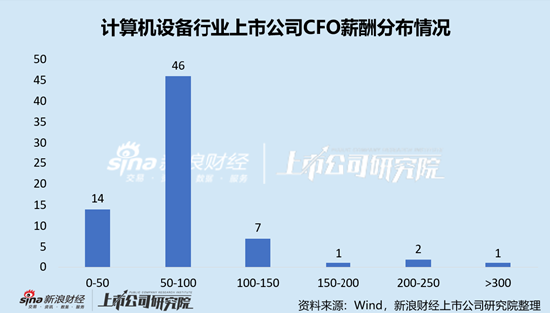
数据显示,截止7月29日,A股市场共有5817家上市公司。作为上市公司核心管理层关键成员,财务总 监CFO不仅需要确保公司财务稳健、资金高效运转,更需要从财务视角为公司的战略制定提供支撑,其 能力与决策直接影响公司的财务健康、战略成败、资本市场形象乃至生存风险。据2024年年报显示,去 年A股CFO(财务总监、财务负责人等)薪酬合计达42.43亿元,平均薪酬76.03万元。 专题:专题|2024年度A股董秘数据报告:1144位董秘年薪超百万 占比超21% 在计算机设备行业中,CFO薪酬与企业业绩表现出显著的相关关系。其中,四个薪酬段对应的营收增速 分别为3.42%、6.34%、8.75%,随CFO薪酬增长而显著提升。其对应的归母净利润增速分别为-1.08%、 6.73%、16.47%,也与CFO薪酬表现出显著的相关性。 MACD金叉信号形成,这些股涨势不错! 从学历角度来看,除去一位缺失学历信息的CFO后,余下70位CFO中本科和硕士学历分别有32位、29 位,共计61位,占比为86%。值得注意的是,计算机设备行业中大专学历平均薪酬高于本、硕、博平均 薪酬,主要是由于大专学历平均薪酬受到大华股份徐巧芬207. ...


计算机设备行业上市公司财务总监PK:57岁为薪酬最高年龄段,主要由金宏气体宗卫忠169.87万元高薪拉动
Xin Lang Cai Jing· 2025-08-07 10:26
专题:专题|2024年度A股董秘数据报告:1144位董秘年薪超百万 占比超21% 数据显示,截止7月29日,A股市场共有5817家上市公司。作为上市公司核心管理层关键成员,财务总 监CFO不仅需要确保公司财务稳健、资金高效运转,更需要从财务视角为公司的战略制定提供支撑,其 能力与决策直接影响公司的财务健康、战略成败、资本市场形象乃至生存风险。据2024年年报显示,去 年A股CFO(财务总监、财务负责人等)薪酬合计达42.43亿元,平均薪酬76.03万元。 分行业来看,计算机设备行业信息完备的上市公司CFO共有71位,2024年CFO平均薪酬为77.37万元, 在124个申万一级行业中排名第75位,CFO薪资水平处于行业中游。此外, 2024年计算机设备行业CFO 平均薪资水平相较上年下降1.67万元,薪酬增幅在124个申万一级行业中排名第96位,处于行业中下游 水平。 从年龄角度来看,71位CFO的年龄分布在35到60岁之间,其中44-48岁的CFO数量最多,为27位,占比 近四成。其中,53岁为平均薪酬最高的年龄段,平均薪酬高达163.70万元,主要是由大华股份徐巧芬 207.4万元的高薪拉动。 MACD金 ...
