BYD(002594)

Search documents
比亚迪(002594) - H股公告(股份发行人及根据《上市规则》第十九B章上市的香港预托证券发行人的证券变动月报表)
2026-03-02 11:45
截至月份: 2026年2月28日 狀態: 新提交 股份發行人及根據《上市規則》第十九B章上市的香港預託證券發行人的證券變動月報表 致:香港交易及結算所有限公司 公司名稱: 比亚迪股份有限公司 呈交日期: 2026年3月2日 I. 法定/註冊股本變動 | 1. 股份分類 | 普通股 | | 股份類別 | H | | | 於香港聯交所上市 (註1) | | 是 | | | --- | --- | --- | --- | --- | --- | --- | --- | --- | --- | --- | | 證券代號 (如上市) | 01211 | | 說明 | | | | | | | | | 多櫃檯證券代號 | 81211 | RMB | 說明 | | | | | | | | | | | | 法定/註冊股份數目 | | | 面值 | | | 法定/註冊股本 | | | 上月底結存 | | | | 3,683,400,000 | RMB | | | 1 RMB | | 3,683,400,000 | | 增加 / 減少 (-) | | | | | | | | RMB | | | | 本月底結存 | | | | 3, ...
比亚迪股份:2月法定/注册股本总额91.17亿元 无变动
Jin Rong Jie· 2026-03-02 11:44
Core Viewpoint - BYD Company Limited announced that as of February 28, 2026, its total statutory/registered capital amounts to 9.117 billion yuan, with no changes from the previous month [1] Group 1: Capital Structure - The total number of H shares is 3.683 billion, while A shares amount to 5.434 billion, both remaining unchanged from the previous month [1] - The issued shares consist of 3.683 billion H shares and 5.434 billion A shares, with no treasury shares reported, also unchanged from the previous month [1] Group 2: Compliance - The company confirmed that it meets the applicable public float requirements [1]
比亚迪汽车单月出口量占比首次过半,股价暴涨超8%
2 1 Shi Ji Jing Ji Bao Dao· 2026-03-02 11:28
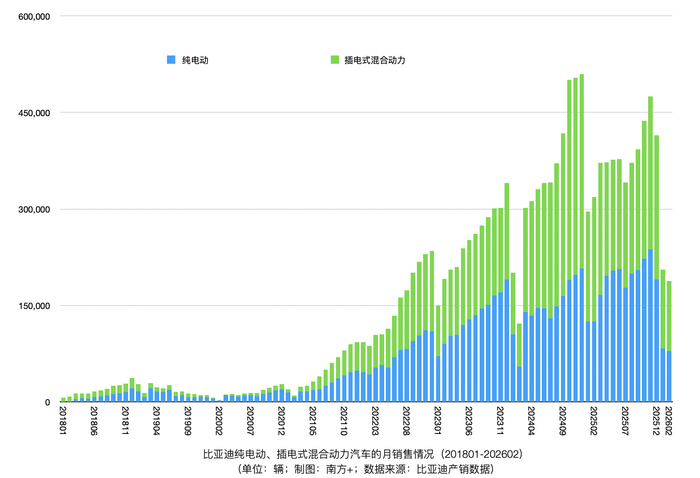
Core Insights - BYD's February 2026 production and sales data for new energy vehicles showed significant declines compared to the same period last year, with production down 47.54% and sales down 41.09% [1] - Despite the overall decline in production and sales, BYD's export volume and battery installation capacity demonstrated strong performance, with exports exceeding 100,600 units in February [1][3] - The company's stock price surged over 8% following the announcement of a disruptive technology conference scheduled for March 5, 2026 [5] Production and Sales Data - In February 2026, BYD produced 175,280 new energy vehicles, down from 334,124 units in February 2025, marking a 47.54% year-on-year decrease [1] - Cumulative production for the year reached 407,638 units, a decline of 38.4% compared to 661,988 units in the same period last year [1] - February sales totaled 190,190 units, down from 322,846 units in February 2025, reflecting a 41.09% year-on-year drop [1] - Year-to-date sales reached 400,241 units, a decrease of 35.8% compared to 623,384 units last year [1] Segment Performance - Passenger vehicles remained the mainstay of production and sales, with February production at 172,525 units and cumulative production at 400,360 units, both down approximately 38.7% year-on-year [3] - Sales of passenger vehicles in February were 187,782 units, with cumulative sales of 393,300 units, reflecting a 36.0% year-on-year decline [3] - Electric passenger vehicles produced in February totaled 77,018 units, with cumulative production at 165,089 units, both down 37.3% year-on-year [3] - Plug-in hybrid passenger vehicles saw February production of 95,507 units, with cumulative production at 235,271 units, down 39.6% year-on-year [3] - Commercial vehicle production and sales also declined, with February production at 2,755 units and cumulative production at 7,278 units, down 18.8% year-on-year [3] Export and Battery Performance - BYD's export volume in February 2026 reached 100,600 units, with the export sales ratio surpassing 50% for the first time [5] - The total installed capacity of power batteries and energy storage batteries in February was approximately 18.773 GWh, with a cumulative total of about 38.960 GWh for the year [3]

果然财经|比亚迪股价上涨近8%,3月5日召开颠覆性技术发布会
Qi Lu Wan Bao· 2026-03-02 11:20
Group 1 - BYD's stock price increased by nearly 8% on March 2, 2023, following the announcement of a groundbreaking technology conference scheduled for March 5, 2026 [1] - The company responded to investor inquiries on an interactive platform, confirming the upcoming event [1]

又一省!2026重点储能项目已超628亿元
行家说储能· 2026-03-02 11:08
Core Insights - The article highlights the significant investment and development in energy storage projects across various provinces in China, with a focus on the 2026 key project lists released by different regions [2][5]. Group 1: Guizhou Province - Guizhou has announced 52 energy storage projects with a total capacity of 6.125GW and 12.55GWh, including one production capacity project and several application projects [3][4]. - The projects include various types such as wind-solar-storage and independent/shared energy storage power stations [3]. Group 2: National Overview - A total of 18 provinces have released their 2026 key project lists, comprising over 17,798 projects with a total investment of 38.77 trillion yuan, including 291 energy storage projects with known investments exceeding 628.25 billion yuan [5][6]. - The energy storage capacity projects total 130.2GWh, while application projects amount to 26.999GW and 66.7294GWh [5]. Group 3: Project Distribution - Hebei leads with 58 energy storage application projects, while Shandong has 54 projects, and Guizhou follows with 52 projects [6][7]. - The production capacity projects are primarily concentrated in Jiangsu, Fujian, Shanghai, and other provinces, indicating a regional specialization in energy storage technologies [8][12]. Group 4: Specific Projects - Notable projects include the 600MW/2.4GWh storage project in Hainan and various projects in Sichuan focusing on energy storage materials and manufacturing [9][10]. - Ningxia has also announced 22 energy storage projects with a total scale of 4.15GW and 14.4GWh, reflecting the growing trend in energy storage investments [10].


2月车市迎结构性调整:吉利独破20万辆,比亚迪海外销量首超国内
Mei Ri Jing Ji Xin Wen· 2026-03-02 10:21
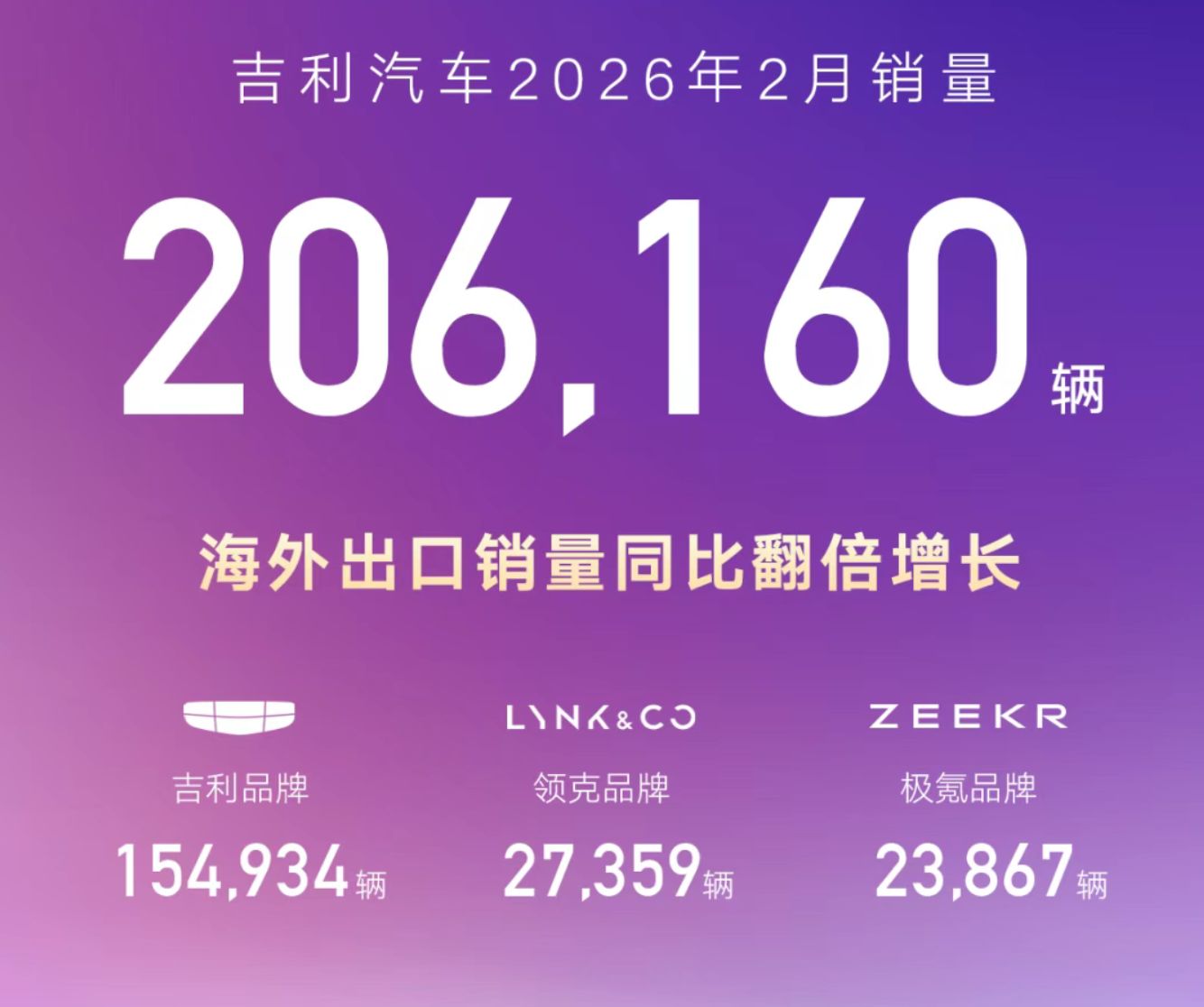
Core Insights - The automotive market is experiencing a significant decline in sales during the Chinese New Year period, with many dealerships reporting low customer traffic and minimal transactions [1][6] - A majority of dealers, 76.8%, indicated that February sales did not meet their expectations, reflecting a challenging market environment [1][6] Group 1: Sales Performance - Among traditional automakers, only a few companies, including Geely, BYD, Chery, Great Wall, SAIC, and Dongfeng Honda, have reported their February sales figures [2] - Geely's sales exceeded 200,000 units in February, reaching 206,200 units, a slight increase of 1% year-on-year [3] - BYD's February sales were 190,200 units, while SAIC's sales for domestic brands (excluding joint ventures) were 187,000 units [3] - Chery's sales reached 160,800 units, and Great Wall's sales were 72,600 units, showing a year-on-year decline of 6.79% [3] Group 2: Export Trends - BYD's overseas sales surpassed 100,000 units in February, marking a year-on-year increase of 41.4%, and for the first time, exceeded domestic sales [5] - Chery's export volume was 124,900 units, also reflecting a year-on-year growth of 41.5% [5] Group 3: Market Competition - The automotive industry is facing intensified competition, with executives from Changan and SAIC-GM Wuling warning of a complex competitive environment ahead [7] - Many joint venture brands have not released their February sales data, indicating a cautious outlook on short-term market trends [6][7] - Joint venture brands are responding to market pressures with significant discounts, such as Buick and Honda offering price cuts of up to 100,000 yuan [7][8] Group 4: Promotional Strategies - Some joint venture brands, including Dongfeng Honda and GAC Honda, have released their February sales data, with GAC Toyota reporting 41,800 units sold, driven by models like Camry and Highlander [8] - Dongfeng Honda achieved sales of 17,600 units, a year-on-year increase of 10.1%, largely due to low sales figures in the previous year [8] - Zhengzhou Nissan reported sales of 4,531 units, a significant year-on-year increase of 57.5%, with a notable rise in new energy vehicle sales [9]
BYD sales continue to plunge in February
Yahoo Finance· 2026-03-02 09:44
Group 1 - BYD Auto reported a 41% drop in global sales to 190,190 units in February 2026, following strong growth in the same month last year, due to plunging demand in its home market after the government withdrew some NEV sales incentives [1] - February marked the sixth consecutive month of decline for BYD, with global sales down by 30% year-on-year to 210,051 units in January, leading to a total drop of 36% in the first two months of 2026 to 400,241 units [2] - Domestic sales fell by 65% year-on-year to 89,590 vehicles in February, while exports rose by over 50% to 100,600 units, indicating a strategic shift towards global markets [3] Group 2 - In response to declining domestic sales, BYD has introduced 'ultra-long-term' auto financing programs with repayment terms of up to eight years to attract more customers [4]
比亚迪将召开颠覆性技术发布会
盐财经· 2026-03-02 09:31
本文转载自财联社 值班编辑 | 江江 视觉 | 诺言 比亚迪在互动平台表示,公司即将于2026年3月5日召开颠覆性技术发布会。行情方面,今日午后,比亚 迪股价上涨近8%。 | | | 星标关注《盐财经》 洞察趋势,睿智人生 /// 大家都在看 /// 点 在看 把盐撒给更多的人 ...

比亚迪股份(01211) - 截至2026年2月28日股份发行人的证券变动月报表
2026-03-02 09:24
致:香港交易及結算所有限公司 股份發行人及根據《上市規則》第十九B章上市的香港預託證券發行人的證券變動月報表 截至月份: 2026年2月28日 狀態: 新提交 公司名稱: 比亚迪股份有限公司 呈交日期: 2026年3月2日 I. 法定/註冊股本變動 | 1. 股份分類 | 普通股 | | 股份類別 | H | | | 於香港聯交所上市 (註1) | | 是 | | | --- | --- | --- | --- | --- | --- | --- | --- | --- | --- | --- | | 證券代號 (如上市) | 01211 | | 說明 | | | | | | | | | 多櫃檯證券代號 | 81211 | RMB | 說明 | | | | | | | | | | | | 法定/註冊股份數目 | | | 面值 | | | 法定/註冊股本 | | | 上月底結存 | | | | 3,683,400,000 | RMB | | | 1 RMB | | 3,683,400,000 | | 增加 / 減少 (-) | | | | | | | | RMB | | | | 本月底結存 | | | | 3, ...
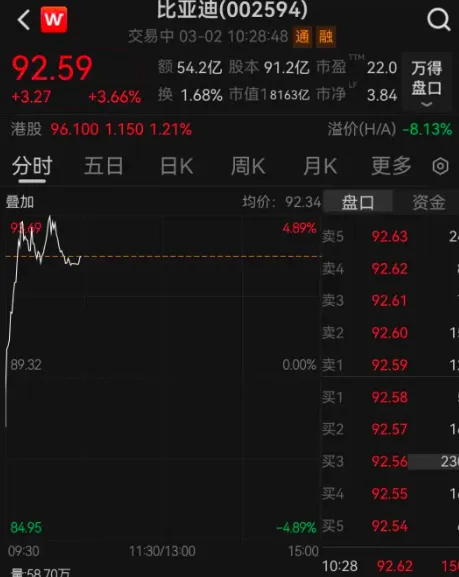
比亚迪股价盘中涨幅一度逼近5%
Cai Jing Wang· 2026-03-02 09:09
消息面上,比亚迪昨日公布2月销量数据,当月销售约19万辆,同比下跌超40%。其中海外销量超10万 辆,同比增长41.4%,首次超过国内销量。今年1~2月,比亚迪海外累计销量突破20万辆。(第一财 经) 3月2日,比亚迪(002594.SZ)开盘即上涨,股价盘中涨幅一度逼近5%,领涨汽车整车板块;比亚迪股 份(01211.HK)股价盘中一度涨超3%,在港股逆势上涨。 ...