BYD(002594)

Search documents
BYD Sales Collapse. What About Tesla?
Yahoo Finance· 2026-03-02 15:31
Core Insights - BYD, the world's largest electric vehicle maker, experienced a significant sales drop of 41% year-on-year in February, with total sales falling to 190,190 units, primarily due to a 65% decline in domestic sales, despite a 50% increase in export sales [2] - The competitive landscape in China's EV market is intense, with 129 brands reported, leading to price cuts that may increase market share but also result in losses for companies like BYD [4] - Tesla's market share in China has decreased to 8%, with its Model Y ranking 20th among all brands, while BYD's sales in the EU have increased by double digits, contrasting with Tesla's declining sales in that region [5] Group 1 - BYD's February sales dropped significantly, attributed partly to the Lunar New Year, but this alone does not explain the decline [2] - The need for BYD to accelerate new model releases is highlighted, as increased consumer choice could potentially drive sales, although new models are costly [4] - Tesla's global unit sales are declining, with a need for strong performance in China, the US, and EU to reverse this trend, indicating potential challenges ahead if BYD's sales are indicative [6] Group 2 - Tesla's market share in the US has fallen to about 50%, with the situation potentially worse without tariffs on Chinese EVs [6] - The competitive pressure from numerous EV brands in China suggests that not all can survive, raising concerns for companies like BYD and Tesla [4] - The contrasting sales trends between BYD and Tesla in both China and the EU suggest a challenging environment for Tesla moving forward [5]


开源证券晨会纪要-20260302
KAIYUAN SECURITIES· 2026-03-02 14:44
Group 1: Macro Economic Outlook - The global AI industry continues to develop rapidly, with US tech giants increasing investments in AI infrastructure to gain competitive advantages, indicating that the risk of over-investment is less than that of under-investment [7][8] - AI products are driving China's export growth, with a projected export growth rate of 4.8%-5.6% in 2026, supported by increased capital expenditure from US tech companies [8] - The competition between China and the US in technology and critical minerals is expected to intensify, as the US aims to maintain its economic and technological lead over China [8][9] Group 2: Industry Insights - The coal industry is expected to experience a rebound due to multiple positive catalysts, including supply-side reforms and a balanced supply-demand dynamic, which will stabilize coal prices [37][49] - The power sector is undergoing deep reforms, with stable electricity demand growth and a projected increase in investment in power grid infrastructure, which is expected to maintain high demand for electrical equipment [41][46] - The non-banking financial sector is seeing consolidation, with Dongwu Securities planning to acquire control of Donghai Securities, enhancing its resource capabilities in the Yangtze River Delta [31][34] Group 3: Investment Recommendations - Investment opportunities are identified in the coal sector, focusing on companies that can benefit from both cyclical and dividend logic, with specific recommendations for companies like China Shenhua and Yancoal [51][52] - The power sector presents opportunities in thermal power, wind power, and electrical equipment, with recommended stocks including Huaneng International and Longyuan Power [48] - The non-banking financial sector is expected to benefit from ongoing mergers and acquisitions, with a focus on firms with strong wealth management capabilities [35]

比亚迪(002594):公司信息更新报告:2月海外销量首超国内,出海、新技术搭载回暖可期
KAIYUAN SECURITIES· 2026-03-02 13:41
Investment Rating - The investment rating for BYD is maintained as "Buy" [1] Core Views - The report highlights that BYD's overseas sales have surpassed domestic sales for the first time, indicating strong performance in international markets [4] - The company is expected to launch new technologies and models in 2026, enhancing its competitive edge in a challenging domestic market [5] - The financial forecasts for 2025-2027 have been revised upwards, with expected net profits of 25.3, 18.6, and 14.7 times respectively, driven by overseas business growth [4] Financial Summary - Total revenue is projected to grow from 602.3 billion yuan in 2023 to 1,126.6 billion yuan in 2027, reflecting a compound annual growth rate (CAGR) of approximately 18.9% [6] - Net profit is expected to increase from 30.04 billion yuan in 2023 to 60.14 billion yuan in 2027, with a notable growth rate of 36.3% in 2026 [6] - The gross margin is forecasted to stabilize around 20% by 2027, while the net margin is expected to improve from 5.0% in 2023 to 5.3% in 2027 [6] Sales Performance - In February 2026, BYD's sales reached 190,200 units, a decrease of 41.1% year-on-year, primarily due to the impact of the Spring Festival [4] - The overseas sales in February were 100,600 units, marking a 50.1% increase year-on-year, and accounted for 52.9% of total sales [4] - For the first two months of 2026, cumulative sales were 400,200 units, down 35.8% year-on-year, largely due to the reduction in subsidies for vehicle replacements [4] Overseas Expansion - BYD aims to achieve over 1.3 million overseas sales in 2026, a 24.3% increase from the previous year, supported by a multi-faceted approach in product, channel, logistics, and production capacity [4] - The company has established over 2,000 overseas dealerships and plans to expand further into Europe and other regions [4] - The logistics capacity is set to exceed one million vehicles annually, with production facilities in Thailand and Brazil already operational, and Hungary expected to start production in 2026 [4]
大消费行业2026年3月金股推荐
Changjiang Securities· 2026-03-02 13:33
Investment Rating - The report maintains a "Buy" rating for all recommended stocks in the consumer sector [6][10][11][12][13][16][17][18][19][21]. Core Insights - The report highlights nine advantageous sectors in the consumer industry, including agriculture, retail, social services, automotive, textile and apparel, light industry, food, home appliances, and pharmaceuticals, with key stock recommendations for March 2026 [3][6]. - The report emphasizes the importance of companies' competitive advantages, such as cost efficiency and cash flow, particularly in the agriculture sector, where capacity reduction is ongoing [9][10]. - The retail sector is expected to benefit from a favorable market environment in Beijing, with companies like Cai Bai Co. poised for growth due to their direct sales model and strong operational capabilities [11]. - The hospitality sector, represented by Jin Jiang Hotels, shows a significant recovery in guest numbers, indicating a positive trend for the company's future performance [12]. - In the automotive sector, BYD is positioned as a global leader in electric vehicles, with expectations for a new product cycle to enhance competitiveness and profitability [13]. - The textile and apparel sector, represented by Hailan Home, is expected to see revenue acceleration due to its direct sales model and expansion strategies [16]. - The IP toy industry, represented by Pop Mart, is anticipated to maintain high growth rates, supported by successful new product launches and market expansion [17]. - The food sector, represented by Weilong, is projected to continue its rapid growth, leveraging its leading position in spicy snacks [18]. - TCL Electronics is expected to benefit from industry trends towards larger and higher-end products, with a stable profit outlook [19]. - The pharmaceutical sector, represented by Zhaoyan New Drug, is expected to see significant demand recovery, driven by the innovation drug market and limited supply of experimental monkeys [21]. Summary by Sector Agriculture - Key recommendation: Dekang Agriculture [6] - Expected net profits for 2025-2027: 1.24 billion, 2.37 billion, 7.15 billion CNY, with corresponding PE ratios of 20, 11, and 4 [10][26]. Retail - Key recommendation: Cai Bai Co. [6] - Expected EPS for 2025-2027: 1.46, 1.75, 2.03 CNY, with PE ratios of 17, 14, and 12 [11][26]. Social Services - Key recommendation: Jin Jiang Hotels [6] - Expected net profits for 2025-2027: 0.95 billion, 1.06 billion, 1.16 billion CNY, with PE ratios of 32, 29, and 26 [12][26]. Automotive - Key recommendation: BYD [6] - Expected net profits for 2025-2026: 35 billion, 48.1 billion CNY, with PE ratios of 23.3 and 16.9 [13][26]. Textile and Apparel - Key recommendation: Hailan Home [6] - Expected net profits for 2025-2027: 2.08 billion, 2.33 billion, 2.58 billion CNY, with PE ratios of 15, 13, and 12 [16][26]. Light Industry - Key recommendation: Pop Mart [6] - Expected net profits for 2025-2027: 12.9 billion, 17.6 billion, 22.1 billion CNY, with PE ratios of 21, 16, and 12 [17][26]. Food - Key recommendation: Weilong [6] - Expected net profits for 2025-2027: 1.43 billion, 1.73 billion, 2.12 billion CNY, with PE ratios of 18, 15, and 12 [18][26]. Home Appliances - Key recommendation: TCL Electronics [6] - Expected net profits for 2025-2027: 2.55 billion, 3.05 billion, 3.39 billion HKD, with PE ratios of 12.12, 10.16, and 9.14 [19][26]. Pharmaceuticals - Key recommendation: Zhaoyan New Drug [6] - Expected net profits for 2025-2027: 0.38 billion, 0.53 billion, 1.02 billion CNY, with PE ratios of 367.3, 97.79, and 68.88 [21][26].


这个2月有点冷,国内车企销量洗牌
凤凰网财经· 2026-03-02 13:18
Core Viewpoint - The automotive market in February 2026 experienced a significant downturn, with all new energy vehicle manufacturers failing to exceed 30,000 units in monthly deliveries, marking a shift in market dynamics and highlighting the challenges faced by both new entrants and established brands [1][2]. Group 1: Sales Performance Overview - In February, BYD's sales reached 190,190 units, a 41% decline year-on-year, with domestic sales dropping to just over 90,000 units, indicating strong pressure from the seasonal downturn [4][5]. - Geely reported total sales of 206,160 units, showing a slight increase of 1% year-on-year, supported by a remarkable performance from its Zeekr brand, which saw a 70% increase in sales [6]. - Great Wall Motors sold 72,600 vehicles in February, down 7% year-on-year and 20% month-on-month, with 12,744 units being new energy vehicles [9]. Group 2: New Energy Vehicle Manufacturers - New energy vehicle manufacturers collectively faced significant challenges, with AITO and XPeng showing notable declines in sales, with AITO delivering approximately 18,000 units in February, a drop of nearly 50% from January [11]. - XPeng delivered 15,256 vehicles in February, reflecting a nearly 50% year-on-year decline and a 24% month-on-month drop, attributed to the aging of older models and product transition pains [12]. - In contrast, Li Auto delivered 26,421 vehicles, showing a slight year-on-year increase, while NIO achieved a substantial 57.6% year-on-year growth with 20,797 units delivered, driven by strong demand for its ES8 model [18][19]. Group 3: Market Dynamics and Future Outlook - The automotive market is experiencing a dual pressure of declining domestic demand and intense price competition, with over 20 brands, including BYD and Tesla, engaging in long-term low-interest promotions [23]. - Despite the challenges, opportunities exist in the form of decreasing battery costs and advancements in smart driving technology, which could enhance the penetration of new energy vehicles in the market [23]. - The export market is becoming increasingly vital for Chinese automotive brands, with BYD's exports exceeding 100,000 units in February, marking a potential shift in focus from domestic to international markets [5].






汽车图谱|2月出海销量高增:比亚迪、奇瑞超10万辆
Xin Jing Bao· 2026-03-02 12:48
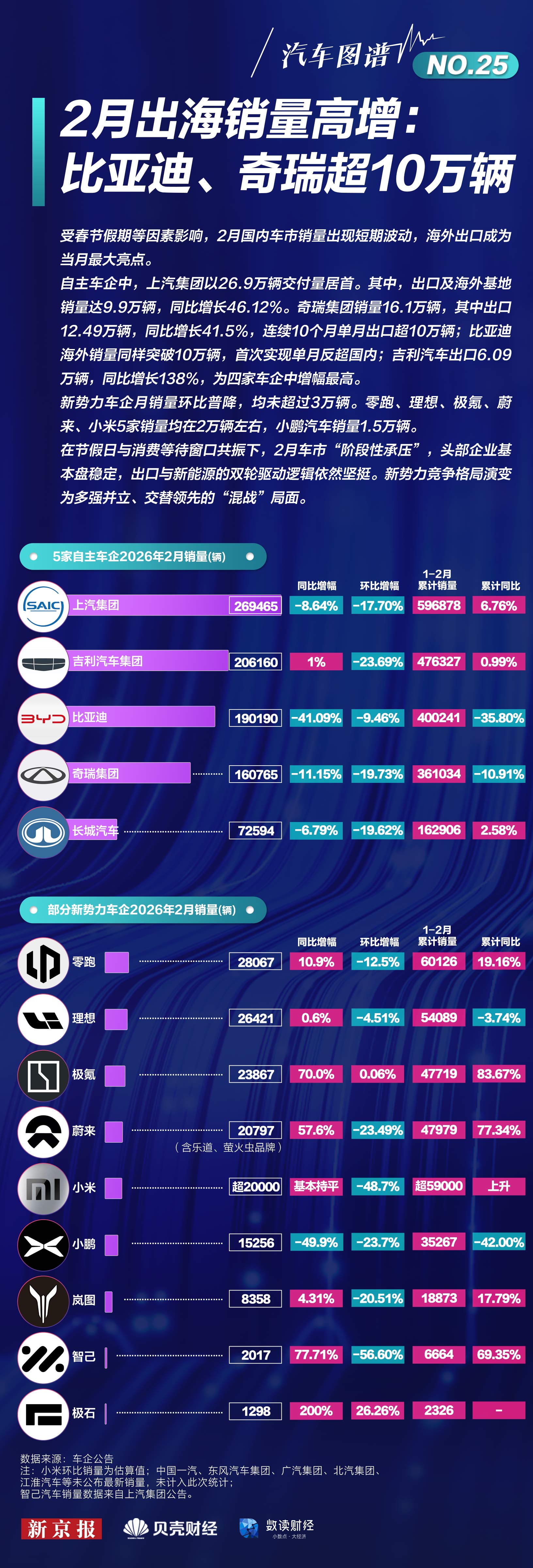
Group 1 - The domestic car market in February experienced short-term fluctuations, but the positive trends of export growth and increasing penetration of new energy vehicles remain unchanged [1] - SAIC Motor led the industry with a delivery volume of 269,465 units, with exports and overseas sales reaching 99,000 units, a year-on-year increase of 46.12%, providing crucial support against domestic market volatility [1] - Chery Group's February sales reached 161,000 units, with exports accounting for 124,900 units, a year-on-year increase of 41.5%, marking ten consecutive months of single-month exports exceeding 100,000 units [1] Group 2 - New energy vehicle companies showed a mixed performance, with sales for Leap Motor, Li Auto, Zeekr, NIO, and Xiaomi around 20,000 units, while XPeng Motors sold 15,000 units [1] - The overall market pressure in February is viewed as a short-term fluctuation rather than a trend decline, with leading companies maintaining their fundamentals and the dual drivers of exports and new energy remaining strong [1] - The competitive landscape among new energy vehicle companies has evolved into a multi-stronghold scenario, characterized by alternating leadership [1] Group 3 - The release of subsequent policy benefits and the arrival of a new round of model cycles are expected to accelerate the recovery of the car market [2] - February sales data for major domestic car companies showed varying performance, with SAIC Motor's sales down 8.64% year-on-year, while BYD's sales dropped significantly by 41.09% [4] - New energy vehicle companies like Ideal and NIO reported year-on-year increases of 0.6% and 57.6%, respectively, while others like Xiaopeng and Lantu faced declines [4]


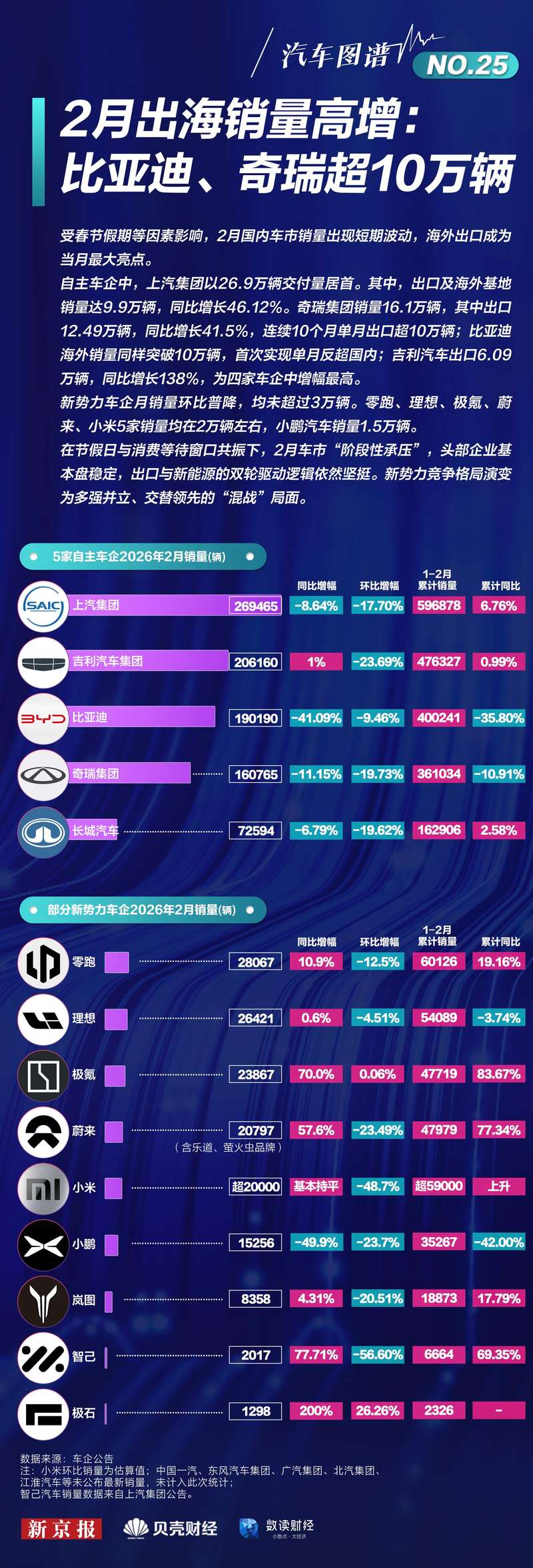
2月出海销量高增:比亚迪、奇瑞超10万辆
Xin Jing Bao· 2026-03-02 12:41
Group 1 - The domestic car market in February experienced short-term fluctuations, but the positive trends of high export growth and steady increase in new energy penetration remain unchanged [1] - SAIC Motor Corporation (600104) led the industry with a delivery volume of 269,000 units, with exports and overseas sales reaching 99,000 units, a year-on-year increase of 46.12% [1] - Chery Group's February sales were 161,000 units, with exports accounting for 124,900 units, a year-on-year growth of 41.5%, marking ten consecutive months of single-month exports exceeding 100,000 units [1] - BYD's overseas sales also surpassed 100,000 units for the first time, while Geely Automobile achieved overseas export sales of 60,900 units, with a year-on-year increase of 138%, the highest among the four companies [1] - New energy vehicle companies showed a "month-on-month decline" in February, with sales around 20,000 units for five companies, while XPeng Motors sold 15,000 units [1] Group 2 - The overall view indicates that the "temporary pressure" in the car market is more of a short-term fluctuation due to holiday effects and consumer waiting periods, rather than a trend of weakening [1] - The leading companies maintained their fundamentals during this "stress test," with the dual driving logic of exports and new energy remaining robust [1] - The competitive landscape among new energy vehicle companies has evolved into a "mixed battle" with multiple strong players and alternating leadership [1][2]
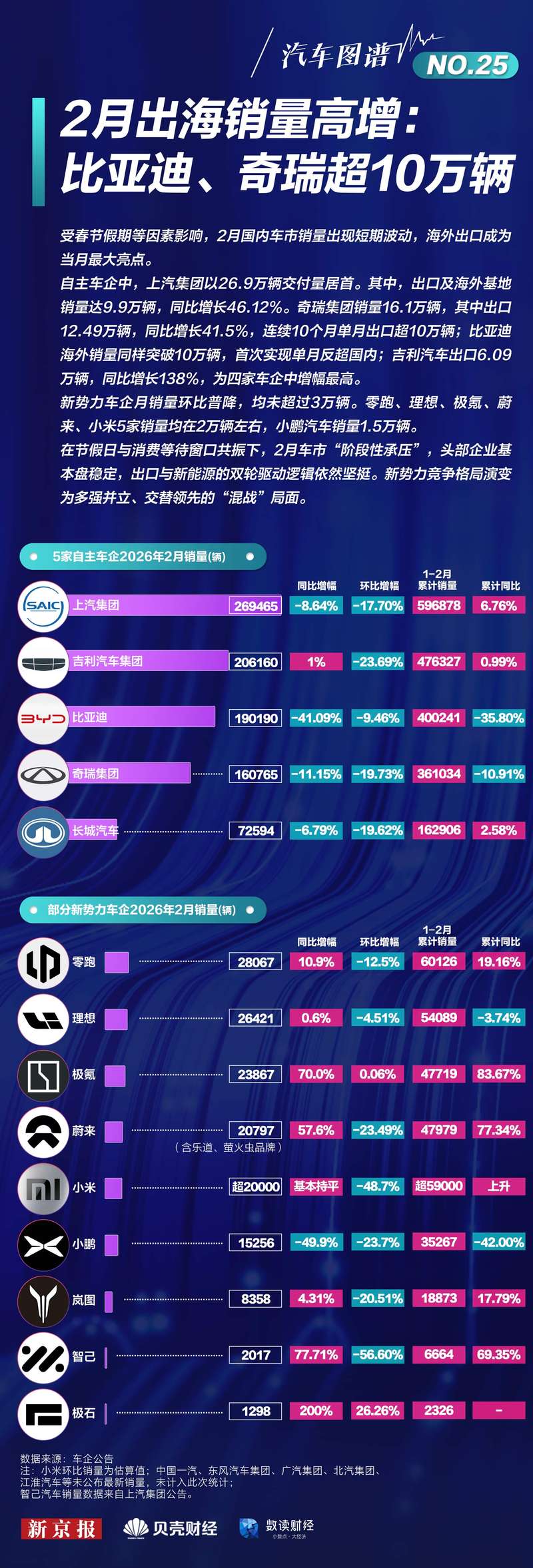
汽车图谱㉕|2月出海销量高增:比亚迪、奇瑞超10万辆
Bei Ke Cai Jing· 2026-03-02 12:38
Group 1 - The core viewpoint of the article indicates that while there was a short-term fluctuation in domestic car sales in February, the positive trends of export growth and increasing penetration of new energy vehicles remain unchanged [1][4]. - SAIC Motor Corporation led the domestic market with a delivery volume of 269,465 units, with exports and overseas sales reaching 99,000 units, a year-on-year increase of 46.12%, serving as a crucial support against domestic market fluctuations [2][8]. - Chery Group's February sales reached 161,000 units, with exports accounting for 124,900 units, marking a year-on-year growth of 41.5%, and achieving over 100,000 units in monthly exports for ten consecutive months [2][8]. Group 2 - New energy vehicle companies showed a "month-on-month decline" in sales, with five companies including Leap Motor, Li Auto, Zeekr, NIO, and Xiaomi each selling around 20,000 units, while XPeng Motors sold 15,000 units [3][10]. - The overall market pressure in February is viewed as a short-term fluctuation influenced by holiday effects and consumer waiting periods, rather than a trend of weakening [4][5]. - The competitive landscape among new energy vehicle companies has evolved into a "mixed battle" scenario with multiple strong players alternating in leadership [4][5].
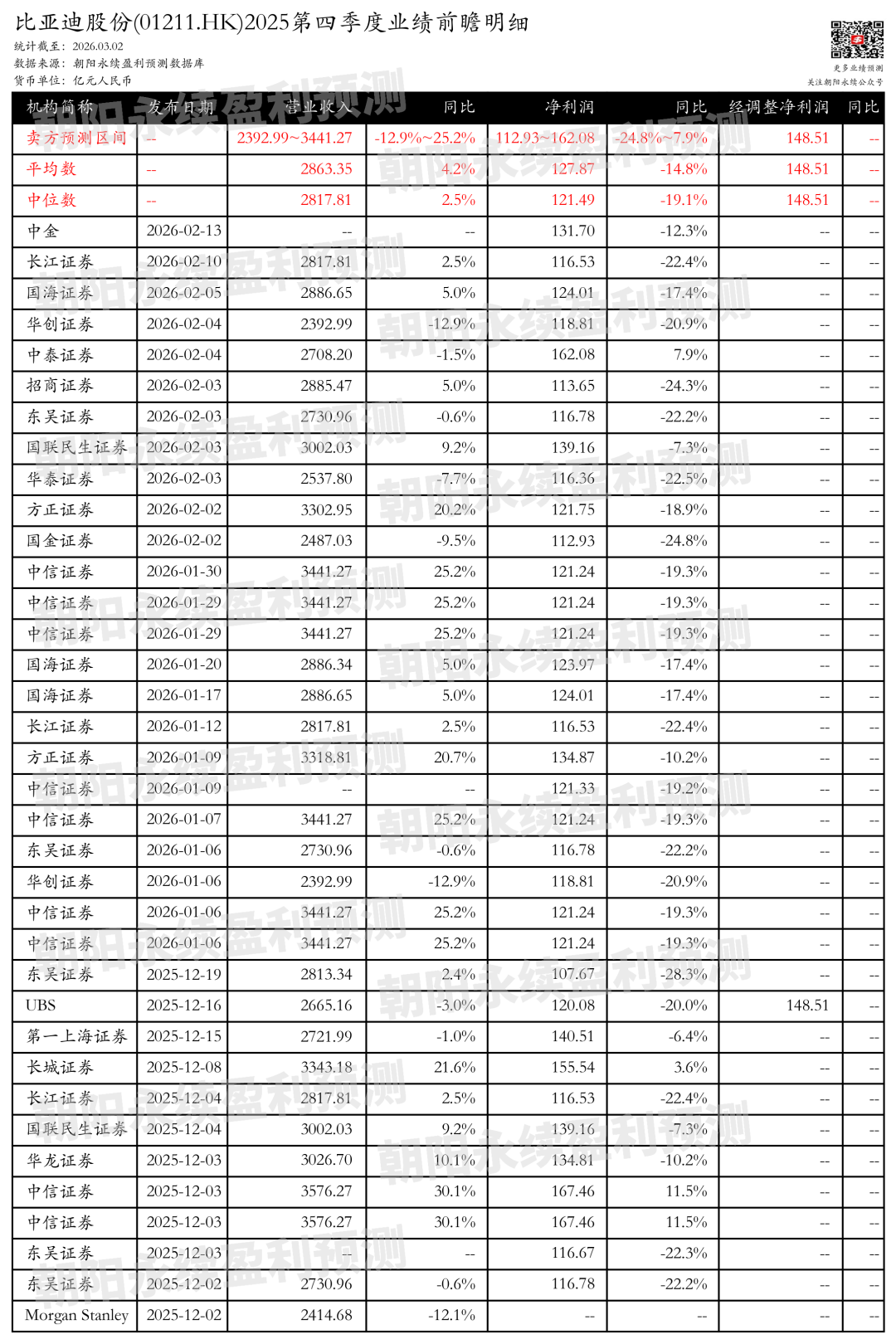
比亚迪股份:海外市场成增长引擎,预测第四季度营业收入2392.99~3441.27亿元,同比变动-12.9%~25.2%
Xin Lang Cai Jing· 2026-03-02 12:05
Core Viewpoint - The forecast for Chaoyang Yongxu's quarterly performance indicates a projected revenue range of 239.29 to 344.13 billion yuan, with a year-on-year change of -12.9% to 25.2%, and a net profit forecast of 11.29 to 16.21 billion yuan, reflecting a year-on-year change of -24.8% to 7.9% [1][6] Revenue and Profit Forecast - The predicted revenue range is 2392.99 to 3441.27 billion yuan, with a year-on-year change of -12.9% to 25.2% [1][2] - The forecasted net profit is between 112.93 and 162.08 billion yuan, with a year-on-year change of -24.8% to 7.9% [1][2] - The adjusted net profit is expected to be 148.51 billion yuan [1][2] Performance Analysis by Securities Firms - Various securities firms have provided differing forecasts, with the average revenue estimate at 286.34 billion yuan, showing a year-on-year increase of 4.2% [2][7] - The median revenue forecast is 281.78 billion yuan, reflecting a year-on-year increase of 2.5% [2][7] - Specific firms like Guohai Securities and Zhongjin Securities have provided individual estimates, with Guohai predicting a revenue of 288.67 billion yuan and Zhongjin forecasting 131.70 billion yuan in net profit [2][7] BYD Sales Insights - BYD's sales in January 2026 showed a year-on-year decline of 30.1%, but overseas sales increased by 51.5%, accounting for 48% of total sales [4][9] - The high-end strategy is progressing, with the Fangchengbao series achieving a significant year-on-year sales increase of 247% [4][9] - BYD is entering a "large battery hybrid" era, launching multiple new models aimed at consolidating market share through technological innovation [4][9] Overall Market Expectations - BYD's total sales for 2026 are projected to reach 5.12 million units, representing an 11% year-on-year increase, with exports expected to be between 1.5 to 1.6 million units, reflecting a growth of 44% to 53% [5][10] - The domestic sales are expected to remain stable, while high-end sales in January reached 28,000 units, marking a year-on-year increase of 54% [5][10] - The battery installation volume in January increased by 30%, with expectations of approximately 80 GWh in energy storage battery shipments for 2026 [5][10]
每天车闻:奇瑞、比亚迪、长城、吉利汽车发布2026年2月销量业绩
Xin Lang Cai Jing· 2026-03-02 11:48
Group 1: Chery Group - Chery Group sold 160,765 vehicles in February, with Chery brand sales at 146,173 units [4][19] - The cumulative export of Chery Group has surpassed 6 million units, maintaining over 100,000 units in exports for 10 consecutive months, and achieving an additional million units in exports over the past 8 months [4][19] Group 2: BYD - BYD's sales in February reached 190,190 units, with passenger vehicle sales at 187,782 units and overseas sales of passenger vehicles and pickups at 100,151 units, marking a year-on-year increase of 41.4% [5][19] - In the first two months, BYD's cumulative sales totaled 400,241 units, with overseas sales of passenger vehicles and pickups at 200,160 units [21] Group 3: Great Wall Motors - Great Wall Motors sold 72,594 new vehicles in February, with overseas sales increasing by 37.36% year-on-year [9][22] - The total sales for the first two months reached 162,906 units, reflecting a year-on-year growth of 2.58% [22][28] - Specific brand performances include Haval brand sales of 43,660 units, WEY brand sales of 5,615 units (up 54.13%), and Tank brand sales of 10,036 units [14][28] Group 4: Geely Automobile - Geely Automobile's sales in February amounted to 206,160 units, with new energy vehicle sales at 117,488 units, representing 57% of total sales [15][29] - The overseas export sales saw a significant increase of 138% year-on-year [15][29] - Geely brand sales were 154,934 units, with Lynk & Co brand sales at 27,359 units and Zeekr brand sales at 23,867 units, showing a year-on-year growth of 70% [15][29]