TINCI(002709)

Search documents
锂电行业跟踪:2025年11月新能源车销量高景气延续,碳酸锂价格快速上行
Shanghai Aijian Securities· 2026-01-13 10:34
Investment Rating - The industry is rated as "Outperform" [3] Core Insights - The production of positive electrode materials has increased significantly, with domestic battery production reaching 176.3 GWh in November 2025, a year-on-year growth of 49.66% [3] - Lithium carbonate prices have risen sharply, reaching 138,000 CNY per ton as of January 9, 2026, with a weekly increase of 17.92% [3] - The demand for lithium iron phosphate batteries has shown strong growth, with a monthly loading volume of 75.3 GWh in November 2025, marking a year-on-year increase of 43.62% [3] Summary by Sections Production - In November 2025, the production of lithium iron phosphate positive electrode materials was 26.93 million tons, a year-on-year increase of 32.48% [3] Prices - As of January 9, 2026, the price of lithium iron phosphate (power type) was reported at 47,100 CNY per ton, up 4.43% from January 4, 2026 [3] - The average price of square lithium iron phosphate energy storage batteries remained stable, with slight increases noted for various capacities [3] Domestic Demand - The monthly loading volume for lithium iron phosphate batteries reached a new high in November 2025, with significant increases in both domestic and new energy storage project bidding capacities [3] Overseas Demand - In November 2025, China's power battery exports reached 21.2 GWh, a year-on-year increase of 69.60% [3] - Global new energy vehicle sales reached 2 million units in November 2025, reflecting a year-on-year growth of 8.53% [3]






3月19-20日 常州 2026锂电关键材料及应用市场高峰论坛
鑫椤锂电· 2026-01-13 07:38
Core Viewpoint - The lithium battery industry is poised for a significant growth cycle in 2026, characterized by strong demand recovery, accelerated global expansion, and disruptive technological advancements, leading to a "spiral rise" in both volume and price [3]. Group 1: Conference Overview - The 2026 Lithium Battery Key Materials and Applications Market Summit will be held on March 19-20, 2026, in Changzhou, Jiangsu, organized by Xinluo Information [4]. - The summit aims to address the supply-demand dynamics in the lithium battery sector, focusing on the critical materials needed for battery production and the expected supply shortages [5]. Group 2: Key Topics of Discussion - The conference will feature three main topics: 1. In-depth discussions on cutting-edge technologies and market supply-demand [5]. 2. Announcement of the "Top Ten Lithium Battery Material Brands of 2025," evaluated based on shipment volume, market share, and customer reputation [6]. 3. B2B procurement matchmaking to connect top battery manufacturers and material suppliers, enhancing resource matching and reducing procurement costs [7]. Group 3: Proposed Discussion Topics - Proposed topics for the main forum include: - Outlook on lithium ore resource supply for 2026 [9]. - Market environment discussions on lithium carbonate operations [9]. - Research and application of high-energy density power battery technology [9]. - Additional topics will cover trends in the global new energy vehicle market and the impact of policies on the lithium market [10][11]. Group 4: Participation and Costs - The participation fee for the conference is set at 2800 yuan per person, with a limited-time free attendance option available for the first 200 registrants [17].






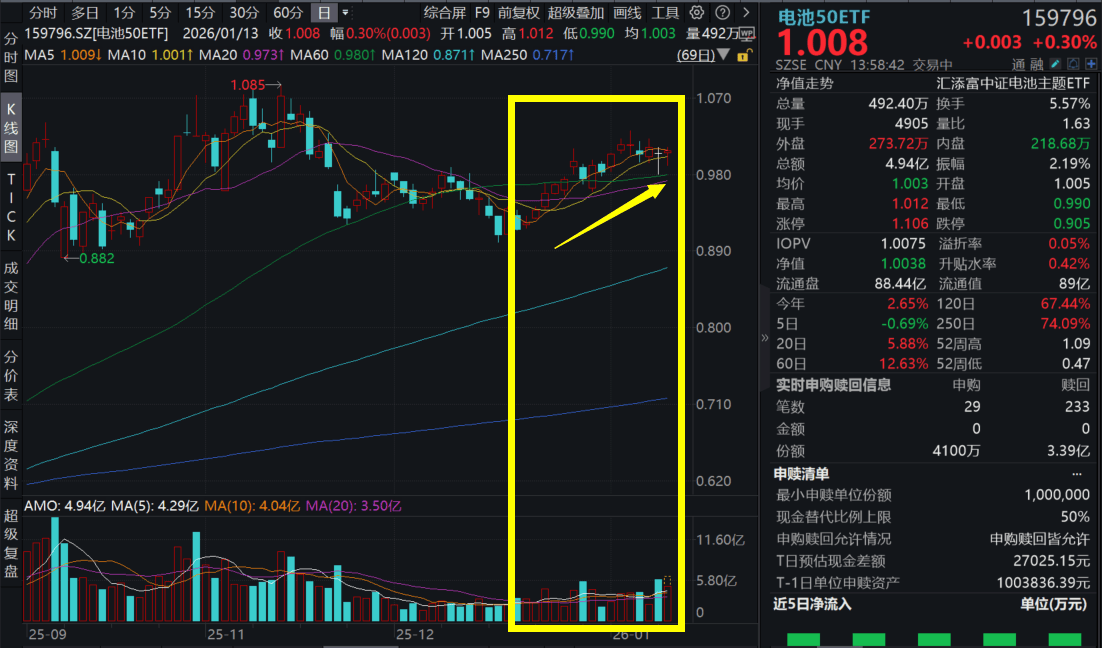
碳酸锂期货暴涨9%,一度涨12%涨停!电池50ETF(159796)窄幅震荡,电池出口退税调整,有何影响?全产业链解析!
Sou Hu Cai Jing· 2026-01-13 06:46
Core Viewpoint - The A-share market showed mixed performance on January 13, with the Battery 50 ETF (159796) experiencing a slight increase of 0.3% amid fluctuations in trading [1] Group 1: Market Performance - The Battery 50 ETF (159796) recorded a trading volume of 4.94 billion CNY, with a price range between 0.990 and 1.012 CNY [1] - The ETF's net asset value was reported at 1.0038 CNY, with a premium rate of 0.42% [1] - The ETF's five-day net inflow was noted at 2.65% [1] Group 2: Component Stocks - Major component stocks of the Battery 50 ETF included Sanhua Intelligent Controls, which rose by 1.05%, and multiple fluorine, which increased by 1.26% [2] - Notable declines were observed in XINWANDA, which fell by 2.40%, and other key players like Yangguang Electric and Ningde Times also experienced slight declines [2] Group 3: Policy Impact - The recent adjustment in export tax rebates for battery products is expected to lead to a surge in exports in 2026, tightening supply and demand in the lithium battery industry [4] - The tax rebate for battery products will decrease from 9% to 6% starting April 1, 2026, and will be eliminated entirely by January 1, 2027 [5] Group 4: Industry Outlook - The battery sector is anticipated to benefit from increased demand driven by both domestic and international markets, with projections indicating a significant rise in global demand for power batteries from 1,253.4 GWh in 2025 to 1,834.2 GWh by 2027 [5] - The storage demand is also expected to grow substantially, with domestic installations projected to reach 265 GWh in 2026, reflecting a 60% increase [5] Group 5: Investment Strategy - The Battery 50 ETF (159796) is highlighted as a leading option for investors due to its significant exposure to the storage sector, which accounts for 18.7% of its index, and a high proportion of solid-state battery technology at 45% [6][8] - The ETF's management fee is noted to be the lowest in its category at 0.15% per year, making it an attractive investment vehicle for capturing opportunities in the battery sector [11]



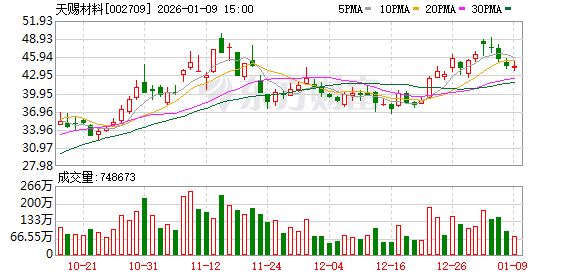
天赐材料涨2.01%,成交额23.98亿元,主力资金净流出6591.75万元
Xin Lang Cai Jing· 2026-01-13 04:37
Core Viewpoint - Tianqi Materials has shown fluctuations in stock performance, with a recent increase in share price but a year-to-date decline, indicating potential volatility in the market [1]. Financial Performance - For the period from January to September 2025, Tianqi Materials achieved a revenue of 10.843 billion yuan, representing a year-on-year growth of 22.34% [2]. - The net profit attributable to shareholders for the same period was 421 million yuan, reflecting a year-on-year increase of 24.33% [2]. Stock Market Activity - As of January 13, Tianqi Materials' stock price was 44.77 yuan per share, with a market capitalization of 91.057 billion yuan [1]. - The stock has experienced a year-to-date decline of 3.26%, a 5-day drop of 5.53%, a 20-day increase of 17.26%, and a 60-day increase of 30.52% [1]. Shareholder Information - As of September 30, 2025, the number of shareholders for Tianqi Materials reached 305,800, an increase of 67.71% from the previous period [2]. - The average number of circulating shares per shareholder was 4,528, which decreased by 40.37% compared to the previous period [2]. Dividend Distribution - Since its A-share listing, Tianqi Materials has distributed a total of 2.857 billion yuan in dividends, with 2.023 billion yuan distributed over the past three years [3]. Institutional Holdings - As of September 30, 2025, the second-largest circulating shareholder was Hong Kong Central Clearing Limited, holding 53.6773 million shares, a decrease of 2.6555 million shares from the previous period [3]. - The third-largest circulating shareholder, Quan Guo Xu Yuan Mixed A, increased its holdings by 8.5152 million shares to 33.8181 million shares [3].
兴业证券:需求双轮驱动+供给刚性约束 锂电材料行业景气上行
智通财经网· 2026-01-13 02:53
Group 1 - The core viewpoint of the report is that global lithium battery demand is expected to grow at a rate of 26% year-on-year by 2026, driven by both power storage and electric vehicle sectors [1][4] - In the electric vehicle sector, the registration of global electric vehicles reached 17.1 million units from January to October 2025, representing a year-on-year increase of 25.5%, primarily due to the resumption of subsidies in Europe and vehicle replacement policies in China [1][4] - The global energy storage battery shipments reached 428 GWh from January to September 2025, showing a significant year-on-year increase of 90.7%, supported by the scaling of independent storage projects in China and market demand in the U.S. [1][4] Group 2 - The lithium battery materials supply side is undergoing optimization due to previous overcapacity leading to low-price competition, resulting in many companies facing continuous losses and high debt levels [2][3] - Companies are focusing on improving existing production efficiency and cost optimization rather than blind expansion, leading to a significant weakening of expansion capabilities and intentions among lithium battery material companies [2][3] - The tightening of environmental policies and energy consumption controls is raising industry entry barriers, causing smaller companies to exit the market, thus enhancing the rigidity of supply constraints [2][3] Group 3 - Technological upgrades are driving supply-side optimization, with advancements in high-pressure lithium iron phosphate and high-strength separators, which require higher production precision and R&D investment [3][4] - Leading companies are leveraging continuous R&D investment to scale up high-end product capacity, while smaller firms struggle to upgrade their products and processes, leading to market elimination [3][4] - The supply structure is evolving towards a "few but excellent" model, with resources concentrating on leading enterprises, which is expected to restore market share and profitability for these companies [3][4] Group 4 - The report indicates a strong certainty of profit recovery in lithium battery materials, driven by supply-side constraints, high demand growth, and industry restructuring [4] - The consensus among companies to scientifically release capacity has led to a continued limitation of supply over the next 1-2 years, while demand is experiencing rapid growth from both power storage and electric vehicle sectors [4] - Core material prices, such as lithium hexafluorophosphate, have started to rebound, and the overall capacity utilization rate in the industry is expected to continue its upward trend in 2026 [4] Group 5 - Investment recommendations suggest prioritizing attention on lithium hexafluorophosphate and lithium iron phosphate sectors, with specific companies like Tianqi Materials and Hunan Youneng being highlighted [5] - Other companies to watch include Duofu Technology, Fulian Precision, Longpan Technology, Defang Nano, Tianji Co., Shida Shenghua, and Wanrun New Energy, particularly in the context of price recovery [5] - For long-cycle, heavy-asset sectors like copper foil and separators, companies such as Enjie, Xingyuan Materials, Fusheng Technology, Defu Technology, Jiayuan Technology, and Nord are recommended for attention [5]




逾百家A股公司预告2025年业绩 科技与生物医药行业增长强劲
Shang Hai Zheng Quan Bao· 2026-01-12 18:35
Core Insights - Approximately 130 A-share companies have disclosed their performance forecasts for 2025, with around 70 companies expecting positive results, including profit increases and turnaround from losses [2][4]. Company Performance Highlights - **Zhongke Lanyun**: Expected net profit of 1.4 billion to 1.43 billion yuan, a year-on-year increase of 366.51% to 376.51%, driven by strategic investments in high-growth areas like GPU and advanced packaging [4][5]. - **Chuanhua Zhili**: Forecasted net profit of 540 million to 700 million yuan, with a growth rate of 256.07% to 361.57%, supported by optimized marketing strategies and asset structure in logistics and chemical businesses [5]. - **Bai'ao Saitou**: Anticipated net profit of 135 million yuan, reflecting a 303.57% increase, attributed to favorable market conditions [4]. - **Kangchen Pharmaceutical**: Expected net profit of 145 million to 175 million yuan, with a growth of 243% to 315%, due to the absence of goodwill impairment losses in the reporting period [5]. - **Guangku Technology**: Projected net profit of 169 million to 182 million yuan, a growth of 152% to 172%, driven by product innovation and cost control [7]. - **Lixun Precision**: Forecasted net profit of 16.518 billion to 17.186 billion yuan, with a growth of 23.59% to 28.59%, supported by innovations in manufacturing and AI integration [6]. - **Daotong Technology**: Expected net profit of 900 million to 930 million yuan, with a growth of 40.42% to 45.10%, driven by AI-driven services [6]. - **Aibisen**: Anticipated net profit of 240 million to 290 million yuan, reflecting a growth of 105.32% to 148.09%, due to increased R&D investment [7]. - **Chaohongji**: Expected net profit of 436 million to 533 million yuan, with a growth of 125% to 175%, supported by a focus on brand optimization and digital transformation [9]. - **WuXi AppTec**: Forecasted net profit of 19.151 billion yuan, with a growth of approximately 102.65%, including gains from divesting joint ventures [9]. - **Hui Sheng Biological**: Expected net profit of 23.5 million to 27.1 million yuan, indicating a turnaround, driven by market expansion and improved production efficiency [9]. Industry Performance Insights - The electronics, semiconductor, pharmaceutical, and machinery sectors are showing strong performance among listed companies [3].




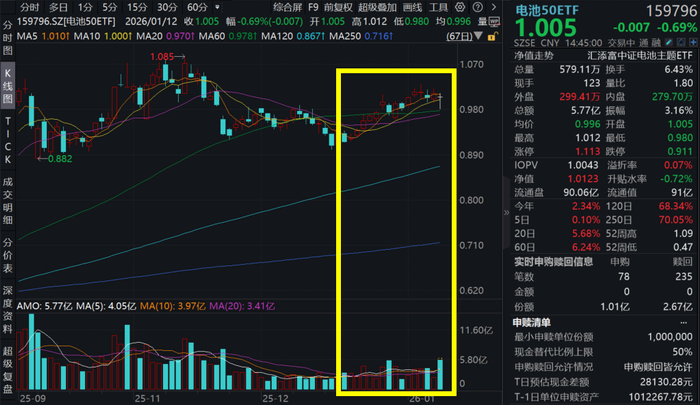
A股现天量,两市成交超3.6万亿元创新高!电池50ETF(159796)逆市爆量收跌,电池出口退税政策调整,影响几何?
Xin Lang Cai Jing· 2026-01-12 08:55
Core Viewpoint - The A-share market experienced a significant surge on January 12, with over 4,100 stocks closing in the green and a record trading volume of 3.64 trillion yuan, surpassing the previous high on October 8, 2024. The adjustment of export tax rebate policies for batteries has influenced market dynamics, leading to a notable increase in trading activity for the Battery 50 ETF (159796), which closed down 0.69% despite a trading volume nearing 600 million yuan [1][3]. Group 1: Market Performance - The Battery 50 ETF (159796) saw most of its constituent stocks decline, with notable drops including Sunshine Power and Xian Dao Intelligent, both down over 3%, while Ningde Times and Guoxuan High-Tech fell over 2% [3]. - The trading volume of the Battery 50 ETF (159796) surged to nearly 600 million yuan, indicating heightened investor interest despite the ETF's decline [1][3]. Group 2: Policy Impact - On January 9, two departments announced adjustments to export tax rebate policies, effective from April 1, 2026, which will reduce the VAT export rebate rate for battery products from 9% to 6%, and eliminate it entirely by January 1, 2027 [4][5]. - The previous reduction in export tax rebates for certain photovoltaic and battery products from 13% to 9% in November 2024 had already triggered a rush in exports, and the latest adjustments may lead to a similar surge, benefiting the lithium carbonate sector [5]. Group 3: Industry Outlook - Global demand for energy storage is expected to grow steadily, with projections indicating that global energy storage installations will reach 404 GWh by 2026, representing a 38% year-on-year increase [5]. - The battery sector is experiencing a sustained upward trend, driven by the growth of the global electric vehicle market, with domestic battery installations expected to maintain high growth rates through 2026 [5][6]. - Solid-state battery technology is advancing, with potential for significant industry upgrades, as companies that can provide stable supply and mature processes are likely to benefit [6]. Group 4: Investment Strategy - The Battery 50 ETF (159796) is positioned to benefit from its high content in energy storage (18.7%) and solid-state batteries (45%), making it a strong candidate for investors looking to capitalize on these growing segments [7][9]. - The ETF's focus on battery chemicals, which account for 31% of its weight, positions it well to benefit from the recovery of upstream material prices, enhancing the overall industry outlook [9][12].


电池出口退税下调,看好海外产能布局企业
HTSC· 2026-01-12 07:21
Investment Rating - The industry rating is "Overweight" [6] Core Viewpoints - The adjustment of the battery export tax rebate is expected to boost exports in 2026 and optimize the industry structure, benefiting companies with overseas production capacity [1][2] - The reduction in export tax rates aims to curb low-price competition in the export market and promote the exit of outdated production capacity [2][3] - The battery export tax rebate will lead to two rounds of export rush before the end of 2026, tightening supply and demand across the lithium battery supply chain [3][4] Summary by Sections Export Tax Rebate Adjustment - The export tax rebate for battery products will be reduced from 9% to 6% starting April 1, 2026, and will be eliminated entirely from January 1, 2027 [1] - This policy is expected to drive a surge in battery exports in 2026, intensifying supply-demand tensions in lithium mining and lithium hexafluorophosphate [1][2] Supply Chain Impact - The reduction in export tax is anticipated to tighten the supply-demand balance in the lithium battery industry, with major lithium material utilization rates projected at 92% for lithium hexafluorophosphate and 81% for copper foil in 2026 [3] - The ongoing demand for energy storage and the increasing sales of new energy vehicles in Europe are expected to further support this tightening [3] Recommendations - Companies with established overseas production capacity, such as CATL and Yiwei Lithium Energy, are recommended for investment [1][4] - Other companies in the supply chain, including Tianqi Lithium, New Chemical Materials, and Shangtai Technology, are also highlighted as potential beneficiaries of the tightening supply-demand dynamics [4]


股市必读:天赐材料(002709)1月9日主力资金净流出5278.92万元
Sou Hu Cai Jing· 2026-01-11 16:52
Core Viewpoint - The company Tianqi Lithium (002709) is increasing its commodity futures hedging business limit to mitigate risks associated with price fluctuations of raw materials such as lithium carbonate, palm oil, and copper [2][3]. Group 1: Trading Information - On January 9, the main funds experienced a net outflow of 52.79 million yuan, while retail investors saw a net inflow of 65.16 million yuan [2][4]. Group 2: Company Announcements - On January 7, the company’s board approved a proposal to raise the maximum guarantee amount for commodity futures hedging from 150 million yuan to 300 million yuan, pending shareholder approval [2][4]. - The board also approved a plan to use up to 600 million yuan of idle raised funds for cash management, allowing for the purchase of high-safety, liquid, and capital-preserving financial products, with a rolling usage period not exceeding 12 months [2][3][4]. Group 3: Risk Management and Compliance - The feasibility analysis report indicates that the adjustment in futures hedging limits aims to avoid risks from price volatility of relevant raw materials, with trading limited to related commodity futures and derivatives [3]. - The company has established relevant management systems and risk control measures to oversee these activities [3].
天赐材料做“减法”:项目投资规模“腰斩”
Zhong Guo Jing Ying Bao· 2026-01-09 12:53
Core Viewpoint - The company, Tianqi Materials, has announced a significant reduction in its planned investment for a lithium battery electrolyte project, cutting the production capacity from 300,000 tons to 250,000 tons and canceling a 100,000-ton battery recycling project, resulting in a total investment decrease from 1.332 billion yuan to no more than 600 million yuan [2][4]. Group 1: Project Changes - The company decided to adjust the original plan for the "300,000 tons lithium battery electrolyte expansion and 100,000 tons iron lithium battery recycling project" due to market changes and site conditions [2][4]. - The total investment for the revised project is capped at 600 million yuan, representing a 55% reduction from the original plan [4]. - The cancellation of the battery recycling project was primarily due to the unsuitability of the originally planned construction site, not a withdrawal from the recycling sector [4]. Group 2: Financial Performance - The adjusted 250,000 tons electrolyte project is expected to generate an average annual revenue of 3.674 billion yuan and an average annual net profit of 180 million yuan once fully operational [4]. - The company has reported a recovery in performance, with a projected net profit for 2025 expected to be between 1.1 billion and 1.6 billion yuan, marking a year-on-year increase of 127.31% to 230.63% [6]. - The growth in profit is attributed to increased demand in the new energy vehicle and energy storage markets, along with improved profitability from core raw material production and cost control [6]. Group 3: Strategic Positioning - The company has established a preliminary full industry chain layout from upstream raw materials to electrolyte and waste battery recycling, enhancing its ability to withstand raw material price fluctuations [5]. - Recent agreements with Guoxuan High-Tech and Zhongchuang Xinhang for long-term supply of electrolytes, totaling over 1.5 million tons over the next three years, indicate a strong market position [6]. - Analysts from Western Securities and Kaiyuan Securities have issued "buy" ratings for the company, citing the price increase of lithium hexafluorophosphate and the company's strategic positioning in solid-state battery materials as key factors [6].