
SUNWODA(300207)

Search documents
高端材料出口遇管制,多家锂电企业回应
2 1 Shi Ji Jing Ji Bao Dao· 2025-10-15 00:23
Core Viewpoint - China's export control on lithium batteries and key materials is set to take effect on November 8, 2025, targeting products with energy density ≥300Wh/kg, which includes critical production technologies and materials [1][12]. Industry Impact - The announcement has led to significant market reactions, with major companies like CATL and Yiwei Lithium Energy experiencing stock declines of 6.82% and 10.96% respectively on October 10 [3]. - The Shenwan Battery Index fell over 4% after three consecutive trading days of decline following the announcement [3]. Company Responses - Companies like Siengda Intelligent and Liyuanheng stated that the new policy's impact on their overall business is minimal, as their overseas orders primarily come from domestic battery manufacturers, which are not subject to the new controls [5][6]. - Rongbai Technology emphasized that the policy is a regulation rather than a prohibition, and it mainly affects products related to semi-solid and solid-state batteries, which do not significantly impact their supply [6][11]. - Companies such as Dingsheng Technology noted that their exports mainly consist of multi-element positive materials, which are not included in the control scope [7]. Market Dynamics - The Chinese lithium battery industry is projected to produce 1170 GWh in 2024, with a total industry output value exceeding 1.2 trillion yuan, reflecting a 24% year-on-year growth [9]. - China supplies approximately 90% of the global lithium battery market, making exports a crucial part of capacity digestion [9]. Long-term Outlook - The export control is expected to reshape the global lithium battery industry landscape, shifting focus from capacity to high-end technology [11]. - The policy may lead to increased emphasis on the domestic market and accelerate the application of high-end battery technologies within China [12].




高端材料出口遇管制,多家锂电企业回应
21世纪经济报道· 2025-10-15 00:14
Core Viewpoint - China's export control on lithium batteries and key materials is set to take effect on November 8, 2025, targeting high-energy-density batteries and critical production equipment, which reflects a shift towards high-end technology in the lithium battery industry [1][10]. Industry Impact - The new regulations have triggered a market reaction, with significant declines in stock prices for major lithium battery companies, including a 6.82% drop for CATL and a 10.96% drop for EVE Energy on October 10 [4][6]. - The Shenwan Battery Index fell over 4% after three consecutive trading days of decline, indicating market concerns about the impact of export restrictions [4][9]. Company Responses - Several companies, including Siengda Intelligent and Rongbai Technology, have stated that the new policy will have a minimal impact on their operations, as their primary overseas orders do not fall under the restricted categories [6][7]. - Companies like Dingsheng Technology emphasized that their exports mainly consist of materials not affected by the new regulations, suggesting a focus on domestic markets moving forward [7][9]. Market Dynamics - The Chinese lithium battery industry has a significant production capacity, with a total output expected to reach 1,170 GWh in 2024, a 24% increase year-on-year, and an industry value exceeding 1.2 trillion yuan [9]. - China supplies approximately 90% of the global lithium battery market, making export a crucial aspect of capacity utilization [9]. Long-term Outlook - The export control is seen as a strategic move to maintain China's leading position in high-end battery technology, potentially reshaping the global supply chain and encouraging domestic market focus [10]. - Analysts suggest that while there may be short-term market adjustments, the long-term implications could favor Chinese companies in the high-end battery sector [10].
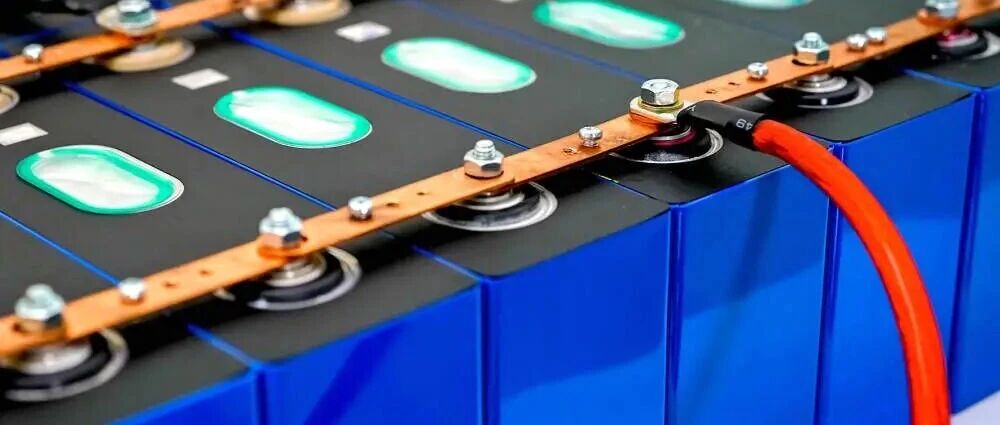
高端材料出口遇管制 多家锂电企业回应
2 1 Shi Ji Jing Ji Bao Dao· 2025-10-14 23:13
Core Viewpoint - China's export control on lithium batteries and key materials is set to take effect on November 8, 2025, targeting products with energy density ≥300Wh/kg, which includes critical production technologies and materials [1] Group 1: Export Control Announcement - The Ministry of Commerce and the General Administration of Customs announced the export control measures, emphasizing the dual-use nature of the targeted items and aligning with international practices to safeguard national security [1] - The measures are not aimed at any specific country or region, and legitimate export applications will be reviewed and potentially approved [1] Group 2: Market Reactions - On October 10, several listed companies in the lithium battery sector experienced significant stock declines, with CATL down 6.82%, EVE Energy down 10.96%, and other second-tier leaders dropping over 8% [2] - The Shenwan Battery Index fell for three consecutive trading days, closing down over 4% on October 14 [2] Group 3: Company Responses - Companies like Siengda Intelligent stated that the policy's impact on their overall business is minimal, as their overseas orders primarily come from domestic battery manufacturers, which are not subject to the export control [3] - Li Yuanheng, a lithium battery equipment supplier, mentioned that they have established a robust R&D and manufacturing base overseas to mitigate potential trade policy changes [3] - Rongbai Technology held an investor communication meeting, clarifying that the export policy is a control rather than a ban, and it mainly affects products related to semi-solid and solid-state batteries [4] Group 4: Industry Insights - The lithium battery industry in China has developed a vast capacity and complete supply chain, with a projected total production of 1170GWh in 2024, representing a 24% year-on-year increase [5] - China supplies approximately 90% of the global lithium battery market, with domestic sales of power and other batteries reaching 920.7GWh in the first eight months of the year, including 173.1GWh in exports, a 48.5% increase year-on-year [6] - The recent export control is seen as a shift in the lithium battery competition from capacity to high-end technology, potentially reshaping the global industry landscape [7]
理想/欣旺达合资公司正式落地
起点锂电· 2025-10-14 10:24
Core Insights - The article discusses the collaboration between Li Auto and Aisin Wanda, focusing on the establishment of a joint venture for battery production and the development of an open-source vehicle operating system called Star Ring OS [2][3][10]. Group 1: Joint Venture and Collaborations - Li Auto and Aisin Wanda have formed a joint venture named Shandong Li Xiang Auto Battery Co., Ltd., with a registered capital of 300 million yuan, where both companies hold a 50% stake [3][4]. - The joint venture aims to focus on battery manufacturing, sales, and the development of new energy technologies, including electric vehicle charging infrastructure [4][3]. - Aisin Wanda's involvement in the Star Ring OS project will enhance the integration of supply chain and vehicle capabilities, promoting a more open and sustainable automotive software ecosystem [2][10]. Group 2: Market Position and Performance - Aisin Wanda ranks among the top 10 domestic power battery manufacturers, with a reported battery installation volume of 10.21 GWh in the first seven months of 2025, reflecting a year-on-year growth of 40.2% [5][11]. - The company's revenue for the first half of 2025 reached 26.985 billion yuan, a 12.82% increase year-on-year, with the power segment showing a 22.63% growth in revenue [11]. - The battery project with Li Auto is seen as a significant step in Aisin Wanda's strategy, following a similar partnership with Geely, which also focused on battery production in Shandong [4][5]. Group 3: Industry Trends and Future Outlook - The establishment of the joint venture is expected to adjust the current supply chain dynamics in the battery industry, particularly for Li Auto, which currently sources batteries from multiple suppliers, including CATL and Aisin Wanda [8][10]. - The overall battery installation volume in China for the first seven months of 2025 reached 343.52 GWh, with Aisin Wanda's contribution being significant [5][9]. - The collaboration is anticipated to enhance the competitive landscape of the electric vehicle market, as Li Auto aims to introduce self-developed battery products by 2026 [2][10].


中国汽车动力电池产业创新联盟:9月我国动力和其他电池合计产量同比增长35.4%
智通财经网· 2025-10-14 10:13
Core Insights - The Chinese automotive power battery industry continues to show significant growth, with production and sales figures for September and the first nine months of 2025 indicating strong year-on-year increases in both categories. Production Summary - In September 2025, the total production of power and other batteries reached 151.2 GWh, representing a month-on-month increase of 8.3% and a year-on-year increase of 35.4% [13][8]. - Cumulatively, from January to September 2025, the total production was 1,121.9 GWh, with a year-on-year growth of 51.4% [7][13]. Sales Summary - In September 2025, the total sales of power and other batteries amounted to 146.5 GWh, with a month-on-month increase of 9.0% and a year-on-year increase of 42.2% [18][16]. - For the first nine months of 2025, cumulative sales reached 1,067.2 GWh, reflecting a year-on-year growth of 55.8% [18][7]. Export Summary - In September 2025, the total export of power and other batteries was 26.7 GWh, showing a month-on-month increase of 18.2% and a year-on-year increase of 28.3% [28][25]. - Cumulatively, from January to September 2025, exports totaled 199.9 GWh, with a year-on-year growth of 45.5% [28][7]. Installation Volume Summary - The installation volume of power batteries in September 2025 was 76.0 GWh, marking a month-on-month increase of 21.6% and a year-on-year increase of 39.5% [49][46]. - From January to September 2025, the cumulative installation volume reached 493.9 GWh, with a year-on-year growth of 42.5% [49][46]. Material Type Breakdown - In September 2025, the production of lithium iron phosphate batteries was 119.4 GWh, accounting for 79.0% of total production, while ternary batteries accounted for 20.9% with a production of 31.5 GWh [12][11]. - Cumulatively, from January to September 2025, lithium iron phosphate batteries accounted for 78.8% of total production, while ternary batteries accounted for 21.0% [12][11]. Market Concentration - In September 2025, the top two battery manufacturers accounted for 63.8% of the market share, while the top five and top ten accounted for 81.1% and 94.4%, respectively [56][59]. - From January to September 2025, the top two manufacturers held 65.2% of the market share, with the top ten holding 94.3% [59][56].

市场监管总局发布最新一批无条件批准经营者集中案件列表
Di Yi Cai Jing· 2025-10-14 08:50
Core Viewpoint - The State Administration for Market Regulation has released a list of unconditionally approved concentration cases for the period from September 22 to September 30, 2025, highlighting several significant mergers and acquisitions in various sectors [1] Group 1: Mergers and Acquisitions - Chongqing Qianli Zhijia Technology Co., Ltd. and Zhejiang Jike Automobile Research and Development Co., Ltd. are establishing a joint venture [1] - Safran Short Cabin Company and Shanghai Aircraft Manufacturing Co., Ltd. are forming a new joint venture [1] - Beijing Ideal Automobile Co., Ltd. is partnering with Xinwangda Power Technology Co., Ltd. to create a new joint venture [1] - Mitsubishi Motors Corporation is acquiring equity in GAC Mitsubishi Automobile Sales Co., Ltd. [1] - eLong Limited is acquiring equity in Wanda Hotel Management (Hong Kong) Co., Ltd. [1]
2025年9月29日-10月8日无条件批准经营者集中案件列表


Zhong Guo Zhi Liang Xin Wen Wang· 2025-10-14 08:01
Core Viewpoint - The document lists a series of unconditional approvals for business concentration cases from September 29 to October 8, 2025, indicating ongoing consolidation activities in various sectors [1]. Group 1: Business Concentration Cases - Case 1: China International Capital Corporation Private Equity Investment Management Co., Ltd. and Schaeffler Investment (China) Co., Ltd. established a joint venture on September 29, 2025 [1]. - Case 2: Eastman Chemical International GmbH and Huafeng Chemical Co., Ltd. established a joint venture on September 29, 2025 [1]. - Case 3: Agricultural Bank of China Capital Management Co., Ltd. and Shandong New Kinetic Energy Capital Management Co., Ltd., among others, established a joint venture on September 30, 2025 [1]. - Case 4: Bank of Communications Guoxin Private Equity Fund Management Co., Ltd. and Suzhou Industrial Park Zhongxin Energy Development Co., Ltd. established a partnership on September 30, 2025 [1]. - Case 5: Qingdao Urban Development Group Co., Ltd. and Qingdao Municipal Space Development Group Co., Ltd. merged on September 30, 2025 [1]. - Case 6: Fujian Wancheng Biotechnology Group Co., Ltd. acquired Nanjing Wanyou Business Management Co., Ltd. on September 30, 2025 [1]. - Case 7: Beijing Ideal Automotive Co., Ltd. and Xinwanda Power Technology Co., Ltd. established a joint venture on September 30, 2025 [1].
欣旺达推出新型储能电芯
Zhong Guo Hua Gong Bao· 2025-10-14 04:29
Core Insights - XINWANDA has introduced two new energy storage cells, 684Ah and 588Ah, at an industry event, addressing key industry pain points and providing diverse and reliable solutions for high-quality development in the energy storage sector [1] Group 1: Product Innovation - The 684Ah energy storage cell utilizes stacking technology, achieving a volumetric energy density exceeding 440+ Wh/L [1] - It features an innovative "thermal separation" design and a three-dimensional heat dissipation structure, fundamentally optimizing thermal management pathways, significantly enhancing system operational safety and long-term reliability [1] - The cell boasts a lifespan of over 20 years, meeting long-term operational demands, and has an energy efficiency of 96.5% [1] Group 2: Safety and Cost Optimization - The product incorporates a high-safety electrolyte and a directional exhaust channel design, ensuring stable and safe system operation while further optimizing costs [1] Group 3: Circular Economy and Recycling Solutions - XINWANDA showcased battery passports and recycling solutions, enhancing its digital energy ecosystem [1] - Battery recycling is a crucial part of XINWANDA's "Five Full" operational strategy, focusing on a comprehensive industry chain layout [1] - The company is actively advancing the construction of multiple bases centered in Shenzhen, aiming to establish a global circular economy network, with a focus on lithium battery recycling (covering ternary/lithium iron phosphate systems) and cascading utilization [1]
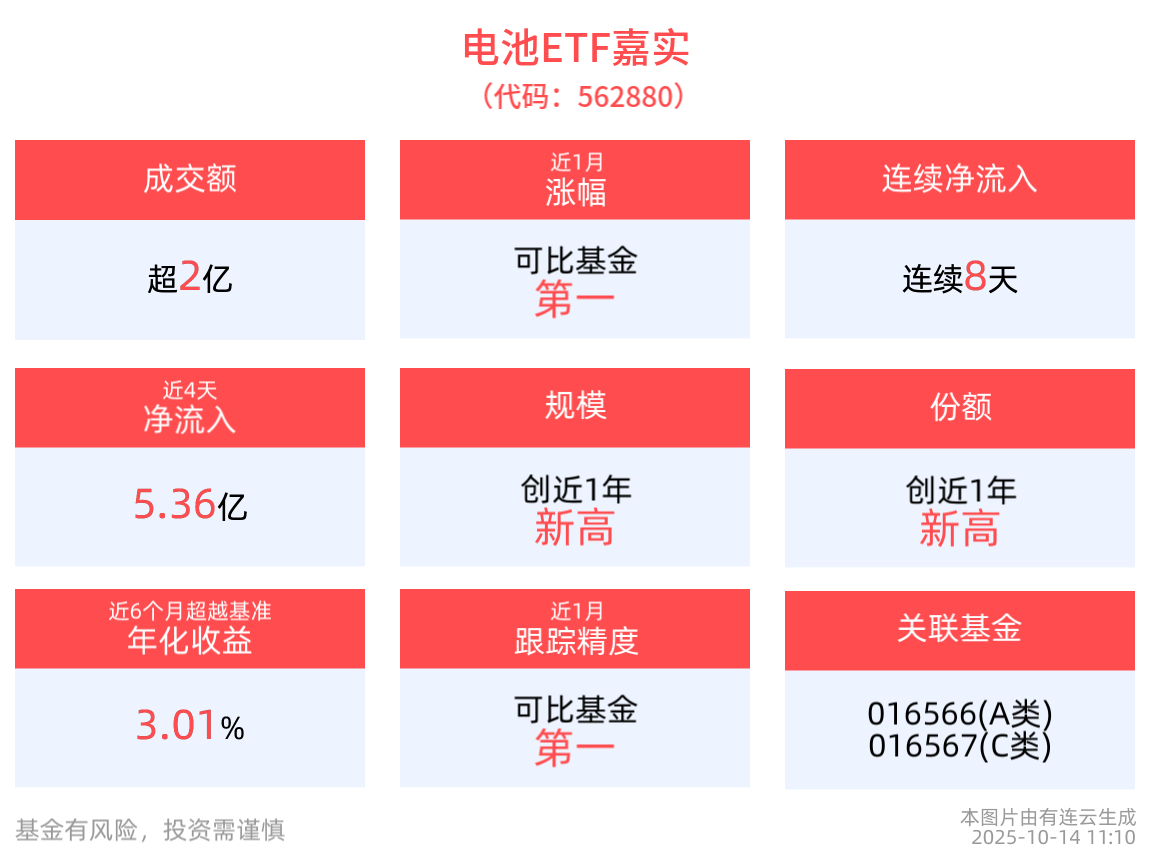
机构:看好锂电行业基本面,电池ETF嘉实(562880)连续8日“吸金”,规模创成立以来新高!
Sou Hu Cai Jing· 2025-10-14 04:24
Core Insights - The China Securities Battery Theme Index has decreased by 1.63% as of October 14, 2025, with mixed performance among constituent stocks [1] - The Jiashi Battery ETF has seen a significant increase of 9.68% over the past month, ranking first among comparable funds [1] - The Jiashi Battery ETF has reached a new high in scale at 1.792 billion yuan and a record share of 2.196 billion [3] Market Performance - Jiashi Battery ETF recorded a turnover rate of 14.21% with a trading volume of 255 million yuan, indicating active market participation [3] - The ETF has experienced continuous net inflows over the past eight days, totaling 603 million yuan, with a single-day peak inflow of 281 million yuan [3] - The net asset value of the Jiashi Battery ETF has increased by 78.67% over the past six months, ranking 49th out of 3737 index equity funds [3] Industry Outlook - CITIC Construction Investment Research suggests a continued focus on the energy storage sector, highlighting a favorable lithium battery industry outlook due to multiple catalysts [3] - The domestic energy storage market is experiencing a turning point, driven by the expansion of renewable energy and new pricing policies [3] - The demand for lithium batteries is expected to grow significantly in 2026, with Q3 showing notable increases in production and sales [4] Key Stocks - The top ten weighted stocks in the China Securities Battery Theme Index account for 55.79% of the index, with significant players including Longi Green Energy, CATL, and Yiwei Lithium Energy [4] - Notable stock performances include Longi Green Energy up by 2.20% and CATL down by 1.30% [6]



《2025全球新能源企业500强竞争力报告》显示: 全球新能源产业中企领跑
Zhong Guo Hua Gong Bao· 2025-10-14 02:40
Core Insights - China's renewable energy companies have transitioned from following to leading the global market, with significant growth potential ahead [1][2] - The 2025 Global Top 500 New Energy Enterprises report indicates that 12 companies will exceed 100 billion yuan in revenue by 2025, with 8 of them being Chinese [1] - Despite a slowdown in overall industry growth, the domestic installed capacity and application market expansion will continue to drive growth in China's renewable energy sector [2] Group 1 - The total revenue of the top 500 companies in the renewable energy sector is projected to reach 9.55 trillion yuan in 2025, reflecting a slight increase of 0.01 trillion yuan or 0.10% from the previous year, but a significant decrease in growth rate of 10.06% year-on-year [2] - The average scale of these companies is estimated at 190.94 billion yuan, showing a marginal increase of 0.07%, with a year-on-year growth decline of 10.05%, marking two consecutive years of substantial decline [2] - Experts emphasize that technological innovation is crucial for overcoming the current cyclical challenges in the industry [3] Group 2 - The integration of new technologies such as IoT, AI, and big data with renewable energy is seen as a pathway to create new application scenarios and business models [3] - The increasing capacity of clean energy sources like wind and solar is leading to challenges in energy consumption, which is becoming a primary constraint on the development of renewable energy [3] - Policies have shifted from being driven by scale to being driven by end-use applications, indicating a transformation in the renewable energy landscape [3]