Sungrow Power Supply(300274)

Search documents
阳光电源中东首座储能工厂落地,年产能10GWh
中关村储能产业技术联盟· 2026-01-13 03:49
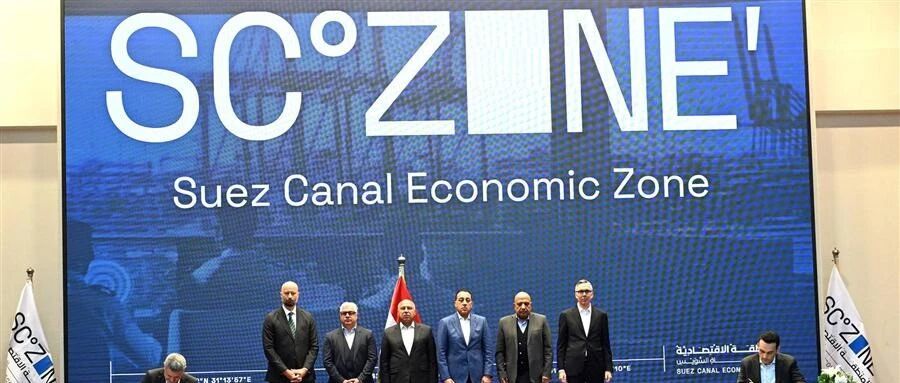
Core Viewpoint - The Egyptian government has signed agreements totaling over $1.8 billion with Scatec and Sungrow Power to develop large-scale solar and energy storage projects, marking a significant step in expanding clean energy capacity and localizing the renewable energy supply chain in Egypt [2][4]. Group 1: Project Details - Scatec will develop the "Energy Valley" project in Minya, which includes a large-scale integrated solar and energy storage power station [2]. - Sungrow Power will establish a battery storage system manufacturing plant in the Suez Canal Economic Zone (SCZONE) to support the project and regional market [2][4]. - The Energy Valley project aims to achieve a total installed capacity of 1.7 GW (AC) of solar power and a battery storage system of 4 GWh, making it one of the largest integrated clean energy projects globally [5]. Group 2: Local Manufacturing and Employment - The manufacturing facility by Sungrow Power in Egypt will be the first battery storage system manufacturing base in the Middle East and Africa, covering approximately 50,000 square meters and expected to create around 150 direct jobs [5]. - The plant is projected to have an annual production capacity of 10 GWh and is scheduled to commence operations in April 2027 [5]. Group 3: Financing and Support - The project has received preliminary financing agreements from multilateral development financial institutions, including the European Investment Bank (EIB), the European Bank for Reconstruction and Development (EBRD), and the African Development Bank (AfDB) [6]. - The agreements signify strong support for the Energy Valley project, aligning with Egypt's strategy to localize renewable energy manufacturing and enhance energy security [2][6].

数据复盘丨传媒、计算机等行业走强 150股获主力资金净流入超1亿元
Zheng Quan Shi Bao Wang· 2026-01-12 10:42
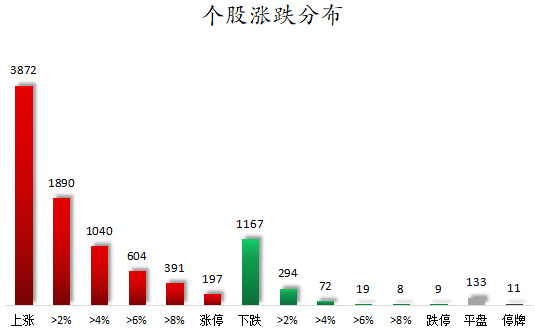
Market Performance - The Shanghai Composite Index closed at 4165.29 points, up 1.09%, with a trading volume of 1.4462 trillion yuan, marking a historical high in trading volume [1] - The Shenzhen Component Index rose 1.75% to 14366.91 points, with a trading volume of 2.1552 trillion yuan [1] - The ChiNext Index increased by 1.82% to 3388.34 points, with a trading volume of 1.0962 trillion yuan [1] - The STAR 50 Index gained 2.43% to close at 1511.84 points, with a trading volume of 106.6 billion yuan [1] - The total trading volume of both markets reached 3.60142 trillion yuan, an increase of 478.659 billion yuan compared to the previous trading day [1] Sector Performance - Strong sectors included Media, Computer, Defense, Education, Communication, Retail, Steel, Machinery, and Textile, with notable gains [2] - Active concepts included Short Drama Interactive Games, Multi-modal AI, Satellite Internet, and Quantum Technology [2] - Weak sectors included Oil, Insurance, and Coal, with notable declines [2] Individual Stock Performance - 3872 stocks rose while 1167 stocks fell, with 197 stocks hitting the daily limit up and 9 stocks hitting the limit down [2] - Fenglong Co. achieved a record 12 consecutive limit-up days, leading the market [5] - 150 stocks saw net inflows exceeding 100 million yuan, with Dongfang Caifu leading at 1.81 billion yuan [9][10] - 168 stocks experienced net outflows exceeding 100 million yuan, with Yangguang Electric leading at 2.081 billion yuan [11][12] Institutional Activity - Institutions had a net sell of approximately 699 million yuan, with 15 stocks seeing net purchases and 21 stocks net sales [14] - The top net purchase stock by institutions was Shanzi High-Tech, with a net inflow of approximately 484 million yuan [14]



超11GWh!阳光电源、天合储能新动作
行家说储能· 2026-01-12 10:32
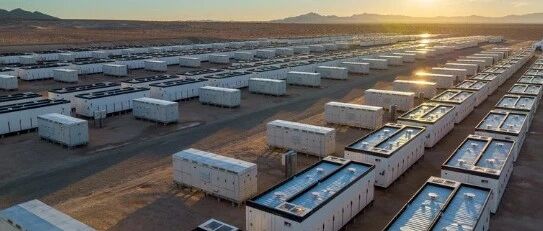
Group 1 - The core viewpoint of the article highlights the recent advancements in energy storage businesses of Sungrow Power and Trina Solar, with Sungrow planning to establish a 10GWh battery storage manufacturing plant in Egypt and Trina Solar securing a 1.2GWh storage order in Latin America [1][2][3]. Group 2 - Sungrow Power will build the first battery energy storage system (BESS) manufacturing plant in the SCZONE area of Egypt, covering an area of 50,000 square meters, with a target annual production capacity of 10GWh, expected to commence operations in April 2027 [2]. - In the first three quarters of 2025, Sungrow's energy storage shipments increased by 70% year-on-year, with overseas shipments rising from 63% to 83% of total shipments [2]. - Sungrow aims for a total energy storage shipment target of 40-50GWh by 2025, anticipating a global energy storage market growth rate of approximately 40-50% in 2026 due to increasing demand for renewable energy integration and user-side market policies [2]. Group 3 - Trina Storage has secured a 1.2GWh energy storage order in Latin America, with contracts signed for projects developed in collaboration with T-Power in Chile and YPF Luz in Argentina, utilizing Trina's Elementa 2 battery containers and related systems [3][5]. - Trina Storage's total known energy storage project orders in Latin America for 2025 exceed 2.4GWh, with over 24GWh of overseas storage orders and project collaborations reported [3][5]. - The Luz del Norte project in Chile will include a 722MWh battery storage system, while the Alma Sur project in Argentina will feature a 90MW/481MWh battery storage system, contributing to Trina's growing presence in the Latin American market [5][6].

解码基金“擒牛术”!从同花顺到新易盛,三波牛市验证三大选股核心逻辑
券商中国· 2026-01-12 10:16
Core Insights - The article highlights the exceptional performance of the Yongying Technology Smart A fund, managed by Ren Jie, which achieved a record annual return of 233.29% in 2025, driven by significant holdings in stocks like Xinyi Sheng and Shenghong Technology, both of which saw cumulative increases exceeding 10 times during 2024-2025 [1] - The analysis of A-shares over the past decade reveals that public funds have consistently played a crucial role in the rise of "tenfold stocks" during three notable bull markets, with deep involvement in stocks like Tonghuashun and Yiyuan Lithium Energy [1][2] Investment Logic for Tenfold Stocks - Each bull market is characterized by distinct themes, with public funds aligning their investment strategies closely with policy directions and industrial changes. For instance, during the "leverage bull" from 2014-2015, funds focused on sectors like finance and defense, leading to significant gains in stocks like Tonghuashun and Guangqi Technology [2] - The "core asset bull" from 2019-2021 saw funds targeting high-growth, high-barrier stocks, reflecting a shift towards quality investments amid consumption and industrial upgrades [2][3] Performance Metrics of Tenfold Stocks - The article notes that the average compound profit growth rate of tenfold stocks during the 2019-2021 period was 69.61%, with an average price increase of 12.9 times. Notable examples include Sunshine Power, which saw a price increase of 15.54 times, and Shanxi Fenjiu, benefiting from consumption upgrades [3] - In the 2024-2025 market, driven by policies promoting technological self-reliance, funds focused on tech companies with core technologies, leading to significant profit growth for stocks like Xinyi Sheng and Shenghong Technology, with peak fund holding ratios of 40.65% and 23.68%, respectively [3] Fund Investment Strategies - Public funds have evolved their stock selection strategies from short-term trend capturing to long-term value digging, with a clear trajectory of improvement in selection capabilities. During the "leverage bull," funds primarily engaged in short-term speculation, while the "core asset bull" period saw a more in-depth analysis of company fundamentals [6][7] - The current strategy emphasizes forward-looking research and precise selection based on industry fundamentals, moving away from broad trend-following approaches to a more nuanced understanding of market dynamics [7] Practical Insights for Investors - Investors are advised to focus on funds' capabilities in core sectors, as evidenced by the performance of funds like Yongying Technology Smart A, which significantly outperformed the market by concentrating on leading stocks [8] - The sustainability of fund holdings and their alignment with performance metrics is crucial for long-term returns. Stocks that consistently deliver earnings, like Yiyuan Lithium Energy, have proven to be beneficial for funds, while those reliant on external events may pose higher risks [9] - Maintaining a diversified investment portfolio is essential for risk management, as concentrated funds may face volatility during industry rotations. Investors should consider allocating funds across various themes to balance opportunities and risks [9]



阳光电源入选“2025中国企业ESG百强”榜单
Xin Lang Cai Jing· 2026-01-12 10:06
Core Insights - The article emphasizes the growing importance of ESG (Environmental, Social, and Governance) as a key metric for high-quality corporate development and a vital link between corporate value and social value [1][11][12] - The "2025 China ESG Top 100" list was released by Sina Finance, evaluating over 5,000 A-share listed companies and mainland companies listed in Hong Kong using 18 industry-specific ESG evaluation models and over 150 ESG indicators [1][12] - The list serves as a benchmark for industry development and provides valuable decision-making references for investors [1][12] Industry Overview - The ESG ecosystem in China is rapidly improving, with tightening regulatory policies and increasing market focus on ESG performance, making sustainable development capabilities a core competitive advantage for companies [1][11] - ESG is no longer seen as an optional enhancement but as an essential requirement for companies to meet global challenges and high-quality development demands [2][12] Company Highlights - Sungrow Power, recognized for its significant contributions in the ESG domain, ranked 6th in the "2025 China ESG Top 100" list, reflecting its strong performance in sustainability practices [2][12] - The recognition of companies in the ESG Top 100 is a testament to their sustainable development efforts and aims to inspire other companies to integrate ESG principles into their strategic planning and operations [2][12]

电力设备行业周报:国内数据中心迎扩容与升级新周期,直流供电设备有望率先受益-20260112
Huaxin Securities· 2026-01-12 10:04
Investment Rating - The report maintains a "Recommended" investment rating for the power equipment sector [6][17]. Core Viewpoints - The domestic data center industry is entering a new cycle of expansion and upgrades, with direct current (DC) power supply equipment expected to benefit first. The market size of China's data center industry is projected to exceed 318 billion yuan in 2025, representing a year-on-year growth of approximately 14.7%. By 2030, it may reach 1.2 trillion yuan, with a compound annual growth rate (CAGR) of about 25%-28% [5][15]. - The load scale of data centers is expected to be around 7.05 GW in 2025, increasing to 9.37 GW by 2030, with a CAGR of approximately 5.85%. The demand for AI computing power is driving significant capital expenditure from leading internet companies, with ByteDance planning to invest about 160 billion yuan in AI infrastructure in 2026, and Alibaba expecting to invest over 380 billion yuan in cloud and AI hardware from 2025 to 2027 [5][15]. - The industry is experiencing an unexpected expansion, with infrastructure technology upgrades creating investment opportunities in IDC-compatible DC power supply equipment [5][15]. Summary by Sections Investment Viewpoints - The report suggests focusing on the IDC sector, recommending companies such as Kehua Data and Jinpan Technology, as well as Sifang Co. and Liangxin Co. for their potential in the HVDC/SST industry. It also highlights the importance of high-voltage circuit breakers and suggests monitoring companies like Zhongheng Electric, Magmeter, and Oulu Tong in the power supply sector [6][16]. Key Companies and Profit Forecasts - The report includes profit forecasts for several companies, with notable mentions: - Kehua Data (002335.SZ): EPS forecast of 1.86 yuan for 2026, currently unrated [18]. - Liangxin Co. (002706.SZ): Rated "Buy" with an EPS forecast of 0.44 yuan for 2026 [19]. - Magmeter (002851.SZ): Rated "Buy" with an EPS forecast of 2.07 yuan for 2026 [19]. - Sunshine Power (300274.SZ): Rated "Buy" with an EPS forecast of 7.74 yuan for 2026 [19]. - Jinpan Technology (688676.SH): Rated "Buy" with an EPS forecast of 2.20 yuan for 2026 [19]. Market Performance - The power equipment sector saw a 5.02% increase last week, ranking 12th among 28 sub-industries, outperforming the Shanghai Composite Index by 1.21 percentage points [46].


今日这些个股异动 主力加仓计算机、传媒板块


Di Yi Cai Jing· 2026-01-12 09:32
【换手率高】 -今日A股共有50只个股换手率超过30%; 【振幅大】 -今日A股共有33只个股振幅超过20%; -C陕旅、天力复合、天润科技等个股振幅居前; -C陕旅、创新医疗、御银股份等个股换手率居前; 【主力资金】 -主力资金今日净流入计算机、传媒、非银金融等板块,净流出电力设备、电子、基础化工等板块; -东方财富、领益智造、岩山科技、山子高科、海格通信资金净流入规模居前,分别净流入18.10亿元、 16.47亿元、14.10亿元、14.03亿元、11.41亿元; -阳光电源、金风科技、新易盛、乾照光电、胜宏科技资金净流出规模居前,分别净流出20.81亿元、 19.58亿元、18.40亿元、13.91亿元、13.43亿元。 ...
电力设备行业资金流出榜:阳光电源、金风科技等净流出资金居前
Zheng Quan Shi Bao Wang· 2026-01-12 09:25
资金面上看,两市主力资金全天净流出274.68亿元,今日有11个行业主力资金净流入,计算机行业主力 资金净流入规模居首,该行业今日上涨7.26%,全天净流入资金157.74亿元,其次是传媒行业,日涨幅 为7.80%,净流入资金为53.91亿元。 沪指1月12日上涨1.09%,申万所属行业中,今日上涨的有28个,涨幅居前的行业为传媒、计算机,涨 幅分别为7.80%、7.26%。电力设备行业今日上涨0.51%。跌幅居前的行业为石油石化、煤炭、房地产, 跌幅分别为1.00%、0.47%、0.29%。 电力设备行业资金流出榜 | 代码 | 简称 | 今日涨跌幅(%) | 今日换手率(%) | 主力资金流量(万元) | | --- | --- | --- | --- | --- | | 300274 | 阳光电源 | -3.31 | 6.12 | -204445.54 | | 002202 | 金风科技 | 9.99 | 11.28 | -190156.03 | | 300750 | 宁德时代 | -2.04 | 1.15 | -94090.75 | | 300450 | 先导智能 | -3.70 | 8.72 | - ...

两市主力资金净流出274.68亿元,电力设备行业净流出居首
Zheng Quan Shi Bao Wang· 2026-01-12 09:17
分行业来看,申万所属的一级行业中,今日上涨的有28个,涨幅居前的行业为传媒、计算机,涨幅为7.80%、7.26%。跌幅居前的行业为石油石 化、煤炭、房地产,跌幅为1.00%、0.47%、0.29%。 (原标题:两市主力资金净流出274.68亿元,电力设备行业净流出居首) 1月12日,沪指上涨1.09%,深成指上涨1.75%,创业板指上涨1.82%,沪深300指数上涨0.65%。可交易A股中,上涨的有4144只,占比75.91%,下 跌的1182只。 资金面上,今日主力资金全天净流出274.68亿元,已连续5个交易日资金呈净流出状态。其中,创业板主力资金净流出10.48亿元;科创板主力资金 净流出69.33亿元;沪深300成份股主力资金净流出126.47亿元。 数字经济ETF (产品代码: 560800) ★ 跟踪:中证数字经济主题指数 近五日涨跌:8.21% 行业资金流向方面,今日有11个行业主力资金净流入,计算机行业主力资金净流入规模居首,该行业今日上涨7.26%,全天净流入资金157.74亿 元,其次是传媒行业,日涨幅为7.80%,净流入资金为53.91亿元。 主力资金净流出的行业有20个,电力设备行业主 ...



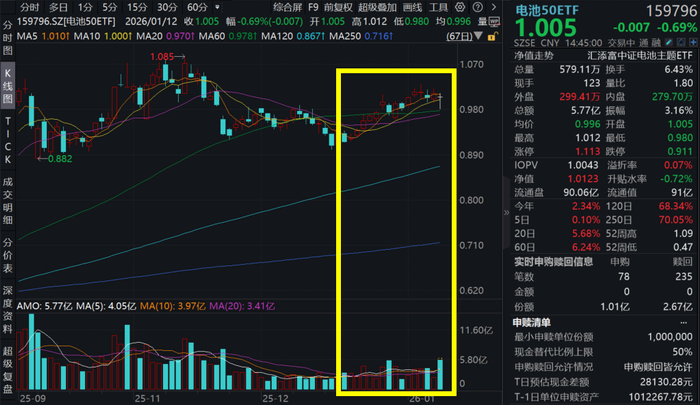
A股现天量,两市成交超3.6万亿元创新高!电池50ETF(159796)逆市爆量收跌,电池出口退税政策调整,影响几何?
Xin Lang Cai Jing· 2026-01-12 08:55
Core Viewpoint - The A-share market experienced a significant surge on January 12, with over 4,100 stocks closing in the green and a record trading volume of 3.64 trillion yuan, surpassing the previous high on October 8, 2024. The adjustment of export tax rebate policies for batteries has influenced market dynamics, leading to a notable increase in trading activity for the Battery 50 ETF (159796), which closed down 0.69% despite a trading volume nearing 600 million yuan [1][3]. Group 1: Market Performance - The Battery 50 ETF (159796) saw most of its constituent stocks decline, with notable drops including Sunshine Power and Xian Dao Intelligent, both down over 3%, while Ningde Times and Guoxuan High-Tech fell over 2% [3]. - The trading volume of the Battery 50 ETF (159796) surged to nearly 600 million yuan, indicating heightened investor interest despite the ETF's decline [1][3]. Group 2: Policy Impact - On January 9, two departments announced adjustments to export tax rebate policies, effective from April 1, 2026, which will reduce the VAT export rebate rate for battery products from 9% to 6%, and eliminate it entirely by January 1, 2027 [4][5]. - The previous reduction in export tax rebates for certain photovoltaic and battery products from 13% to 9% in November 2024 had already triggered a rush in exports, and the latest adjustments may lead to a similar surge, benefiting the lithium carbonate sector [5]. Group 3: Industry Outlook - Global demand for energy storage is expected to grow steadily, with projections indicating that global energy storage installations will reach 404 GWh by 2026, representing a 38% year-on-year increase [5]. - The battery sector is experiencing a sustained upward trend, driven by the growth of the global electric vehicle market, with domestic battery installations expected to maintain high growth rates through 2026 [5][6]. - Solid-state battery technology is advancing, with potential for significant industry upgrades, as companies that can provide stable supply and mature processes are likely to benefit [6]. Group 4: Investment Strategy - The Battery 50 ETF (159796) is positioned to benefit from its high content in energy storage (18.7%) and solid-state batteries (45%), making it a strong candidate for investors looking to capitalize on these growing segments [7][9]. - The ETF's focus on battery chemicals, which account for 31% of its weight, positions it well to benefit from the recovery of upstream material prices, enhancing the overall industry outlook [9][12].