
Jushri Technologies(300762)

Search documents
一则大消息!掀起一个涨停潮
格隆汇APP· 2026-01-22 12:04
Core Viewpoint - The article discusses the resurgence of the commercial aerospace sector in China, highlighting significant developments and investment opportunities driven by government policies and technological advancements [12][42]. Group 1: Market Dynamics - The recent rebound in the A-share market reflects a broader recovery in the technology sector, particularly in the commercial aerospace segment, with over 20 stocks hitting the daily limit up [3][14]. - The Aerospace ETF (159227) has shown a remarkable performance, increasing by 53.64% since its launch in May last year, and has been included in the top ten core ETFs for global investment in China by 2026 [4][14]. Group 2: Industry Developments - Five key commercial aerospace companies, including Xinghe Power and Blue Arrow Aerospace, are progressing towards IPOs, aiming to raise funds for ambitious projects [9][11]. - China's commercial aerospace industry is projected to reach a scale of 2.5 to 2.8 trillion yuan by 2025, with an annual growth rate exceeding 20% and over 600 companies expected to operate in this sector [13][22]. Group 3: Technological Advancements - Significant advancements in technology are being made, such as the construction of the first offshore liquid rocket launch and recovery platform in Yantai, and successful tests of manned spacecraft landing systems [13][21]. - The development of reusable rocket technology is identified as a critical factor for reducing launch costs and enhancing capacity, with expectations for multiple successful test flights in 2026 [43][44]. Group 4: Investment Opportunities - The commercial aerospace sector is viewed as a major investment opportunity, with the potential for substantial returns as the industry matures and expands [36][42]. - The Aerospace ETF (159227) is highlighted as a strategic investment tool, focusing on high-purity military applications and leading commercial aerospace content, with a market size of 2.975 billion yuan and an average daily trading volume of 843 million yuan [41][39].




商业航天:以第一性原理推演中国商业航天降本革命(附报告)
材料汇· 2026-01-21 15:30
Core Conclusion - By 2026, China's commercial aerospace industry is expected to reach a turning point in cost reduction for launch capacity, driven by the concentrated deployment of low Earth orbit (LEO) constellations and the normalization of high-frequency launches, with reusable rockets nearing breakthroughs in reducing unit launch costs. The industry's business model will shift from state-driven tasks to market-driven profitability, with a valuation logic transitioning towards "space infrastructure" as application scenarios and business models are restructured [3]. Market Outlook - 2026 is anticipated to be a prosperous year for China's commercial aerospace sector, with an accelerated pace of multi-constellation launches transitioning to large-scale deployment, leading to a rapid increase in rocket launch frequency. The commercial rocket launch service market in China is projected to grow from 10.26 billion yuan in 2025 to 47.39 billion yuan by 2030, corresponding to a CAGR of approximately 35.8%, primarily driven by high-frequency launch demand from dense deployment of LEO constellations [4][11]. - The industry is expected to maintain medium to long-term growth, with over 237,000 satellites needing to be deployed in accordance with ITU regulations by 2039. Starlink currently has over 9,000 satellites in orbit, and the demand for subsequent launches remains robust due to tightening frequency resources [4][11]. Cost Reduction Pathways - The essence of commercial rockets is a "space logistics" business, where core variables include efficiency improvements and cost reductions in launch capacity. Key pathways for cost reduction include breakthroughs in full-flow engine technology, high-frequency reuse capabilities, and industrialization in manufacturing [5]. - The unit cost of launching rockets is expected to decrease significantly through various stages: 1. Initial launch cost is approximately 55,000 yuan/kg 2. By around 2026, after achieving first-stage reuse, costs may drop to about 25,000 yuan/kg 3. Upgrading from aluminum to stainless steel structures could further reduce costs to approximately 19,000 yuan/kg 4. With the maturation of recovery methods, costs may decline to around 13,000 yuan/kg 5. Long-term, achieving second-stage reuse could bring costs close to 5,000 yuan/kg [5]. Industry Structure and Investment Opportunities - The commercial rocket industry is still in its early growth and valuation evolution phase. Key catalysts for valuation uplift in China's commercial aerospace sector include the realization of reusable rockets for large-scale LEO satellite networking and the transition from customized to standardized launches through long-term batch tasks [7][8]. - The valuation logic for commercial aerospace companies is shifting from manufacturing-oriented to platform and infrastructure-oriented technology enterprises, covering diverse long-term space mission needs such as manned flights and deep space exploration [8]. Key Players and Market Segments - The core technical barriers in rocket engines are concentrated in critical components such as thrust chambers and turbine pumps. The value in satellite manufacturing is primarily found in communication payloads [9]. - Key companies involved in the aerospace supply chain include: - Power Systems: Yingliu Co., Srey New Materials, Guoji Precision Engineering - Satellite Communication Systems: Shanghai Hantong, Aerospace Electronics, Guobo Electronics - Materials and Structural Components: Western Materials, Parker New Materials, Guoji Heavy Industry, Huazhuo High-Tech - Testing and Verification: Xicai Testing, Su Testing [9][10].




商业航天行业深度系列(一):以第一性原理推演中国商业航天降本革命
Shanghai Aijian Securities· 2026-01-21 10:19
Investment Rating - The report rates the industry as "stronger than the market" [1] Core Insights - The report concludes that 2026 will mark a turning point for China's commercial aerospace industry, with a shift from state-driven missions to market-driven profitability, driven by the deployment of low-orbit satellite constellations and advancements in reusable rocket technology [1][6] - The commercial rocket launch service market in China is projected to grow from 10.26 billion yuan in 2025 to 47.39 billion yuan by 2030, with a CAGR of approximately 35.8% [1][12] - The report emphasizes that the core components of rocket launch services are engines (54%) and structural components (24%), which together account for 78% of the value in the launch service segment [1][12] Summary by Sections Industry Overview - The commercial aerospace industry is defined as activities that provide aerospace products and services through social capital investment under national policy guidance, including the R&D, manufacturing, launch, and operation of spacecraft and rockets [6][7] - The global aerospace economy is expected to reach $612 billion by 2024, with commercial aerospace revenues accounting for approximately $480 billion, representing about 78% of the total [6][7] Market Dynamics - The demand for satellite launches is expected to surge as China enters a concentrated deployment phase for low-orbit satellite constellations, with over 200,000 satellites planned for deployment [18][19] - The report highlights that the competition for low-orbit frequency resources is intensifying, necessitating faster deployment of satellite constellations [19][21] Cost Structure and Efficiency - The report breaks down the cost structure of rockets, indicating that engines and structural components dominate the value chain [1][12] - It outlines a pathway for reducing launch costs, projecting that the unit cost of launching payloads could decrease significantly as technology advances [1][12] Investment Recommendations - The report suggests focusing on companies involved in key segments such as propulsion systems, satellite communication systems, materials and structural components, and testing and validation services [2][4] - Specific companies to watch include 应流股份 (603308), 斯瑞新材 (688102), and 上海瀚讯 (300762), among others [2][4]

机构:商业航天有望迎来“政策+技术+资本”三重共振
Zheng Quan Shi Bao Wang· 2026-01-21 08:59
Group 1 - The core viewpoint is that China's commercial space industry is experiencing rapid development, with projections for 2025 indicating 50 launches, accounting for 54% of the total national space launches [1] - In 2025, commercial rockets are expected to complete 25 launches, and the Hainan commercial space launch site will have conducted 9 launches, totaling 10 since its establishment [1] - A total of 311 commercial satellites are projected to be placed into orbit, representing 84% of the total satellites launched in China [1] Group 2 - The commercial space industry is entering a golden era driven by both demand and supply, with recommendations to focus on structural component suppliers such as Aerospace Power, Srey New Materials, and others [1] - In satellite manufacturing, the focus is on low Earth orbit satellites and related infrastructure, with suggested companies including China Satellite and Aerospace Electronics [1] - The upstream and midstream sectors, particularly subsystems and materials supporting satellite mass production, are expected to benefit first, with companies like Zhenlei Technology and Guangwei Composites highlighted [1] Group 3 - In 2026, the domestic commercial space sector is anticipated to experience a "triple resonance" of policy, technology, and capital, making it highly promising [2] - Beneficiary companies in the rocket industry chain include Aerospace Power, Western Materials, and others [2] - In the satellite industry and space computing, recommended companies include Zhongke Xingtou, Aerospace Hongtu, and several others [2]



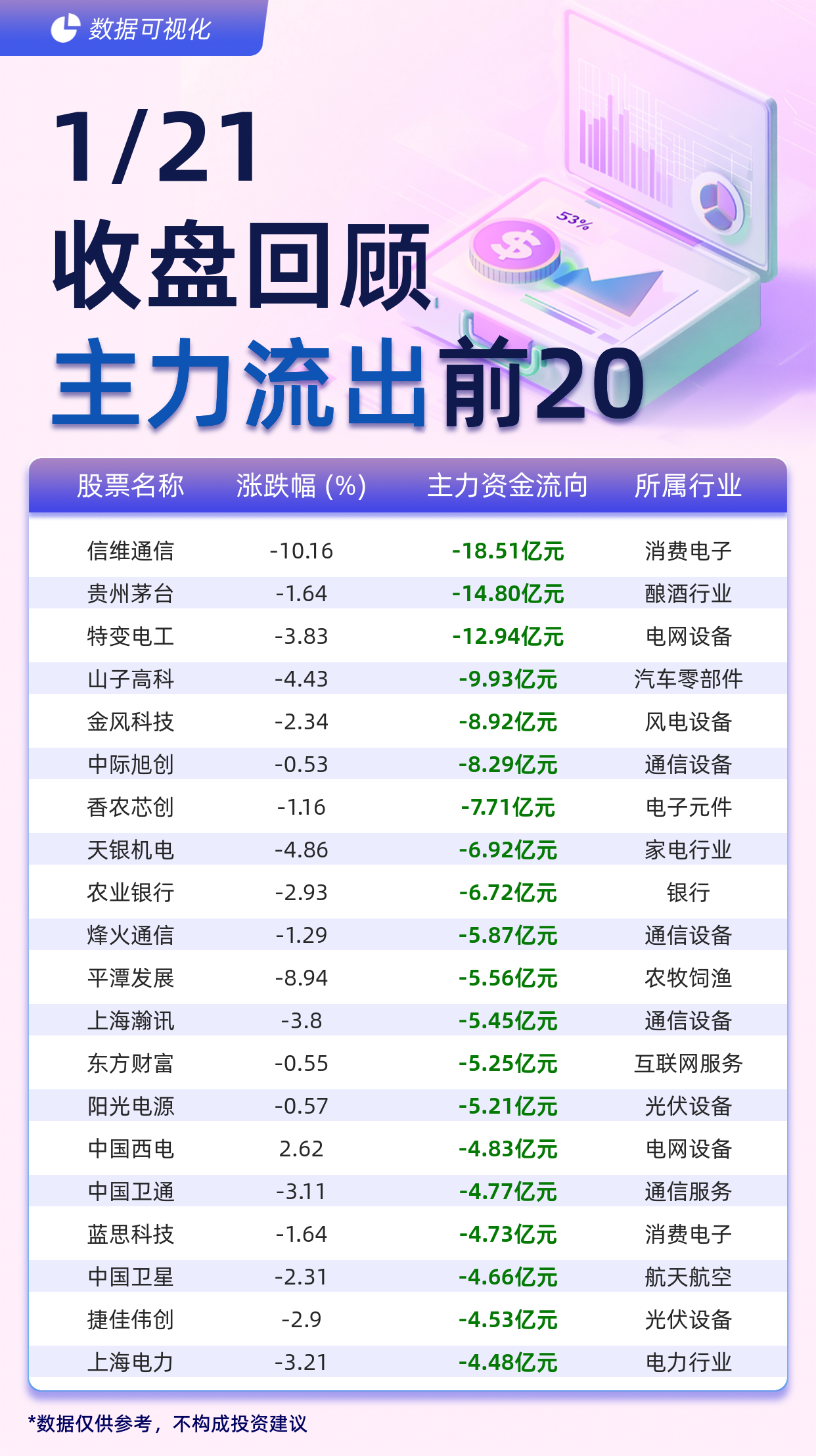
主力个股资金流出前20:信维通信流出18.51亿元、贵州茅台流出14.80亿元
Jin Rong Jie· 2026-01-21 07:11
Core Viewpoint - The data indicates significant outflows of main funds from various stocks, with notable amounts withdrawn from companies across different sectors, suggesting a potential shift in investor sentiment and market dynamics [1][2][3] Group 1: Stock Performance and Fund Outflows - The top stock with the largest fund outflow is XW Communication, with a withdrawal of 1.851 billion yuan and a decline of 10.16% in its stock price [2] - Guizhou Moutai follows with a fund outflow of 1.480 billion yuan and a decrease of 1.64% [2] - TBEA Co., Ltd. experienced a fund outflow of 1.294 billion yuan and a drop of 3.83% [2] - Other notable companies with significant outflows include: - Sanzi Gaoke: -0.993 billion yuan, -4.43% [2] - Goldwind Technology: -0.892 billion yuan, -2.34% [2] - Zhongji Xuchuang: -0.829 billion yuan, -0.53% [2] Group 2: Sector Analysis - The consumer electronics sector is represented by XW Communication and Lens Technology, both experiencing substantial fund outflows [2][3] - The beverage industry, highlighted by Guizhou Moutai, shows a minor decline in stock price despite significant fund outflow [2] - The power equipment sector, including TBEA Co., Ltd. and China Western Power, reflects mixed performance with varying fund outflows [2][3] - The telecommunications sector, represented by companies like Zhongji Xuchuang and Fenghuo Communication, also shows notable fund withdrawals [2][3]





中美竞逐万亿美元新赛道,五层解构下的投资蓝图
Tebon Securities· 2026-01-21 04:07
Investment Rating - The report maintains an "Outperform" rating for the commercial aerospace industry [1] Core Insights - The aerospace sector is transitioning from being viewed as a "cost center" driven by national will to a "growth engine" driven by commercial demand, with significant investments and strategic planning from both the US and China [6][9] - The global aerospace economy is projected to reach $613 billion in 2024, with commercial aerospace contributing 78%, and is expected to exceed $1 trillion by 2032 [6][9] - The value chain of commercial aerospace is divided into five core levels: "space, ground, terminal, rocket, and application," each presenting unique market opportunities and technical challenges from 2026 to 2030 [10][29] Summary by Sections 1. Space: Satellite Manufacturing - The satellite manufacturing market in China is expected to grow from approximately 7.1 billion yuan in 2025 to about 39.4 billion yuan by 2030, reflecting a shift from sporadic research models to continuous, batch engineering deliveries [16][18] 2. Ground: Ground Systems - The ground systems market is projected to increase from around 1.2 billion yuan in 2025 to approximately 39.1 billion yuan by 2030, evolving from a supporting role to a core infrastructure essential for stable satellite constellation operations [21][22] 3. Terminal: Key Variable for Commercial Aerospace - The terminal market is anticipated to grow from 500 million yuan in 2025 to about 141.9 billion yuan by 2030, driven by multiple vertical industries and potential consumer scenarios [23][24] 4. Rocket: Core Constraint - The cost of rocket launches is a critical constraint, with reusable technology expected to reduce costs by 80%-90% compared to traditional expendable rockets. The market for rocket launch services is projected to grow from approximately 10.7 billion yuan in 2025 to about 34.3 billion yuan by 2030 [25][26] 5. Application: Final Value Realization - The application market is expected to expand from 200 million yuan in 2025 to 525 billion yuan by 2030, with the revenue share from applications projected to rise from single digits to over 67% by around 2030 [27][28] 6. Investment Opportunities - Investment opportunities in commercial aerospace can be categorized into three main tracks: 1. Launch and manufacturing segments, which are expected to benefit directly from increased orders and visibility 2. Core components and systems, characterized by high technical barriers and critical for long-term competitiveness 3. Downstream applications and operational services, which, while currently limited in scale, hold the greatest long-term potential for value realization [29][30]


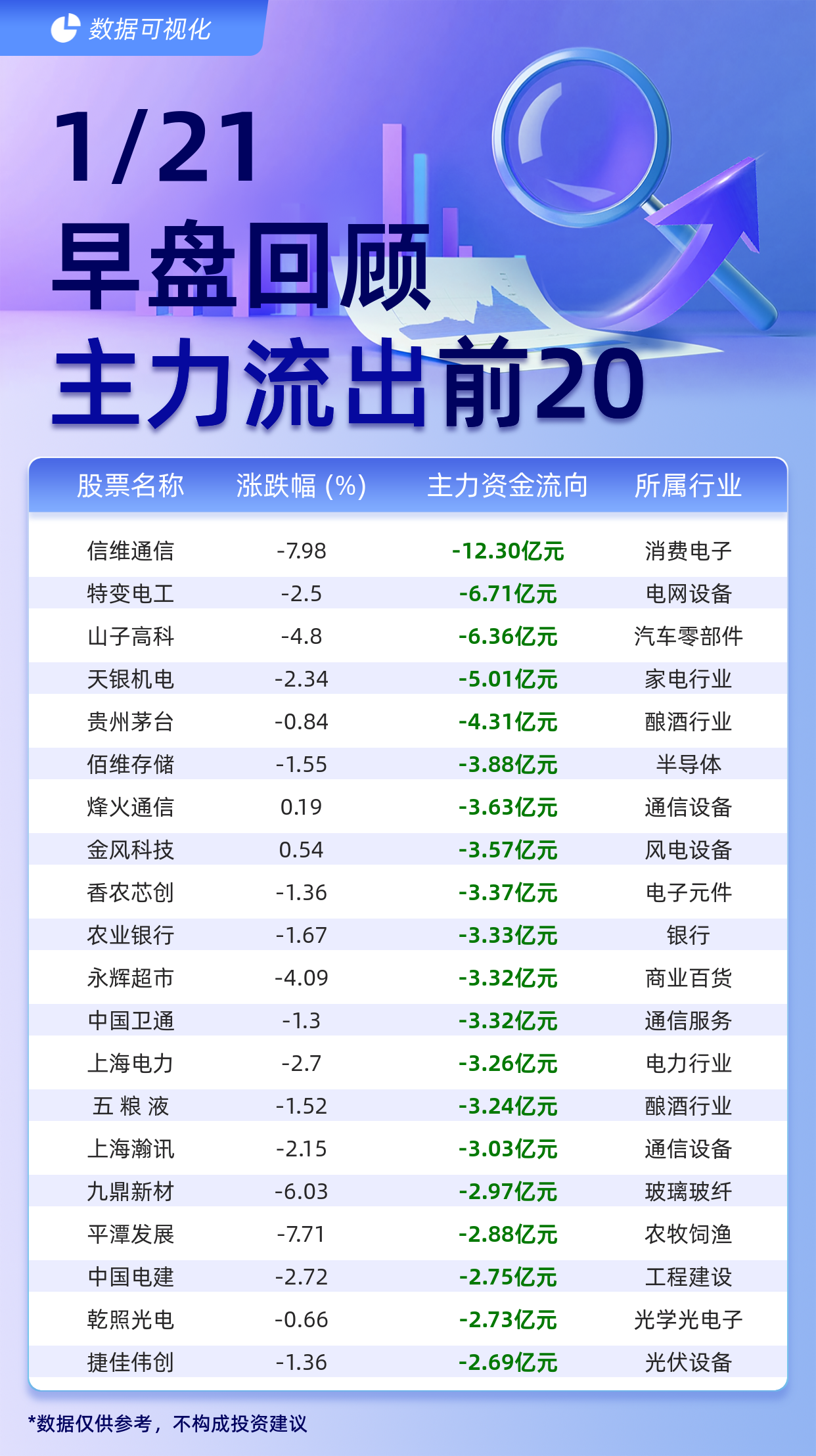
主力个股资金流出前20:信维通信流出12.30亿元、特变电工流出6.71亿元
Jin Rong Jie· 2026-01-21 04:04
Core Viewpoint - The data indicates significant outflows of capital from various stocks, with notable declines in share prices across multiple sectors, suggesting a bearish sentiment in the market. Group 1: Major Stocks with Capital Outflows - Xinyi Communication experienced a capital outflow of 1.23 billion, with a price drop of 7.98% [1][2] - Tebian Electric witnessed a capital outflow of 671 million, with a price decline of 2.5% [1][2] - Shanzi Gaoke had a capital outflow of 636 million, with a decrease of 4.8% [1][2] - Tianyin Electromechanical saw an outflow of 501 million, with a drop of 2.34% [1][2] - Kweichow Moutai experienced a capital outflow of 431 million, with a decline of 0.84% [1][2] Group 2: Additional Stocks with Notable Outflows - Baiwei Storage had a capital outflow of 388 million, with a price drop of 1.55% [1][2] - Fenghuo Communication saw an outflow of 363 million, with a slight increase of 0.19% [1][2] - Goldwind Technology experienced a capital outflow of 357 million, with a price increase of 0.54% [1][2] - Shannon Chip Creation had an outflow of 337 million, with a decline of 1.36% [1][2] - Agricultural Bank saw a capital outflow of 333 million, with a drop of 1.67% [1][2] Group 3: Further Stocks with Capital Outflows - China Satellite Communications experienced a capital outflow of 332 million, with a decline of 1.3% [3] - Shanghai Electric saw an outflow of 326 million, with a price drop of 2.7% [3] - Wuliangye experienced a capital outflow of 324 million, with a decline of 1.52% [3] - Shanghai Hanxun had an outflow of 303 million, with a drop of 2.15% [3] - Jiuding New Materials saw a capital outflow of 297 million, with a significant decline of 6.03% [3]


上海瀚讯(300762) - 关于上海瀚讯2025年度向特定对象发行股票并在创业板上市之发行保荐书
2026-01-19 08:18
国泰海通证券股份有限公司 关于 上海瀚讯信息技术股份有限公司 2025 年度向特定对象发行股票并在创业板 上市 之 发行保荐书 保荐机构(主承销商) (中国(上海)自由贸易试验区商城路 618 号) 二零二六年一月 上海瀚讯信息技术股份有限公司 向特定对象发行股票并在创业板上市之发行保荐书 国泰海通证券股份有限公司 关于上海瀚讯信息技术股份有限公司 2025 年度向特定对象发行股票之发行保荐书 深圳证券交易所: 国泰海通证券股份有限公司(以下简称"国泰海通"、"保荐人"或"本保 荐人")接受上海瀚讯信息技术股份有限公司(以下简称"上海瀚讯"、"公司" 或"发行人")的委托,担任上海瀚讯本次向特定对象发行 A 股股票的保荐人。 国泰海通及其保荐代表人根据《中华人民共和国公司法》(以下简称"《公司 法》")、《中华人民共和国证券法》(以下简称"《证券法》")、《上市公 司证券发行注册管理办法》(以下简称"《注册管理办法》")、《证券发行上 市保荐业务管理办法》(以下简称"《保荐管理办法》")等法律法规和中国证 券监督管理委员会(以下简称"中国证监会")、深圳证券交易所(以下简称"深 交所")的有关规定,诚实守信, ...
上海瀚讯(300762) - 关于上海瀚讯2025年度向特定对象发行股票并在创业板上市之上市保荐书
2026-01-19 08:18
国泰海通证券股份有限公司 关于 上海瀚讯信息技术股份有限公司 2025 年度向特定对象发行股票 并在创业板上市 之 上市保荐书 保荐机构(主承销商) (中国(上海)自由贸易试验区商城路 618 号) 二零二六年一月 上海瀚讯信息技术股份有限公司 上市保荐书 声 明 国泰海通证券股份有限公司(以下简称"国泰海通"、"保荐机构"或"本 保荐机构")及其保荐代表人孔海宾、归剑元根据《中华人民共和国公司法》(下 称《公司法》")、《中华人民共和国证券法》(下称"《证券法》")、《上 市公司证券发行注册管理办法》(以下简称"《注册管理办法》")《证券发行 上市保荐业务管理办法》(以下简称"《保荐管理办法》")等有关法律、法规 和中国证券监督管理委员会(以下简称"中国证监会")的有关规定以及深圳证 券交易所(以下简称"深交所")的有关业务规则,诚实守信,勤勉尽责,严格 按照依法制定的业务规则和行业自律规范出具本上市保荐书,并保证上市保荐 书的真实、准确、完整。 如无特别说明,本上市保荐书中所涉简称与《上海瀚讯信息技术股份有限公 司 2025 年度向特定对象发行股票募集说明书》一致。 3-3-1 | 声 | 明 1 | | ...
上海瀚讯(300762) - 2025年度向特定对象发行A股股票募集说明书(申报稿)
2026-01-19 08:18
证券代码:300762 证券简称:上海瀚讯 上海瀚讯信息技术股份有限公司 (上海市嘉定区鹤友路 258 号) 2025 年度向特定对象发行 A 股股票 募集说明书 (申报稿) 保荐机构(主承销商) (中国(上海)自由贸易试验区商城路 618 号) 本募集说明书所述事项并不代表审批机构对于本次向特定对象发行股票相 关事项的实质性判断、确认、批准,本募集说明书所述向特定对象发行股票相 关事项的生效和完成尚待取得有关审批机构的批准、核准或注册。 1-1-1 上海瀚讯信息技术股份有限公司 向特定对象发行股票募集说明书 二〇二六年一月 上海瀚讯信息技术股份有限公司 向特定对象发行股票募集说明书 发行人声明 本公司及全体董事、监事、高级管理人员承诺募集说明书及其他信息披露 资料不存在任何虚假记载、误导性陈述或重大遗漏,并对其真实性、准确性及 完整性承担相应的法律责任。 本募集说明书按照《上市公司证券发行注册管理办法》《公开发行证券的公 司信息披露内容与格式准则第 61 号——上市公司向特定对象发行股票募集说明 书和发行情况报告书》等要求编制。 本次向特定对象发行股票完成后,公司经营与收益的变化由公司自行负责; 因本次向特 ...