Guangdong Suqun New Material (301489)

Search documents
投资策略点评:液冷的0-1时刻或已到来
KAIYUAN SECURITIES· 2026-02-12 11:43
Core Insights - The report identifies liquid cooling as a strategic investment opportunity, potentially replicating the success of optical modules and PCBs, with strong growth prospects driven by AI computing needs and stringent energy efficiency standards [2][3] - Liquid cooling is characterized by three main features: strong growth, complete narrative, and favorable odds, indicating a favorable market environment for investment [2] - The industry is transitioning from speculative hype to a high-growth phase with confirmed orders, as evidenced by significant order increases from key suppliers like Vidi Technology [3] Industry Trends - The liquid cooling industry is entering a high-growth phase with a 252% year-over-year increase in organic orders reported by Vidi Technology, highlighting strong market demand [3] - Major tech companies like NVIDIA and Google are adopting liquid cooling as a mandatory standard for their next-generation platforms, indicating a shift from optional to essential technology in AI computing [3] - The industry is witnessing a wave of mergers and acquisitions, with companies like Liying Intelligent Manufacturing acquiring liquid cooling suppliers to secure positions in the AI server supply chain [3] Liquid Cooling Industry Chain - The liquid cooling industry chain consists of three main segments: upstream components, midstream system integration and manufacturing, and downstream applications [4] - Upstream includes key technologies and components such as cooling fluids and CDU, which have high technical barriers and value [4] - Midstream integrates upstream components to provide complete liquid cooling server solutions, with technical integration capabilities as a core barrier [4] - Downstream focuses on high-performance data center operators and industry users driving the large-scale adoption of liquid cooling [4]


思泉新材:股东吴攀已减持0.4829%股份
Guo Ji Jin Rong Bao· 2026-02-12 10:08
Core Viewpoint - Wu Pan, a major shareholder and executive of Siquan New Materials, reduced his stake in the company by selling 390,000 shares, representing 0.4829% of the total share capital, decreasing his ownership from 7.1552% to 6.6723% [1] Summary by Relevant Sections - **Shareholder Activity** - Wu Pan has announced a reduction of his shareholding through a centralized bidding process, selling 390,000 shares [1] - This transaction has brought his total shareholding below the 7% threshold, marking a significant change in his ownership status [1] - **Future Plans** - Prior to this reduction, Wu Pan had disclosed plans to sell up to 1,444,500 shares (1.7888%) between January 29, 2026, and April 28, 2026, through centralized bidding or block trading [1] - As of the date of this announcement, this planned reduction has not yet been fully executed [1]
思泉新材(301489) - 关于持股5%以上股东、董事、高级管理人员吴攀减持股份权益变动触及1%整数倍的公告
2026-02-12 09:58
证券代码:301489 证券简称:思泉新材 公告编号:2026-003 广东思泉新材料股份有限公司 关于持股 5%以上股东、董事、高级管理人员吴攀 | 1.基本情况 | | | --- | --- | | 信息披露义务人 | 吴攀 | | 住所 | 广东省东莞市南城街道 | 一、本次权益变动情况 | 年 月 权益变动时间 2026 2 | 日 11 | | | | | --- | --- | --- | --- | --- | | 吴攀因自身资金需求,于 | 年 月 2026 2 11 | | 日以集中竞价交易方式累计减持公司 | | | 股份 390,000 | 股,占公司股份总数的 | | 0.4829%。本次权益变动后,吴攀的持股 | | | 比例由 | 7.1552%变动为 6.6723%,变动触及 | 1%的整数倍。 | | | | 权益变动过程 | 本次减持事项已按照规定进行了预披露,本次减持与已披露的减持意向、减持 | | | | | | 计划一致。本次减持计划的实施不会导致公司控制权发生变更,不会对公司的 | | | | | 持续性经营产生影响。 | | | | | | 思泉新材 股票简称 | ...
首航新能:在北美市场尚未形成规模化收入
Jin Rong Jie· 2026-02-12 09:49
Group 1 - The company has a global business layout covering over 100 countries and regions, with a focus on various markets including Europe, Asia-Pacific, Latin America, Australia, the Middle East, and Africa [1] - In the North American market, the company has not yet formed significant revenue on a large scale [1] - The company has accumulated numerous high-quality customer resources in its operational regions [1]
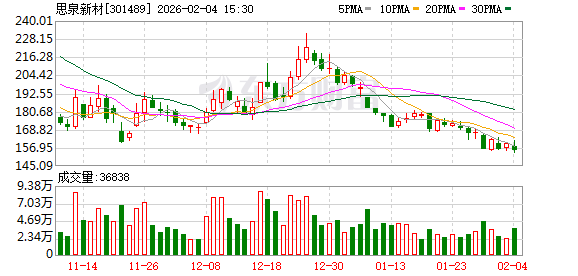
思泉新材:公司投资建设了液冷散热产品生产线
Zheng Quan Ri Bao· 2026-02-04 11:44
Core Viewpoint - The company has established a production line for liquid cooling products and formed a specialized R&D team, indicating a commitment to high-quality development and long-term investment value [2] Group 1 - The company has invested in the construction of a liquid cooling product production line [2] - A professional R&D team for liquid cooling has been assembled, demonstrating the company's focus on innovation [2] - The company has achieved scale production capability for liquid cooling modules, indicating readiness to meet market demand [2] Group 2 - The company's liquid cooling product projects are progressing in an orderly manner, reflecting effective project management [2] - The management expresses strong confidence in the company's future operations and long-term development [2] - The company remains committed to its strategic goals, aiming to enhance long-term investment value [2]

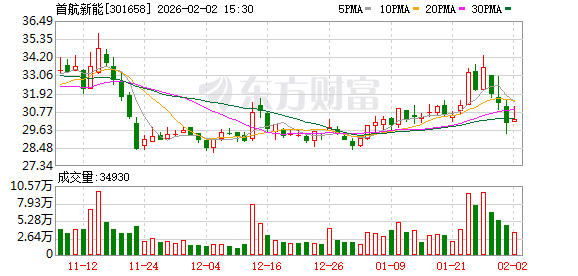
首航新能:公司积极优化业务布局以适应市场变化
Zheng Quan Ri Bao· 2026-02-02 10:16
Core Viewpoint - The company is closely monitoring national energy policy trends and industry development opportunities, actively optimizing its business layout to adapt to market changes [2] Group 1 - The company emphasizes compliance with information disclosure regulations and will provide updates through regular reports or temporary announcements as required by law [2]
数据中心的下一个胜负手:跳出AI芯片
3 6 Ke· 2026-01-25 06:05
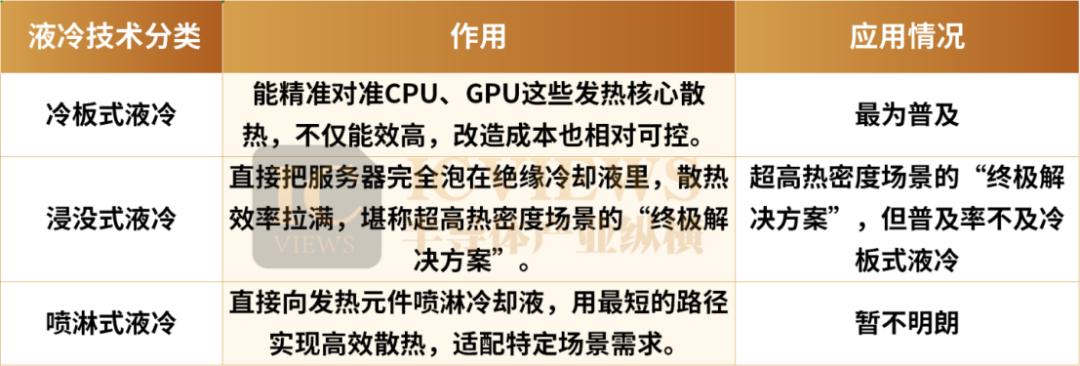
Core Insights - The current reality of AI chips in data centers reveals that significant investments may yield less than 60% of their theoretical value due to power consumption issues [1] - The expansion of computing power is outpacing electricity supply, reshaping the development logic of the data center industry [1] Group 1: Power Consumption Challenges - The disconnection between AI chip technology and actual data center usage is a core issue leading to high power consumption [2] - Many AI chips focus on peak computing power rather than balancing efficiency and power usage, resulting in wasted energy [2] - The rapid increase in computing demand, with a growth rate of 74.1% in 2024, exacerbates the power consumption problem, turning data centers into "power black holes" [3] Group 2: Cooling Technology Innovations - Data centers rely heavily on cooling systems, which account for over 38% of total power consumption, with some cases exceeding 50% [4] - Liquid cooling technology is emerging as a key solution, with three main types: cold plate liquid cooling, immersion cooling, and spray cooling [5][6] - Despite being the most efficient, liquid cooling technology has a low adoption rate of about 10% in the industry [7] Group 3: Market Dynamics and Competitive Landscape - Companies like NVIDIA and AMD are developing customized liquid cooling solutions to enhance cooling efficiency and adapt to high-density computing environments [8] - In China, Shuguang Shuchuang leads the liquid cooling infrastructure market with a 56% share, providing solutions to major internet firms [9] - The overall manufacturing advantage of China is becoming evident in the transformation of data centers, with the manufacturing sector's value surpassing that of the US [10][11][12] Group 4: Future Directions - The future of data centers will prioritize intelligent design over sheer size, focusing on efficient power usage and effective cooling solutions [13]


思泉新材:公司经营管理一切正常
Zheng Quan Ri Bao Wang· 2026-01-19 13:12
Core Viewpoint - The company expresses confidence in its management and future development, emphasizing a commitment to high-quality growth and enhancing long-term investment value [1] Group 1 - The company confirms that its operations and management are functioning normally [1] - The management team has a strong belief in the company's future operations and long-term development [1] - The company is focused on achieving its strategic goals and promoting high-quality development [1]
2025年中国聚合物基导热界面材料(TIM)行业政策、发展现状、细分市场及未来发展趋势研判:新兴需求持续放量,国产替代加速破局[图]
Chan Ye Xin Xi Wang· 2026-01-17 01:02
Core Viewpoint - The polymer-based thermal interface materials (TIM) industry is experiencing steady growth driven by advancements in AI, 5G, and electric vehicles, with the Chinese market expanding at a faster rate than the global market. The demand for high-end thermal management solutions in sectors like data centers and ADAS is expected to significantly increase, with the ADAS TIM market projected to reach $600 million by 2033 [1][6]. Industry Overview - Polymer-based TIMs are essential for electronic thermal management, designed to fill microscopic gaps between heat-generating devices and heat sinks, thereby reducing thermal resistance and ensuring efficient operation [1][3]. - TIMs are categorized into TIM1, which is used between chips and packaging, and TIM2, which is used between packaging and heat sinks, with TIM1 requiring higher performance standards [3][4]. Industry Policies - The polymer-based TIM industry is part of the new materials sector, which is a strategic focus for national development. Various policies have been implemented to support technological research, industrial application, and market promotion, facilitating breakthroughs in high-end technology and accelerating domestic substitution [5][6]. Industry Chain - The upstream of the TIM industry includes polymer matrices and high thermal conductivity fillers, while the midstream focuses on material formulation and composite process innovation. The downstream applications span consumer electronics, electric vehicles, 5G communication, and data centers, with electric vehicles and data centers being key growth drivers [5][6]. Market Size and Growth - The global TIM market is projected to grow from $2.012 billion in 2024 to $4.148 billion by 2031, with a compound annual growth rate (CAGR) of 10.74%. The Chinese TIM market is expected to grow from $1.027 billion in 2024 to $2.164 billion by 2031, with a CAGR of 11.09%, indicating strong growth potential [6][7]. Competitive Landscape - The competitive landscape shows a dynamic balance where international giants dominate the high-end market while local companies like Huitian New Materials and Feirongda are making significant advancements. These local firms are transitioning from cost advantages to competing directly in high-end supply chains through technological breakthroughs [7][8]. Development Trends - The industry is expected to evolve around three core directions: technological upgrades focusing on high thermal conductivity and multifunctional integration, deepening industry chain collaboration for domestic substitution, and expanding application scenarios that drive customized solutions [8][9][10]. - Future innovations will emphasize high-performance materials with integrated functionalities, while collaboration between upstream and downstream players will enhance the self-sufficiency of the supply chain [10][11].



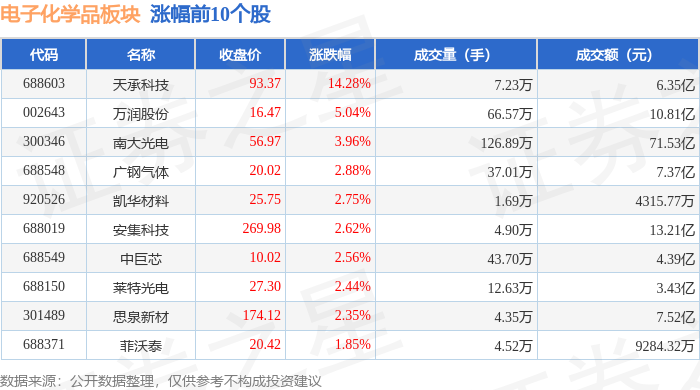
电子化学品板块1月14日涨1.2%,天承科技领涨,主力资金净流出6.07亿元
Zheng Xing Xing Ye Ri Bao· 2026-01-14 08:50
Group 1 - The electronic chemicals sector increased by 1.2% on January 14, with Tiancheng Technology leading the gains [1] - The Shanghai Composite Index closed at 4126.09, down 0.31%, while the Shenzhen Component Index closed at 14248.6, up 0.56% [1] - Key stocks in the electronic chemicals sector showed significant price movements, with Tiancheng Technology rising by 14.28% to a closing price of 93.37 [1] Group 2 - The electronic chemicals sector experienced a net outflow of 607 million yuan from institutional investors, while retail investors saw a net inflow of 674 million yuan [2] - Notable stocks with significant net inflows from retail investors include Wanrun Co., which had a net inflow of 100 million yuan [3] - The overall trading volume and turnover for various stocks in the electronic chemicals sector varied, with Wanrun Co. achieving a turnover of 1.08 billion yuan [1][3]