
Alcoa(AA)

Search documents
2 Stocks to Buy for a $3 Trillion Investment Boom
Investor Place· 2025-11-30 17:00
Core Insights - The article discusses investment opportunities arising from government policies during President Trump's administration, particularly in the energy and technology sectors [3][5][6]. Investment Opportunities - The U.S. government has made significant investments in sectors like rare earths and uranium, leading to substantial stock price increases for companies like MP Materials Corp. and Cameco Corp. [3][4]. - The Biden administration's initiatives, such as the $555 billion Build Back Better Act, have laid the groundwork for a multitrillion-dollar investment in artificial intelligence, with estimates of a $3 trillion "AI war chest" [6][26]. Company Focus: Lithium Americas Corp. - Lithium Americas Corp. (LAC) has recently secured a $100 million investment from the U.S. government, which will acquire a 5% equity stake in the company [10]. - The company is positioned to benefit from the growing demand for lithium, especially as the U.S. aims to increase domestic production [11]. - LAC's Thacker Pass project in Nevada is expected to complete construction by 2027, despite previous regulatory challenges [11]. Company Focus: Alcoa Corp. - Alcoa Corp. (AA) has seen its stock price recover after a period of low valuations, driven by a cyclical downturn in aluminum prices [13][14]. - The demand for aluminum is expected to rise due to its applications in AI data centers, which require lightweight materials for power distribution and thermal management [15]. - Recent tariff adjustments by the Trump administration have positively impacted Alcoa's stock, with a reduction in tariffs from 50% to 25% [17][18]. Market Dynamics - The article highlights the chaotic nature of government investment strategies, particularly in AI, and the need for investors to stay informed about policy changes and market trends [24][25]. - The aluminum market is facing supply constraints, with American stockpiles dwindling, which could further drive up prices and benefit companies like Alcoa [21][22].



Best Value Stocks to Buy for Nov. 26
ZACKS· 2025-11-26 10:16
Group 1: Commercial Metals Company (CMC) - Commercial Metals Company is a steel and metal products provider with a Zacks Rank 1 [1] - The Zacks Consensus Estimate for its current year earnings has increased by 12.5% over the last 60 days [1] - The company has a price-to-earnings ratio (P/E) of 11.35, significantly lower than the industry average of 21.00, and possesses a Value Score of A [1] Group 2: Alcoa Corporation (AA) - Alcoa Corporation produces and sells bauxite, alumina, and aluminum products, also holding a Zacks Rank 1 [2] - The Zacks Consensus Estimate for its current year earnings has increased by 5.8% over the last 60 days [2] - Alcoa has a price-to-earnings ratio (P/E) of 11.16, slightly below the industry average of 11.60, and possesses a Value Score of A [2] Group 3: James River Group Holdings, Ltd. (JRVR) - James River Group Holdings is a specialty insurance company with a Zacks Rank 1 [3] - The Zacks Consensus Estimate for its current year earnings has increased by 10.5% over the last 60 days [3] - The company has a price-to-earnings ratio (P/E) of 5.46, which is lower than the industry average of 8.30, and possesses a Value Score of B [3]

从特朗普50%关税到力拓加价:在AI时代,铝正在被推向“超级周期”
智通财经网· 2025-11-18 00:28
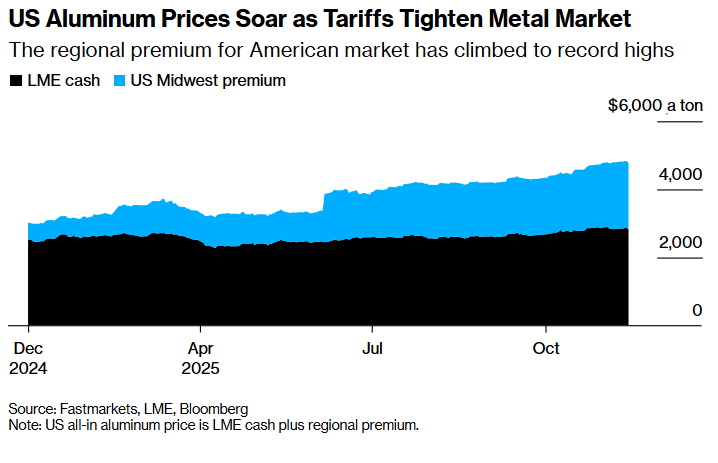
Core Viewpoint - Rio Tinto Group, the world's largest aluminum producer, is imposing additional fees on aluminum shipments to the U.S., which may further disrupt the North American aluminum market already affected by rising consumer costs due to Trump's import tariffs and increasing global demand driven by electric vehicles, solar energy, and AI data centers [1][2][4]. Group 1: Market Dynamics - The U.S. aluminum market is under significant pressure due to a 50% import tariff imposed by President Trump, which has made Canadian aluminum too expensive for U.S. metal processors and consumers, leading to a reliance on domestic inventory and exchange warehouse resources [2][4]. - The aluminum market is experiencing a "super cycle" driven by strong demand, particularly from the rapidly expanding AI data center sector, which is heavily reliant on aluminum for infrastructure and cooling systems [3][12]. Group 2: Pricing and Premiums - The new additional fee imposed by Rio Tinto adds to the existing Midwest premium, resulting in a total premium exceeding 70% on the LME aluminum price, which is already at approximately $2,830 per ton [4][11]. - The U.S. aluminum price has reached historical highs, with the Midwest premium being the highest globally, contrasting with a 5% decline in European regional premiums over the past year [11][12]. Group 3: Future Outlook - Analysts from major financial institutions, including Morgan Stanley and Citigroup, predict that the LME aluminum price could rise above $3,000 per ton, with extreme scenarios suggesting prices could reach $4,000 per ton due to ongoing demand pressures and supply constraints [12][16]. - The aluminum market is expected to remain tight, with U.S. domestic aluminum inventory only sufficient for 35 days of consumption, which typically triggers higher trading prices [15].

What's Next After Alcoa's 40% Surge?
Forbes· 2025-11-16 16:10
Core Viewpoint - Alcoa reported a net income of US $232 million in Q3 2025, more than double the US $90 million from the same quarter last year, contributing to a stock surge of approximately 40% over the last six months [2][7] Factors Driving the Increase - Stronger aluminum prices, a streamlined cost structure, and a strategic shift towards energy-efficient and critical-minerals sectors are key drivers of Alcoa's stock performance [7] - Aluminum prices have risen to around US $2,892 per tonne, indicating growing demand alongside limited supply, with a potential 40% increase in aluminum demand by 2030 [8] - Alcoa's revenue rose to US $2.995 billion in Q3 2025, up from US $2.904 billion a year prior, partly due to the sale of its joint venture with "Ma'aden" in Saudi Arabia [8] - The company has lowered its capital expenditure forecast for 2025 to US $625 million and restructured parts of its portfolio, indicating a focus on operational efficiency [8] - Alcoa is investing in critical minerals and sustainable aluminum production, including a gallium-production facility in Western Australia [8] What's Next — Key Factors & Risks - Alcoa's anticipated aluminum production for the full year is projected to be between 2.3-2.5 million metric tons, with alumina expected in the 9.5-9.7 million metric ton range [8] - The company faces approximately US $90 million in adverse impacts due to U.S. tariffs on Canadian imports, alongside risks from energy costs and fluctuations in alumina prices [8] - The aluminum industry is cyclical, and any downturn in global demand or oversupply could compress margins [8] - Positive expectations are already factored into the stock price, leaving limited margin for error; execution challenges could lead to a sharp decline [8] - Strategic growth initiatives, such as green-smelting partnerships and critical-minerals assets, could unlock additional growth if objectives are met [8]

Decoding Alcoa's Options Activity: What's the Big Picture? - Alcoa (NYSE:AA)
Benzinga· 2025-11-10 18:02
Core Insights - Significant investors have adopted a bullish outlook on Alcoa, with 75% of trades reflecting bullish expectations and 25% bearish [1] - The projected price targets for Alcoa range from $37.0 to $45.0 over the past three months, indicating investor confidence in price appreciation [2] Options Activity - Recent options trading shows a total of 8 trades, with 6 being calls totaling $185,695 and 2 being puts totaling $556,000, highlighting a preference for bullish positions [1] - Noteworthy options activity includes several large trades, with significant amounts allocated to both puts and calls, indicating varied investor sentiment [8] Volume & Open Interest - The analysis of volume and open interest provides insights into liquidity and investor interest in Alcoa's options, particularly within the strike price range of $37.0 to $45.0 over the last 30 days [3] Company Overview - Alcoa is a vertically integrated aluminum company, recognized as the world's largest bauxite miner and alumina refiner by production volume, and the eighth-largest aluminum producer [9] - The company has a historical significance as the first mass producer of aluminum and has undergone strategic changes, including the spin-off of its automotive and aerospace segment in 2016 [10] Analyst Opinions - Recent analyst opinions indicate an average price target of $37.67, with varying ratings from different firms: HSBC maintains a Buy rating with a target of $41, JP Morgan holds a Neutral rating with a target of $35, and BMO Capital has a Market Perform rating with a target of $37 [11][12] Current Market Position - Alcoa's stock is currently trading at $38.58, reflecting a 3.38% increase, with an anticipated earnings release in 72 days [14]

Alcoa Corporation (AA) Analyst/Investor Day Transcript
Seeking Alpha· 2025-11-01 09:26
Group 1 - Alcoa emphasizes safety as a core value during its Investor Day 2025 presentation [1] - The company requests attendees to silence their cell phones and identify emergency exits [1][2] - Online participants are reminded to ensure their work environment is safe and free of risks [2]

This Is What Whales Are Betting On Alcoa - Alcoa (NYSE:AA)
Benzinga· 2025-10-31 20:01
Core Insights - Investors are showing a bullish stance on Alcoa (NYSE:AA), with significant options activity indicating potential upcoming developments [1] - The sentiment among large traders is mixed, with 50% bullish and 37% bearish positions observed [2] - Major market movers are focusing on a price range between $35.0 and $40.0 for Alcoa over the past three months [3] Options Activity - In the last 30 days, Alcoa's options activity revealed 8 trades, with a total of $245,292 in puts and $33,750 in calls [2][5] - The volume and open interest trends indicate liquidity and interest in Alcoa's options, particularly within the $35.0 to $40.0 strike price range [4] Company Overview - Alcoa is a vertically integrated aluminum company, the largest bauxite miner and alumina refiner globally, and the eighth-largest aluminum producer [11] - The company has a historical significance as the first mass producer of aluminum and has undergone strategic changes, including a spin-off in 2016 to focus on mining, smelting, and refining [11] Analyst Ratings - Recent analyst ratings for Alcoa show an average target price of $37.9, with individual targets ranging from $34 to $42 from various analysts [13][14] - Analysts from HSBC and Morgan Stanley maintain bullish ratings with target prices of $41 and $42, respectively, while JP Morgan holds a neutral stance with a target of $34 [14] Current Market Status - Alcoa's current trading volume is 3,207,930, with a slight price increase of 0.19%, bringing the stock price to $36.83 [16] - The stock may be approaching overbought conditions according to RSI readings, with anticipated earnings release in 82 days [16]
Australian Stock Market rises, sees modest gains across indices, Mayne Pharma drops 30%; check ASX 200 top gainers and losers
The Economic Times· 2025-10-31 05:55
Market Overview - The Australian stock market showed modest gains on Friday, with the S&P/ASX 200 rising by 10.60 points or 0.12% to close at 8,896.10, despite a weekly loss of 1.36% and being 2.40% below its 52-week high [8] - The All Ordinaries Index opened at 9,178.90 and closed at 9,189.60, marking a 0.1% increase [8] Sector Performance - Smaller companies outperformed larger ones, with the S&P/ASX Small Ordinaries rising 0.5% to 3,777.80, while the S&P/ASX Midcap 50 dipped 0.1% to 11,883.10 [2] - The S&P/ASX 200 A-REIT gained 0.4%, rising from 1,870.00 to 1,877.90, while the S&P/ASX 200 Consumer Discretionary Index fell 1.2% from 4,280.50 to 4,227.60 [3][9] Top Gainers and Losers - Ventia Services Group Limited (VNT) led the gainers, climbing 4.945% to close at $5.73, followed by Westgold Resources Limited (WGX) with a 4.851% increase to $5.30 [5][9] - The top decliner was Steadfast Group Limited (SDF), which fell 8.791% to $5.66, followed by Droneshield Limited (DRO) with a 5.160% loss to $3.86 [6][9] Company-Specific News - Mayne Pharma's shares dropped 30% to $4.31 after news that the Australian treasurer is considering blocking a $672 million proposed buyout by Cosette, with the stock slumping nearly 40% to $3.81 during intraday trading [7][9]

Alcoa Corporation (AA) Analyst/Investor Day - Slideshow (NYSE:AA) 2025-10-30
Seeking Alpha· 2025-10-30 20:34
Group 1 - The article does not provide any specific content related to a company or industry [1]

Alcoa (NYSE:AA) 2025 Investor Day Transcript
2025-10-30 14:02
Alcoa (NYSE:AA) 2025 Investor Day Summary Company Overview - **Company**: Alcoa Corporation - **Event**: Investor Day 2025 - **Date**: October 30, 2025 Key Industry Insights - **Aluminum Market Outlook**: The long-term outlook for aluminum is positive, driven by growth in demand and constrained supply, particularly in North America and Europe [34][41] - **Supply Constraints**: The market is experiencing constrained supply due to Chinese production caps and rising capital costs outside of China, which is a shift from the previous two decades where supply was more abundant [35][41] - **Investment in Growth**: Alcoa has opportunities for disciplined growth, highlighted by the successful acquisition of Alumina Limited in 2024, which has positioned the company favorably within the industry [35][39] Financial Performance - **EBITDA**: Alcoa reported $1.6 billion in EBITDA for 2024, indicating strong financial health [36] - **Debt Management**: The company has monetized $1 billion worth of assets, strengthening its balance sheet, with a net debt target of $1 billion to $1.5 billion [40] - **Shareholder Returns**: Alcoa has returned $1 billion to shareholders over the last five years, demonstrating a commitment to shareholder value [40] Operational Excellence - **Production Capacity**: Alcoa produces approximately 40 million metric tons of bauxite, 10 million metric tons of alumina, and 2 million metric tons of aluminum annually [36] - **Safety Initiatives**: The company has achieved a 75% reduction in serious injuries in North America and a 50% reduction in serious chemical burns across its refining network [62][75] - **Alcoa Business System (ABS)**: The ABS has been modernized to improve operational performance, leading to increased production and efficiency across various sites [61][63] Strategic Vision and Culture - **New Vision**: Alcoa's vision is to "build a legacy of excellence for future generations," which aims to engage employees at all levels [86] - **Cultural Shift**: The company is focused on fostering a high-performance culture, emphasizing accountability, empowerment, and continuous improvement [89][90] - **Employee Engagement**: Initiatives such as "leadership time in field" are designed to enhance engagement and safety by having leaders spend more time with frontline employees [52][53] Technological Innovations - **Investment in Technology**: Alcoa continues to invest in breakthrough technologies, including AI applications and robotics, to enhance operational efficiency and safety [46][65] - **Sustainability Efforts**: The company is committed to green products, with 86% of its energy sourced from renewable sources, positioning itself well for the green transition [45] Regional Operations - **Global Presence**: Alcoa operates in 25 locations across 8 countries, with a focus on North America and Europe, which are expected to face aluminum supply deficits in the future [36][41] - **Operational Improvements**: Incremental improvements in production have been noted across various regions, with specific examples of success in North America and Australia [68][69] Conclusion - **Future Outlook**: Alcoa is well-positioned for future growth with a strong balance sheet, disciplined capital allocation, and a commitment to operational excellence and safety [40][48][75] - **Engagement with Stakeholders**: The company emphasizes the importance of stakeholder engagement and environmental responsibility, particularly in sensitive areas like the Amazon rainforest [78][70]