Arm plc(ARM)

Search documents
美股异动 | 芯片股普跌 费城半导体指数跌超2.8%
智通财经网· 2025-08-20 15:26
Core Viewpoint - The semiconductor sector experienced a significant decline, with major companies' stocks dropping sharply on Wednesday [1] Group 1: Market Performance - The Philadelphia Semiconductor Index fell over 2.8% [1] - Intel (INTC.US) saw a decline of more than 7% [1] - Micron Technology (MU.US) dropped over 6% [1] - Taiwan Semiconductor Manufacturing Company (TSM.US) decreased by more than 3% [1] - Nvidia (NVDA.US) fell over 2.5% [1] - Arm Holdings (ARM.US) experienced a decline of more than 4.8% [1]



前瞻全球产业早报:软银20亿美元“救火”英特尔
Qian Zhan Wang· 2025-08-20 10:52
Group 1: Market Overview - The total scale of China's movable property financing market is approximately 15 trillion yuan [2] - By June 2025, the unified registration and public announcement system for movable property financing has registered 152,000 users, including banks and various financial institutions [2] - The number of guarantors served is nearly 18 million, primarily consisting of small and micro enterprises [2] Group 2: Technological Advancements - China has successfully mastered relevant technologies in the field of artificial cavern gas storage, marking a significant milestone [3] - The world's largest artificial cavern gas storage in-situ test platform achieved a breakthrough pressure of 18 MPa, setting five world records in performance indicators [3] Group 3: Corporate Developments - Kodak clarified that it has not ceased operations or filed for bankruptcy, countering media reports based on a misunderstanding of its SEC filing [4] - Xiaomi Group reported a revenue of 21.3 billion yuan for its smart electric vehicle and AI innovation business segment in Q2 2025, with smart electric vehicle revenue at 20.6 billion yuan [5] - Pop Mart achieved a revenue of 13.876 billion yuan in the first half of 2025, a year-on-year increase of 204.4%, with net profit rising by 396.5% [5] Group 4: Market Competition - Gree Electric's market director responded to rumors that Xiaomi's air conditioning sales surpassed Gree's online sales, stating that Gree still leads in the online market as of July [6] Group 5: Investment and Financing - SoftBank announced a $2 billion investment in Intel, purchasing shares at $23 each, aimed at supporting digital transformation and advanced technology acquisition [10] - Magic Warehouse Robotics completed a new round of financing worth several hundred million yuan, with funds allocated for product iteration and capacity enhancement [13] - FastRead is seeking $5 million in equity financing to deepen core technology development and expand its team [13] Group 6: IPO and Market Activity - Luxshare Precision Industry has submitted an IPO application to the Hong Kong Stock Exchange, with Citic Securities, Goldman Sachs, and CICC as joint sponsors [14] - Zhejiang Yifei Intelligent Technology has also submitted an IPO application to list on the main board of the Hong Kong Stock Exchange [14] Group 7: Economic Indicators - The A-share market saw a collective decline in the three major indices, with the Shanghai Composite Index down by 0.02% [15] - The Hang Seng Index fell by 0.21%, closing at 25,122.90 points [15]






美股AI泡沫深夜崩盘,新一轮东升西落来了
3 6 Ke· 2025-08-20 10:11
Group 1: Market Performance - The Hong Kong stock market has shown weak performance recently, but certain sectors have experienced significant gains, particularly in the new consumption sector, with companies like Pop Mart and Lao Pu Gold exceeding market expectations and rising nearly 9% [2] - The Shanghai Composite Index has demonstrated resilience, rising despite the decline in US stocks, indicating strong market sentiment in China [1] Group 2: Company Earnings - Pop Mart reported a remarkable revenue increase of 204.4% year-on-year, reaching 13.876 billion RMB, with plush product revenue surging by 1276.2%, now accounting for 44.2% of total revenue [5][6] - The net profit of Pop Mart increased nearly 400%, with significant contributions from the Americas market, which saw revenue soar over 11 times [5][6] - The performance of companies in the Apple supply chain, such as Sunny Optical and Q Technology, has been strong, particularly with Sunny Optical exceeding market expectations [2] Group 3: Semiconductor Industry Developments - Arm Holdings has recruited key personnel from Amazon, indicating a strategic shift towards developing complete chip systems, which could challenge Nvidia's dominance in the AI chip market [3][4] - The semiconductor market is witnessing a resurgence, with companies like Hua Hong Semiconductor and SMIC showing positive trends, driven by new product launches and market speculation [2] Group 4: Economic Outlook - Goldman Sachs highlights that the core issue for the US stock market in the coming months will be the balance between recession risks and interest rate cuts, with a significant observation period ahead [7] - The market is pricing in a high likelihood of interest rate cuts by the Federal Reserve, which could impact both the stock and bond markets [7]

美股大跌的导火索,这篇MIT的报告有什么特别?
水皮More· 2025-08-20 09:31
Core Viewpoint - A recent MIT report reveals that up to 95% of companies are not seeing any returns from their investments in generative AI, raising concerns about the sustainability of the AI hype and its ability to translate into profits for businesses [5][6][9]. Group 1: Market Reaction - The report has led to a significant sell-off in the tech sector, with the Nasdaq Composite Index dropping 1.4%, marking its largest single-day decline since August 1 [6]. - Major beneficiaries of the AI boom, such as Nvidia, saw a decline of 3.5%, while companies like Palantir and Arm experienced drops of 9.4% and 5%, respectively [6]. - Defensive sectors like consumer staples, utilities, and real estate saw gains, indicating a shift of funds away from high-risk tech stocks [6]. Group 2: Findings from the MIT Report - The report titled "The Generative AI Gap: The State of Business AI in 2025" indicates that despite high expectations, most generative AI projects fail to deliver financial impact [9]. - Only about 5% of AI pilot projects have achieved rapid revenue growth, while the majority have stagnated without measurable effects on profit and loss statements [10]. - The report attributes the failures not to the quality of AI models but to internal organizational issues and integration strategies [10]. Group 3: Success Factors and Strategies - Successful AI implementations often involve identifying a specific pain point and executing well, with some startups reportedly increasing their revenue from zero to $20 million within a year [12]. - Over half of the generative AI budgets are allocated to sales and marketing tools, but the highest ROI comes from back-office automation [12]. - Purchasing AI tools from specialized vendors and forming partnerships has a success rate of about 67%, compared to only one-third for companies building their own systems [13]. Group 4: Valuation Pressures and Market Sentiment - The report's release coincides with growing concerns over high valuations in the tech sector, with the Nasdaq 100 index's expected P/E ratio at 27, significantly above its long-term average [15]. - Sam Altman's warning about potential investor losses and the possibility of an AI bubble has further fueled market anxiety [15]. - The market has shown sensitivity to negative news regarding AI, with past incidents causing notable fluctuations in stock prices [15].


More Than 95% of Nvidia's $4.3 Billion Investment Portfolio Has Been Put to Work in These 2 Scorching-Hot Artificial Intelligence (AI) Stocks
The Motley Fool· 2025-08-20 07:06
Core Investment Focus - Nvidia's public investments are heavily concentrated in two primary AI companies, CoreWeave and Arm Holdings, which together account for over 95% of its $4.33 billion assets under management [6][7][13] - CoreWeave represents 91.4% of Nvidia's invested assets, with Nvidia holding 24,277,573 shares valued at approximately $3.96 billion [7][8] - Arm Holdings accounts for 4.1% of Nvidia's portfolio, with 1,101,249 shares valued at $178.1 million [13] CoreWeave Overview - CoreWeave is focused on providing data-center infrastructure services and has aggressively invested in AI-GPUs, purchasing 250,000 of Nvidia's Hopper chips [7][10] - The company is projected to see sales growth from an estimated $5.25 billion this year to $19.55 billion by 2028, contingent on meeting Wall Street's expectations [9] - Despite rapid sales growth, CoreWeave faces significant financial challenges, including over $1 billion in interest expenses and a projected net loss of $1.2 billion for the year [10] Arm Holdings Overview - Arm Holdings generates revenue primarily from royalties and licensing fees related to its intellectual property, rather than manufacturing physical chips [14][15] - The company reported a gross profit margin of 97.2% in its fiscal first quarter, with net sales of $1.053 billion against a cost of sales of only $30 million [15][16] - Arm's unique position in the market allows it to benefit from growing demand for energy-efficient AI chips, while also being less vulnerable to potential downturns in the AI sector due to its diverse applications in CPUs and smartphones [17][18] Valuation Considerations - Arm Holdings is currently valued at a forward price-to-earnings (P/E) ratio of 61, which may be considered excessive given its expected sustained growth rate of 20% [18]


异动盘点0820|锂业股早盘走低;蔚来涨超4%,Viking Therapeutics跌超42%
贝塔投资智库· 2025-08-20 04:01
Group 1: Hong Kong Stocks - Chow Sang Sang (00116) surged over 18%, expecting a mid-term profit attributable to shareholders of approximately HKD 900 million to 920 million [1] - XPeng Motors (09868) rose over 4%, reporting a 125.3% year-on-year revenue growth in Q2, achieving a historical high for a single quarter [1] - Sunny Optical Technology (02382) increased over 6%, with a 52.56% year-on-year rise in mid-term profit attributable to shareholders for the six months ending June 30, 2025 [1] - China Gold International (02099) gained over 3%, reporting a turnaround to profitability in the first half of 2025, supported by a rich resource reserve and stable production [1] - Hansoh Pharmaceutical (03692) fell over 8%, announcing a 6.5% discount on a placement to raise nearly HKD 3.9 billion for innovative drug development [1] - Pop Mart (09992) rose over 6%, with adjusted net profit in the first half of 2025 increasing 3.6 times year-on-year [1] - Kunlun Energy (00135) dropped over 3%, reporting a 4.36% year-on-year decrease in mid-term profit attributable to shareholders for the first half of 2025 [1] Group 2: Other Stocks - Gilead Sciences (01672) fell over 8%, announcing a placement to raise a net amount of HKD 468 million, while its controlling shareholder cashed out nearly HKD 390 million [2] - Yixin Group (02858) rose over 1%, reporting a 28% year-on-year increase in adjusted net profit for the first half of 2025, with financial technology revenue soaring 124% [2] - Lithium stocks declined, with Ganfeng Lithium (01772) and Tianqi Lithium (09696) both dropping nearly 6%, amid inventory pressure in the lithium carbonate spot market [2] Group 3: US Stocks - Palo Alto Networks (PANW.US) rose 3.06%, exceeding expectations in Q4 earnings and providing optimistic guidance for future earnings [3] - BHP Group (BHP.US) increased 0.51%, reporting dividends exceeding expectations despite weak iron ore and coal prices [3] - NIO (NIO.US) rose 4.11%, with its L90 model delivering 6,400 units in 20 days since launch, with the factory operating at full capacity [3] - New Oriental (EDU.US) fell 2.79%, influenced by a drop in Oriental Selection's stock, while denying regulatory investigation rumors [3] - Viking Therapeutics (VKTX.US) plummeted 42.12% after reporting adverse side effects in its experimental obesity drug trials [4] - Arm (ARM.US) dropped 5.00%, as it hired Amazon's AI chip director to advance its chip development plans [4] - Home Depot (HD.US) rose 3.17%, reaching a new high since January, with Q2 net sales meeting market expectations [4] - Best Buy (BBY.US) increased 3.20%, launching a third-party online shopping platform to expand product variety [4] - Nexstar Media Group (NXST.US) rose 0.65%, announcing a $6.2 billion acquisition of Tegna [4] - Aurora Innovation (AUR.US) fell over 8%, closing down 7.14% after a short-seller report questioned its profit potential [5] - Boeing (BA.US) dropped 3.19%, with Airbus A320 deliveries expected to surpass Boeing's soon [5]




美股AI和数字币大跌,MIT的报告导致市场发生了什么?
美股IPO· 2025-08-20 01:49
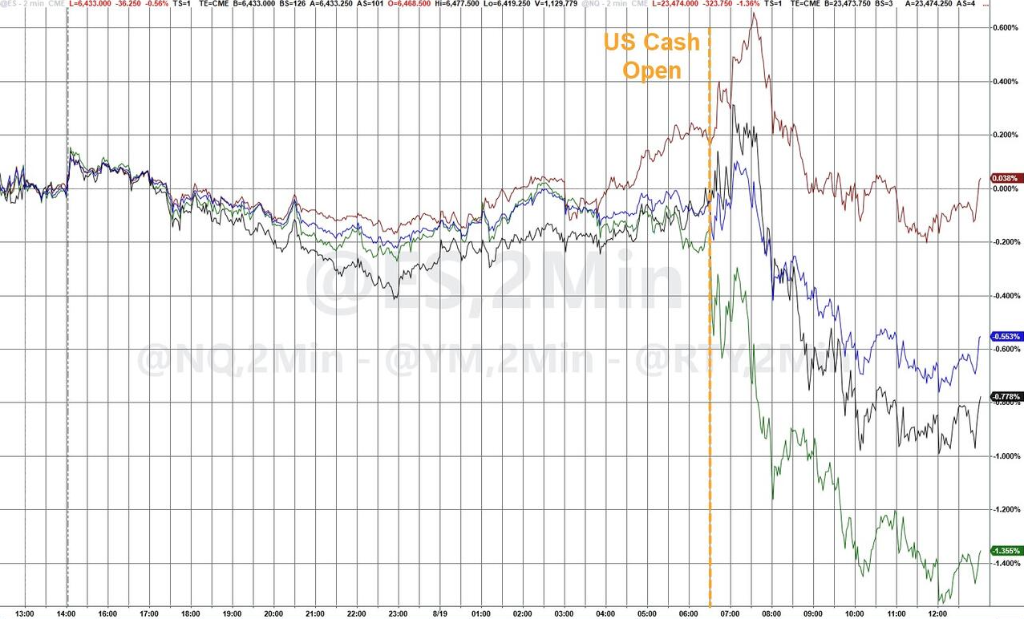
Core Viewpoint - The recent sell-off in technology stocks is driven by concerns over the lack of returns from generative AI investments, as highlighted by a MIT report stating that "95% of organizations have seen zero returns" from such investments, alongside warnings from OpenAI CEO Sam Altman about a potential bubble forming in the AI sector [1][4][5]. Group 1: Market Reaction - The Nasdaq Composite Index, heavily weighted in technology stocks, fell by 1.4%, marking its largest single-day drop since August 1 [2]. - Major tech companies like Nvidia, Palantir, and Arm experienced significant declines, with Nvidia down 3.5%, Palantir down 9.4%, and Arm down 5% [2][11]. - The S&P 500 Index also decreased by 0.7%, reflecting broader market concerns [2]. Group 2: Valuation Concerns - The Nasdaq 100 Index's expected price-to-earnings ratio stands at 27 times, nearly one-third higher than its long-term average, raising valuation concerns among investors [4]. - The MIT report challenges the prevailing expectation that AI will quickly translate into corporate profits, stating that "the vast majority of AI projects have yet to produce measurable profit impacts" [8]. Group 3: Shift to Defensive Sectors - As tech stocks faced sell-offs, funds shifted towards defensive sectors such as consumer staples, utilities, and real estate, with about 70% of S&P 500 constituents closing higher [13]. - The bond market also reflected this trend, with U.S. Treasury prices rising and yields falling as risk assets came under pressure [14]. Group 4: Broader Market Implications - Other risk assets, including Bitcoin, also suffered, with Bitcoin dropping 2.7% and reaching a near three-week low [16]. - The market's reaction indicates a rotation from high-momentum stocks, suggesting a concentrated profit-taking and style shift rather than indiscriminate selling [17]. Group 5: Investor Sensitivity - The market has previously shown sensitivity to potential risks associated with AI, as evidenced by a brief market disturbance earlier this year due to advancements by a Chinese AI company that raised questions about U.S. dominance in AI [19]. - Upcoming events, such as the Jackson Hole global central bank conference and Nvidia's earnings report, are expected to be critical in testing market sentiment towards AI [21].



美股大跌的导火索,这篇MIT的报告有什么特别?
硬AI· 2025-08-20 01:08
Core Viewpoint - A recent MIT report reveals that up to 95% of companies are not seeing any returns from their generative AI investments, raising concerns about the sustainability of the AI hype and its ability to translate into corporate profits [2][3][6]. Market Reaction - Following the MIT report, the tech sector in the U.S. experienced a significant sell-off, with the Nasdaq Composite Index dropping 1.4%, marking its largest single-day decline since August 1. Major tech stocks like Nvidia, Palantir, and Arm saw declines of 3.5%, 9.4%, and 5% respectively, while defensive sectors like consumer staples and utilities rose [3][4]. AI Investment Insights - The MIT report titled "The Generative AI Gap: The State of Business AI in 2025" indicates that despite high expectations for generative AI, most projects fail to deliver measurable financial impact. Only about 5% of AI pilot projects achieve rapid revenue growth, while the majority stagnate [6][7]. - The report highlights that over half of generative AI budgets are allocated to sales and marketing tools, but the highest ROI comes from back-office automation [9]. Success Factors - Successful AI implementations are characterized by addressing specific pain points and forming strategic partnerships. Some startups have reportedly increased their revenue from zero to $20 million within a year [9]. - The report emphasizes that purchasing AI tools from specialized vendors yields a success rate of about 67%, compared to only one-third for internally developed systems. This challenges companies investing heavily in proprietary AI systems [10]. Valuation and Market Sentiment - The report's findings coincide with growing concerns over high valuations in the tech sector, with the Nasdaq 100 Index's expected P/E ratio at 27, significantly above its long-term average. This inflated valuation sets the stage for potential market corrections [12]. - Sam Altman's warning about the possibility of significant investor losses and the presence of "irrational exuberance" further exacerbates investor anxiety [12][13].

美股大跌的导火索,这篇MIT的报告有什么特别?
Hua Er Jie Jian Wen· 2025-08-20 00:49
Core Insights - A report from MIT reveals that up to 95% of companies are not seeing any returns from their generative AI investments, challenging the optimistic sentiment on Wall Street and leading to a significant sell-off in tech stocks [1][2] - The Nasdaq Composite Index fell by 1.4%, marking its largest single-day drop since August 1, while the S&P 500 Index decreased by 0.7% [1] - Key beneficiaries of the AI boom, such as Nvidia, Palantir, and Arm, experienced notable declines in their stock prices, indicating a shift of funds from high-risk tech stocks to defensive sectors [1][2] AI Investment Gap - The MIT report titled "The Generative AI Gap: The State of Business AI in 2025" highlights that most AI projects fail to deliver financial impact, despite high expectations from enterprises [2] - Based on interviews with 150 business leaders and analysis of 300 AI deployment cases, only about 5% of AI pilot projects achieved rapid revenue growth [2][3] - The report attributes the failures not to the quality of AI models but to internal organizational issues and integration strategies [2][3] Success vs. Failure in AI Deployment - Successful AI implementations often involve targeting specific pain points and forming strategic partnerships, with some startups reportedly increasing their revenue from zero to $20 million within a year [3] - Over half of generative AI budgets are allocated to sales and marketing tools, while the highest ROI comes from backend automation [3] - Purchasing AI tools from specialized vendors has a success rate of about 67%, compared to only one-third for internally built systems, challenging the trend of companies developing proprietary AI solutions [3] Market Sentiment and Valuation Pressure - The report coincides with growing concerns over the high valuations of tech stocks, with the Nasdaq 100 Index's expected P/E ratio at 27, significantly above its long-term average [4] - Sam Altman's warning about potential investor losses and the possibility of irrational exuberance has further fueled market anxiety [4] - The market's sensitivity to negative news regarding AI commercialization capabilities has been demonstrated, as evidenced by previous market reactions to adverse developments [4]
久违的美国科技股大跌,AI和数字币领跌,发生了什么?
Hua Er Jie Jian Wen· 2025-08-20 00:44
Group 1 - The core viewpoint of the articles highlights a significant sell-off in U.S. tech stocks, driven by concerns over the commercialization returns of AI and warnings of a potential bubble from industry leaders [1][3][5] - The Nasdaq Composite Index experienced its largest single-day drop since August 1, closing down 1.4%, with notable declines in major tech stocks such as Nvidia (-3.5%), Palantir (-9.4%), and Arm (-5%) [1][3] - A report from MIT indicated that up to 95% of organizations have seen no returns from generative AI investments, raising doubts about the profitability of AI projects [3][5] Group 2 - The market is increasingly concerned about high valuations in tech stocks, with the Nasdaq 100 Index's expected P/E ratio at 27, significantly above its long-term average [3][5] - Sam Altman, CEO of OpenAI, expressed concerns about over-excitement among investors regarding AI, suggesting a bubble may be forming [3][5] - The sell-off was characterized by a rotation of funds from high-risk tech stocks to defensive sectors, with consumer staples, utilities, and real estate showing gains [7][8] Group 3 - The decline in tech stocks was particularly pronounced among high-momentum stocks, which had previously seen significant gains since mid-May, with the S&P 500 Information Technology sector rising 14% during that period [6][8] - Other risk assets, including Bitcoin, also faced declines, with Bitcoin dropping 2.7% and reaching a near three-week low [10] - Investor sensitivity to AI-related risks has been highlighted, with previous events causing market fluctuations, indicating a heightened vigilance towards negative news in the AI sector [11]