
Broadcom(AVGO)

Search documents
Where Will Broadcom Stock Be by December 2026?
Yahoo Finance· 2026-01-23 22:00
Core Viewpoint - Broadcom's stock experienced significant growth in 2025, increasing by 49.3%, and investors are encouraged to evaluate future investment opportunities as the company undergoes substantial changes in 2026 [1] Group 1: Business Focus and Growth - Broadcom is shifting its focus towards custom artificial intelligence (AI) accelerator chips, which are gaining popularity and may challenge Nvidia's dominance in AI computing by 2026 [2] - The company is transitioning from a diverse product line, including mainframe hardware, cybersecurity, and networking equipment, to concentrate on its AI accelerator chip business [4] - Broadcom is becoming a key partner for AI hyperscalers, designing application-specific integrated circuits (ASICs) that provide better performance at lower costs compared to traditional GPUs [5][6] Group 2: Financial Performance - In Q4 of fiscal year 2025, Broadcom's AI semiconductor revenue surged by 74% year over year to $6.5 billion, contributing to a total revenue of $18 billion for the quarter [7] - The company anticipates $8.2 billion in AI semiconductor revenue for Q1, representing a 100% year-over-year increase, with total projected revenue of $19.1 billion for the same quarter [7] - Custom AI accelerator revenue is expected to double in Q1, indicating strong growth potential for Broadcom's AI-focused business [8]

Broadcom Shares Hit Intraday High After Key Trading Signal
Benzinga· 2026-01-23 21:53
Core Insights - Broadcom Inc (NASDAQ:AVGO) triggered a significant Power Inflow alert, indicating a bullish trend in trading activity, particularly from institutional and retail investors [3][4]. Group 1: Power Inflow Signal - On January 23 at 10:30 AM EST, AVGO's price was $317.17 when the Power Inflow signal was triggered, following a period of stagnant trading [4]. - After the alert, AVGO's stock price rose to a post-alert high of $321.99 by 2:45 PM EST, demonstrating the immediate impact of the Power Inflow signal [4][7]. - The Power Inflow alert is a proprietary signal from TradePulse, highlighting significant shifts in order flow that suggest a strong trend toward buying activity [5]. Group 2: Order Flow Analytics - Order flow analytics provide insights into real-time buying and selling behaviors by analyzing volume, timing, and order size among retail and institutional participants [6]. - These analytics help traders and institutions make informed decisions by offering a deeper understanding of price action and market sentiment [6]. Group 3: AVGO Performance - The Power Inflow alert on AVGO illustrates how real-time order flow analytics can reveal bullish momentum, especially when price action appears stagnant or declining [7]. - Traders who acted on the Power Inflow signal could have realized immediate intraday gains, underscoring the effectiveness of monitoring order flow data [7].


Cathie Wood buys $10.7 million of sinking AI stock
Yahoo Finance· 2026-01-23 19:17
Group 1: Investment Strategy and Performance - Cathie Wood, head of Ark Investment Management, focuses on "disruptive" tech companies and actively manages her positions, often buying shares during price declines and trimming them during price increases [1] - The Ark Innovation ETF delivered a remarkable 153% return in 2020 and gained 35.49% in the previous year, significantly outperforming the S&P 500's return of 17.88% during the same period [1] - However, the Ark Innovation ETF experienced a decline of over 60% in 2022, leading to a five-year annualized return of -10.98%, compared to the S&P 500's annualized return of 13.94% [2] Group 2: Fund Flows and Market Sentiment - In the 12 months through January 21, the Ark Innovation ETF faced approximately $1.18 billion in net outflows, indicating a lack of confidence among investors [3][7] - Despite the outflows, Wood maintains a positive outlook on emerging high-tech companies, viewing them as potential drivers of significant change and long-term growth [3] Group 3: Wealth Impact and Future Outlook - From 2014 to 2024, the Ark Innovation ETF has resulted in a loss of $7 billion in investor wealth, ranking as the third-biggest wealth destroyer among mutual funds and ETFs [4] - In a recent outlook letter, Wood expressed optimism about the U.S. economy, suggesting it is poised for a sharp rebound, describing it as a "coiled spring" ready to bounce back [5] - Wood also dismissed concerns about an "AI bubble," asserting that a major capital spending cycle is on the horizon, driven by advancements in AI, robotics, and other technologies [6] Group 4: Recent Stock Purchases - On January 20, Ark Innovation ETF purchased 32,408 shares of Broadcom Inc. (AVGO) for approximately $10.7 million, following earlier purchases of 31,573 shares on January 8 and 143,089 shares on January 14 [8]
美股中资光伏股大涨
Di Yi Cai Jing Zi Xun· 2026-01-23 14:57
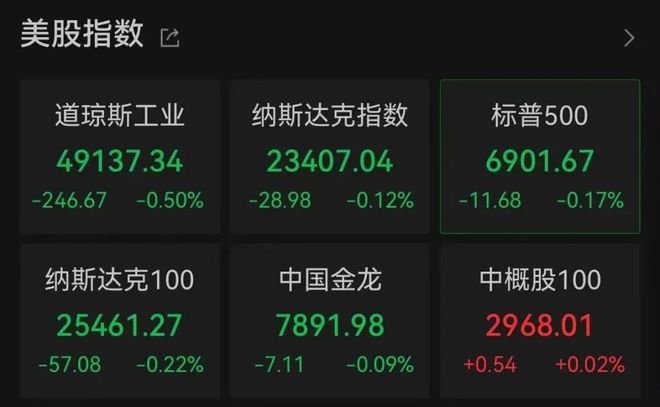
Market Overview - US stock market opened mixed with Nasdaq slightly up while Dow Jones and S&P 500 indices declined [1] - As of the report, Dow Jones fell by 0.5% to 49,137.34, Nasdaq decreased by 0.12% to 23,407.04, and S&P 500 dropped by 0.17% to 6,901.67 [2] Sector Performance - Semiconductor sector weakened significantly, with Intel experiencing a nearly 15% drop, while SanDisk and Western Digital fell over 4% [2][3] - Other notable declines included Broadcom down over 3%, Micron Technology down 1.49%, and Qualcomm down 0.51% [2][3] Chinese Solar Stocks - Chinese solar index surged over 7%, with JinkoSolar rising nearly 9%, and Daqo New Energy and Canadian Solar both increasing over 6% [4][5] Tech Giants Performance - Among the tech giants, Nvidia rose over 2%, while Tesla and Apple saw declines [5][6] - Specific stock movements included Nvidia at 189.08 (+2.29%), Amazon at 236.04 (+0.73%), and Microsoft at 453.525 (+0.53%) [6]


通信行业2026年度投资策略:聚焦AI:算力降本向光而行,应用落地网络先行
Guolian Minsheng Securities· 2026-01-23 12:20
Group 1 - The core viewpoint of the report emphasizes that the demand for AI computing power will continue to grow and diversify in 2026, extending from data centers to network edges and even internal terminals [8][13][27] - The report highlights the significant capital expenditure (Capex) growth driven by business revenue, with major cloud service providers like Google, Microsoft, and Amazon showing consistent revenue growth exceeding 20% year-on-year [27][31][35] - The report identifies the increasing importance of silicon photonics technology, particularly the 1.6T optical module, which is expected to maintain accelerated growth and enhance the global market share of domestic optical chips and devices [7][54][70] Group 2 - The report discusses the emergence of new technologies such as Scale-UP supernodes and their impact on optical link demand, indicating that these technologies will drive additional link requirements in 2026 [7][9][66] - It notes that the AI infrastructure is experiencing a high level of prosperity, with significant investments in data centers and AI capabilities expected to continue, particularly in the U.S. [47][49][53] - The report anticipates that the integration of silicon photonics will significantly increase its market penetration, projecting that by 2026, over half of optical module sales will come from silicon photonics solutions [70][75]


The Dot-Com Bubble and Potential AI Bubble Share One Striking Similarity, but Also a Critical Difference
Yahoo Finance· 2026-01-23 09:11
Group 1 - The rise of AI is seen as a significant technological leap similar to the internet revolution, with the potential to positively impact corporate growth and attract retail investors [1][5] - The AI revolution is primarily led by established companies like Nvidia, Broadcom, and TSMC, which have a history of profitability and proven operating segments, unlike many dot-com stocks during the internet boom [9][11] - The addressable market for AI is projected to be $15.7 trillion by 2030, indicating a substantial growth opportunity for industry leaders [4] Group 2 - Nvidia, Broadcom, and TSMC have experienced significant stock gains in 2023, with Nvidia up 1,170%, Broadcom up 529%, and TSMC up 360%, driven by high demand for AI hardware and data center infrastructure [15] - Despite high investor expectations for AI adoption, many businesses are not yet optimizing their AI solutions, which could impact the long-term returns on AI investments [17][18] - The established foundations of leading AI companies may protect them from severe downturns similar to the dot-com bubble, but a potential AI bubble burst would still negatively affect their stock prices [19]


Prediction: 4 Stocks That'll Be Worth More Than Apple 5 Years From Now
The Motley Fool· 2026-01-23 06:05
Core Viewpoint - Apple's growth stagnation may allow competitors like Microsoft, Amazon, Taiwan Semiconductor, and Broadcom to surpass it in market value over the next five years [1][2]. Group 1: Apple’s Current Position - Apple is currently valued at $3.6 trillion but is experiencing slower revenue growth at 10% year-over-year, relying on past performance rather than innovation [4]. - The company has not launched any significant new products recently, which raises concerns about its ability to maintain market share against more innovative competitors [4]. Group 2: Competitors' Potential - Microsoft, with a market cap of $3.4 trillion, and Amazon, valued at $2.5 trillion, are positioned to potentially surpass Apple due to their faster growth rates [7]. - Microsoft has benefited from the generative AI trend through its Azure cloud service, achieving mid- to high-double-digit EPS growth, which could propel it past Apple [8]. - Amazon's growth is driven by higher-margin divisions, and despite a slowdown in the third quarter, its operating income is expected to grow rapidly, allowing it to surpass Apple within five years [11]. Group 3: Semiconductor Industry Growth - Taiwan Semiconductor (TSMC) aims for a 25% compounded annual growth rate (CAGR) through 2029, which could triple its revenue and potentially surpass Apple [13]. - Broadcom is also well-positioned with its custom AI accelerator chips, expecting 100% year-over-year growth for these products, and could surpass Apple if it matches the projected growth in global data center capital expenditures [15][16].




磷化铟,火了
3 6 Ke· 2026-01-23 03:28
Core Insights - The future of computing power will be determined by optical transmission efficiency, highlighting the critical role of optical interconnect technology and the growing market enthusiasm for indium phosphide (InP) materials [1][2] - The global AI infrastructure spending is expected to exceed $1 trillion by 2026, driving the rapid iteration of data center optical modules to 800G/1.6T and beyond [1] - The demand for InP materials is surging due to their unique properties, with a significant supply-demand gap projected to persist until 2026 [1][9] Group 1: InP Material Advantages - InP exhibits over ten times the electron mobility of silicon, making it suitable for high-frequency and high-speed applications, particularly in optical communication at critical wavelengths [3][4] - InP's high thermal resistance and radiation tolerance are essential for AI servers and data centers operating in high-temperature environments [3] - InP is positioned as the core material for high-end long-distance communication, outperforming silicon and gallium arsenide in efficiency and adaptability [4] Group 2: Market Demand Drivers - The explosive growth of AI data centers is the primary driver for the increasing demand for InP, with 800G optical modules becoming standard [6] - The introduction of Co-Packaged Optics (CPO) technology is expected to significantly increase the demand density for InP substrates, with a projected market growth of 166 times by 2030 [7] - In addition to data centers, InP is penetrating advanced fields such as LiDAR, 5G/6G mobile communications, low Earth orbit satellite communications, and quantum computing [8] Group 3: Global Market Dynamics - The global InP industry is characterized by a high degree of oligopoly, with major players like Sumitomo Electric and AXT dominating over 95% of the market [9] - A significant supply-demand gap is anticipated, with a projected need for 2 million InP devices by 2025 against a production capacity of only 600,000 [9] - Major manufacturers are ramping up production capacity to address this gap, with AXT planning to double its capacity by 2026 [9][10] Group 4: Domestic Industry Developments - Chinese companies are accelerating efforts to break the foreign monopoly in the InP market, with several firms achieving significant milestones in production capacity and technology [10][11] - The domestic market is witnessing a collaborative push towards a full-chain upgrade in the InP industry, enhancing quality and efficiency [12] - Government policies are supporting the development of InP materials, including tax reductions and funding for research in high-purity indium production [12] Group 5: Future Outlook and Challenges - The InP industry is on the brink of a significant scale-up, driven by the urgent need for high-performance materials in AI and optical communication [18] - Despite the promising outlook, challenges such as low crystal growth yield and high costs remain, necessitating technological advancements and cost reductions [14][15] - Geopolitical factors and export controls are creating uncertainties in the global supply chain, impacting the InP industry's growth trajectory [16]



Jim Cramer says he's not abandoning the Mag 7 stocks despite recent struggles. Here's why
CNBC· 2026-01-22 23:23
Core Viewpoint - The tech giants known as the Magnificent Seven, which include Amazon, Alphabet, Apple, Microsoft, Meta Platforms, Nvidia, and Tesla, are expected to regain investor interest despite a sluggish start in 2026, as they possess significant financial resources and strong leadership [1]. Group 1: Market Dynamics - The recent cooling off of the Magnificent Seven stocks is attributed to a rally in storage and semiconductor equipment stocks, which have become significant contributors to market capitalization [2]. - Micron has seen a substantial increase of approximately 39% year to date and has doubled in value over the past three months due to a shortage of memory chips essential for AI computing [3]. - Storage companies like Seagate, Sandisk, and Western Digital have also experienced significant price increases, driven by the growing demand for storage solutions [3]. Group 2: Pricing Power and Market Trends - The current market situation is characterized by storage companies continuously raising prices without resistance, likening the necessity of storage devices to gasoline for cars [4]. - Despite the current high prices for memory chips, it is believed that this trend cannot sustain indefinitely, suggesting that these stocks may eventually lose momentum [5]. - The expectation is that once the peak in storage prices is reached, investors will be rewarded for maintaining their positions in the Magnificent Seven [5].



JPMorgan revamps AI 'stocks to buy' list ahead of earnings
Yahoo Finance· 2026-01-22 21:07
JPMorgan just shook up its AI stocks-to-buy list heading into earnings season, positioning Nvidia (NVDA), Broadcom (AVGO), and Micron (MU) at the top of the heap. The big bank said expectations for the upcoming quarter and beyond remain mostly constructive, despite ballooning valuations across the AI trade. The note comes at a point when stock market investors will be nursing their wounds from Tuesday’s sell-off, Reuters reported, which sent the major indices sharply lower. S&P 500: Dropped 2.06% to 6, ...