
BeiGene(BGNE)

Search documents
新一代BCL2抑制剂索托克拉获批上市 重塑B细胞淋巴瘤治疗格局
Huan Qiu Wang· 2026-01-07 07:25
Group 1 - The core point of the news is that BeiGene's new BCL2 inhibitor, SOTUCLAR (百悦达®), has received conditional approval from the National Medical Products Administration (NMPA) in China for the treatment of adult patients with chronic lymphocytic leukemia (CLL) and small lymphocytic lymphoma (SLL) who have previously received at least one systemic therapy including a BTK inhibitor, as well as for adult patients with relapsed or refractory mantle cell lymphoma (MCL) who have received at least two systemic therapies including a BTK inhibitor [1][2] - SOTUCLAR is the first of its kind to be approved in China, allowing Chinese patients to benefit from this innovative therapy ahead of other markets [1] - The approval process in China took only 8 months from acceptance to approval, highlighting the urgent treatment needs of patients with blood cancers who have developed resistance [2] Group 2 - The approval of SOTUCLAR marks a significant milestone in BeiGene's hematology product pipeline and reinforces the company's leadership in the treatment of B-cell malignancies [2] - SOTUCLAR has also received breakthrough therapy designation and priority review qualification from the U.S. Food and Drug Administration (FDA) for the treatment of adult patients with relapsed or refractory MCL who have received BTK inhibitors, potentially making it the first BCL2 inhibitor approved for this indication in the U.S. [1]

创新药ETF南方(159858.SZ)涨1.60%,百济神州涨3.29%
Jin Rong Jie· 2026-01-07 07:10
Group 1 - The A-share market experienced narrow fluctuations on January 7, with coal, chips, and innovative drug sectors leading in gains. The Southern Innovative Drug ETF (159858.SZ) rose by 1.60%, and Baijie Shenzhou increased by 3.29% [1] - The Chinese innovative drug industry is expected to undergo a value return and structural reshaping by 2025, with a shift in core logic towards product strength, platform capability, and global operational ability [1] - Policies are transitioning from encouraging innovation to a new phase of systematic and precise guidance, providing institutional support for original innovation [1] Group 2 - Capital is concentrating on companies with core technology platforms, clear clinical value, and global potential, favoring mid-to-late-stage projects in areas such as ADC, bispecific antibodies, CGT, and AI drug development [1] - The transaction amount for innovative drugs going overseas has reached a historical high, with deepening collaboration models [1] - Domestic ADC and bispecific antibody products have been approved and show globally leading data, while breakthroughs have been made in small molecule drugs targeting "undruggable" targets, and significant progress has been observed in cell therapies and nucleic acid drugs [1] Group 3 - The industry is transitioning from following innovation to original innovation, and from technology input to systematic output [1] - The trend for the innovative drug industry is positive, with strengthened global competitiveness, ongoing international expansion, and gradual realization of commercial profitability [1] - The medical device industry is experiencing a calming of influencing factors, with accelerated innovation and internationalization [1] Group 4 - The innovative drug industry is showing enhanced innovation vitality and significant internationalization results, with sufficient long-term development momentum [1] - The Southern Innovative Drug ETF (159858.SZ) can focus on innovative drugs and the industry chain, sharing the growth dividends of truly competitive companies amid industry differentiation and seizing opportunities for value reshaping [1]
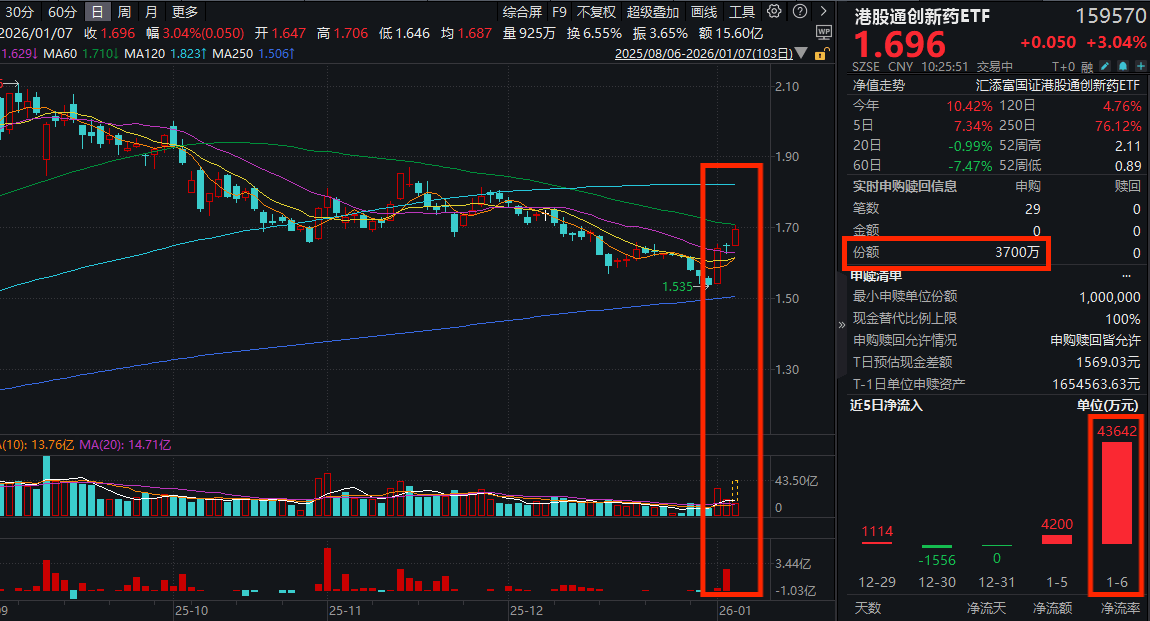
创新药行情卷土重来!港股通创新药ETF(159570)大涨3%,昨日净流入超4.3亿元!美联储降息大消息!
Xin Lang Cai Jing· 2026-01-07 02:45
Group 1: Market Performance - Hong Kong's innovative drug ETF (159570) surged by 3%, with a trading volume exceeding 1.5 billion yuan, following a net inflow of over 62 million yuan today after a previous inflow of 430 million yuan [1][3] - As of January 6, the latest scale of the Hong Kong innovative drug ETF reached over 23.3 billion yuan, leading its peers in the same category [1] Group 2: Economic Signals - Federal Reserve Governor Milan indicated that upcoming economic data may support further interest rate cuts, with expectations of a reduction exceeding 100 basis points this year [3] - Wall Street analysts suggest that if the U.S. unemployment rate rises to 4.7% by December 2025, the Fed may cut rates by 25 basis points this month [3] Group 3: Company Developments - Brain-computer interface "unicorn" Strong Brain Technology completed a financing round of 2 billion yuan, second only to Musk's Neuralink [3] - AI pharmaceutical company Insilico Medicine announced a long-term collaboration with Siveya for anti-tumor drug development, with a total deal value of 888 million USD [3] Group 4: New Drug Approvals - On January 6, BeiGene announced that its self-developed BCL2 inhibitor, Baiyueda® (sotucumab), received conditional approval from the National Medical Products Administration [3] - Shiyao's SYS6017 has initiated Phase II clinical trials for the prevention of shingles [3] Group 5: Investment Insights - Zhongtai Securities predicts that the pharmaceutical sector's opportunities in 2025 will focus on innovation and industry upgrades, with investment strategies continuing into 2026 [5] - The report emphasizes the importance of "innovative drugs and industry chains, demand recovery, and AI" as key investment dimensions [5] Group 6: J.P. Morgan Healthcare Conference - The 44th J.P. Morgan Healthcare Conference is set to take place from January 12 to 15, 2026, in San Francisco, attracting over 8,000 global participants [6] - The conference will feature over 500 listed companies and thousands of startups, focusing on "capital + strategy" discussions [6] Group 7: Industry Trends - Three major trends are highlighted for 2026: the continued rise of gene and cell therapies, deep integration of AI in pharmaceuticals, and the emergence of new market forces [7] - The report notes that over 20 gene editing companies will showcase breakthroughs in CAR-T and base editing at the conference [7] Group 8: MNC Engagement - Multinational corporations (MNCs) are willing to pay higher prices for innovative drugs from China, with the average total package for drugs purchased from China being 2.76 billion USD, compared to 1.29 billion USD for those from overseas [8] - The willingness of MNCs to pay a premium for Chinese innovations is driven by the need to fill significant pipeline gaps due to impending patent expirations [8] Group 9: Investment Focus - Investment strategies should focus on companies with strong clinical development capabilities and those in popular therapeutic areas such as ADCs, GLP-1, and dual antibodies [11] - Companies that can produce high-quality late-stage clinical assets are likely to attract MNC interest [11] Group 10: Key Therapeutic Areas - The report identifies key therapeutic areas for investment, including ADCs, GLP-1, dual antibodies, and neuroscience, emphasizing the need for innovative platforms and clinical data superiority [12]



又出血液肿瘤新药,百济神州股价微跌,“创新药一哥”能再造爆款?
3 6 Ke· 2026-01-06 12:12
Core Viewpoint - The approval of the BCL-2 inhibitor Sotorakra by BeiGene marks a significant advancement in the treatment of hematologic malignancies, with potential implications for the competitive landscape of BCL-2 inhibitors in the market [1][3]. Company Developments - BeiGene's Sotorakra has received approval for two indications: treatment of adult patients with previously treated chronic lymphocytic leukemia/small lymphocytic lymphoma (CLL/SLL) and mantle cell lymphoma (MCL) [1]. - The approval came just eight months after the new drug application was accepted by the NMPA, indicating a rapid development timeline [1]. - Sotorakra is positioned as a next-generation BCL-2 inhibitor, designed to block the BCL-2 protein that aids tumor cell survival, and has shown strong efficacy and specificity in clinical trials [1][2]. Clinical Trial Results - Early clinical trials of Sotorakra combined with Zebutini have demonstrated unprecedented rates of undetectable minimal residual disease in treatment-naive CLL patients [2]. - Recent data from five clinical studies indicate significant clinical benefits for Sotorakra, suggesting its potential as a cornerstone therapy for various B-cell malignancies [2]. Market Landscape - The global BCL-2 inhibitor market is projected to reach $5.2 billion by 2028, with the Chinese market expected to reach 1.4 billion yuan [5]. - The approval of Sotorakra follows the approval of another BCL-2 inhibitor, Lisatoclax, from Ascentage Pharma, indicating a growing presence of Chinese companies in the BCL-2 space [3][5]. - The competitive landscape is intensifying as multiple Chinese pharmaceutical companies, including Innovent Biologics and Zai Lab, are developing BCL-2 inhibitors [3][4]. Financial Performance - BeiGene's Zebutini has become a significant revenue driver, with global sales reaching $1.3 billion in 2023, marking a 129% year-over-year increase [6]. - In the first half of 2025, BeiGene reported a revenue of 17.52 billion yuan, a 46% increase year-over-year, largely driven by Zebutini sales [6][7]. - The company is under pressure to identify the next blockbuster product as Zebutini's growth may slow down in the future [7].
百济神州新型BCL2抑制剂百悦达(索托克拉片)在中国获得上市许可
Ge Long Hui· 2026-01-06 11:01
Core Viewpoint - BeiGene (6160.HK) announced that its self-developed first-in-class BCL2 inhibitor, Baiyueda® (Sotukral tablets), has received conditional approval from the National Medical Products Administration (NMPA) for the treatment of adult patients with chronic lymphocytic leukemia (CLL) or small lymphocytic lymphoma (SLL) who have previously received at least one systemic treatment including a Bruton tyrosine kinase (BTK) inhibitor, as well as for adult patients with relapsed or refractory mantle cell lymphoma (MCL) who have received at least two systemic treatments including a BTK inhibitor [1] Group 1 - The approval of Sotukral provides a new treatment option for CLL/SLL patients who have previously been treated with BTK inhibitors [1] - Sotukral becomes the first and only BCL2 inhibitor approved for the treatment of MCL in China [1] - The applications for these indications were previously included in the priority review process by the NMPA's Center for Drug Evaluation (CDE) [1]
百济神州新型BCL2抑制剂百悦达(索托克拉片)在中国获得上市许可
Zheng Quan Shi Bao Wang· 2026-01-06 10:49
Core Viewpoint - BeiGene announced that its self-developed first-in-class BCL2 inhibitor, Baiyueda® (Sotoclisib), has received conditional approval from the National Medical Products Administration (NMPA) for the treatment of adult patients with chronic lymphocytic leukemia (CLL) or small lymphocytic lymphoma (SLL) who have previously received at least one systemic therapy including a Bruton tyrosine kinase (BTK) inhibitor, as well as for adult patients with relapsed or refractory mantle cell lymphoma (MCL) who have received at least two systemic therapies including a BTK inhibitor [1] Group 1 - The approval of Sotoclisib provides a new treatment option for CLL/SLL patients who have previously been treated with BTK inhibitors [1] - Sotoclisib becomes the first and only BCL2 inhibitor approved for the treatment of MCL in China [1] - The applications for these indications were previously included in the priority review process by the NMPA's Center for Drug Evaluation (CDE) [1]
宝盈基金姚艺包揽去年12月股基与混基跌幅第一
Zhong Guo Jing Ji Wang· 2026-01-06 07:46
Group 1 - The core point of the article highlights that in December 2025, the worst-performing ordinary equity and mixed funds were both managed by Baoying Fund, specifically the Baoying Medical Health Hong Kong-Shenzhen Stock A and C, which reported returns of -13.20% and -13.26% respectively [1] - The Baoying Innovation Medical Mixed Initiation A and C funds also performed poorly, with returns of -14.14% and -14.19%, making them the worst in the mixed fund category [1] - All these funds are themed around the medical sector and are managed by the same fund manager, Yao Yi, who has a background in research and fund management [1] Group 2 - The latest quarterly report indicates that the top ten holdings of the Baoying Medical Health Hong Kong-Shenzhen Stock fund include major companies such as Innovent Biologics, Kelun Pharmaceutical, and others, while the Baoying Innovation Medical Mixed Initiation fund shares many of the same top holdings [1][2] - Notably, several of these top holdings experienced significant declines in December, with the largest holding, Innovent Biologics, dropping by 18.97%, and another major holding, 3SBio, declining by over 22% [2] - The performance metrics of the funds show that the Baoying Innovation Medical Mixed Initiation C has a cumulative net value of 0.8857 and a scale of 0.51 billion, while the A share has a cumulative net value of 0.8886 and a scale of 0.47 billion [3]



盈利与流动性共同驱动港股行情,AI、硬科技或仍是主线
Sou Hu Cai Jing· 2026-01-06 06:41
Group 1 - The core viewpoint of the article highlights the active performance of the Hong Kong technology sector, with notable gains in stocks such as SenseTime-W, JD Health, and others, indicating a positive market sentiment [1] - The macroeconomic context includes the Federal Reserve's decision to lower interest rates as indicated in the December 2025 meeting minutes, alongside a rise in China's composite PMI output index to 50.7%, reflecting an expansion in production activities [1][13] - The net inflow of southbound funds exceeded 18.7 billion HKD on the first trading day of the year, while foreign capital showed a decreasing trend in outflows, with passive foreign capital inflows into Hong Kong and Chinese concept stocks reaching 900 million USD [1][13] Group 2 - GF Securities notes that the recent rise in Hong Kong stocks is supported by fundamentals, with signs of structural recovery in profitability expected to strengthen from the second half of 2024 due to stabilizing domestic and external demand [1][16] - The article mentions that the Hong Kong technology index consists of 30 leading tech companies selected based on high market capitalization, R&D investment, and revenue growth, with a flexible sample adjustment mechanism to maintain competitiveness [4] - The top five constituents of the Hong Kong technology index include Tencent Holdings, Alibaba-W, and Xiaomi Group, with significant weightings of 15.46%, 14.54%, and 13.50% respectively, indicating a high concentration in the index [9][7]

2026年度医药策略观点更新
2026-01-05 15:42
Summary of Key Points from the Conference Call Industry Overview - The pharmaceutical sector is currently in a left-side layout phase after adjustments in 2025, with both institutional holdings and valuations positioned for upward elasticity, particularly in innovative drugs and their supply chains for 2026, benefiting from China's strengthening innovation competitiveness [1][4] - The recovery of the innovative industry chain is expected to continue, with CDMO orders and performance starting to recover from 2024, further improving in 2025 and expected to sustain into 2026 [1][9] Core Insights and Arguments - The driving forces behind the enhancement of China's innovation competitiveness include the successful implementation of business development (BD), overseas clinical progress, and commercialization, along with breakthroughs in new technologies such as XDC, dual antibodies, and small nucleic acids [5] - Investment opportunities in 2026 are concentrated in globally competitive assets, including innovative drugs, high-end manufacturing, and domestic demand-related sectors, particularly those with recovery logic [2] - The domestic demand recovery trend is clear, strengthening quarter by quarter in 2025, driven by high domestic innovation BD, a warming primary and secondary market, and an increase in IPOs in both A-shares and Hong Kong stocks [20] Notable Companies and Technologies - Key companies to watch include Innovent Biologics, Botai Biological Products, and Engen Biologics, which are core recommended assets due to their potential for significant data readouts and BD catalysts [6][10] - In the CRO sector, companies like Tigermed and Zhaoyan New Drug are expected to see performance turning points in 2026, supported by a recovery in domestic demand [3][21] - The CDMO sector is projected to continue its growth trajectory, with leading companies such as WuXi AppTec and Kelun Biotech expected to perform well due to increasing orders from overseas [22][23] Emerging Technologies and Investment Opportunities - Emerging technologies such as brain-computer interfaces and AI in pharmaceuticals are anticipated to bring new investment opportunities, with potential IPOs in these areas [12][29] - The central OTC sector is expected to see marginal recovery in 2026, with key companies like China Resources and Dong'e Ejiao being highlighted for their potential growth [13][30] Upcoming Catalysts and Key Events - Important upcoming events include the JPMorgan conference, which may provide data updates and BD changes, and significant data readouts expected in Q1 and April from major conferences [8][10] - The performance of companies in the first quarter of 2026 is anticipated to show significant elasticity and fundamental support, particularly in the CRO and innovative drug sectors [11][20] Conclusion - The pharmaceutical industry is positioned for a recovery phase with significant investment opportunities in innovative drugs, CDMO, and CRO sectors, driven by domestic demand recovery and technological advancements. Key companies and upcoming events will play a crucial role in shaping the market dynamics in 2026 [1][2][4][20]


1月5日医疗健康(980016)指数涨3.48%,成份股百济神州(688235)领涨
Sou Hu Cai Jing· 2026-01-05 10:59
Core Viewpoint - The Medical Health Index (980016) experienced a significant increase of 3.48%, closing at 6299.52 points on January 5, with a total trading volume of 38.349 billion yuan and a turnover rate of 1.16% [1]. Group 1: Index Performance - On the same day, 47 constituent stocks of the Medical Health Index saw an increase, with BeiGene leading the rise at 12.02%, while only 3 stocks declined, with Changshan Pharmaceutical leading the decline at 1.0% [1]. Group 2: Capital Flow - The net inflow of main funds into the Medical Health Index constituent stocks totaled 0.947 billion yuan, while speculative funds experienced a net outflow of 1.115 billion yuan, and retail investors had a net inflow of 0.168 billion yuan [2].
