
Citi(C)

Search documents
美国金融板块周五再度爆发抛售潮,发生了什么?
Feng Huang Wang· 2026-02-27 22:42
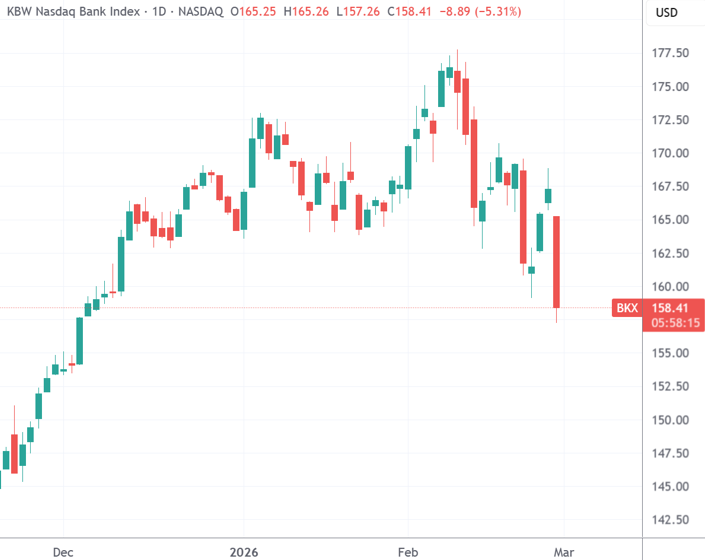
Group 1 - The U.S. banking, asset management, and financial services sectors faced heavy selling pressure, with the KBW Bank Index dropping over 5%, nearing its largest single-day decline since April of the previous year [1] - Major Wall Street firms such as Goldman Sachs and Morgan Stanley saw declines exceeding 7%, while Wells Fargo, Citigroup, and Bank of America dropped over 5% [1] - Concerns about financial system risks stemming from artificial intelligence and the collapse of the UK mortgage company MFS have shaken confidence in the private credit industry [1][3] Group 2 - Financial technology company Block announced layoffs of over 10,000 employees, reducing its workforce to below 6,000, citing increased productivity from AI as the reason [3] - The collapse of MFS has raised new concerns regarding the quality of private credit, with Apollo Global Management, Jefferies, and TPG identified as creditors of MFS [3][4] - MFS is reported to have a "double pledging" issue, potentially leading to a £930 million shortfall in its £1.2 billion debt, which has parallels to previous bankruptcy cases that caused significant losses for misled institutions [4] Group 3 - Jefferies shares fell over 10%, while Apollo Global Management dropped more than 8%, with KKR and TPG also experiencing declines [4] - The credit card and payment service provider American Express saw a decline of over 6%, as the market sold off assets sensitive to credit [5] - Truist Securities highlighted that the market is focused on American Express due to its direct reflection of potential white-collar unemployment risks [5]






苹果跌超3%,英伟达市值蒸发超1.2万亿元!金、银、原油,全线上涨!什么情况?
Mei Ri Jing Ji Xin Wen· 2026-02-27 22:37
Group 1: Market Performance - The KBW Bank Index in the US fell nearly 5%, marking the largest single-day decline since April of the previous year [1] - Major tech stocks mostly declined, with Nvidia dropping over 4%, Apple over 3%, and Microsoft over 2%, while Netflix surged over 13%, marking its best single-day performance since October 2023 [1] - Goldman Sachs fell over 7%, Morgan Stanley over 6%, and Wells Fargo and Citigroup over 5%, contributing to a broader decline in US banks, which fell over 4% [1] Group 2: Company-Specific Developments - Nvidia's market value evaporated by $187.1 billion (approximately 128.32 billion RMB) despite revenue growth and a positive outlook for Q1, highlighting market concerns over high valuations in the AI sector [1] - Block announced layoffs of 4,000 employees, nearly half of its workforce, betting on AI to enhance productivity, which intensified existing market risks; however, Block's stock rose by 16.76% by the end of the trading day [1] Group 3: Chinese Stocks and Indices - The Livermore China Concept Stock Index fell by 1.26%, with notable declines in stocks such as Canadian Solar (over 11%), NEGG, and iQIYI (over 6%) [2] - Positive movements were seen in stocks like Yuchai International (over 8%) and Kingsoft Cloud (over 6%) [2] Group 4: Commodity Prices - Gold and silver prices surged due to geopolitical tensions, with spot gold rising by 1.75% and COMEX gold futures up by 1.64%; spot silver increased by 6.33% and COMEX silver futures by 7.67% [5] - International oil prices also saw significant increases, with WTI crude oil futures rising by 2.78% to $67.02 per barrel and Brent crude oil futures up by 2.45% to $72.48 per barrel [5]





Essex Property Trust to Present at The 2026 Citigroup Global Property CEO Conference
Businesswire· 2026-02-27 21:15
Group 1 - Essex Property Trust, Inc. will participate in the 2026 Citigroup Global Property CEO Conference on March 2, 2026, with President and CEO Angela L. Kleiman presenting at a roundtable [1] - The company is a fully integrated real estate investment trust (REIT) focused on acquiring, developing, redeveloping, and managing multifamily residential properties primarily in West Coast markets [1] - Essex currently owns interests in 259 apartment communities, totaling over 63,000 apartment homes, with an additional property under active development [1] Group 2 - Essex Property Trust has announced a 0.8% increase in its annual cash dividend, marking the 32nd consecutive annual dividend increase [1] - The declared first quarter dividend is $2.59 per share, payable on April 15, 2026, to shareholders of record as of March 31, 2026, which annualizes to $10.36 per common share [1] Group 3 - The company has released its fourth quarter and full-year 2025 earnings results, detailing net income, Funds from Operations (FFO), and Core FFO per diluted share for the periods ending December 31, 2025, and December 31, 2024 [1] - Essex has also announced the income tax treatment for its 2025 distributions to shareholders, providing details on the characteristics of the distributions [1]


美股科技、银行股深夜大跌,CoreWeave重挫17%,戴尔狂飙18%,金银原油齐涨,美伊战争风险急剧升高
2 1 Shi Ji Jing Ji Bao Dao· 2026-02-27 15:32
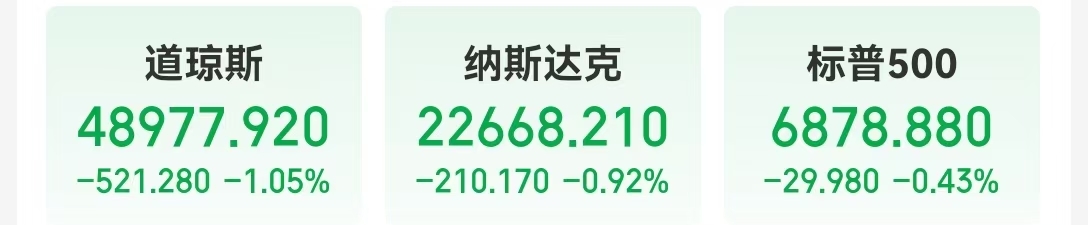
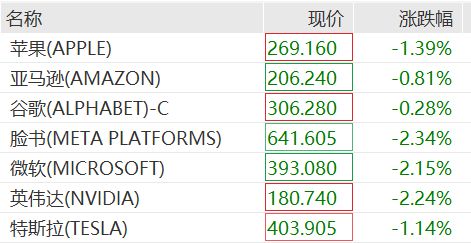
Market Overview - The U.S. stock market indices collectively declined, with all three major indices falling over 1% [1] - Major technology stocks mostly dropped, with Oracle and Salesforce down over 4%, and the "Big Seven" tech stocks, including Nvidia and Microsoft, down over 2% [1] Individual Stock Performance - Apple shares fell by 1.39%, Amazon by 0.81%, Google by 0.28%, Facebook by 2.34%, Microsoft by 2.15%, Nvidia by 2.24%, and Tesla by 1.14% [2] - Semiconductor stocks experienced a significant decline, with the Philadelphia Semiconductor Index leading the market drop, and companies like Bluefin Semiconductor down over 5% and Broadcom and GlobalFoundries down over 2% [2] - Bank stocks also saw a downturn, with Barclays and Citigroup down approximately 4%, and Bank of America and Wells Fargo down over 4% [2] Notable Stock Movements - CoreWeave's stock plummeted over 17%, marking its largest drop since August of the previous year due to concerns over massive capital expenditures [4] - Duolingo's stock fell by 22%, reaching its lowest level since February 2023, as the company's booking outlook for Q1 and the full year fell short of expectations [4] - Dell Technologies saw its stock surge by 18%, the largest intraday increase since April 9, as its revenue guidance for fiscal 2027 exceeded market expectations [4] - Netflix's stock rose by 12%, marking its largest increase since January 2025, following its exit from the Warner Bros. bidding war [4] - Block, the U.S. version of Alipay, increased nearly 20%, achieving its largest intraday gain since February 2024 [4] Commodity Market - Gold and silver prices surged due to escalating tensions in the Middle East, with silver rising approximately 5% and gold exceeding $5,230 [3][5] - International oil prices also spiked, with WTI and ICE Brent crude both increasing over 3% [3][5] - Year-to-date, international oil prices have risen nearly 20%, with potential for significant fluctuations depending on geopolitical developments involving the U.S. and Iran [5] Cryptocurrency Market - The cryptocurrency market experienced a widespread decline, with Bitcoin down 2.5% and Ethereum down over 5%, leading to over 100,000 liquidations globally in the past 24 hours [5]


道琼斯指数跌1.6% 多数银行股下挫
Ge Long Hui A P P· 2026-02-27 15:06
Group 1 - The Dow Jones Index fell by 1.59%, closing at 48,710.54 points [1] - Most U.S. bank stocks experienced declines, with Citigroup dropping over 5% [1] - Other banks such as Bank of America and Wells Fargo fell by more than 4%, while JPMorgan and Barclays decreased by over 3%, and BNY Mellon dropped nearly 2% [1]


花旗:《预算案》确认香港经济复苏范围扩大 预计财政储备将保持稳定
Zhi Tong Cai Jing· 2026-02-27 07:47
花旗发布研报称,香港2026/27年度《财政预算案》确认经济复苏范围扩大,得益于金融活动的强劲税 收及利得税,香港在多年赤字后恢复盈余。 政府正透过转拨债券基金的累积盈余及外汇基金的投资收益来整合基金,以支持北部都会区项目及其他 资本开支。此战略性重新配置旨在推动未来经济增长。同时,公共债务发行将增加,绿色及基建债券的 借款上限已提高。总体债务与本地生产总值比率预期将维持在14.4%至19.9%的可控水平。 该行预期香港的财政储备将保持稳定,并通过财政转拨及发行债券支持长远发展项目的持续资本开支。 该行对香港经济复苏范围扩大持建设性看法,与政府对2026年本地生产总值增长2.5%至3.5%的预测范 围一致。 ...
花旗上调希慎兴业目标价至24.3港元 维持买入评级
Xin Lang Cai Jing· 2026-02-27 04:26
Group 1 - Citi has raised the target price for Hysan Development from HKD 17.35 to HKD 24.3 while maintaining a "Buy" rating [1] - Hysan Development's basic profit is expected to decline by 2% for the fiscal year 2025 due to rising financing costs, with a 9% drop in profit after excluding perpetual capital securities [1] - The debt-to-asset ratio for Hysan Development stands at 32.4% [1] Group 2 - The Lee Garden Phase 8 is anticipated to bring over 20% growth potential in foot traffic during 2026-2027, which is expected to drive sales growth for merchants [1] - The expected growth in rental income from lease renewals is projected to be 2% in 2026 [1] - The recovery in office building occupancy rates provides flexibility for future new supply [1]

What Makes Citigroup Inc. (C) Appear So Attractive
Yahoo Finance· 2026-02-26 18:47
Core Viewpoint - Citigroup Inc. is recognized as one of the top banking stocks to buy, with positive ratings and price target increases from multiple financial firms, indicating strong investor confidence and potential for growth [1][2][3]. Group 1: Analyst Ratings and Price Targets - Piper Sandler reiterated an Overweight rating for Citigroup and raised the price target from $130 to $135, suggesting a 23% upside potential [1]. - Truist Securities maintained a price target of $129 and a Buy rating after Citigroup's solid fourth-quarter results, with reported EPS at $1.19 and adjusted EPS at $1.81 after excluding a one-time loss [3]. Group 2: Financial Performance - Citigroup's adjusted EPS of $1.81 exceeded consensus estimates by 12%, supported by strong provision and pre-provision net revenue performance [4]. - The company reaffirmed its target of achieving a 10–11% Return on Tangible Common Equity (ROTCE) by 2026, with an expected improvement in cost efficiency, targeting an efficiency ratio of approximately 60% [4]. Group 3: Business Structure - Citigroup operates through five distinct segments: Services, Markets, Banking, U.S. Personal Banking, and Wealth, offering a wide range of financial products and services to consumers, corporations, governments, and institutions [5].
Citigroup invests in Japan’s Sakana AI
Yahoo Finance· 2026-02-26 14:36
Investment Overview - Citigroup has made its first investment in Japan by investing in Sakana AI, although the investment size remains undisclosed and is described as "strategic" [1] - The partnership aims to accelerate innovation in global financial services by leveraging Citigroup's market reach and Sakana AI's research and development capabilities [1] Company Profile - Sakana AI is a Tokyo-based AI start-up that specializes in developing foundational models and enterprise-grade AI tools inspired by nature [2] - The company plans to use the new capital to enhance its international expansion and build on existing partnerships with major financial institutions [2] Strategic Partnerships - In 2025, Sakana AI announced collaborations with Mitsubishi UFJ Financial Group (MUFG) and Daiwa Securities Group to create custom AI models for specialized financial sectors [3] - Santander Group from Spain also invested in Sakana AI as part of its Series B fundraising, similar to Citigroup's investment [3] Market Position - Citigroup's global head of Markets Strategic Investments, Siris Singh, noted that Sakana AI has established a strong foundation and product market fit in Japan [4] - Other major US banks are also increasing their focus on AI strategies, indicating a broader trend in the financial sector [4]