
salesforce(CRM)

Search documents
Buy the Dip in These 2 Underperforming Cloud Software Stocks, Say Analysts
Yahoo Finance· 2025-09-20 10:18
Company Overview - Workday operates a flexible AI-powered, cloud-based platform that manages back-office functions for enterprise-scale businesses, including HR, finance, and customer service [4] - The company serves over 11,000 clients across various industries, including healthcare, financial services, and technology, with operations in more than 175 countries [2][4] Financial Performance - In fiscal 2Q26, Workday reported a revenue of $2.35 billion, reflecting a 13% year-over-year increase and exceeding forecasts by $10 million [9] - The non-GAAP EPS for the same quarter was $2.21, which was 9 cents higher than expected [9] - Workday's full-year guidance for fiscal 2026 subscription revenues is projected at $8.815 billion, indicating a 14% year-over-year growth, which is lower than the 16% growth achieved in fiscal 2025 [9] Market Position and Analyst Insights - Despite facing headwinds, analysts like Guggenheim's John DiFucci believe Workday's growth potential outweighs current challenges, with a Buy rating and a price target of $285, suggesting a 22% upside [10] - The stock currently has a Strong Buy consensus rating, with 22 Buy and 7 Hold ratings, and is trading at $233.50, with an average target price of $281.42, indicating a potential gain of 20.5% in the next 12 months [11] Industry Context - The AI and cloud software sector is experiencing growth, with AI driving recent market rallies, although Workday's stock has declined by 9.5% year-to-date due to temporary setbacks [1][5] - Analysts emphasize the importance of distinguishing between short-term declines and deeper structural issues, suggesting that fundamentally sound stocks may present investment opportunities during dips [6][7]


Jim Cramer on Salesforce: “They’ve Got a Terrific Business”
Yahoo Finance· 2025-09-20 04:44
Salesforce, Inc. (NYSE:CRM) is one of the stocks Jim Cramer recently shared his thoughts on. A caller asked Cramer for his thoughts on the stock after taking a large position, and noted the stock’s underperformance year-to-date. Cramer commented: “At 21 times next year’s earnings, I’m beginning to think that, that I’m not going to pull the trigger on more because… the trust has a very small position. I’m beginning to think that the buy case is just much better than the sell case, down 27%. They’ve got a t ...
硅谷大厂裁员背后的组织变革丨硅谷AI转型录NO.1
腾讯研究院· 2025-09-19 07:48
Core Insights - The article discusses the profound transformation driven by AI in Silicon Valley, emphasizing that this is not merely an upgrade of production tools but a fundamental change in production relationships, collaboration methods, and value creation [3][5][32] - It highlights two main focuses: how AI serves as a foundational capability reshaping work and competition, and how various groups, especially pioneering companies and individuals in Silicon Valley, are adapting to and leading this change [3][5] Group 1: Systemic Changes in Silicon Valley - The ongoing layoffs and restructuring in Silicon Valley are indicative of a long-term systemic change rather than a short-term phenomenon, driven by the integration of AI [5][8][9] - Companies are increasingly focusing on core activities like manufacturing and sales, outsourcing and tool-ifying many other functions [5][10] - The shift from a traditional employee model to a partnership model is becoming prevalent, where clear accountability and incentive structures can lead to rapid growth [5][10][21] Group 2: New Work Paradigms - The emergence of a flatter organizational structure is a direct result of AI's ability to enhance communication efficiency and standardize tasks, reducing the need for middle management [12][14] - The demand for entry-level positions is declining as companies seek individuals who can immediately contribute to business value, leading to challenges for recent graduates [14][16] - The focus has shifted from merely finding programmers to addressing fundamental business questions like how to generate revenue and acquire customers [16][17] Group 3: AI's Impact on Business Value - The culture of hackathons has evolved, with participants now leveraging AI coding to implement their ideas independently, shifting the focus from technical skills to business acumen [16][17] - The traditional notion of needing additional programmers is fading, as the emphasis is now on understanding how to monetize ideas and find customers [17][18] - Companies are increasingly adopting a partner-like structure where employees are incentivized based on performance, aligning with the capabilities that AI brings [21][27] Group 4: AI Transformation Strategies - Many companies are still in the early stages of AI transformation, primarily focusing on productivity rather than organizational change [20][21] - Successful AI integration often involves creating new departments or companies to explore AI applications without the constraints of existing structures [20][21] - The trend towards a partnership model is gaining traction, where employees are encouraged to take ownership of their contributions and share in the financial rewards [21][27] Group 5: Future Trends and Predictions - The ongoing trend of "big restructuring" indicates a need for companies to rethink their operations around AI, moving beyond incremental improvements [32] - The rise of small, agile teams capable of generating significant revenue is becoming the norm, with a shift in focus from fundraising to profitability [32][33] - Globalization is expected to become a core selling point for companies, as the ability to operate on a global scale will enhance their market appeal [33]




Here's a rapid fire update on all 31 portfolio stocks including our newest name
CNBC· 2025-09-18 20:15
Summary of Key Points Group 1: Stock Analysis - Apple: The latest iPhone 17 models are considered a bargain, especially with trade-in values and provider incentives [1] - Amazon: Potential for upside if margin expansion continues, particularly in e-commerce and cloud growth [1] - Abbott Laboratories: Valued at approximately 24 times earnings, seen as a high-quality med tech stock worth holding [1] - Broadcom: Recent profit-taking due to exceeding 5% portfolio weighting, but long-term outlook remains positive [1] - Boeing: Newly added to the portfolio, expected to benefit from trade policies and has significant multi-year upside potential [1] - BlackRock: Described as a "bull market stock," with a focus on fast-growing investments [1] - Bristol Myers Squibb: Awaiting results from upcoming studies on its schizophrenia drug, Cobenfy, which could improve sentiment [1] - Capital One: Anticipating share repurchases post-Discover acquisition, with strong management praised [1] - Costco: Long-term outlook remains positive despite recent struggles attributed to market perception [1] - Salesforce: Current levels are not recommended for buying or selling ahead of the Dreamforce conference [1] - CrowdStrike: Ambitious target of $20 billion in annual recurring revenue set, indicating strong management confidence [1] - Cisco Systems: Continued support despite underperformance, with a solid dividend [1] - DuPont: Progressing towards a planned breakup, with Qnity expected to unlock more value [1] - Danaher: Facing headwinds from China but announced a significant buyback [1] - Disney: Shares have stalled, but theme park business remains strong [1] - Dover: Future outlook remains bright despite recent disappointing earnings [1] - Eaton: Potential for increased business from data centers as AI spending rises [1] - GE Vernova: High valuation justified by demand for energy generation in AI infrastructure [1] - Goldman Sachs: Expected revenue growth in investment banking and attractive wealth management business [1] Group 2: Additional Stock Insights - Home Depot: Likely to trim position due to housing market turnaround not meeting expectations [2] - Honeywell International: Shares lagging until split is complete, but value remains [2] - Linde: Continues to deliver for shareholders despite challenging end markets [2] - Eli Lilly: Position maintained due to strong performance and potential game-changing products [2] - Meta Platforms: Dominance in advertising market bolstered by generative AI [2] - Microsoft: Attractive long-term investment, with potential for trimming positions [2] - Nvidia: Partnership with Intel solidifies its leadership in GPUs [2] - Palo Alto Networks: High valuation justified by leadership in cybersecurity [2] - Starbucks: Promising turnaround plan under new CEO [2] - TJX Companies: Strongest earnings performance seen, recognized as a top retail performer [2] - Texas Roadhouse: Stock performance tied to cattle futures, expected surge in share price [2] - Wells Fargo: Positive outlook with increased buybacks and diversification into fee-based businesses [2]



India's M&A Boom Meets AI: Navatar Brings Salesforce-Powered Deal Origination CRM To Private Equity & Investment Banking Firms
Globenewswire· 2025-09-18 01:02
Industry Overview - India's mergers and acquisitions market has reached nearly $41 billion in 2025, driven by significant deals from major players like Reliance, JSW Group, and Tata Sons [1] - Private equity activity in India is at its highest level in over a decade, with global investors and sovereign funds actively seeking opportunities alongside influential Indian conglomerates [1] Company Expansion - Navatar, a leader in AI-powered CRM for private markets, is expanding its operations in India with a dedicated local office and founders of Indian origin, providing deep market insights and necessary technology for Indian dealmakers [2] Technology and Features - Navatar's CRM integrates seamlessly with Outlook and Salesforce, automating data capture and transforming daily activities into structured intelligence without manual entry [4] - The platform is built on Salesforce and integrated with Microsoft Copilot, offering enterprise-grade AI and privacy safeguards to ensure client confidentiality [4] - AI-driven features include automated intelligence capture, deal origination and sourcing, buyer-seller matching, document intelligence, fundraising LP intelligence, and real-time workflow insights [7] Market Impact - As global capital flows into sectors such as healthcare, consumer goods, renewables, and technology, Navatar provides the infrastructure for Indian dealmakers to scale their operations confidently [5] - Hundreds of leading firms worldwide already utilize Navatar to enhance their competitive edge in winning mandates, deepening relationships, and closing deals more efficiently [5]
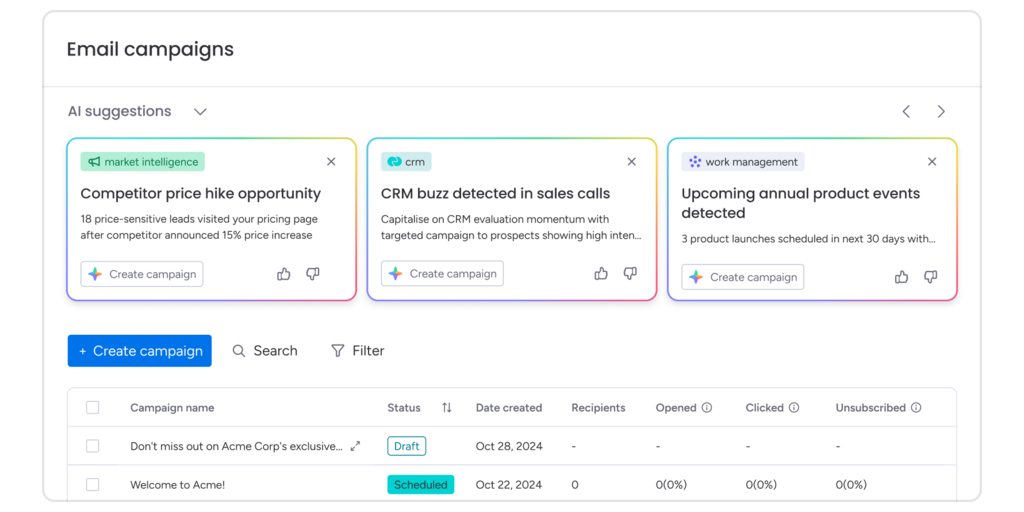
monday.com Expands AI-Powered Agents, CRM Suite, and Enterprise-Grade Capabilities
Businesswire· 2025-09-17 18:00
Core Insights - The company announced new product innovations at its annual customer conference, Elevate, focusing on AI capabilities [1] - Introduction of the new agent builder, monday agents, and the full availability of three latest AI features: monday magic, monday vibe, and monday sidekick [1] - Launch of monday campaigns, an AI-powered product within the monday CRM suite, indicating a strategic expansion in enterprise offerings [1] Product Innovations - The new agent builder, monday agents, enhances the company's AI foundation [1] - Full availability of monday magic, monday vibe, and monday sidekick showcases the company's commitment to integrating advanced AI features into its platform [1] - The introduction of monday campaigns signifies a new addition to the CRM suite, aimed at improving customer relationship management through AI [1] Enterprise Expansion - The company is expanding its enterprise capabilities, reflecting a strategic focus on larger business clients [1]

Palantir's Defense Dominance Faces First Real Threat—And It's Already Winning
Benzinga· 2025-09-17 15:48
Core Insights - Palantir Technologies Inc faces potential pricing pressure due to Salesforce Inc's new national security division, Missionforce, which has already secured a U.S. Army contract, raising concerns about Palantir's pricing power [1][2][4]. Company Developments - Salesforce has shifted its focus from being a traditional enterprise CRM provider to aggressively pursuing defense contracts with its Missionforce initiative, claiming a significant U.S. Army contract win [2][3]. - Palantir continues to maintain a strong market position, recently being selected by the State Department for its Orion program, highlighting its unique capabilities among competitors [3]. Market Dynamics - The competition in the government AI sector is intensifying, with Salesforce's Missionforce potentially offering a lower-cost alternative to Palantir's premium services, which could impact Palantir's market share [4][5]. - Despite Palantir's stock rising 125% this year, there are concerns about its valuation sustainability in light of increasing competition from Salesforce [4][5].


Salesforce Is Capitalizing On Agentic AI Better Than Anyone Else
Seeking Alpha· 2025-09-17 14:10
Core Insights - Salesforce's stock dropped 6% after hours following Q2 earnings, despite showing strong demand for its AI offerings with 12,500 Agentforce deals and 120% year-over-year growth in AI revenue [1] Company Performance - Salesforce reported 12,500 Agentforce deals, indicating robust market interest in its AI solutions [1] - The company achieved a significant 120% year-over-year growth in AI revenue, reflecting the increasing adoption of AI technologies in enterprise settings [1] Market Reaction - The stock price decline of 6% after the earnings report suggests that market expectations may have been set too high, leading to a negative reaction despite positive performance metrics [1]

Software companies are fighting back with AI. The stocks are still hurting.
MINT· 2025-09-17 09:39
Core Insights - The software sector has lagged behind other tech areas despite the overall market rally driven by artificial intelligence (AI) [1][2] - Major software companies like Adobe and Salesforce are experiencing stock price declines despite reporting revenue growth, while ServiceNow's stock has risen [3][4] Company Performance - Adobe reported third-quarter revenue of $5.99 billion, an 11% increase year-over-year, while Salesforce's revenue grew 10% to $10.2 billion, and ServiceNow's revenue rose 23% to $3.22 billion [3] - Adobe's stock trades at 15.2 times expected earnings, down from 21 times at the beginning of the year; ServiceNow trades at 49.8 times, down from 63.5; Salesforce's forward P/E is 19.9, down from 30 [6] Market Sentiment - There is a disconnect between the strong financial results of software companies and investor concerns regarding the impact of AI on their business models [4][5] - The iShares Expanded Tech-Software Sector ETF has only risen 0.6% this year, underperforming the S&P 500's 12% gain [6] AI Integration - Adobe reported that AI-influenced annual recurring revenue surpassed $5 billion, with 99% of Fortune 100 companies using AI in Adobe applications [7] - Other software companies like Snowflake, Datadog, and JFrog have seen revenue acceleration due to AI [8] Customer Retention - Despite fears of AI replacing software functions, enterprises are likely to remain loyal to existing software providers due to the "stickiness" of these services [9][10]


每日投资策略-20250917
Zhao Yin Guo Ji· 2025-09-17 03:40
Global Market Overview - The Hang Seng Index closed at 26,439, up 0.19% for the day and up 31.80% year-to-date [2] - The Southbound capital recorded a net inflow of HKD 3.189 billion [2] - The Chinese stock market showed mixed results, with sectors like consumer discretionary and industrial technology rising, while materials, healthcare, and real estate fell [2] Economic Indicators - China's Ministry of Commerce plans to promote orderly opening in the internet and cultural sectors [2] - Japan's government is expected to increase fiscal expansion, with potential tax cuts for households and inflation subsidies [2] - The U.S. retail sales increased by 0.6% month-on-month in August, marking the third consecutive month of exceeding expectations [3] Sector Performance - The automotive sector shows strong potential with companies like Geely Automobile and XPeng Motors rated as "Buy" with target prices indicating significant upside [4] - The equipment manufacturing sector, including companies like SANY International and Zoomlion, is also rated as "Buy" with positive growth forecasts [4] - The consumer discretionary sector, particularly Luckin Coffee and Green Tea Group, is highlighted for its growth potential, with target prices suggesting substantial upside [4] Investment Recommendations - Geely Automobile (175 HK) is rated "Buy" with a target price of HKD 25.00, indicating a 31% upside [4] - SANY International (631 HK) is rated "Buy" with a target price of HKD 8.90, suggesting a 29% upside [4] - Luckin Coffee (LKNCY US) is rated "Buy" with a target price of USD 44.95, indicating a 14% upside [4]


