
salesforce(CRM)

Search documents
赛富时将大幅调整产品命名策略,不排除将公司改名为Agentforce
Ge Long Hui A P P· 2025-12-08 03:20
Core Viewpoint - The company Salesforce is shifting its product naming strategy to focus on artificial intelligence software, potentially rebranding the entire company as Agentforce [1] Group 1: Product Naming Strategy - Salesforce CEO Marc Benioff announced a significant adjustment in the company's product naming strategy, moving the focus from cloud computing to AI software [1] - Several products and services have already been renamed, including Sales to Agentforce Sales, Service to Agentforce Service, and Platform to Agentforce 365 Platform [1]

Salesforce要改名Agentforce?CEO贝尼奥夫称这事儿有可能
Sou Hu Cai Jing· 2025-12-08 00:19
Core Insights - Salesforce CEO Marc Benioff has shifted the company's focus from "cloud" to artificial intelligence, rebranding nearly all products and services under the name "Agentforce" [1][2] - The company has renamed several key products, including "Sales" to "Agentforce Sales" and "Service" to "Agentforce Service," indicating a significant branding transformation [2][3] - Benioff noted that customers are no longer interested in the concept of "cloud," but rather in AI agents, reflecting a broader industry trend towards AI integration [3] Product Rebranding - Salesforce has extensively adopted the "Agentforce" branding across its product lineup, with major changes to product names [2] - The former "Data Cloud" has been renamed to "Data 360," which will be central to the company's strategic planning for 2026 [3] Strategic Focus - The company is making a strong bet on AI agents, despite some internal skepticism regarding this strategic shift [4] - Following the announcement of the new branding and focus, Salesforce raised its revenue expectations in its latest financial report, signaling positive market reception [4]

META, NFLX, CRM, And More: 5 Stocks That Dominated Investor Buzz This Week - Apple (NASDAQ:AAPL), Salesforce (NYSE:CRM)
Benzinga· 2025-12-06 14:30
Group 1: Retail Investor Interest - Retail investors showed significant interest in five stocks: Meta Platforms Inc., Salesforce Inc., UiPath Inc., Netflix Inc., and Tesla Inc., driven by earnings reports, retail hype, AI developments, and corporate news [1] - The stocks represent diverse sectors including social networking, AI, software, robotics, streaming, and automotive [1] Group 2: Meta Platforms Inc. (META) - Meta Platforms is under an EU antitrust probe regarding its WhatsApp AI policies, which may restrict third-party AI competition and could result in substantial fines [5] - The company announced plans for up to 30% budget cuts to metaverse initiatives, shifting focus to AI, with projected capital expenditures of $72 billion for 2026 [5] - META stock had a 52-week range of $479.80 to $796.25, trading around $660 to $664 per share, up 10.39% year-to-date and 8.64% over the year [6] Group 3: Salesforce Inc. (CRM) - Salesforce reported third-quarter FY25 earnings of $9.44 billion in revenue and $2.41 per share, raising FY25 revenue guidance to $38 billion with a 20% operating margin [6] - The company is focusing on Agentforce AI, with 200 deals signed and plans to hire 1,400 AI-focused sales representatives [6] - CRM stock performance was positively received by retail investors following the earnings report [6] Group 4: UiPath Inc. (PATH) - UiPath reported third-quarter FY25 earnings of $355 million in revenue and a non-GAAP EPS of $0.11, with annual recurring revenue (ARR) growth to $1.61 billion and a 113% net retention rate [11] - The stock had a 52-week range of $9.38 to $18.74, trading around $18 to $20 per share, up 42.92% year-to-date and 23.61% over the year [10] - Investors reacted positively to PATH's innovative AI developments and partnerships [11] Group 5: Netflix Inc. (NFLX) - NFLX shares fell over 5% after co-founder Reed Hastings sold approximately 375,000 shares for about $40.7 million, raising insider selling concerns [16] - Despite the drop, strong demand for the final season of "Stranger Things" and exclusive negotiations for acquiring Warner Bros. Discovery's assets were notable developments [16] - NFLX stock had a 52-week range of $82.11 to $134.12, trading around $103 to $105 per share, up 16.41% year-to-date and 12.45% over the year [17] Group 6: Tesla Inc. (TSLA) - Tesla's November sales data showed a 10% year-on-year increase in China deliveries, while European sales declined significantly [17] - The stock had a 52-week range of $214.25 to $488.54, trading around $453 to $455 per share, up 19.83% year-to-date and 23.00% over the year [19] - Regulatory changes proposed by President Trump could ease EV mandates, potentially benefiting Tesla's inventory clearance [17]





Salesforce Is One of the Dogs of the Dow. Should You Buy the Dip in CRM Stock Now?
Yahoo Finance· 2025-12-06 14:00
Core Insights - The Dow Jones Industrial Average is up 12.78% in 2025, indicating solid performance despite not matching the gains of the S&P 500 or Nasdaq [1] - Salesforce has faced significant challenges, with its stock experiencing double-digit losses due to slow AI adoption and increased competition, making it one of the worst performers in the Dow [2] Company Overview - Salesforce is a leading customer relationship management (CRM) platform, known for pioneering cloud-based CRM since 1999 and now focusing on AI integration [3][5] - The company’s AI innovation, Agentforce, aims to enhance operational efficiency by introducing autonomous AI agents to assist employees and customers [4] Market Performance - Salesforce's revenue growth has slowed, and the anticipated excitement around its AI initiatives has not materialized, leading to investor skepticism [6] - Concerns about an AI bubble and the potential for powerful AI tools to undermine Salesforce's software offerings have contributed to cautious investor sentiment [6]
Why the timing was right for Salesforce’s $8 billion acquisition of Informatica — and for the opportunities ahead
Yahoo Finance· 2025-12-06 14:00
Core Insights - The key to successful mergers and acquisitions (M&A) includes alignment of strategies, technology compatibility, and a focus on innovation and customer needs [1][4] M&A Activity - M&A volume in 2025 reached $2.2 trillion in the first half, marking a 27% increase from the previous year, with 72% of deals exceeding $1 billion [1] - Thousands of M&A transactions are expected in the U.S. across various industries, with startups often positioning themselves for acquisition [2] Company Specifics - Informatica, established in 1993, brings extensive experience in enterprise data management, differentiating itself from typical startups [2] - The alignment of Salesforce and Informatica's strategies is crucial, particularly regarding their technology stacks, which are based on open protocols, cloud-native design, and AI capabilities [4] Market Trends - The demand for agentic AI is rising, with an estimated market growth to $155 billion by 2030, highlighting the importance of high-quality data for businesses pursuing productivity gains [5]

This Remains One of the Most Underrated AI Stocks
The Motley Fool· 2025-12-06 02:41
Core Insights - Salesforce reported record third-quarter fiscal 2026 results, highlighting a strong AI strategy built on a profitable software platform [2][10] - The company’s revenue grew to $10.3 billion, a 9% increase year over year, with a non-GAAP operating margin of 35.5% [4][6] - Salesforce's AI products, particularly Agentforce and Data 360, generated nearly $1.4 billion in annual recurring revenue, reflecting a 114% year-over-year growth [7][8] Financial Performance - Salesforce's remaining performance obligations (RPOs) rose 11% year over year to $29.4 billion, indicating strong future sales demand [5] - Free cash flow increased by 22% to $2.2 billion, allowing the company to return $4.2 billion to shareholders through repurchases and dividends [6][10] - Full-year revenue guidance was raised to a range of $41.45 billion to $41.55 billion, implying a growth rate of 9% to 10% for the year [6] AI Growth Potential - AI-specific products are growing significantly faster than the overall company, with Agentforce revenue exceeding $500 million in annual recurring revenue after quadrupling [7][9] - The demand for AI tools has been a key driver in the growth of current RPOs, showcasing the integration of AI into the broader business strategy [9][10] Competitive Positioning - Compared to Palantir, Salesforce offers a more diversified business model with a lower price-to-sales ratio of less than 6 and a price-to-earnings ratio of 32 [12][17] - Salesforce's established software suite provides a strong foundation for AI initiatives, making it less dependent on speculative technology compared to Palantir [13][14] - The overall revenue growth for Salesforce has moderated to high-single-digit rates, but its AI-related revenue is still a growing segment within a larger business [16][17]

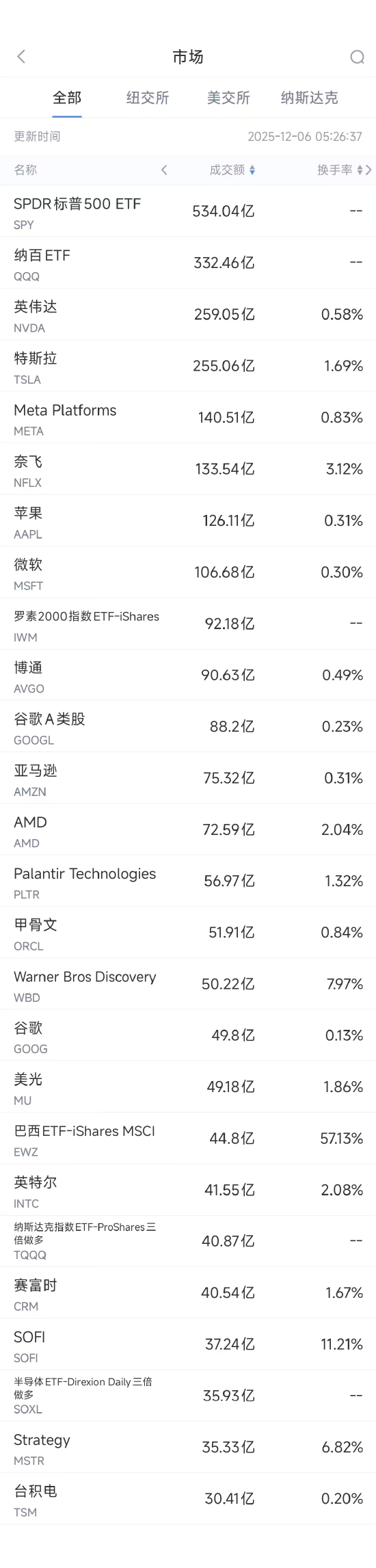
12月6日美股成交额前20:英伟达称大模型厂商多是其间接客户
Xin Lang Cai Jing· 2025-12-05 21:48
Group 1: Nvidia - Nvidia's stock closed down 0.53% with a trading volume of $25.905 billion, with CFO Colette Kress highlighting that over 50% of the company's revenue comes from large cloud service providers (CSPs) [1][9] - Kress emphasized the ongoing need for computational resources among model developers, who must consider profitability and funding while ensuring sufficient computational capacity for future demands [1][9] Group 2: Tesla - Tesla's stock increased by 0.10% with a trading volume of $25.506 billion, as CEO Elon Musk confirmed that the Full Self-Driving (FSD) system now allows users to send text messages while driving under certain conditions [1][10] Group 3: Meta Platforms - Meta Platforms' stock rose by 1.80% with a trading volume of $14.051 billion, following reports that the company plans to cut its metaverse department budget by up to 30%, which analysts view positively as a sign of financial discipline [2][10] - The potential layoffs may affect Meta's virtual reality division, indicating a focus on efficiency and growth [2][10] Group 4: Netflix and Warner Bros - Netflix's stock fell by 2.89% with a trading volume of $13.054 billion, as the company announced a deal to acquire Warner Bros, including its film and television studios, for a total enterprise value of approximately $82.7 billion [2][10][11] - The acquisition will be financed through cash and stock, with Warner Bros shares valued at $27.75 each, translating to an equity value of $72 billion [2][10] Group 5: Other Companies - Broadcom's stock increased by 2.42% with a trading volume of $9.063 billion, as Oppenheimer raised its target price from $400 to $435 [12] - Palantir's stock rose by 2.16% with a trading volume of $5.697 billion, marking a 7.9% increase over the week [13] - Micron's stock increased by 4.66% with a trading volume of $4.918 billion, announcing a complete exit from its Crucial consumer storage business by March 2026 [14] - TSMC's stock rose by 0.61% with a trading volume of $3.041 billion, with the U.S. Commerce Secretary stating that TSMC will increase investments in the U.S. [15]


Salesforce shares pop 5% after earnings beat, aiming for best week since 2023
CNBC· 2025-12-05 18:31
Core Insights - Salesforce shares increased by 5% following better-than-expected Q3 earnings, with adjusted earnings per share at $3.25, surpassing estimates of $2.86, while revenue grew 8.6% year-over-year to $10.26 billion, slightly missing projections of $10.27 billion [1] - The company aims to demonstrate that AI will enhance its products rather than threaten the industry, countering investor concerns about AI rendering cloud software firms obsolete [2] - Salesforce's year-to-date share performance is down 21%, contrasting with a 22% gain in the Nasdaq, but analysts express optimism for growth by 2026 [3] Financial Performance - Adjusted earnings per share for Q3 were reported at $3.25, exceeding Wall Street's expectations [1] - Revenue for the quarter was $10.26 billion, reflecting an 8.6% increase year-over-year, but just below analyst expectations [1] AI and Product Development - Salesforce acquired AI startups Regrello and Waii during Q3, which focus on generating code through natural language instructions [3] - The company's AI platform, Agentforce, has seen a significant annual recurring revenue increase of 330% year-over-year, reaching $540 million [5] - CEO Marc Benioff emphasized that Agentforce integrates humans, data, AI, and applications to enhance business experiences [6] Market Outlook - Analysts from Mizuho expect Salesforce to maintain solid growth rates and fiscal discipline, with potential for higher operating and free cash flow margins [4] - Cantor analysts noted strong adoption of Agentforce in customer service, indicating a maturing strategy that could facilitate customer understanding and adoption [5]

Top Stock Movers Now: Ulta Beauty, Salesforce, Paramount Skydance, and More
Investopedia· 2025-12-05 18:25
Group 1: Market Overview - Major U.S. equities indexes rose after key inflation data came in lower than expected, boosting hopes for a Federal Reserve interest rate cut next week [1] - The S&P 500 and Dow edged up about 0.1% to near their all-time highs, while the Nasdaq also ticked 0.1% higher [1] Group 2: Company Performances - Ulta Beauty (ULTA) was the best-performing stock in the S&P 500, with shares up about 14% after posting better-than-expected quarterly results and raising its outlook [1] - Victoria's Secret (VSCO) shares jumped 11% following strong earnings and an increase in guidance, attributed to lower promotional costs and higher prices [2] - Salesforce (CRM) climbed over 5% after reporting better-than-expected earnings, driven by growing sales of its Agentforce AI offerings and Data 360 products [2] - Paramount Skydance (PSKY) shares slumped nearly 8% after losing a bidding war for Warner Bros. Discovery's film and streaming properties to Netflix (NFLX) [3] - Shares of Netflix were down 3%, while Warner Bros. Discovery shares gained 2% [3] - W.R. Berkley (WRB) shares tumbled 7% after announcing that Japan's Mitsui Sumitomo Insurance took a 12.5% stake in the firm [3]




Salesforce Generates Strong Free Cash Flow - CRM Could Be 23% Too Cheap
Yahoo Finance· 2025-12-05 17:58
Core Insights - Salesforce, Inc. (CRM) generated free cash flow (FCF) that was 22% higher year-over-year in its fiscal Q3 ending October 31, indicating that CRM stock could be undervalued by 23% [1][4][6] Financial Performance - Q3 revenue rose 8.63% year-over-year to $10.259 billion, while 9-month revenue increased by 8.68% to $30.324 billion, with 94.8% of revenue coming from subscription and support services [3][4] - FCF for Q3 was $2.177 billion, up 22.4% year-over-year, and for the 9-month period, it increased by 5.35% to $9.079 billion [4][5] - The Q3 FCF margin was 21.2%, an increase from 18.4% a year ago, while the trailing 12 months (TTM) FCF margin rose to approximately 32% from 31.64% last quarter [4][5] Future Projections - Analysts project that next year's sales will rise by 10.5% from management's guidance of $41.55 billion to $45.80 billion [7] - Applying a 32% FCF margin to the projected sales results in an estimated FCF of $14.656 billion for the next 12 months, which is 21% higher than the market's expected run rate of $12.105 billion [7]