
Alphabet(GOOG)

Search documents
Stay Long. Capex-geddon Is A Déjà Vu
Seeking Alpha· 2026-02-07 11:57
Group 1 - The article discusses the concept of "Geo-capex" investing, which is an evolution of the "Capex Nation" idea, highlighting the ongoing bull market driven by AI enthusiasm despite January's volatility [1] - The focus is on long-term investment strategies in U.S. and European equities, emphasizing undervalued growth stocks and high-quality dividend growers [1] - Sustained profitability, characterized by strong margins, stable and expanding free cash flow, and high returns on invested capital, is identified as a more reliable driver of returns than valuation alone [1] Group 2 - The author manages a portfolio publicly on eToro, qualifying as a Popular Investor, which allows others to replicate real-time investment decisions [1] - The interdisciplinary background of the author, including Economics, Classical Philology, Philosophy, and Theology, enhances both quantitative analysis and market narrative interpretation [1] - The investment philosophy aims to balance asset accumulation with the freedom to choose work that aligns with personal expression, rather than seeking to avoid work altogether [1]




做不到“绝对公正”与“全网比价”的AI购物助理,都不会成功
虎嗅APP· 2026-02-07 10:10
Core Viewpoint - The article discusses the impact of AI development on e-commerce platforms, particularly focusing on the competitive dynamics between companies like Amazon, Alibaba, and Pinduoduo, emphasizing the importance of consumer trust and value delivery in the retail sector [6][29]. Group 1: AI and E-commerce Dynamics - The daily token consumption in China is projected to increase from 100 billion at the beginning of 2024 to 40 trillion by September 2025, representing a growth of over 400 times [7]. - Major US tech companies are significantly increasing their capital expenditures for AI infrastructure, with Google estimating its 2026 CapEx to be between $175 billion and $185 billion, nearly double its 2025 spending [8]. - Amazon's projected capital expenditure for 2026 is $200 billion, primarily focused on AWS AI infrastructure, while Microsoft anticipates around $150 billion in spending [9]. Group 2: Competitive Analysis of E-commerce Platforms - Amazon's 2025 GMV is estimated at approximately $700 billion, with AI assistant Rufus contributing $12 billion in annual transaction volume, accounting for 1.67% of total GMV [11][12]. - The article critiques the effectiveness of AI assistants in enhancing user experience, suggesting that they often serve as high-level customer service rather than providing significant incremental value [17]. - Pinduoduo's business model emphasizes "lowest price" as a prerequisite for advertising, contrasting with Amazon and Alibaba, which rely on advertising revenue from brand merchants [20][21]. Group 3: Consumer Trust and Value Proposition - The article argues that platforms like Costco succeed because they prioritize consumer trust and value, contrasting with Amazon and Alibaba, which may not always align with consumer needs [22]. - The effectiveness of AI shopping assistants is questioned, particularly in their ability to deliver on consumer expectations for price and quality, with the assertion that they cannot change the underlying business models of platforms like Alibaba [22][23]. - The article concludes that the future of AI in e-commerce will likely favor companies that can maintain consumer trust and deliver genuine value, with Apple and WeChat identified as potential leaders in this space due to their business models [27][28].



千问App投入30亿开启春节攻势;SpaceX收购xAI,马斯克整合商业帝国丨AI周报
创业邦· 2026-02-07 10:09
Core Insights - The article highlights significant developments in the AI industry, including mergers, funding rounds, and technological advancements, reflecting the rapid growth and competitive landscape of AI companies globally. Group 1: Mergers and Acquisitions - SpaceX has acquired xAI, marking a strategic move by Elon Musk to integrate AI into its aerospace operations [7] - OpenAI is prioritizing the commercialization of ChatGPT, leading to the departure of several executives amid a shift in focus from long-term research to immediate product development [9] Group 2: Funding and Investments - A total of 34 AI financing events were disclosed globally, with a total funding amount of 169.13 billion RMB, averaging 8.05 billion RMB per event [42] - The highest funding in the domestic AI sector was achieved by Zhijidongli, which completed a 14.01 billion RMB A++ round of financing [49] Group 3: Technological Advancements - The first AI percutaneous navigation robot has been approved for market release in China, enhancing precision in medical procedures [9] - Tencent's HPC-Ops has improved inference throughput by 30%, showcasing advancements in AI model performance [23] Group 4: Market Trends and Predictions - The domestic transformer market is expected to grow over 20% year-on-year by 2025, driven by the increasing demand for AI computing power [40] - The CEO of Xiaopeng Motors predicts that AI will be a central theme in technology for the next 30 to 50 years, emphasizing its integration into the automotive industry [38] Group 5: Company Strategies and Developments - Ant Group's CEO announced an "AI Credit" incentive program to encourage innovative contributions in AI [29] - Meitu's CEO discussed the competitive landscape between general AI models and specialized applications, emphasizing the importance of niche markets [19]



一张图生成游戏?谷歌Genie体验:万物皆可玩,但离“杀死游戏公司”还远
3 6 Ke· 2026-02-07 10:08
Core Viewpoint - The anticipation for the release of "GTA 6" is contrasted with Google's DeepMind's Project Genie, which has the potential to revolutionize gaming by allowing users to create their own playable game worlds [1][4]. Group 1: Impact on Gaming Companies - Following the announcement of Project Genie, Take-Two Interactive's stock fell by 10%, Roblox's stock dropped over 12%, and Unity's stock plummeted by 21%, while Chinese companies like NetEase and Tencent remained largely unaffected [4]. - Project Genie represents a significant shift in game development, potentially disrupting traditional game creation processes that require extensive planning, coding, and artistic input [6][24]. Group 2: Project Genie Capabilities - Project Genie allows users to generate interactive game worlds from simple inputs like photos or text descriptions, fundamentally changing how games can be created and experienced [8][11]. - Users can manipulate the generated worlds in real-time, with the ability to modify elements and create dynamic environments without needing coding skills [14][17]. Group 3: Limitations and Current State - Despite its innovative approach, Project Genie currently suffers from issues such as inconsistency and a lack of logical coherence in gameplay, which can lead to bizarre experiences [27][29]. - The technology is still in its early stages, primarily serving as a tool for game designers to quickly validate ideas rather than providing a fully immersive gaming experience for players [32]. Group 4: Future Implications of AI in Gaming - Project Genie signifies a critical advancement in AI, moving from understanding static worlds to simulating dynamic, interactive environments, which could pave the way for more advanced forms of artificial intelligence [33][35]. - The competition in the realm of world modeling is intensifying, with various companies, including OpenAI and NVIDIA, also exploring similar technologies, indicating a burgeoning field with significant future potential [35].

Why investors may have to contend with market volatility for a while
Youtube· 2026-02-07 10:00
Market Overview - The Dow closed above 50,000 for the first time, indicating a significant milestone in market performance [1][17] - The S&P 500 is nearing record highs, but there are ongoing challenges in the tech sector, particularly among hyperscalers [1][6] Sector Performance - There is a distinct repricing of expectations in the market, with hyperscalers experiencing declines while their suppliers, such as semiconductor and power companies, are seeing gains [2][3] - Consumer staples have shown strong performance year-to-date, with energy leading the sectors, followed by staples up 13.2% [4] - A rotation is occurring from AI technology stocks to more defensive and cyclical sectors, indicating a shift in investor sentiment [6][8] Investment Sentiment - Investors are derisking their portfolios by moving away from high-beta names and into sectors perceived as more stable and tied to economic growth [7][8] - The market is expected to remain volatile due to geopolitical uncertainties and job market fluctuations, complicating the Federal Reserve's focus on inflation [8][9] Behavioral Trends - The investment community has seen a shift towards trend-following strategies, with contrarian investors becoming less prominent [12][13] - The "buy the dip" mentality has become ingrained in investor psychology, leading to rapid rebounds following market downturns [20][21] Options Market Dynamics - Zero-day-to-expiration (ZDT) options are gaining popularity, with a significant portion of trading volume now occurring in these contracts [26][28] - The SIBO is exploring new products in prediction markets, reflecting a growing interest in innovative financial instruments [30][31]


千亿景林持仓曝光!大幅减持英伟达,重仓谷歌、Meta、拼多多
券商中国· 2026-02-07 09:44
Core Viewpoint - Jinglin Capital has significantly adjusted its US stock holdings in the fourth quarter, reducing its position in Nvidia while increasing investments in Google, Pinduoduo, and Intel [1][5]. Group 1: Holdings Overview - As of the end of the fourth quarter, Jinglin's total US stock holdings amounted to $4.04 billion, a decrease of 3.37% from the previous quarter [2]. - The top ten holdings include Google, Meta, Pinduoduo, NetEase, Manbang, Futu, Nvidia, Alibaba, Intel, and Yaduo [2]. Group 2: Major Increases in Holdings - The largest increase in holdings was in Google, where the number of shares rose to 2.69 million, reflecting a 52.81% increase, making it the largest position at 20.82% of the portfolio [4]. - Jinglin also initiated a position in Broadcom with 245,800 shares, representing 2.1% of the portfolio, and increased holdings in Pinduoduo, Intel, and Futu [4]. Group 3: Major Reductions in Holdings - The most significant reduction was in Nvidia, where Jinglin sold 1.5409 million shares, a decrease of 64.78%, reducing its portfolio share to 3.86% [5]. - Additionally, Jinglin reduced its stake in Meta by 22,910 shares, resulting in an 18.68% decrease in holdings [5]. Group 4: Investment Strategy Insights - Jinglin's partner and fund manager, Gao Yuncheng, highlighted the importance of companies in emerging sectors like AI, new energy, and smart driving, emphasizing the ongoing transformation across industries [5][6]. - The core holdings are characterized by strong customer loyalty, pricing power, and distinct product differentiation, focusing on companies with stable valuations and cash flows [6].


Waymo联手DeepMind打造世界模型:基于Genie 3,让自动驾驶「脑补」罕见场景
机器之心· 2026-02-07 07:00
Core Insights - Waymo has launched the Waymo World Model, a new standard in large-scale, hyper-realistic autonomous driving simulation, built on DeepMind's Genie 3 [1][4] - The model can generate highly realistic and interactive 3D environments tailored for the strict requirements of autonomous driving [4][8] - Waymo Driver has completed nearly 200 million miles of fully autonomous driving, enhancing road safety through extensive virtual world training [4][28] Group 1: Model Capabilities - Waymo World Model leverages Genie 3's extensive world knowledge to simulate rare events that are difficult to replicate in real life, such as tornadoes and encounters with elephants [4][9] - The model supports high-fidelity, multi-sensor data generation, including camera images and LiDAR point clouds, providing a comprehensive training and testing environment for autonomous systems [4][8] - The simulation allows for real-time adjustments through simple language prompts, driving inputs, or scene layouts, enhancing the model's adaptability [4][11][16] Group 2: Simulation Control Mechanisms - The model features three main control mechanisms: driving behavior control, scene layout control, and language control, enabling the simulation of various driving scenarios [11][13][16] - Driving behavior control allows for the simulation of counterfactual events, assessing how the Waymo Driver would respond under specific conditions [11] - Scene layout control enables customization of road layouts and traffic signals, while language control provides flexibility in adjusting time of day and weather conditions [13][16] Group 3: Realism and Accuracy - Waymo World Model can convert real-world videos into multi-modal simulations, achieving high levels of realism and factual accuracy [22] - The model's efficient variants allow for long-duration simulations while maintaining high fidelity, supporting large-scale testing [24] - By simulating rare scenarios, Waymo Driver prepares for complex driving situations, setting a higher safety benchmark for autonomous systems [28]

黄仁勋谈科技行业AI“烧钱潮”:“合理适当”的良性循环,只要盈利就会持续翻倍
Huan Qiu Wang Zi Xun· 2026-02-07 05:44
Group 1 - The core viewpoint is that the increasing capital expenditure in AI infrastructure by tech companies is reasonable, appropriate, and sustainable, as their cash flows are expected to grow [1][3] - Major clients of Nvidia, including Meta, Amazon, Google, and Microsoft, have recently announced plans to significantly increase their investments in AI infrastructure [3] - Wall Street's reaction to the surge in spending has been mixed, with Meta and Alphabet's stock prices rising, while Amazon and Microsoft's stock prices faced pressure [3] Group 2 - Nvidia's CEO emphasized that as long as people continue to pay for AI, AI companies will be able to profit and will continue to grow exponentially [3]
支出激增60%:微软等四巨头2026狂砸6600亿美元豪赌AI
Sou Hu Cai Jing· 2026-02-07 05:18
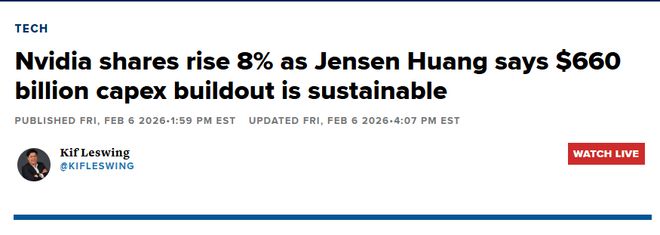
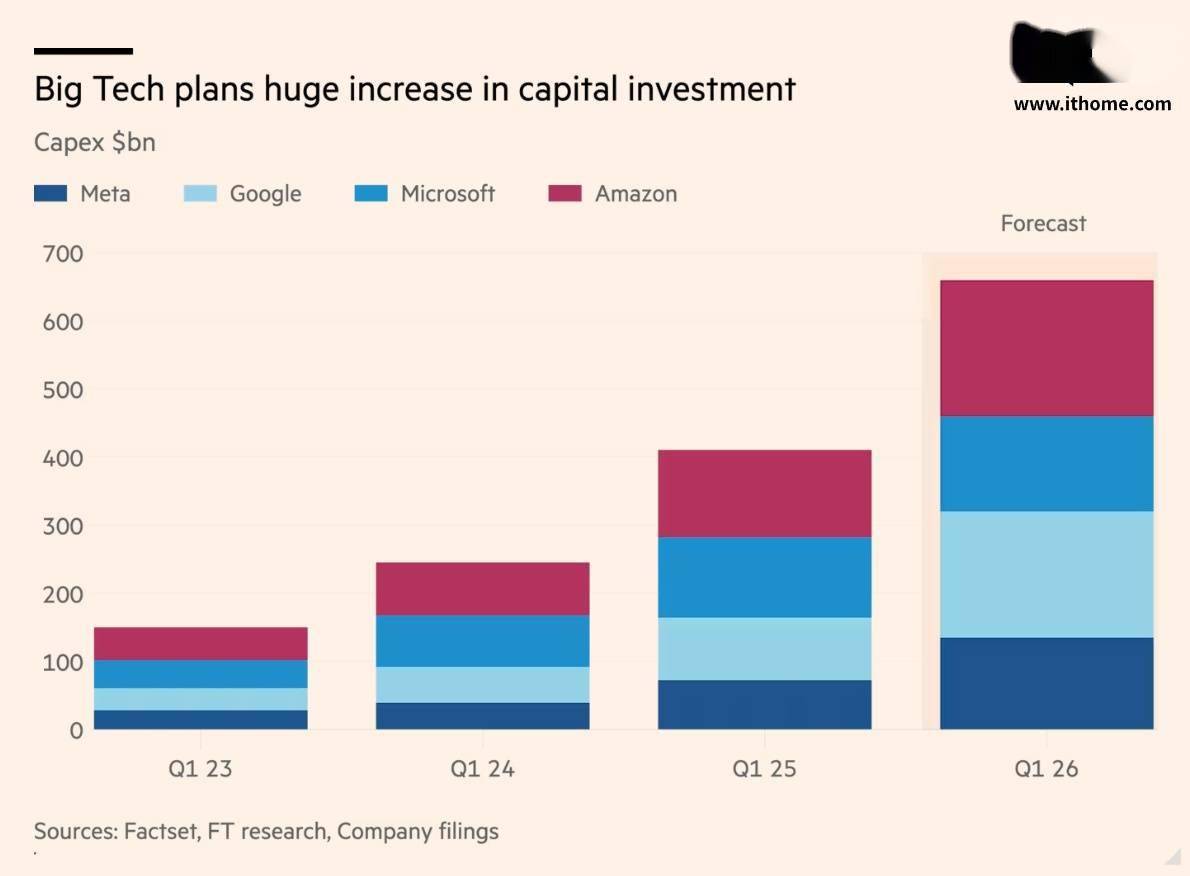
Group 1 - The core point of the article is that major tech companies, including Amazon, Google, Microsoft, and Meta, are significantly increasing their capital expenditures for 2026 to a total of $660 billion, which is a 60% increase from 2025 and more than double the spending in 2024 [1] Group 2 - Amazon's capital expenditure is projected to reach $200 billion, exceeding market expectations by $50 billion, which led to an 8% drop in its stock price during pre-market trading [3] - Microsoft reported a staggering 66% increase in quarterly data center spending and revealed a significant risk exposure to OpenAI, with 45% of its $625 billion future cloud contracts linked to the startup, raising concerns about over-reliance on a single client [5] - Alphabet, Google's parent company, plans to double its capital expenditure to $185 billion despite its annual revenue surpassing $400 billion, which negatively impacted its stock price [5] Group 3 - Despite strong growth in cloud business revenues and a 14% increase in total annual revenue to $1.6 trillion, market sentiment remains pessimistic, with analysts noting that the scale of spending is "staggering" [6] - Analysts believe that high capital expenditures indicate that AI strategies will take longer to yield returns, leading to a shift in investor sentiment from initial "AI frenzy" to a "mini pause," with a focus on profit statements [6] - Apple emerged as a winner by outsourcing most of its AI infrastructure costs through an agreement with Google, adopting a "pay-as-you-go" model, resulting in a capital expenditure of only around $12 billion last year, which even saw a 17% decline in the last three months [6] - Thanks to strong sales of the iPhone 17 and a low-risk AI strategy, Apple's stock price increased by 7.5% [6]
昨夜,暴力反弹了!
Xin Lang Cai Jing· 2026-02-07 04:15
Market Overview - The U.S. stock market experienced a significant rebound, with the Dow Jones Industrial Average rising by 2.47%, surpassing the 50,000 mark for the first time, while the S&P 500 and Nasdaq Composite increased by 1.97% and 2.18%, respectively, driven primarily by large technology stocks [1] - Semiconductor stocks led the rally, with notable gains from ARM and AMD exceeding 11%, and Nvidia and Broadcom rising nearly 8% [1] - Smaller tech stocks in niche sectors such as quantum computing, drones, and nuclear power also showed remarkable performance, indicating a shift in market sentiment towards high-growth technology areas [1][3] Geopolitical Factors - A breakthrough in U.S.-Iran nuclear negotiations has significantly improved global risk appetite, contributing to the stock market rebound [2] - The negotiations, which took place in Oman, resulted in a "good start" according to Iranian officials, and have altered the pricing logic for commodities and risk assets, leading to a decline in oil prices and a return of funds to technology stocks [2] Technology Sector Insights - Despite the overall rebound, there are concerns regarding the divergence within the technology sector, particularly with major players like Amazon and Google facing stock price declines due to high capital expenditure plans [4][5] - Amazon's announcement of a $200 billion capital expenditure plan for 2026, significantly above market expectations, led to an over 11% drop in its stock price [4] - The total AI-related spending by major tech companies, including Amazon, Google, Microsoft, and Meta, has reached $660 billion, raising concerns about the sustainability of such investments relative to revenue growth [5] Emerging Sectors Solar Energy - Tesla's ambitious solar energy production goal of 100 gigawatts within three years is set to reshape the global solar industry, with plans for factory expansions in multiple U.S. states [6] - The integration of AI computing with renewable energy solutions is expected to drive growth in both sectors, presenting opportunities for domestic solar companies to increase market share [6] AI Computing - The Chinese government has initiated a new policy to enhance the efficiency of computing infrastructure, marking a transition to a 2.0 era in computing capabilities [7] - The policy aims to create a unified system for computing resource allocation, which is expected to benefit sectors such as optical communication and computing hardware [8] Chemical and Oil & Gas - The global chemical industry is experiencing price increases, with BASF raising TDI prices by 11% in the Asia-Pacific region, leading to a ripple effect in domestic chemical sectors [9] - The geopolitical situation in the Middle East and severe weather conditions in Europe have contributed to rising oil and gas prices, benefiting domestic oil and gas sectors [10]