Alphabet(GOOG)

Search documents
电子行业双周报(2026、01、23-2026、02、05):谷歌业绩超预期,上游多个材料调涨-20260206
Dongguan Securities· 2026-02-06 06:06
Investment Rating - The report maintains an "Overweight" rating for the electronic industry, indicating an expectation that the industry index will outperform the market index by more than 10% over the next six months [31]. Core Insights - Google's Q4 performance exceeded market expectations, with a 17% year-on-year growth in search revenue and a 48% increase in cloud computing revenue, driven by the acceleration of enterprise-level AI products [27][19]. - The passive components industry is experiencing price increases, with multilayer ceramic capacitors (MLCC) seeing price hikes of up to 20% as demand continues to rise [19][27]. - The SW electronic sector's PE TTM (excluding negative values) is at 62.07 times, placing it in the 97.56th percentile over the past decade, indicating high valuation levels [9][14]. Market Review and Valuation - The SW electronic sector has seen a cumulative decline of 6.81% over the past two weeks (01/23-02/05), underperforming the CSI 300 index by 5.68 percentage points, ranking 31st among the Shenwan industries [9][11]. - In February, the sector has declined by 4.70%, again underperforming the CSI 300 index by 3.94 percentage points, ranking 29th [9][11]. - Year-to-date, the sector has increased by 5.31%, outperforming the CSI 300 index by 4.44 percentage points, ranking 18th [9][11]. Industry News - Apple's Q1 FY2026 revenue grew by 16% year-on-year, with iPhone sales revenue increasing by 23%, surpassing analyst expectations [19]. - Anthropic's new AI model, Claude Opus 4.6, shows enhanced programming capabilities and can generate high-quality professional outputs, significantly reducing the time required for financial analysis tasks [19]. - Recent price increases in upstream materials, including copper-clad laminates and electronic fabrics, are expected to persist due to the current supply-demand dynamics [27]. Company Announcements - Shengyi Technology expects a net profit of 3.25 to 3.45 billion yuan for 2025, representing a year-on-year increase of 87% to 98% [19]. - Luxshare Precision's board approved a foreign exchange derivatives trading plan, allowing transactions up to 4.9 billion USD over three years [20]. Industry Data - Global smartphone shipments reached 336 million units in Q4 2025, reflecting a year-on-year growth of 2.28% [21]. - In December 2025, China's smartphone shipments totaled 22.87 million units, a decline of 29.40% year-on-year [21]. - Liquid crystal panel prices for various sizes have shown slight increases, with 32-inch panels priced at 35 USD, reflecting a month-on-month change of 1 USD [24]. Weekly Perspective - Google's Q4 results indicate a significant increase in AI-driven search queries and cloud services, with capital expenditures expected to exceed market forecasts, suggesting ongoing benefits for the Google chain [27].


资本开支超GDP!硅谷巨头6600亿美元押注AI,市场却越烧钱越恐慌
Hua Er Jie Jian Wen· 2026-02-06 06:05
Core Viewpoint - The record AI investment plans by major US tech companies are reigniting market fears of a bubble, leading to significant stock sell-offs despite strong earnings reports from most companies [1] Group 1: Investment Plans and Market Reactions - Amazon, Google, and Microsoft collectively lost $900 billion in market value after announcing plans to invest $660 billion in data centers and specialized chips by 2026, a 60% increase from $410 billion in 2025 and 165% from $245 billion in 2024 [1][2] - Amazon's capital expenditure for this year is projected to reach $200 billion, exceeding expectations by $50 billion, which contributed to an 11% drop in its stock price [2] - Microsoft experienced the most significant decline, with an 18% drop in stock price following its earnings report, despite a 26% increase in cloud revenue to $51.5 billion [2][3] Group 2: Investor Sentiment and Concerns - Rising capital expenditures signal that the realization of AI commitments may require more time and funding, testing investor confidence in long-term returns [3] - Analysts express concerns that Microsoft and Amazon must prove that their increased spending will yield attractive returns, as fears of an AI bubble resurface [3] - The Nasdaq index, heavily weighted with tech stocks, fell 4% over the past five days, reflecting a shift in market sentiment [3] Group 3: Company-Specific Developments - Apple's strategy of minimal capital investment has positioned it as a clear winner, reporting record quarterly revenue of $144 billion, while its capital expenditure decreased by 17% to $2.4 billion [5] - Apple's collaboration with Google to enhance its AI capabilities through a pay-as-you-go model has allowed it to benefit from AI advancements without significant capital outlay [5] - Nvidia, as the highest-valued public company, is expected to face a turbulent market when it releases its earnings report, as investors seek signs of a shift in spending related to AI [6]



黄金、白银、美股,全线暴跌
Sou Hu Cai Jing· 2026-02-06 04:43
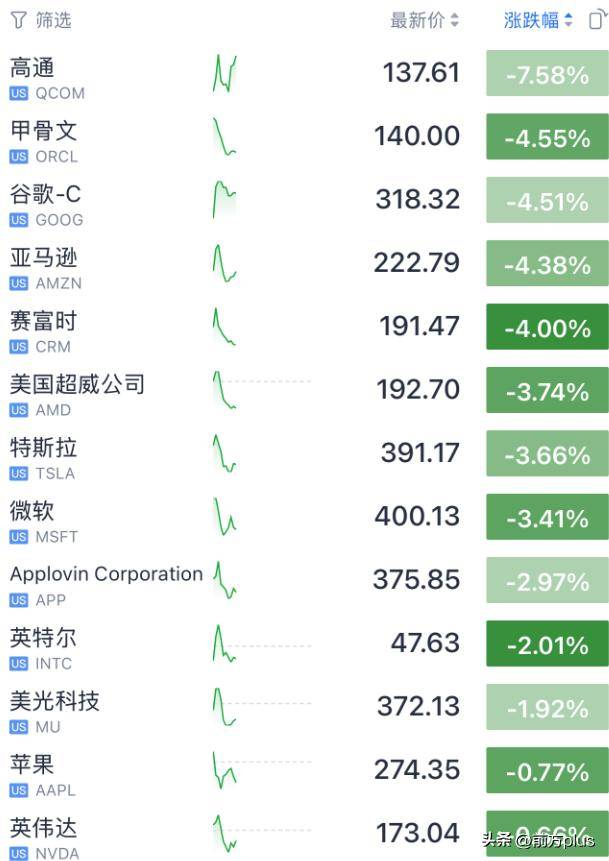
Market Overview - Global markets experienced a significant downturn, with major U.S. stock indices falling sharply; the Dow Jones dropped approximately 600 points, and the Nasdaq fell nearly 2% [1] - Technology stocks collectively declined, with notable drops in major companies [1] Company Performance - Qualcomm's stock fell by 7.58% to $137.61 after providing a lower-than-expected earnings guidance due to global memory shortages [2] - Alphabet, the parent company of Google, saw its stock decrease by 4% to $318.32, as it announced a substantial increase in AI-related capital expenditures, potentially reaching $185 billion by 2026 [6] - Other tech giants also faced declines, including Oracle (-4.55%), Amazon (-4.38%), and Tesla (-3.66%) [2] Commodity Market - Precious metals experienced a sharp decline, with silver prices plummeting over 16% [2] - Oil prices also saw a significant drop, contributing to the overall market downturn [3] Cryptocurrency Market - Bitcoin fell below the $70,000 mark, reaching $67,000, indicating a loss of interest from traditional investors and a growing pessimism towards cryptocurrencies [4] - The ongoing sell-off in the cryptocurrency market is attributed to diminishing confidence in Bitcoin as a store of value and inflation hedge [4] Economic Indicators - Concerns about a weakening labor market have intensified, with U.S. employers announcing 108,435 layoffs in January, the highest number for that month since the global financial crisis [6] - Initial jobless claims for the week ending January 31 also exceeded expectations, indicating potential economic challenges [6] - The U.S. Bureau of Labor Statistics reported that job vacancies fell to their lowest level since September 2020 by December 2025 [7]


美国四大科技巨头资本支出规模急剧攀升,2026年合计料达约6500亿美元
Ge Long Hui A P P· 2026-02-06 03:46
Core Insights - The four major U.S. tech companies are projected to collectively spend approximately $650 billion on capital expenditures by 2026, representing a growth of about 60% compared to the previous year, indicating a renewed surge in global data center construction [1] Company Summaries - Meta is expected to reach a capital expenditure of up to $135 billion in 2026, reflecting an increase of approximately 87% [1] - Microsoft anticipates a year-over-year capital expenditure growth of 66% in the second fiscal quarter of 2026 [1] - Alphabet has announced a capital expenditure plan of $185 billion [1] - Amazon forecasts its capital expenditures to reach as high as $200 billion in 2026 [1]
Alphabet Just Delivered Great News for Nvidia Stock Investors
The Motley Fool· 2026-02-06 03:30
Core Insights - Alphabet is significantly increasing its capital expenditure (capex) to $175 billion-$185 billion this year, doubling its spending from the previous year, which reflects its commitment to advancing its AI initiatives [2][4]. Financial Performance - Alphabet reported strong fourth-quarter earnings, surpassing estimates on both revenue and earnings, although the stock's recent rally has faced challenges due to pressures in the AI sector [1][2]. Capital Expenditure Plans - The planned capex is aimed at enhancing AI capabilities, particularly in developing cutting-edge models through Google DeepMind, and improving core business areas like advertising [4][5]. - Nvidia is highlighted as a crucial partner in this strategy, with Alphabet expected to be among the first to utilize Nvidia's new Vera Rubin GPU platform [4][5]. AI Market Dynamics - Alphabet's AI investments are showing positive returns, with 8 million paid seats sold for Gemini Enterprise shortly after its launch, indicating strong demand and growth potential in the AI sector [6]. - The increase in capital expenditures from major tech companies like Alphabet and Meta suggests that the AI boom is not only ongoing but also accelerating, which is favorable for Nvidia's growth prospects [7][8]. Industry Implications - The substantial capex from Alphabet and other tech giants indicates a robust outlook for the AI chip market, with expectations for Nvidia's revenue to potentially exceed the Wall Street consensus of a 52% increase for fiscal 2027 [8].
苹果、英伟达、谷歌押注AI,电子产业链有望乘势崛起!电子ETF(515260)拥抱科技巨头,抢占发展先机
Xin Lang Cai Jing· 2026-02-06 03:08
= 玉 本 金 苹果、英伟达、谷歌押注Al 电子产业链有望乘势崛起 无论是英伟达的巨额投资,还是谷歌TPU的明确量产 计划,都证实了AI算力需求强劲,这为半导体、服务器 等中上游产业链提供了持续的订单保障。苹果考虑分 散芯片代工、谷歌深化与特定元件商的合作,凸显了供 应链安全的重要性,这为中国相关产业链优质供应商 创造了切入或提升份额的机会。 电子剧 型 공 515260 代码 联接A 012550 联接C 012551 荟聚电子板块核心龙头 拥抱科技巨头 抢占发展先机 电子ETF标的指数覆盖热门科技概念,苹果、英伟达、谷 歌产业链权重占比分别为45.19%、27.87%、21.85%,深 度绑定全球科技龙头成长红利,有望受益于科技巨头产 业扩张与技术创新。 英伟达产业链 苹果产业链 谷歌产业链 : 45% = 733% r 要 。 其股上市公司 以上公司仪作为背景就明 不代表该基金投资方向 n will and the will be the will be the will be the will be the will be the will be the with lll/得为王 电子板块迎 "喜报潮 ...

招财日报-20260206
Zhao Yin Guo Ji· 2026-02-06 01:44
Industry Insights - The Chinese medical examination industry is experiencing rapid growth, driven by an aging population and increasing health awareness, with a projected CAGR of 9.2% from 2020 to 2024 and an accelerated growth of 18.3% from 2024 to 2030 [6] - The penetration rate of medical examinations in China is approximately 40%, significantly lower than the 70% in developed countries, indicating substantial room for growth [6] - The market is characterized by a "public-led, private-catching-up" dynamic, with public hospitals holding a 69% market share and private institutions increasing their share to 24% [6] - Leading private examination institutions, such as Meinian Health and Aikang Guobin, are focusing on high-end services, which has resulted in an increase in average selling price (ASP) and profit margins [6] Company Insights - Google (GOOG US) reported a 4Q25 revenue growth of 18% to $113.8 billion, driven by strong performance in search and cloud services, with operating profit increasing by 16% to $35.9 billion [7] - The management has guided for capital expenditures of $175-185 billion for FY26E, significantly above consensus estimates, indicating a strong commitment to AI investments [7] - Zhongji Xuchuang (300308 CH) remains a solid investment, with a focus on pluggable optical modules expected to dominate the market during 2026-27, despite recent stock volatility [8] - Jizhi Jia (2590 HK) announced a 31.7% year-on-year increase in new orders for 2025, totaling 4.1 billion RMB, attributed to stable growth in mature markets and breakthroughs in specific sectors [9]

Buy Alphabet Stock After Strong Q4 Results or is it Too Soon?
ZACKS· 2026-02-06 01:16
Core Viewpoint - Alphabet reported strong Q4 results with significant revenue growth, but concerns over its high spending plans led to a slight dip in stock price [1][2]. Financial Performance - Q4 sales reached a record $97.23 billion, exceeding estimates by 2% and increasing 19% year-over-year, driven by a 48% surge in Google Cloud revenue to $17.66 billion [3]. - Q4 net income was a record $34.46 billion, translating to adjusted earnings of $2.82 per share, which beat expectations by nearly 10% and increased 31% from $2.15 a year ago [4]. - For the full fiscal year 2025, Alphabet's revenue surpassed $400 billion for the first time, totaling $403 billion, a 15% increase year-over-year, with adjusted EPS rising 34% to $10.13 [6]. Cloud and AI Focus - Google Cloud backlog reached $240 billion at the end of Q4, reflecting a 55% sequential increase, indicating strong demand for AI-driven services [8]. - Alphabet's capital expenditures for 2026 are projected to be between $175 billion and $185 billion, nearly double the $91 billion to $93 billion spent in 2025, focusing on AI compute capacity and cloud infrastructure [9]. Return on Investment - Alphabet boasts a return on invested capital (ROIC) of 31.6%, significantly above the 20% benchmark, suggesting effective capital utilization despite increased spending concerns [10]. - The company has the highest ROIC among major cloud service competitors, indicating strong profitability potential in the AI sector [11]. Strategic Positioning - Alphabet is positioning itself to lead in AI infrastructure and enterprise AI services, although its capital expenditure guidance raises questions about near-term profitability [12]. - The company maintains a strong balance sheet with over $98 billion in cash and equivalents, and its stock trades at a reasonable 30X forward earnings multiple [14].

Omdia:AI与Micro-LED创新技术将重塑2026年巴塞罗那ISE展会ProAV领域
Canalys· 2026-02-06 01:03
Core Insights - Omdia's latest analysis indicates that AI, cybersecurity, robotics, and sustainability are accelerating their integration, reshaping the Pro AV market ahead of the Integrated Systems Europe (ISE) 2026 event in Barcelona, scheduled for February 3-6, 2026 [1] Group 1: AI-Driven AV Technology - AI is redefining the Pro AV industry, extending its impact beyond software to dedicated hardware innovations optimized for AI. Manufacturers are expected to showcase AI-driven AV technologies that upgrade professional displays from mere content playback devices to intelligent interactive terminals [2] - These displays will integrate multimodal perception capabilities, including visual, voice, and environmental awareness, combined with edge AI reasoning for real-time, personalized content presentation and adaptive content management [2] - A key challenge for the industry is scaling these solutions and promoting them across various verticals, which relies on ecosystem collaboration, supply chain maturity, and the continuous improvement of industry standards [2] Group 2: Unified Communication and Collaboration Ecosystem - Major collaboration platforms like Microsoft Teams, Zoom, and Google are expected to showcase integrated solutions aimed at simplifying Pro AV deployment and providing a consistent collaboration experience across various meeting spaces [2] - As enterprises continue to upgrade meeting rooms and office spaces, platforms such as Microsoft Teams, Zoom, and Google Meet are becoming standard for collaboration, leveraging their deep integration advantages within their ecosystems [2] - There is an increasing investment in officially certified collaboration display devices and video conferencing terminals optimized for Teams, Zoom, and Google Meet, although the lack of native interoperability between these platforms remains a significant challenge for enterprises seeking flexibility and a unified experience [3] Group 3: Emerging Display Technologies - Innovations in electronic paper technology are being pursued, with advantages such as glare-free and flicker-free displays, energy efficiency, and eye protection. However, current size limitations (primarily below 31.5 inches) restrict its application mainly to indoor or semi-outdoor environments [6] - Micro-LED technology is driving the transition of display products from "traditional screens" to "spatial interactive interfaces." While pixel pitch is not expected to shrink below 0.3mm in the short term, cost reductions and yield improvements are anticipated by 2026 [6] - The ISE 2026 event may also showcase higher brightness fixed-size outdoor displays, 21:9 all-in-one display products, larger OLED displays with professional AV characteristics, and other cutting-edge display technology products [6]


RDDT Takes Big Steps as "Baby" META, Faces Double-Edged Sword in GOOGL
Youtube· 2026-02-06 01:01
Core Insights - Reddit's stock has faced challenges, down approximately 30% year-over-year, but sentiment data shows positive engagement trends [2][3] - Advertising growth on Reddit is significant, with a 111% year-over-year increase in ad site visits, outperforming competitors like Pinterest, Snapchat, and Meta [3] - The partnership with Google and its Gemini AI platform poses a potential risk, as Google is prioritizing YouTube over Reddit for traffic [4][5][9] Financial Performance - Reddit is expected to report a strong quarter based on current metrics, with gross margins above 90% and EBITD margins around 60% [8] - Average revenue per user is growing rapidly, indicating effective monetization strategies, although there is a need for better monetization overall [6][8] Market Position and Future Outlook - Despite current challenges, Reddit is seen as having a strong long-term trajectory, with significant opportunities for growth [14][15] - The company is in a critical phase where it must navigate short-term issues while building out long-term solutions [15] - There is speculation about potential acquisition interest from larger companies like Google or Amazon, but current valuations may not support such moves [17][20]