Alphabet(GOOG)

Search documents
全球大公司要闻 | 亚马逊谷歌资本支出激增,英伟达首次推迟游戏芯片发布
Wind万得· 2026-02-06 00:43
Group 1 - Meituan has agreed to acquire Dingdong Fresh Holding Limited for $717 million, which will make Dingdong a wholly-owned subsidiary of Meituan, enhancing its core competitive advantages on a larger platform [3] - Nvidia will not launch new gaming graphics chips this year due to a shortage of storage chips, marking the first time in thirty years, and will reduce the production of the current GeForce RTX50 series [3] - Amazon announced a capital expenditure of approximately $200 billion for 2026, exceeding market expectations, primarily for cloud infrastructure and AI technology development [3] Group 2 - Alphabet's Q4 revenue reached $113.83 billion, a year-on-year increase of 18%, with Google Cloud revenue growing by 48% to $17.66 billion [4] - NIO expects to achieve an adjusted operating profit of 700 million to 1.2 billion yuan in Q4 2025, marking its first quarterly profit [4] Group 3 - Baidu's board has approved a $5 billion share buyback plan and a dividend policy, with the first dividend expected in 2026, reflecting confidence in its growth prospects [6] - TSMC plans to invest approximately $17 billion in its Kumamoto plant for 3nm chip production, while also evaluating adjustments to its second wafer fab's process planning [6] - Guoxuan High-Tech plans to issue A-shares to raise up to 5 billion yuan for various battery projects and to supplement working capital [6] Group 4 - Samsung Electronics announced the construction of a dedicated HBM4 DRAM production line at its P4 plant, aiming to increase production capacity by nearly 20% [12] - Toyota continues to focus on hybrid vehicles after achieving six consecutive years of global sales leadership, with a projected decline in net profit for Q3 [12] - Sony Group's Q3 operating profit was 515.04 billion yen, exceeding market expectations, and it raised its full-year operating profit forecast to 1.54 trillion yen [12]



早报 (02.06)| 血洗全球!金银、原油、美股、币圈集体崩盘;亚马逊砸2000亿美金豪赌AI;OpenAI与Anthropic王炸对决
Ge Long Hui· 2026-02-06 00:33
Group 1: Amazon Financial Performance - Amazon reported Q4 sales of $213.39 billion, exceeding the estimate of $211.49 billion, with earnings per share of $1.95, slightly below the forecast of $1.96 [2] - The company plans to invest approximately $200 billion in capital expenditures by 2026, indicating a strong commitment to growth and technology investment [2] - Amazon's projected revenue for Q1 is between $173.5 billion and $178.5 billion, reflecting continued growth expectations [2] Group 2: Stock Market Overview - Major U.S. stock indices experienced declines, with the Dow Jones down 1.2%, Nasdaq down 1.59%, and S&P 500 down 1.23% [3][4] - Large tech stocks saw significant drops, with Microsoft down nearly 5%, Amazon down over 4%, and AMD down over 3% [3][4] - The Nasdaq China Golden Dragon Index rose by 0.9%, with mixed performance among popular Chinese stocks [3] Group 3: Global Asset Performance - International oil prices fell sharply, with WTI crude oil down 2.84% to $63.29 per barrel and Brent crude down 2.75% to $67.55 [4] - Precious metals also declined, with spot gold down 1.27% to $4719.69 per ounce and silver down 5.51% to $67.07 per ounce [4] - Bitcoin dropped below $63,000, trading at $62,800, while Ethereum fell over 2.72% to $1,818 [4] Group 4: AI Developments - OpenAI launched a new coding model, GPT-5.3 Codex, which is 25% faster than its predecessor and allows users to create complex software using natural language [6] - Anthropic released a new AI model, Claude Opus 4.6, designed for financial research, which can analyze corporate data and generate detailed financial reports [8] Group 5: Mergers and Acquisitions - Meituan announced plans to acquire Dingdong for approximately $717 million, which will integrate Dingdong's financial performance into Meituan's reports [9] - NIO expects to achieve its first quarterly profit in Q4 2025, with adjusted operating profit projected between 700 million and 1.2 billion yuan [10]





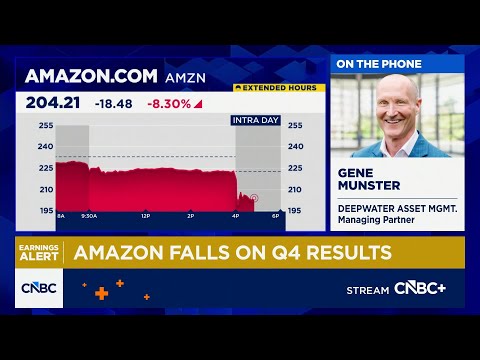
About 80% of Amazon's 2026 capex spending likely AI-related: Deepwater's Munster
CNBC Television· 2026-02-06 00:25
Um, let's dig into the huge capex forecasts from this week as well as tonight. Joining us on the phone, Gene Munster, Deep Water Asset Managing Partner. Gan, great to have you with us.I want to pick up uh where Kate left off with that statement from Andy Jasse about capex and how that capex will be deployed. Is there some fear that the 200 billion it's not it's not a pure let's seize the moment in AI. It's let's also spend on robotics and you know orbital satellites and all sorts of other things.Well, Googl ...

About 80% of Amazon's 2026 capex spending likely AI-related: Deepwater's Munster
Youtube· 2026-02-06 00:25
Core Insights - The significant capital expenditure (capex) forecasts indicate a strong commitment from major companies towards AI and related technologies, with a notable portion of the spending directed towards robotics and satellite technologies [1][2][4] - Approximately 80% of the capex is expected to be AI-related, reflecting the companies' confidence in the future of AI and its potential impact on their business models [2][4] - The anticipated $600 billion in capex from a select few companies suggests a substantial shift in revenue and profit pools within the software industry, indicating a potential disruption [3][4] Company-Specific Insights - Companies like Google and Amazon are expected to continue investing heavily in AI, with their capex numbers signaling a long-term commitment to this transformation [5][6] - The market's reaction to these capex announcements, particularly in the software sector, raises questions about the competence of these companies in navigating the evolving landscape [4][5] - The ongoing investment in AI infrastructure is seen as a precursor to increased utility and disruption across various sectors, not limited to software [6][7]

Amazon, and Qualcomm stocks sink following earnings, bitcoin plunges
Youtube· 2026-02-05 23:54
Core Insights - The article discusses Amazon's significant increase in capital expenditures (capex), projecting it to reach $200 billion by 2026, which is substantially higher than previous estimates of around $140 billion and consensus estimates of approximately $146 billion [2][5][4] - The acceleration of Amazon Web Services (AWS) growth to 24% is highlighted as a positive aspect, exceeding market expectations of 21-22% [2][3] - The competitive landscape among major tech companies, including Google, Microsoft, and Meta, is driving aggressive investments in compute resources to meet rising AI demand [7][19] Capital Expenditures - Amazon's capex for 2026 is projected at $200 billion, representing a 50% increase from 2025, which itself was a 60% increase from 2024 [3][4] - Analysts had previously estimated a much lower capex, indicating a significant upward revision in spending expectations [5][2] - The high capex is seen as necessary for Amazon to capture AI demand and maintain its competitive edge [4][19] AWS Growth - AWS growth has accelerated to 24%, which is a critical metric for evaluating the effectiveness of Amazon's increased spending [2][12] - Analysts expect AWS growth estimates to rise further due to the substantial capex commitment [12] - AWS margins have been solid, hovering around the mid-30% range, with potential for further improvement [12][13] Competitive Landscape - Major tech companies are competing for compute resources, which are essential for sustaining market advantages in the AI space [7][19] - Amazon's previous underinvestment in compute resources is acknowledged, emphasizing the need for increased spending to avoid falling behind competitors [9][19] - The demand for compute resources remains high, with companies like Nvidia experiencing sustained demand for their products [9][19] Long-term Outlook - The long-term growth potential for Amazon is supported by its high-margin businesses, including AWS and advertising, which are expected to drive significant operating margin expansion over the next 5 to 10 years [23][24] - Amazon is projected to exceed $1 trillion in annual revenue within the next decade, indicating substantial earnings potential [24] - The perception of Amazon as playing catch-up in the AI space is acknowledged, but the company is making progress in scaling its capabilities [25][28]


AI高支出疑虑加剧道指跌近600点,微软重挫近5%,白银暴跌逾一成
Di Yi Cai Jing Zi Xun· 2026-02-05 23:29
2026.02.06 本文字数:2000,阅读时长大约4分钟 作者 |第一财经 胡弋杰 周四,美国股市全线走低,科技权重股再度承压,微软、亚马逊跌超4%,市场对人工智能相关巨额资 本支出的焦虑持续发酵。与此同时,贵金属市场剧烈波动,白银价格出现断崖式下跌。 | 道琼斯工业 | 纳斯达克指数 | 标普500 | | --- | --- | --- | | 48908.72 | 22540.59 | 6798.40 | | -592.58 -1.20% | -363.99 -1.59% | -84.32 -1.23% | 截至收盘,道琼斯工业指数下跌1.20%,报48908.72点;标普500指数下跌1.23%,报6798.40点;纳斯达 克综合指数下跌1.59%,报22540.59点。标普500指数与纳指均连续第三个交易日收跌,其中纳指本周累 计跌幅接近4%。 热门股表现 权重科技股普遍承压。微软重挫4.95%,亚马逊下跌4.4%,谷歌A类股下跌0.54%,谷歌C类股下跌 0.60%;特斯拉下跌2.17%,,苹果小幅下跌0.21%,Meta Platforms小幅上涨0.18%。芯片股分化,英伟 达下跌1.33 ...

全线暴跌,黄金、白银、原油、币圈、美股全崩了!
Xin Lang Cai Jing· 2026-02-05 23:24
来源:中国基金报 【导读】全线暴跌 中国基金报记者 泰勒 兄弟姐妹们啊,今晚全线暴跌,黄金、白银、原油、币圈、美股全崩! 一起看看发生了什么事情。 2月5日晚间,全球市场大溃败,美股三大指数大跌,道指跌约600点,纳指跌近2%。 科技股集体下跌。 | 了 筛选 | | 最新价 = | 涨跌幅 = □" | | --- | --- | --- | --- | | 高通 | N | 137.61 | -7.58% | | us QCOM | | | | | 甲骨文 | | 140.00 | -4.55% | | us ORCL | | | | | 谷歌-C | | 318.32 | -4.51% | | us GOOG | | | | | 亚马逊 | 1 | 222.79 | -4.38% | | US AMZN | | | | | 赛富时 | | 191.47 | -4.00% | | us CRM | | | | | 美国超威公司 | | 192.70 | -3.74% | | US AMD | | | | | 特斯拉 | | 391.17 | -3.66% | | US TSLA | | | | | 微软 ...

华尔街见闻早餐FM-Radio | 2026年2月6日
Hua Er Jie Jian Wen· 2026-02-05 23:23
Market Overview - US employment data shows weakness, leading to a decline in US stocks, with all three major indices dropping over 1% and small-cap stocks leading the decline, as the Russell 2000 fell by 1.8% [2] - The S&P 500 saw declines in 9 out of 11 major sectors, with software stocks ETF dropping by 5%, Oracle down nearly 7%, and Microsoft down nearly 5% [2] - Cryptocurrency and silver experienced significant drops, with Bitcoin falling by 12% to below $63,000, marking a nearly 50% decline since last October [4] Bond Market - Risk aversion has driven US Treasury yields significantly lower, with the 10-year yield dropping by 9 basis points to 4.19% and the 2-year yield also down by 9 basis points to 3.46%, reaching a near one-month low [3] Commodity Market - Gold prices fell by 4% to $4,763.2 per ounce, while silver plummeted by 19% to around $70.84 per ounce [12] - WTI crude oil prices dropped approximately 2.84% to $63.29 per barrel [12] Company News - Foxconn (Hon Hai) reported January sales of NT$730 billion, a 35.5% year-on-year increase, reflecting strong demand for AI infrastructure [17] - Meituan has acquired Dingdong Maicai, indicating consolidation in the Chinese e-commerce market [18] Employment Data - The US JOLTS job openings for December hit a five-year low, significantly below expectations, indicating a cooling labor market [19] - Challenger companies announced layoffs of 108,435 in January, the highest for the month since 2009, with a 205% month-on-month increase [19] Central Bank Actions - The Bank of England maintained its interest rate at 3.75%, with a close 5-4 vote indicating a strong signal for potential rate cuts [21] - The European Central Bank held rates steady for the fifth consecutive time, citing challenges in predicting inflation [20] Technology Sector - Amazon's Q4 revenue grew by 14%, with AWS revenue exceeding expectations, but the company’s stock fell over 10% post-earnings due to high capital expenditure guidance of $200 billion for the year [22] - Nvidia announced delays in releasing new gaming chips due to a shortage of storage chips, prioritizing AI business needs [22] AI Developments - Anthropic launched a financial research AI model, causing significant drops in stock prices for traditional financial information services like FactSet and Reuters [23] - OpenAI introduced its enterprise-level AI agent platform, Frontier, aimed at automating business processes, amidst growing competition in the AI space [24]


华尔街那些最热门的交易,全线退潮!
美股IPO· 2026-02-05 23:11
Group 1 - The market is experiencing a shift from risk-on to risk-off sentiment, with a series of accumulated news triggering concerns over asset valuations, leading to simultaneous investor withdrawals [3][4][11] - The S&P 500 index fell by 1.2%, marking its third consecutive day of decline, while the Nasdaq 100 index saw its deepest correction since April of the previous year [4] - Software stocks continue to decline, with new AI models posing competitive threats to existing financial research practices [5] Group 2 - Silver prices plummeted by 17%, while Bitcoin experienced a 10% drop, erasing all gains since Trump's election victory 15 months ago, as investors began to unwind leveraged positions [6] - U.S. Treasury bonds rebounded, reaffirming their role as a traditional "safe haven" [7] - Alphabet's stock price fell despite exceeding revenue expectations, as ambitious spending plans raised concerns among analysts about excessive investments in AI [8] Group 3 - The current market dynamics contrast sharply with earlier predictions of a prolonged bull market, which were based on assumptions of sustained AI momentum and resilient economic support for corporate profits [8] - Investors are increasingly questioning which companies will survive the AI wave and whether the significant investments in this technology will yield returns [9] - The overall market sentiment reflects fear and uncertainty, indicating a potential reset after rapid price increases in popular stocks and assets like gold [11]

当视频不再被观看,而是被「进入」:谷歌世界模型与教育想象的边界
3 6 Ke· 2026-02-05 23:09
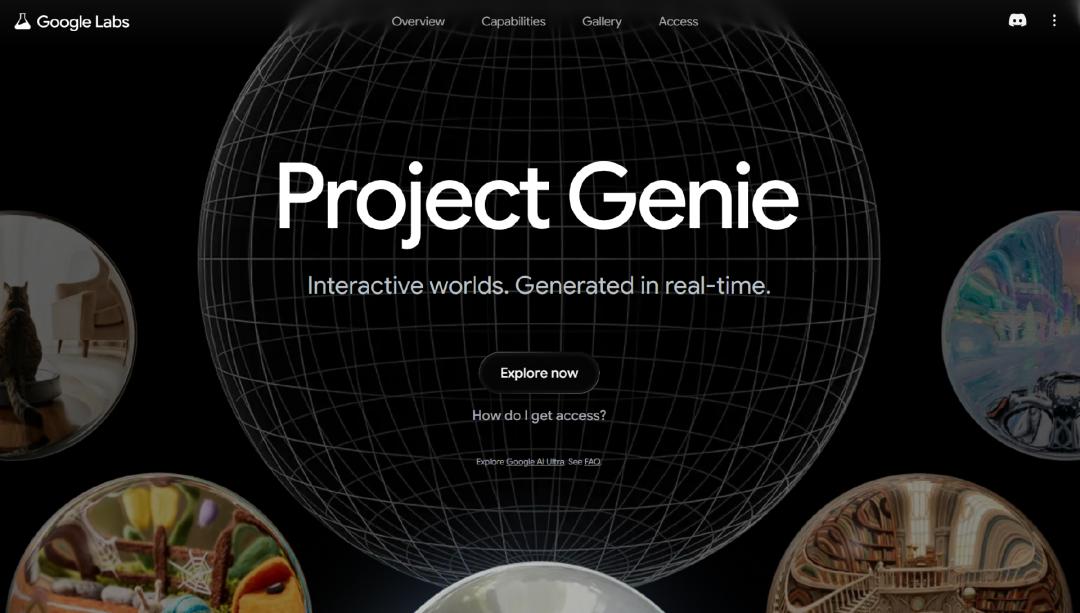
Core Insights - Google DeepMind has opened Project Genie to the public, marking a significant step in its World Model research, allowing users to interact with a generated world [1] - The evolution of generative AI is shifting from content generation to creating immersive environments that can be entered and manipulated, fundamentally changing the concept of media [2][3] Industry Perspective - The concept of video is evolving from passive viewing to an interactive space, where users can engage with content in a more dynamic way, as highlighted by a16z's predictions for 2026 [2] - Project Genie represents a breakthrough in understanding video as an environment rather than a sequence of frames, focusing on maintaining continuity and user interaction [4][12] Technological Advancements - Project Genie aims to redefine the generation of content by treating it as an environment with rules and causal relationships, rather than merely predicting the next frame in a sequence [4][12] - The model introduces three key advancements: maintaining basic temporal continuity, allowing user actions to influence subsequent states, and shifting from frame-by-frame prediction to state updates [4][12] Educational Implications - The potential of world models in education lies in reducing the cost of creating high-quality learning environments, which has traditionally been a barrier to experiential learning [13][14] - World models could transform education by enabling immersive learning experiences, where students actively participate in their learning process rather than passively receiving information [14][15] Future Considerations - The impact of Project Genie on the education sector is seen as a long-term shift in how education is presented and engaged with, rather than an immediate solution [15][16] - The focus should be on whether education can evolve into a continuous participatory process, rather than just a series of consumable content [15][16]