
HP(HPQ)

Search documents
卫星物联网进入商用试验,万科债券盘中临时停牌 | 财经日日评
吴晓波频道· 2025-11-27 00:29
Group 1: Satellite IoT Commercial Trials - The Ministry of Industry and Information Technology (MIIT) of China has initiated commercial trials for satellite IoT services to enhance market supply and stimulate industry vitality, aiming for a two-year trial period [2] - The trials are expected to establish a regulatory framework and promote the technology's application in sectors like agriculture and logistics, thereby supporting the development of commercial aerospace and low-altitude economies [2][3] - Current domestic satellite IoT applications are limited, with high costs hindering widespread adoption; the trials may help identify profitable pathways and unify standards [3] Group 2: Credit Repair Management - The National Development and Reform Commission (NDRC) has introduced a credit repair management method that classifies credit information based on severity, with minor infractions generally not being publicly disclosed [4] - The new method allows for a clearer path to credit repair, enabling individuals to rectify minor credit issues after fulfilling their obligations [5] Group 3: U.S. Consumer Confidence and Economic Indicators - U.S. consumer confidence has dropped significantly, with the November index falling to 88.7, the second-lowest in five years, indicating a cautious consumer sentiment amid rising unemployment and persistent inflation [6][7] - Retail sales growth in September was only 0.2%, below expectations, suggesting a cooling consumer market as households become more price-sensitive [6][7] Group 4: Alibaba's Financial Performance - Alibaba reported a 5% year-on-year revenue increase to 247.8 billion yuan for Q2 of fiscal year 2026, exceeding market expectations, with a notable 16% growth in its Chinese e-commerce segment [8] - The company experienced a significant decline in net profit, down 52% to 20.99 billion yuan, attributed to high capital expenditures in AI and cloud infrastructure [8][9] - Alibaba's cloud revenue grew by 34%, driven by strong demand for AI-related products, marking the ninth consecutive quarter of triple-digit growth in this segment [8] Group 5: NIO's Financial Results - NIO reported a 16.7% year-on-year revenue increase to 21.79 billion yuan for Q3 2025, with a gross margin improvement to 13.9%, the highest in nearly three years [10] - The company achieved positive operating cash flow for the first time, with cash reserves reaching 36.7 billion yuan, a significant increase from the previous quarter [10] - NIO anticipates delivering between 120,000 to 125,000 vehicles in Q4, representing a year-on-year growth of 65.1% to 72% [10][11] Group 6: HP's Workforce Reduction - HP announced plans to cut 4,000 to 6,000 jobs by fiscal year 2028 as part of a strategy to streamline operations and enhance productivity, aiming to save $1 billion over three years [12] - The company is also focusing on integrating AI to accelerate product development amid a slowing PC market [12][13] Group 7: Vanke's Bond Market Activity - Vanke's bonds experienced significant declines, with "22 Vanke 02" dropping over 30%, leading to temporary trading halts [14][15] - The company has been relying on loans from Shenzhen Metro Group to address liquidity issues, but this is insufficient to resolve its broader financial challenges [14][15]





AI热潮引爆内存芯片“超级周期”!供应短缺及涨价或延续至2026年
Zhi Tong Cai Jing· 2025-11-27 00:26
Core Insights - Several technology companies, including Dell Technologies and HP, have warned of a potential shortage of memory chips next year due to a surge in demand driven by AI infrastructure development [1][3] - Market research firm Counterpoint Research predicts that memory module prices could rise by 50% by the second quarter of next year [1] - The shortage of memory chips may increase manufacturing costs across various products, from smartphones to medical devices and automobiles [1] Group 1: Company Responses - Dell Technologies is adjusting its configurations and product mix, considering options such as repricing some devices due to rising costs [2] - HP's CEO indicated that the second half of 2026 will be particularly challenging, and the company may raise prices as necessary [2] - Apple has a more optimistic outlook, with its CFO noting a slight tailwind in memory prices while emphasizing effective cost management [2] Group 2: Market Dynamics - The memory chip industry is entering what analysts refer to as a "super cycle," with manufacturers prioritizing high-bandwidth memory (HBM) production over traditional memory types [3][7] - Major players like Samsung and SK Hynix are shifting their focus to higher-margin, advanced memory products, planning to cease DDR4 production by late 2025 [6] - Morgan Stanley estimates that tech giants will invest $400 billion in AI infrastructure this year, exacerbating the supply constraints for non-HBM memory chips [6] Group 3: Price Trends - The price of RAM has surged significantly, with 4GB DDR4X chips rising from $7 to over $30 per unit, a 3-4 times increase [6] - NAND flash memory prices have also increased, with 64G eMMC chips going from $3.2 to over $8, a nearly 1.5 times rise [6] - The ongoing demand for memory chips is expected to sustain price increases for several quarters [8]


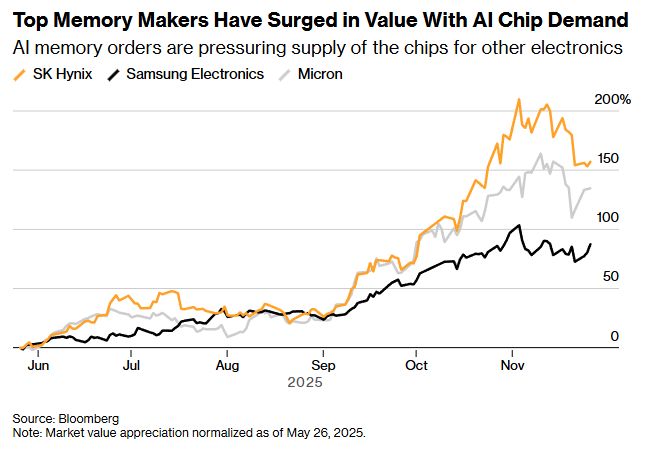
Tech Firms From Dell to HP Warn of Memory Chip Squeeze From AI
Yahoo Finance· 2025-11-26 20:14
Core Insights - Tech companies, including Dell Technologies and HP, are warning of potential memory-chip supply shortages due to increased demand from artificial intelligence infrastructure buildout [1][3] - Consumer electronics manufacturers, such as Xiaomi and Lenovo, are anticipating price increases and are stockpiling memory chips in response to rising costs, with a forecasted 50% price rise for memory modules through Q2 of next year [2][3] Industry Impact - A shortage of memory chips could lead to increased manufacturing costs for a wide range of products, including phones, medical equipment, and cars, as these chips are essential for data storage in modern electronic devices [3] - The AI boom is contributing to the shortage as manufacturers prioritize production for more complex and profitable AI-related products, impacting the availability of more common memory types [3] Company Responses - Dell has reported unprecedented cost increases and tighter supplies of dynamic random access memory (DRAM), NAND flash memory, and hard drives, indicating that these cost increases will inevitably affect customers [4][6] - HP anticipates significant challenges in the latter half of 2026 and plans to increase prices where necessary, while also exploring options to mitigate the impact of memory shortages [5][6] - Companies are taking proactive measures, such as bringing on more memory suppliers and reducing memory in products, with memory accounting for 15% to 18% of the cost of a typical PC [6]
What Kevin Hassett could mean for the future of the Fed, plus new tax info for crypto investors
Youtube· 2025-11-26 19:57
Market Overview - The stock market is experiencing a rebound, with the Dow rising by approximately 0.33% (about 160 points), the S&P 500 up by about 0.33%, and the Nasdaq increasing by about 0.25% ahead of the Thanksgiving holiday [1] - Large-cap tech stocks are showing mixed performance, with Alphabet down by 1% and Nvidia rising, indicating sector volatility [1] - Utilities and energy sectors are performing well, while consumer discretionary and communications services are lagging, with healthcare being the best performer this quarter [1] Federal Reserve and Economic Outlook - Markets are pricing in a potential rate cut in December, with Kevin Hasset emerging as a front-runner to replace current Fed Chair Jerome Powell [1][2] - Economic growth is expected to pick up in 2026, with GDP growth projected to be slightly below trend this year but improving due to tax season benefits for mid to lower-end consumers [1][2] - AI spending is estimated to contribute about 1.5% to GDP, accounting for approximately 25% of current GDP growth, indicating its importance but not suggesting a bubble [1][2] Consumer Spending and Holiday Shopping - A new survey indicates that 41% of consumers plan to do most of their holiday shopping between Thanksgiving and Cyber Monday, with 29% of holiday budgets already spent by November 1st [2][3] - Despite a cautious consumer sentiment, actual spending is anticipated to increase by 3-4% year-over-year during the holiday season, driven by discounts and promotions [2][3] - The spending behavior varies by income cohort, with lower to middle-income consumers trading down and seeking discounts, while higher-income consumers continue to spend significantly [2][3] Retail Sector Insights - Retailers like Abercrombie, Steve Madden, and TJX are expected to perform well during the holiday season due to product innovation and effective management of tariffs [4][5] - The retail market is experiencing a bifurcation, with lower-income consumers being more cautious while higher-income consumers are maintaining spending levels [4][5] - Gen Z and baby boomers are projected to be significant spenders, with Gen Z showing a shift towards in-store shopping despite initial plans to cut back [4][5] Technology Sector Developments - Alphabet's stock is nearing a $4 trillion market cap following the successful launch of its Gemini 3 AI model, outperforming other tech stocks [6] - Meta is reportedly in talks with Google to spend billions on Google's chips and data centers, indicating strong demand for AI-related technologies [6] - Analysts suggest that the market is currently favoring Google, but there may be better investment opportunities in companies like Meta and Oracle, which have been oversold [6]



Wall Street Extends Gains as Rate Cut Hopes Fuel Afternoon Rally, Tech Leads the Charge
Stock Market News· 2025-11-26 19:07
Market Overview - U.S. equities continued to rise, with major indexes extending a multi-day winning streak, driven by optimism for a Federal Reserve interest rate cut in December and dovish economic data releases [1][8] - The Nasdaq Composite led the gains, climbing 1%, while the S&P 500 and Dow Jones Industrial Average rose 0.9% each, marking their fourth consecutive day of gains [2][3] Economic Indicators - Expectations for a 25-basis-point rate cut by the Federal Reserve in December are high, with probabilities around 80-85%, supported by weaker-than-expected economic data [3][6] - Recent economic data included a decline in September retail sales, a softer Producer Price Index (PPI), decreased consumer confidence, and a drop in private payrolls [3] Sector Performance - Technology stocks were the primary drivers of the market rally, with the "Magnificent Seven" technology stocks significantly contributing to the overall market performance [4] - The Health Care Select Sector SPDR and Consumer Discretionary Select SPDR also performed well, gaining 2.3% and 2.1% respectively, while the housing sector benefited from a decline in Treasury yields [4] Corporate News and Stock Highlights - Apple shares rose about 1% as it is expected to surpass Samsung in global smartphone shipments for the first time in 14 years [7] - Dell Technologies surged 6-6.4% after announcing record orders for its AI servers, indicating strong demand in the AI infrastructure space [11] - Advanced Micro Devices (AMD) rose approximately 3.5%, while Broadcom gained about 3% [11] - Nvidia experienced a significant drop of 2.6-3.9% on Tuesday but rebounded slightly on Wednesday, facing increased competition in the AI chip market [11] - Urban Outfitters soared between 10% and 12.1% after reporting stronger-than-expected quarterly results, while Workday sank 9% despite positive earnings [11] - Petco surged 19.8% after raising its fiscal year earnings outlook, and Robinhood Markets jumped 10.7% following plans to launch a futures and derivatives exchange [11]




HP Joins Big Tech Companies Laying Off Workers Amid AI Push
Investopedia· 2025-11-26 18:15
Core Insights - HP plans to lay off between 4,000 and 6,000 employees as part of a cost-cutting initiative aimed at saving $1 billion over the next three fiscal years, which could represent up to 10% of its workforce [2][8] - Despite reporting better-than-expected revenue of $14.6 billion for the fiscal fourth quarter, HP's profit outlook for fiscal 2026, projected at $2.90 to $3.20 in EPS, fell below analyst consensus [5][6] - The layoffs at HP reflect a broader trend in the tech industry, where companies like Amazon and Microsoft are also reducing their workforce while increasing investments in AI [4][5] Company Strategy - CEO Enrique Lores emphasized the company's commitment to investing in AI-related initiatives, viewing it as a significant opportunity to enhance product innovation, customer satisfaction, and productivity [3] - The restructuring plan is part of a strategic move to align resources with the company's long-term goals, particularly in the context of rising AI investments [8] Market Reaction - Following the announcement of layoffs and the restructuring plan, HP's stock experienced a decline of approximately 2%, contributing to a year-to-date loss of nearly 27% [6]

阿科玛&惠普:推出S新一代先进3D打印用生物基PA11Gen2材料
DT新材料· 2025-11-26 16:04
Core Insights - Arkema and HP Additive Manufacturing Solutions have launched a new generation of HP 3D printing material, HR PA11 Gen2, which is 100% bio-based and enhances mechanical performance while significantly reducing carbon footprint [2][4]. Group 1: Mechanical Performance - HP 3D HR PA11 Gen2 offers consistent mechanical performance with improved repeatability and higher dimensional accuracy, achieving an excellent powder reuse rate of 80/20, which helps lower production costs and reduce waste [3]. - Compared to the previous generation, HP 3D HR PA11 expands the application potential in automotive, medical, and consumer goods sectors [3]. Group 2: Sustainability - Rilsan® PA11, derived from castor oil, contains 100% renewable carbon and is sourced responsibly from semi-arid regions, contributing to sustainability goals [4]. - The new generation of PA11 reduces the carbon footprint of final 3D printed parts by 20-30% compared to the previous specifications, aiding manufacturers in achieving their sustainability targets [4]. Group 3: Technology Platform - HP 3D HR PA11 Gen2 is designed for use with HP's Multi Jet Fusion (MJF) technology platform, providing manufacturers with a reliable and eco-efficient solution for high-performance parts production [5].

HPQ's Q4 Earnings Beat Estimates, Revenues Increase Y/Y
ZACKS· 2025-11-26 16:01
Core Insights - HP Inc. reported fourth-quarter fiscal 2025 earnings of 93 cents per share, exceeding the Zacks Consensus Estimate by 2.2%, but down from 96 cents per share a year ago [1] - The company's revenues for the fourth quarter were $14.64 billion, reflecting a year-over-year increase of 4.2%, but missing the Zacks Consensus Estimate by 2.2% [2] Revenue Breakdown - Personal Systems (PS) revenues, which account for 71% of net revenues, reached $10.4 billion, up 8% year over year, driven by strong demand in both commercial and consumer PC segments [3] - The Printing business, contributing 29% of net revenues, generated $4.27 billion, down 4% year over year, primarily due to declines in Supplies and Commercial Printing [4] Geographic Performance - Revenue growth was observed in all regions, with the Americas rising 1.1%, EMEA up 1.1%, and Asia Pacific & Japan growing 11% year over year [5] Operating Results - Personal Systems' non-GAAP operating margin was 5.8%, down 40 basis points year over year, while the Printing division's non-GAAP operating margin was 18.9%, down 70 basis points [6] - Overall non-GAAP operating margin for HP was 8.0%, contracting 80 basis points from the prior-year quarter [6] Financial Position - At the end of the fiscal fourth quarter, HP had $3.7 billion in cash and cash equivalents, an increase from $2.9 billion in the previous quarter [7] - The company generated $1.6 billion from operating activities and delivered $1.5 billion in free cash flow, returning $0.8 billion to shareholders through dividends and share repurchases [7] Summary of Earnings - HPQ's Q4 earnings beat estimates, with revenues rising 4.2% year over year, while Personal Systems revenues grew 8% due to stronger demand [9]

Best tech stocks to own as 2025 closes, why markets could see new highs if the Fed cuts rates in Dec
Youtube· 2025-11-26 15:56
Company Developments - HP is cutting 10% of its workforce to integrate AI tools, aiming for a billion dollars in productivity savings [19][20][21][26]. - The company is transitioning from pilot programs to specific initiatives across multiple areas, indicating a significant shift towards AI implementation [20][27]. Market Trends - The market is experiencing a resurgence, with stocks attempting to reach record highs as expectations for a 25 basis point rate cut by the Fed increase to 80% from 30% [3][28]. - The ECB has issued warnings about stretched valuations in the US tech sector, suggesting that fear of missing out (FOMO) is driving current market behavior [3][13]. AI Sector Insights - The AI trade is expected to persist for several years, with companies increasingly applying AI to enhance productivity and efficiency [17][18][24]. - There is a notable divergence in stock performance among major tech companies, with Alphabet gaining momentum while Nvidia faces pressure [7][9]. Investment Opportunities - Analysts suggest focusing on major players like Nvidia and Alphabet, as well as solution providers in sectors like healthcare that are leveraging AI [16][17]. - The current AI landscape is characterized by significant demand, particularly for Nvidia chips, with a reported 12 to 1 demand-supply ratio [40][46]. Economic Indicators - The Fed's upcoming meeting on December 10 is critical, with market participants closely monitoring language and guidance regarding future rate cuts [32][35]. - Concerns about a cooling labor market are influencing Fed policy discussions, with implications for inflation and economic stability [35][36].

转投人工智能 惠普裁员6000人
Bei Jing Shang Bao· 2025-11-26 15:54
Core Viewpoint - HP has announced a comprehensive AI transformation plan alongside a lackluster earnings report, indicating a shift towards AI to enhance business operations while also planning to lay off thousands of employees [1][2] Financial Performance - For Q4 ending October 31, HP reported a revenue increase of 4.2% year-over-year to $14.6 billion, slightly below analyst expectations of $14.8 billion [2] - Adjusted earnings per share decreased by 3% to $0.93, aligning with expectations [2] - The personal systems business saw an 8% revenue growth to $10.4 billion, driven by an upgrade cycle due to the end of Windows 10's lifecycle [2] - The printing segment experienced a revenue decline of 4% to $4.3 billion, with hardware sales down by 12% [2] AI Transformation Plan - HP plans to invest significantly in AI to accelerate product development, improve customer satisfaction, and enhance internal efficiency, transitioning from pilot projects to concrete initiatives [1] - The company anticipates laying off 4,000 to 6,000 employees by fiscal year 2028 and aims for annual savings of $1 billion [1] - An estimated $650 million will be invested in restructuring, with $250 million allocated for fiscal year 2026 [1] Market Context - Despite the AI hype boosting many tech stocks, HP's stock has underperformed, dropping nearly 17% over the past year while the S&P 500 rose by 15% [2] - Analysts have downgraded HP's stock rating to "neutral," citing a challenging environment as the company moves away from a favorable PC cycle [2] Industry Challenges - Rising costs of DRAM and NAND chips due to increased demand for AI infrastructure may pressure HP's profit margins [3] - Analysts predict HP could face a 120 basis point loss in gross margin and a $0.46 loss in earnings per share due to memory chip price increases [3] - HP is aware of the impact of rising storage chip prices and plans to take proactive measures, such as reducing memory configurations and adjusting prices [3] Competitive Landscape - Companies like Dell are also facing similar challenges with server costs and are expected to leverage market conditions to adjust pricing strategies [4]