
Hesai(HSAI)

Search documents
美股异动 | 禾赛(HSAI.US)涨逾2% 下一代L3车规级激光雷达解决方案将亮相CES 2026
智通财经网· 2025-12-16 15:29
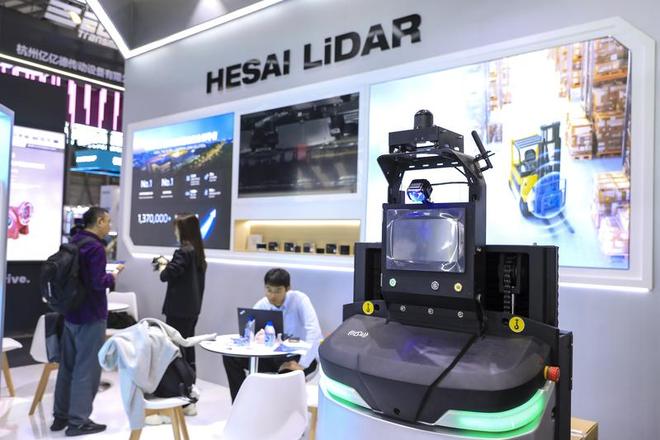
Core Viewpoint - Hesai Technology (HSAI.US) is set to showcase its latest innovations at CES 2026, highlighting its advancements in lidar technology and solutions for various applications [1] Group 1: Company Developments - Hesai's stock rose over 2% to $21.34 on Tuesday [1] - The company will present its updated ATX lidar featuring the Fermi C500 chip and photon isolation technology at CES 2026 [1] - The next-generation L3 automotive-grade lidar solutions, including the long-range ET series and short-range FT series, will be featured [1] Group 2: Product Highlights - The showcase will include several key products such as the mini high-performance 3D lidar JT series designed for robotics [1]

禾赛入选大摩机器人年鉴“人形机器人科技25强”
Xin Lang Cai Jing· 2025-12-16 08:40
全球激光雷达行业领导者禾赛科技近日成功入选摩根士丹利重磅发布的"Humanoid Tech 25(人形机器 人科技 25 强)"榜单。该榜单聚焦全球最具影响力的 25 家机器人及相关技术企业,禾赛凭借为机器人 在真实物理世界中规模化落地提供关键三维感知能力而获得高度认可,成为全球唯一入选的激光雷达公 司。与禾赛一同入选的还包括英伟达、超威半导体、索尼、三星、安森美、地平线机器人以及百度等多 家全球科技与机器人领域的标杆企业,充分彰显了禾赛在全球机器人产业链中的重要地位。(禾塞科 技) ...

Hesai Recognized as the Only Lidar Company on Morgan Stanley's "Humanoid Tech 25" of Global Robotics Leaders
Prnewswire· 2025-12-15 14:00
Core Insights - Hesai Technology has been recognized by Morgan Stanley as the only lidar company in the "Humanoid Tech 25" list, highlighting its influence in the robotics sector [1][4] - The report emphasizes that the robotics era is already in progress, with reliable perception being essential for the effective operation of robots [2] - Lidar technology is crucial for providing accurate 3D spatial perception, which is necessary for the functionality of 1.4 billion robots expected by 2050 [3] Company Positioning - Hesai has achieved significant milestones, including being the first automotive lidar company to exceed 2 million cumulative deliveries and maintaining the top market share for ADAS main lidar for nine consecutive months [4] - The company has developed four generations of proprietary ASICs, which enhance product reliability and manufacturing scalability, with production capabilities of one lidar every 10 seconds [4] - Hesai's JT-series mini 360° 3D robotics lidars have surpassed 200,000 cumulative deliveries, indicating strong market validation and adoption across various sectors [5] Industry Outlook - The demand for lidar units is projected to increase nearly 300 times from 2025 levels to support the perception needs of the anticipated 1.4 billion robots by 2050 [3] - Global robot hardware revenues are expected to reach $25 trillion by 2050, marking robotics as a significant computing and industrial platform [7] - As robotics applications expand, Hesai is positioned to play a foundational role in the development of the next generation of robotics and embodied AI [6]


交银国际_汽车行业2026年展望:穿越周期的新动能智驾商用、储能共振与机器人量产_
2025-12-15 02:13
Summary of the Conference Call Industry Overview - **Industry**: Automotive Industry - **Date**: December 5, 2025 - **Rating**: Leading - **2026 Outlook**: New driving forces through cycles - smart driving commercial use, energy storage resonance, and mass production of robots [1] Key Points Automotive Market Trends - **Passenger Vehicles**: - After stimulus, the market is entering a high-level consolidation phase. - Expected retail sales for 2026 are projected to increase by 0.3% year-on-year to 24.45 million units, with a penetration rate of new energy vehicles (NEV) exceeding 60% [5][19]. - Growth is driven by product iterations and cost advantages from domestic brands in hybrid and pure electric technologies [5][20]. - **Exports**: - Total overseas sales are expected to reach 7.5-8 million units in 2026, with a shift towards localized manufacturing to address trade uncertainties [5][10]. - In the first ten months of 2025, cumulative exports reached 6.51 million units, a year-on-year increase of 23.3%, with NEVs accounting for nearly 40% of exports [10][36]. Heavy-Duty Trucks - **Market Growth**: - Anticipated sales for heavy-duty trucks in 2026 are around 1.1 million units, a 5% increase year-on-year, with better performance expected in the second half of the year [5][10]. - The market is benefiting from policy incentives and accelerated penetration of new energy vehicles [5][10]. Smart Driving - **L3 Commercialization**: - 2026 is expected to be the year of large-scale commercialization for L3 autonomous driving, with several manufacturers accelerating development [9][11]. - The penetration rate for L2 and above smart driving systems reached 87% in the first eight months of 2025 [9]. Robotics - **Market Development**: - The robotics sector is transitioning from "technological breakthroughs" to "commercial realization," with significant advancements expected in 2026 [13][14]. - The sector is entering a consolidation phase, focusing on actual delivery capabilities and performance realization [14]. Lithium Battery Sector - **Demand Growth**: - Global lithium battery demand is projected to grow by approximately 22% in 2026, with energy storage demand expected to grow faster than power batteries [15][16]. - The industry is experiencing a recovery in profitability, but caution is advised regarding the price of lithium carbonate and supply chain uncertainties [16][17]. Investment Recommendations - **Short-term (H1 2026)**: - Market adjustments may occur post-policy withdrawal, but structural opportunities will emerge, particularly in high-level smart driving [11]. - **Mid-term (H2 2026)**: - The entry of L3 into mass production will drive product iterations and new purchasing momentum [11]. - **Long-term (2027 and beyond)**: - Focus on the sustainability of embodied intelligence and the Robotaxi/AI ecosystem [11]. Additional Insights - **Market Dynamics**: - The automotive market is shifting from a growth-driven model to one focused on replacement demand, with significant implications for market structure and competition [19][20]. - **Technological Advancements**: - The integration of advanced technologies in vehicles is reshaping consumer preferences and driving demand for new energy vehicles [27][29]. This summary encapsulates the key insights and projections from the conference call, highlighting the automotive industry's evolving landscape and investment opportunities.



禾赛科技将于CES 2026发布L3级别远距激光雷达
Feng Huang Wang· 2025-12-12 13:35
Core Viewpoint - Hesai Technology will participate in CES 2026, marking its eighth consecutive appearance at the event [1] Group 1: Product Offerings - Hesai will showcase the upgraded ATX LiDAR featuring the new Fermi C500 chip, L3-level ET series long-range LiDAR, FT series short-range blind-spot LiDAR, and JT series mini 3D LiDAR for robotics [1] - The company has achieved a 25% penetration rate of LiDAR in China's new energy passenger vehicles [1] Group 2: Market Position and Orders - Hesai has secured mass production contracts with over 24 OEMs for more than 120 vehicle models, with plans for delivery between 2026 and 2030 [1] - The order volume for the upgraded ATX model has exceeded 4 million units, with mass production expected to start in April 2026 [1] Group 3: Robotics Applications - Hesai's LiDAR products are utilized in lawn mowing robots, smart companion robots, and 3D spatial scanning devices [1] - The company became the first global LiDAR manufacturer to surpass cumulative deliveries of 2 million units in November [1]

大摩预测了25家人形机器人公司将主导行业,没有宇树、智元
具身智能之心· 2025-12-12 07:59
Core Insights - Morgan Stanley predicts that 25 humanoid robot companies will dominate the industry, with 7 Chinese companies listed [2][3] - The Chinese companies include Baidu, Alibaba, Horizon Robotics, Junsheng Electronics, iFlytek, Desay SV, and Hesai Technology, focusing on various sectors such as AI, automotive, and electronic manufacturing [3][4] - The report emphasizes the importance of component and module suppliers over traditional humanoid robot manufacturers, highlighting the critical role of companies providing AI chips, visual sensors, precision actuators, and power management chips [3][4] Company and Industry Summary - The 7 Chinese companies identified are significant players in their respective fields, with a focus on AI, automotive intelligence, language recognition, and electronic manufacturing [3] - The absence of companies like Yushun and Zhiyuan in the report raised questions about its professionalism, but Morgan Stanley justified this by focusing on the foundational components essential for the humanoid robot industry [4] - The Chinese market has seen the emergence of nearly 150 humanoid robot startups, indicating a growing interest and investment in this sector, regardless of potential market bubbles [4]




突发,美国计划禁用中国传感器!
是说芯语· 2025-12-12 03:58
Core Viewpoint - The article discusses a proposal by U.S. lawmakers to phase out Chinese-made sensors, particularly LiDAR technology, used in autonomous vehicles and critical infrastructure due to national security concerns, highlighting the dominance of Chinese companies in this market [1][2][3]. Group 1: Legislative Actions - U.S. Congressman Raja Krishnamoorthi introduced a bill to gradually eliminate the use of Chinese LiDAR sensors, with a ban on new purchases starting in three years, while allowing exemptions for scientific and cybersecurity research [2][3]. - The bill includes a five-year transition period for existing equipment used in critical infrastructure [2]. Group 2: Market Dominance - Chinese companies dominate the LiDAR market, holding 93% of the passenger vehicle market share and 89% of the overall LiDAR market, according to Yole Group [2][3]. - The report identifies four major Chinese LiDAR manufacturers—Hesai Technology, RoboSense, Huawei, and TuSimple—collectively referred to as the "Big Four," which control 88% of the market [3][6]. Group 3: National Security Concerns - National security organizations warn that Chinese LiDAR could pose hacking risks during conflicts, potentially disabling large areas of the U.S. infrastructure within seconds [3][9]. - The U.S. Department of Defense has listed major Chinese LiDAR manufacturers as entities that assist the Chinese military, indicating a strong governmental stance against these companies [3][8]. Group 4: Ongoing Investigations - In November 2023, a group of 20 U.S. lawmakers urged the Biden administration to investigate all Chinese LiDAR companies for potential sanctions [6]. - The Department of Defense updated its list of Chinese military-related companies, including Hesai Technology, further intensifying scrutiny on these firms [7][8].
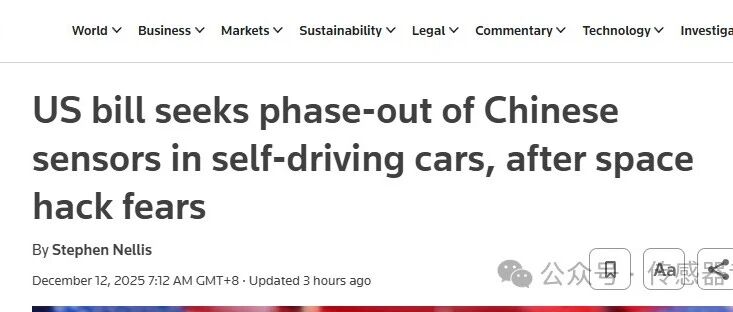
美议员加戏:别用中国的了,万一打起来…
Guan Cha Zhe Wang· 2025-12-12 01:47
Group 1 - The U.S. House of Representatives is targeting Chinese lidar sensors used in autonomous vehicles and critical infrastructure, proposing a bill to phase them out due to security concerns [1][3] - The bill mandates a ban on new procurement of Chinese lidar sensors after three years, with exemptions for research and cybersecurity, and a five-year transition period for existing equipment [1][3] - Chinese companies dominate the lidar market, holding 93% of the global passenger vehicle lidar market and 89% of the overall lidar market, according to Yole Group [1] Group 2 - The proposal is driven by fears that Chinese lidar technology could be exploited in conflicts, potentially leading to widespread system failures in the U.S. [3][4] - The U.S. Department of Defense has listed Hesai Technology, a major lidar manufacturer, on its military-related entity list, although the company denies any military sales [4] - The narrative of a "Chinese threat" has become a reflexive discourse in the West, reflecting an imbalance in the technological competition mindset [4][5]
美国计划淘汰中国传感器
半导体行业观察· 2025-12-12 01:12
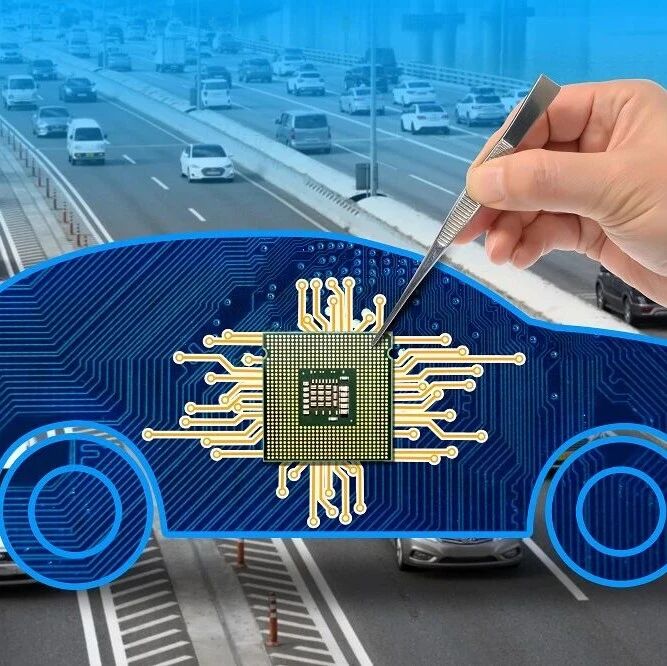
Core Viewpoint - A U.S. lawmaker has proposed phasing out Chinese-made sensors used in autonomous vehicles and critical infrastructure due to concerns over potential hacking risks during conflicts, which could disable systems rapidly [2][3]. Group 1: Legislative Proposal - The proposed legislation aims to gradually eliminate Chinese-made lidar sensors, which are essential for autonomous vehicles to perceive their environment in 3D [2]. - The bill will prohibit the purchase of new Chinese lidar sensors three years after its enactment, with exemptions for scientific and cybersecurity research [2]. - Existing equipment in critical infrastructure will have a five-year transition period before being phased out [2]. Group 2: Market Dynamics - Despite efforts from U.S. companies like Ouster and Aeva Technologies to capture market share, Chinese companies currently dominate the lidar market, holding 93% of the passenger vehicle market and 89% of the overall lidar market as of June [2]. - The U.S. Department of Defense has listed Hesai Group, the largest global lidar sensor manufacturer, as an entity of concern, indicating heightened scrutiny on Chinese technology in critical sectors [3]. Group 3: National Security Concerns - National security organizations have warned that Chinese lidar devices could pose hacking risks to the U.S. during conflicts, with the capability to disable large areas of sensors via satellites in seconds [3]. - Experts emphasize the need for the U.S. and its allies to lead in lidar innovation to prevent foreign adversaries from gaining control over critical technologies [3].
禾赛科技激光雷达获吉利银河多款车型定点 并将陆续量产交付
Mei Ri Jing Ji Xin Wen· 2025-12-11 06:16
Core Viewpoint - Hesai Technology announced the mass production of its long-range LiDAR ATX, which is now equipped in Geely's Galaxy V900 model, indicating a significant partnership and technological advancement in the automotive sector [1] Group 1 - The long-range LiDAR AT series has been designated for multiple models under the Geely Galaxy brand for the years 2025 and 2026, showcasing a commitment to future vehicle development [1] - The mass production and delivery of the AT series LiDAR will commence, reflecting the growing demand for advanced driver-assistance systems in the automotive industry [1]
