Intel(INTC)

Search documents
供需失衡驱动服务器CPU价格上涨
Western Securities· 2026-01-18 03:38
Investment Rating - The industry investment rating is "Overweight" [5] Core Views - The demand for server CPUs is increasing due to the upgrade of data center architectures and the continuous rise in AI inference computing power, leading to sustained growth in demand [2][3] - Intel and AMD are raising server CPU prices by 10%-15% to address supply-demand imbalances and ensure stable future supply, with their server CPU capacity for 2026 nearly sold out [1][2] - The general server market is recovering, with a projected global server shipment growth of over 9% year-on-year, driven by data center architecture upgrades and the replacement of existing server CPUs [1][2] Summary by Sections Section 1: Price Adjustments and Market Dynamics - Intel and AMD are increasing server CPU prices by 10%-15% due to supply-demand imbalances [1] - The global server shipment is expected to grow by over 9% year-on-year, influenced by the launch of new CPU products and data center upgrades [1][2] Section 2: AI Influence and Capital Expenditure - The rise of generative AI is driving an increase in AI server procurement, which is affecting the budget for general servers [2] - Cloud vendors are expanding capital expenditures to meet the growing demand for AI inference servers, with global AI server shipments projected to grow over 20% year-on-year by 2026 [2] Section 3: Domestic CPU Developments - Domestic next-generation server CPUs are accelerating deployment in various scenarios, with improvements in stability and compatibility [2][3] - Companies such as Loongson Technology, Haiguang Information, and China Great Wall are highlighted as key players in the domestic CPU market [3]


下周外盘看点丨美国PCE或搅动美联储,特朗普亮相达沃斯会说什么
Di Yi Cai Jing· 2026-01-18 02:24
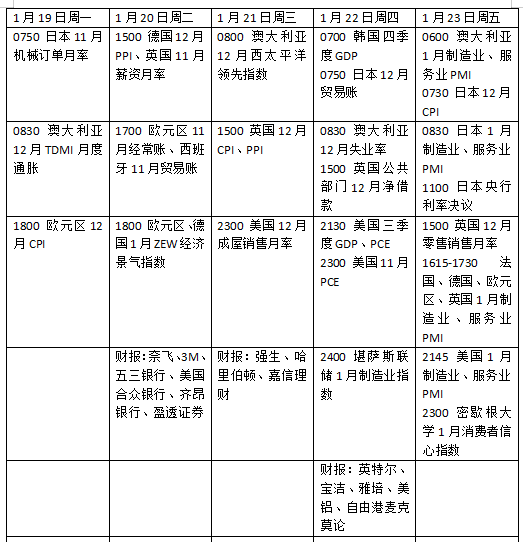
Economic Overview - The U.S. stock market experienced a decline, with the Dow Jones down 0.29%, Nasdaq down 0.66%, and S&P 500 down 0.38% for the week [1] - European stock indices showed mixed results, with the UK FTSE 100 up 1.09%, Germany's DAX 30 up 0.14%, and France's CAC 40 down 1.23% [1] - The upcoming week will focus on U.S. GDP data, PCE inflation data, and consumer confidence index, which are expected to provide insights into the Federal Reserve's policy direction [3] Corporate Earnings - The second week of the U.S. earnings season will feature major tech companies like Netflix and Intel, along with industry leaders such as Johnson & Johnson, Abbott, and Halliburton reporting their earnings [4] Commodity Market - Oil prices continued to rise, with WTI crude up 0.54% to $59.44 per barrel and Brent crude up 1.25% to $64.13 per barrel, driven by concerns over potential supply disruptions in Iran [5] - Gold futures for January delivery increased by 2.18% to $4588.40 per ounce, while silver futures rose by 11.69% to $88.09 per ounce, amid geopolitical tensions and market volatility [6] European Economic Outlook - The Eurogroup finance ministers' meeting and the EU finance ministers' meeting are set to discuss fiscal stimulus policies, particularly Germany's fiscal measures, which are crucial for the Eurozone's economic growth outlook [7] - The European Central Bank's monetary policy meeting minutes will be released, with expectations that there will be no interest rate changes this year, but discussions on potential future rate hikes may be of interest [7] Upcoming Economic Data - Key macroeconomic data releases next week include the Eurozone and Germany's January ZEW economic sentiment index, as well as manufacturing PMI data for France, Germany, and the Eurozone [7]





KeyBanc Turns Bullish on Intel (INTC), Citing Server CPU Tightness and Foundry Yield Gains
Yahoo Finance· 2026-01-17 17:38
Group 1 - Intel Corporation is recognized as a trending AI stock, with KeyBanc upgrading its rating from Sector Weight to Overweight and setting a price target of $60.00, driven by improving foundry yields and strong data center demand from hyperscalers [1] - Despite challenges in the server CPU market, Intel is reportedly sold out for the year in server CPUs as hyperscalers increase data center construction [2] - The company is contemplating a 10-15% increase in average selling prices, with foundry yields for the 18A process improving to over 60%, facilitating the ramp-up of Panther Lake [3] Group 2 - Intel's yield performance is favorable compared to Samsung's SF2 process, although it lags behind TSMC's 2nm process, which operates at 70-80% yield [4] - Intel has secured Apple as a customer for its 18A process, which will be utilized for low-end M-series processors in MacBooks and iPads, expected to enter production in 2027 [5] - Discussions are ongoing between Intel and Apple regarding the use of the 14A process for low-end mobile A-series processors for iPhones, anticipated for 2029 [5]
Netflix, Intel Step Into Earnings Spotlight; GDP On Deck
Seeking Alpha· 2026-01-17 16:00
Market Overview - Wall Street experienced mixed performance, with losses in materials and utilities stocks countered by gains in chipmakers and the industrial sector, particularly following strong results from Taiwan Semiconductor Manufacturing (TSM) [2] Upcoming Economic Events - The upcoming week is expected to be quiet due to the U.S. markets being closed on January 19 for Martin Luther King, Jr. Day. Key economic data releases are scheduled for later in the week, including Q/Q GDP data, initial jobless claims, and the PCE price index for November [3] Earnings Reports - Major S&P 500 companies are set to release their quarterly financial results during the week ending January 23, including Netflix (NFLX), 3M (MMM), Johnson & Johnson (JNJ), Kinder Morgan (KMI), Intel (INTC), Visa A (V), GE Aerospace (GE), and Procter & Gamble (PG) [4] - Specific earnings highlights include Netflix and 3M on Tuesday, Johnson & Johnson and Kinder Morgan on Wednesday, and Intel, Visa A, GE Aerospace, and Procter & Gamble on Thursday [5] Volatility Watch - Firefly Aerospace (FLY) and AXT (AXTI) are anticipated to experience a volatile trading week based on options volume, with High Roller Technologies (ROLR) and Zion Oil identified as overbought stocks according to their 14-day relative strength index [6]

Wall Street Is Starting to Like Intel Stock Again
The Motley Fool· 2026-01-17 13:40
Core Viewpoint - Intel's stock is gaining attention from investors after years of struggles, with recent upgrades from analysts indicating a more optimistic outlook for the company [1][2][10] Group 1: Analyst Upgrades and Market Sentiment - KeyBanc analyst upgraded Intel's stock to "buy" with a price target of $60, reflecting growing investor optimism [2] - Citigroup analyst Atif Malik upgraded Intel from "sell" to "hold" with a price target of $50, indicating a cautious but improved outlook [3][10] Group 2: Foundry Opportunities - Malik identifies significant opportunities for Intel's foundry segment due to a shortage of advanced packaging capacity at TSMC and U.S. government investments [4] - The demand for AI ASICs is expected to drive business to Intel Foundry, as companies like Alphabet, Amazon, and Microsoft design custom AI chips [6] Group 3: Production and Technology Developments - Intel's 18A process is in production, with Panther Lake chips set to debut in laptops, achieving yields of around 60% [5] - The successful implementation of the 18A process is seen as a compelling option for chip designers facing manufacturing capacity challenges [5] Group 4: Market Challenges and Risks - Despite positive developments, concerns remain regarding Intel's CPU business, particularly with the performance of Arrow Lake chips and competition from AMD and Arm-based devices [7][9] - Rising memory chip prices could negatively impact overall PC demand, complicating Intel's recovery in the PC market [9]
英特尔的先进封装,太强了
Xin Lang Cai Jing· 2026-01-17 09:33
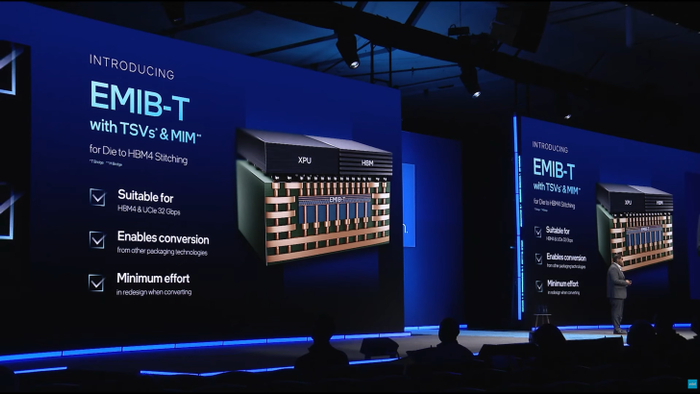
Core Viewpoint - Intel's EMIB interconnect solution demonstrates advantages over traditional 2.5D technology in advanced chip packaging design, showcasing its application in various products and its potential for next-generation chips [1][14]. Group 1: EMIB Technology and Applications - Intel's EMIB technology has been implemented in several of its products, including Ponte Vecchio, Sapphire Rapids, Granite Rapids, Sierra Forest, and the upcoming Clearwater Forest series [1]. - The company emphasizes its advanced packaging capabilities, which include large-scale packaging using EMIB and other proprietary technologies, specifically designed for data center solutions [1][12]. - EMIB technology allows for efficient and cost-effective connections between multiple complex chips, supporting both 2D and 3D expansions, which traditional 2.5D methods cannot achieve [12][14]. Group 2: Comparison with Competitors - Competitors like TSMC utilize 2.5D and 3D packaging technologies that rely on silicon interposers and TSV (Through-Silicon Vias) for interconnections, which can increase design complexity and costs [3][7]. - Intel points out the drawbacks of 2.5D packaging, such as additional costs for silicon used solely for interconnections and limitations in chip size and flexibility [7]. Group 3: Future Prospects and Industry Position - Intel's advancements in EMIB, including the "T" type packaging and Foveros packaging, have attracted attention from industry giants, intensifying competition in the chip manufacturing sector previously dominated by TSMC [14][15]. - The company aims to leverage its advanced packaging solutions to establish a foothold in the foundry business, particularly with the 14A process node designed for third-party customers [28]. - Intel's upcoming products, such as the Jaguar Shores and Crescent Island GPU, are critical for regaining market share, with a focus on securing orders from third parties [30].
Cramer's week ahead: Earnings from Netflix, Intel, Capital One, McCormick
CNBC· 2026-01-16 23:12
分组1 - Earnings season is ongoing, with notable reports expected from companies like Netflix, Intel, and Capital One Financial [1] - Homebuilders have disappointed so far, but signs of recovery are emerging in the housing sector [1] - 3M has been performing well and is favored ahead of its earnings report [1] - Netflix's potential acquisition of Warner Bros. Discovery is a key point of interest [1] - United Airlines is recommended for purchase due to the ongoing relevance of post-Covid travel [1] 分组2 - Johnson & Johnson is transitioning to a pharmaceutical focus, despite ongoing talc-related lawsuits [2] - Charles Schwab is benefiting from wealth transfer trends from older to younger generations [2] 分组3 - The PCE price index is anticipated to show restrained inflation numbers [3] - Procter & Gamble is not expected to report an outstanding quarter, but its brands and new CEO are viewed positively [3] - GE Aerospace is expected to report strong results due to a significant backlog of aircraft orders [3] - Freeport-McMoRan is likely to benefit from high copper and gold prices [3] - Intel's stock has performed well, but earnings may not meet expectations due to competition in the semiconductor industry [3] - Capital One is expected to discuss its acquisition of Discovery and a large buyback [3] - Intuitive Surgical may deliver a surprising earnings report [3] - McCormick faces uncertainty regarding its upcoming quarter [3] 分组4 - SLB's upcoming quarterly report may be challenged by low crude oil prices [4]



Intel Reports Earnings on January 22. Here Is Where Options Data Says INTC Stock Could Be Trading Next.
Yahoo Finance· 2026-01-16 21:48
Core Viewpoint - Intel's stock has seen significant gains leading up to its earnings release, with expectations for further increases by 2026 according to Citi analyst Atif Malik [1][2]. Group 1: Earnings and Stock Performance - Intel is projected to lose $0.02 per share in fiscal Q4, which is consistent with the same quarter last year [1]. - The stock has increased over 160% from its 52-week low, prompting Malik to upgrade his rating to "Neutral" [2]. Group 2: Long-term Outlook and Market Position - Malik emphasizes the importance of focusing on Intel's long-term potential rather than short-term earnings fluctuations [3]. - A capacity crunch at Taiwan Semiconductor could present a unique opportunity for Intel to attract major foundry customers, alleviating some of the stock's overhang [4]. Group 3: Options Data and Market Sentiment - Options data indicates a bullish sentiment for Intel shares, with upper price targets around $56 for mid-April [5]. - The implied move for the stock is 7.73%, suggesting it could exceed $50 shortly after January 23 [5]. Group 4: Seasonal Trends and Analyst Recommendations - Historically, Intel has gained over 2% in February, which supports a positive outlook ahead of its Q4 earnings [6]. - Wall Street maintains a generally positive stance on Intel, with a consensus rating of "Hold" and price targets reaching as high as $60, indicating a potential upside of approximately 30% [8].
Earnings live: PNC rounds out bank earnings this week as attention shifts to Netflix, Intel
Yahoo Finance· 2026-01-16 21:41
Group 1 - The fourth quarter earnings season is gaining momentum, initiated by major banks like JPMorgan Chase, Bank of America, and Goldman Sachs [1][2] - Upcoming earnings reports from notable companies include Netflix and Intel, with additional reports from United Airlines, 3M Company, D.R. Horton, Johnson & Johnson, GE Aerospace, Procter & Gamble, Abbott Laboratories, and Capital One scheduled for next week [2][6] - As of January 16, 7% of S&P 500 companies have reported fourth quarter results, with analysts estimating an 8.2% increase in earnings per share, marking the potential for the 10th consecutive quarter of annual earnings growth for the index [3] Group 2 - Analysts had initially expected an 8.3% increase in earnings per share for the fourth quarter, a decrease from the third quarter's 13.6% growth rate, but have since raised expectations, particularly for technology companies [4] - The earnings season is expected to test the improved stock market breadth observed at the beginning of 2026, with ongoing themes such as artificial intelligence and economic policies from the Trump administration continuing to influence market dynamics [5]
3 Key Earnings Releases to Watch Next Week
ZACKS· 2026-01-16 21:20
Earnings Season Overview - The 2025 Q4 earnings season is underway, with major banks initiating the reporting period, leading to a positive outlook supported by favorable earnings estimate revisions for the S&P 500 [1][8] - Upcoming reports from Netflix (NFLX), Intel (INTC), and Johnson & Johnson (JNJ) are anticipated to be significant for investors [1][13] Netflix (NFLX) - Netflix is set to report its quarterly results next Tuesday, but shares have struggled post-split, likely due to profit-taking after a significant price increase [2] - Earnings and revenue expectations for Netflix have remained flat, with estimates indicating a 27% EPS growth on 17% higher sales, alongside improved profitability and higher margins [3] Johnson & Johnson (JNJ) - Johnson & Johnson has experienced a substantial share price increase of over 53% in the past year and has consistently exceeded EPS and revenue estimates in six consecutive earnings releases [4] - Expectations for JNJ remain stable, with forecasts indicating a 22% EPS growth on 7% higher sales, marking a notable growth rate for the company given its established market position [5][9] Intel (INTC) - Intel shares have surged over 140% in the last year due to a turnaround in sentiment and favorable business developments [10] - EPS and revenue expectations for Intel have not changed significantly, with forecasts predicting a 30% decline in earnings on 6% lower sales, while the focus on AI PCs is expected to be a key topic in the upcoming release [10][12]