Intel(INTC)

Search documents
技嘉确认Z890主板支持英特尔Arrow Lake Refresh处理器
Xin Lang Cai Jing· 2026-01-08 11:48
Core Viewpoint - GIGABYTE confirmed during the recent International Consumer Electronics Show that its Z890 series motherboards will support Intel's upcoming "Arrow Lake Refresh" processors, although the specific release date for these processors has not been announced [1][4]. Group 1: Product Announcements - Intel highlighted its new generation "Panther Lake" processor series at the event, which garnered significant attention, but the anticipated "Arrow Lake Refresh" was not officially launched [3][4]. - Despite the lack of a formal release, multiple sources indicate that Intel may quietly launch the "Arrow Lake Refresh" series in the near term, prompting motherboard manufacturers to expedite hardware compatibility preparations [3][4]. Group 2: GIGABYTE Product Features - GIGABYTE showcased the Z890 AORUS Elite WiFi 7 Plus motherboard, which is factory-equipped to support the "Arrow Lake Refresh" architecture. The upcoming processor models will also adopt a "Plus" suffix, including known models such as Core Ultra 9 290K Plus, Ultra 7 270K Plus, and Ultra 5 250K Plus [5]. - The design of the Z890 AORUS Elite WiFi 7 Plus motherboard maintains the style of its predecessor but features adjustments, such as the removal of the onboard shortcut button area and the absence of physical power and reset buttons, resulting in a more streamlined layout [5]. - Additionally, GIGABYTE presented a high-performance gaming PC built on the Z890 AORUS Tachyon ICE motherboard, equipped with the Core Ultra 9 285K processor and 256GB DDR5 CQDIMM memory, demonstrating excellent memory compatibility and overclocking capabilities with stable operation at 6400 MT/s [4][5].

强强联合!节卡机器人×Intel达成战略合作,共推“算力与作业力融合”,引领具身智能新纪元
机器人大讲堂· 2026-01-08 11:21
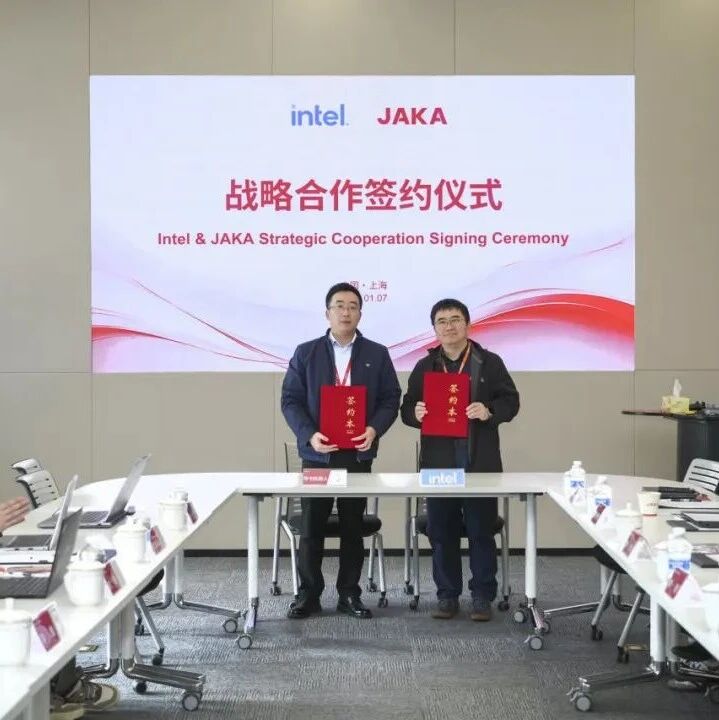
Core Viewpoint - The strategic partnership between JAKA Robotics and Intel aims to integrate computing power with operational capabilities to advance the industrialization of embodied intelligence technology, providing adaptable and easily deployable intelligent robotic solutions across various industries [1][3]. Group 1: Partnership Overview - JAKA Robotics and Intel signed a memorandum of cooperation to establish a deep strategic partnership focused on the fusion of computing power and operational capabilities [1]. - Intel, as a leader in the semiconductor and computing innovation sectors, will support JAKA Robotics in exploring general-purpose intelligent robotics [3]. - JAKA Robotics has a comprehensive stack from core components to complete machines, including products like the JAKA Kargo wheeled dual-arm robot and the JAKA Lumi embodied intelligence platform [3]. Group 2: Focus Areas of Collaboration - The collaboration will focus on three main areas: 1. Exploring key fusion technologies in the embodied intelligence field based on Intel's advanced hardware platforms, such as the Intel® Core™ Ultra processors [5]. 2. Developing customized technology and integration work for specific scenarios in industrial manufacturing and commercial services, creating rapidly deployable intelligent robotic solutions [5]. 3. Joint market activities and ecosystem building to empower developers and academic-industry partners, fostering an open and collaborative industrial ecosystem [5]. Group 3: Statements from Executives - The CTO of JAKA Robotics emphasized the commitment to enhancing robots' perception, decision-making, and operational capabilities, aiming for robots to become valuable partners in human work and life [7]. - The General Manager of Intel China highlighted that the integration of a powerful, open computing platform with top-notch robotic technology is essential for the large-scale implementation of embodied intelligence [9]. - This strategic cooperation is seen as a significant step towards transitioning embodied intelligence from technology to large-scale industrial application, with plans for continued innovation in computing architecture and robotic technology [9].

直击CES|PC芯片战场的分化:英特尔押注新一代芯片
Di Yi Cai Jing· 2026-01-08 10:58
Core Insights - Intel is increasingly focusing on the Chinese market as part of its product strategy, especially in the context of the AI wave reshaping the semiconductor industry [1] - The competition in the PC chip market is evolving, with Intel taking a different path compared to Nvidia and AMD, who are focusing on data centers and AI infrastructure [1] Group 1: Product Development - Intel's upcoming Panther Lake chip, based on the 18A process, is seen as a critical test of its competitiveness in advanced process technology and client products [1] - The new generation of products introduces fully surrounded gate transistors and backside power delivery technology, achieving approximately a 15% improvement in energy efficiency within a power range of 15 to 45 watts, and a 30% increase in transistor density [2] - The Panther Lake aims to maintain the energy efficiency of previous low-power platforms while providing higher performance, achieving performance levels of the previous generation at about 40% of the power consumption [2] Group 2: Market Strategy - Intel aims to restore credibility in its technology cadence and product delivery capabilities in the PC market with this new generation of products [3] - The company is focusing on enhancing local AI computing capabilities in PCs, collaborating with partners like Perplexity and ByteDance to explore workload distribution between cloud and local environments [3] - Intel believes that future PCs will evolve from mere cloud service terminals to capable computing nodes for local AI tasks, which is why it is strengthening the collaboration between CPU, GPU, and NPU in this generation of processors [5] Group 3: Importance of the Chinese Market - The Chinese market is becoming increasingly important for Intel, with partnerships with companies like Lenovo, ByteDance, and Alibaba being highlighted [5] - Chinese partners have high expectations, and Intel is committed to strengthening its collaboration with edge ODMs and OEMs in the region [6] - Despite the positive feedback for Panther Lake, Intel faces uncertainty in market dynamics, particularly with Nvidia dominating the data center AI accelerator market and AMD making steady progress in servers and high-performance computing [6]

美国半导体与半导体设备・SemiBytes:CES 前瞻、2025 回顾US Semiconductors and Semi Equipment_ SemiBytes_ CES Preview, 2025 in Retrospective
2026-01-08 10:42
Summary of the Conference Call Transcript Industry Overview - **Industry**: US Semiconductors and Semiconductor Equipment - **Event**: CES 2026 Preview and 2025 Retrospective Key Points CES 2026 Preview - The team is attending CES in Las Vegas with meetings scheduled with major semiconductor companies including Micron, Marvell, NVIDIA, and others [2][3] - NVIDIA is expected to provide updates on its QuantumX/SpectrumX silicon photonics switches and the Groq technology licensing deal during its keynote [2] - AMD may introduce the Helios rack featuring the Instinct MI400 and Venice server CPUs [2] Market Performance in 2025 - Semiconductors returned **42%** in 2025, outperforming the tech sector at **23%** and the broader market at **16%** [5] - Memory/Storage sector led EPS growth at **+168%**, with Micron and other key players showing significant returns [5] - Memory valuations expanded by **17%** to **9.8x** NTM PE, while semiconductor capital equipment (semicap) expanded by **40%** to **32.5x** [5] - Compute and networking EPS grew by **+65%** and **+63%** respectively, driven by AI integration in data centers [5] Sector-Specific Insights - **Compute**: Market cap increased from **$3,703.9 billion** to **$5,173.4 billion**, with a total return of **+40%** and EPS growth of **+65%** [7] - **Networking**: Market cap rose from **$1,208.1 billion** to **$1,747.9 billion**, with a total return of **+44%** and EPS growth of **+63%** [7] - **Memory/Storage**: Market cap surged from **$471.4 billion** to **$1,373.8 billion**, with a total return of **+199%** and EPS growth of **+168%** [7] - **Analog**: Market cap increased from **$510.8 billion** to **$561.3 billion**, with a total return of **+13%** and EPS growth of **+10%** [7] Future Expectations - The tone in investor meetings is expected to be positive, but share prices may remain stable unless full-year estimates are revised upwards [2] - There is skepticism regarding the wearable devices market despite anticipated new product launches [3] - Electrification sentiment is expected to remain weak due to regulatory risks, but advancements in Level 2+/Level 3 ADAS are anticipated [3] Risks and Valuation - Various valuation techniques such as P/E and EV/FCF are employed for company assessments [9] - Risks include macroeconomic downturns, disruptions in international trade, and technological innovations that could alter market dynamics [9] Additional Insights - The report includes a comprehensive slide deck with key charts, forecasts, and analyses for over **180** semiconductor stocks [4] - The semiconductor sector is expected to continue its growth trajectory into 2026, with significant developments anticipated in AI and data center technologies [4][5] This summary encapsulates the critical insights and data from the conference call, providing a comprehensive overview of the semiconductor industry and its performance in 2025, along with expectations for 2026.


紧抓稀缺性
Hua Xia Shi Bao· 2026-01-08 10:32
Core Viewpoint - Scarcity is defined as the limitation in obtaining resources needed by people, with a focus on time as a crucial factor in both enhancing and destroying scarcity [2][4]. Group 1: Definition of Scarcity - Scarcity in investment refers to a situation where demand for a product remains stable or grows while supply cannot keep pace, often due to a lack of adequate substitutes [2][3][4]. - The definition emphasizes limited supply and the absence of sufficient substitutes [2]. Group 2: Types of Scarcity - Geographic scarcity occurs when a product is unique to a specific location, making it irreplaceable, such as Moutai liquor, which can only be produced in Maotai Town, Guizhou [4]. - Technological scarcity is characterized by monopolistic advantages, as seen with companies like NVIDIA, which have maintained a strong market position through innovation [5][6]. - Non-renewable scarcity refers to resources that are inherently limited and diminish with use, such as indium, which has a very low natural reserve [11]. Group 3: Impact of Time on Scarcity - Scarcity is not constant and can be altered by supply factors; for example, cocoa has seen increasing scarcity due to rising demand and limited production areas [13][14]. - The cocoa market is particularly sensitive to environmental conditions, which can drastically affect supply and prices [14][15]. Group 4: Market Dynamics and Investment Implications - The investment value of certain products can fluctuate significantly over time, influenced by market conditions and consumer behavior [4][17]. - Companies must adapt to changing market dynamics, especially during periods of consumer downgrading, to maintain their competitive edge [17].


3个月裁2万人,量产1.8nm芯片,华人CEO又救活一家美国芯片企业
Sou Hu Cai Jing· 2026-01-08 07:30
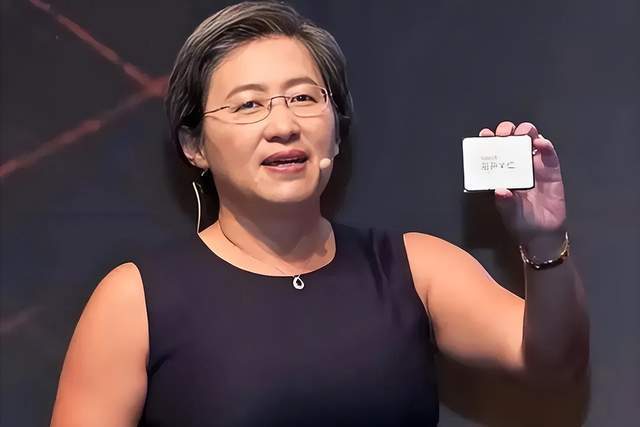
Core Viewpoint - The article highlights the significant role of Chinese CEOs in reviving major American chip companies, particularly AMD and Intel, showcasing their leadership and strategic decisions that have led to substantial improvements in these firms' performance [1][3]. Group 1: AMD's Revival - AMD was on the brink of collapse before Dr. Lisa Su took over as CEO, successfully turning the company around and leading it to its current strong position [1]. Group 2: Intel's Transformation - Intel, once a dominant player in the chip industry, faced challenges due to poor leadership decisions and missed opportunities, leading to a decline in its market position [3]. - Following the retirement of former CEO Pat Gelsinger, Chinese CEO Chen Lifeng took over in late 2025, initiating significant reforms [3]. Group 3: Strategic Changes Under Chen Lifeng - Chen Lifeng implemented drastic measures, including laying off 20,000 employees within three months and eliminating unprofitable business units [5]. - Financial restructuring included securing $8.9 billion from the U.S. government for a 9.9% equity stake and attracting investments from Nvidia and SoftBank, totaling $15.9 billion [5]. - Changes in chip manufacturing strategy involved limiting external orders for the 18A process and planning production based on demand rather than blind expansion [7]. Group 4: Market Impact and Future Outlook - As a result of these strategies, Intel's market value increased by 80% in 2025, enhancing its financial resilience [7]. - At CES 2026, Intel launched the Core Ultra series chips based on the 18A process, achieving its goal of mass production of 1.8nm chips [7]. - The article concludes that under Chen Lifeng's leadership, Intel is poised for a revival, reinforcing the influence of Chinese leaders in the semiconductor industry [9].
四大芯片巨头掌门人罕见同台发声
2 1 Shi Ji Jing Ji Bao Dao· 2026-01-08 05:57
Core Insights - The CES 2026 highlighted the significant advancements in AI technology, particularly in the context of increasing computational power and the emergence of new applications across various sectors [1][2][8] - Chinese companies are playing an increasingly vital role in the global tech landscape, showcasing innovative AI hardware and solutions that attract considerable attention at international events [1][4][9] Group 1: AI and Computational Power - NVIDIA's CEO Jensen Huang emphasized the arrival of the "ChatGPT moment," indicating that machines are beginning to understand and act in the real world, with autonomous taxis being one of the first applications to benefit [2] - Huang introduced the new Rubin architecture, which includes a comprehensive stack solution with six core components, addressing the exponential growth in AI computational demands, projected to increase tenfold annually [2] - AMD's CEO Lisa Su noted that the computational power is transitioning from Zetta to Yotta Scale, with AI model training floating-point computation power increasing fourfold each year and inference token consumption rising by 100 times over the past two years [2] Group 2: Emerging AI Applications - Qualcomm's CEO Cristiano Amon highlighted the potential of next-generation personal AI devices, predicting a market size of 100 million units in the coming years, driven by edge AI and situational awareness capabilities [3] - The CES showcased a variety of AI-native products, with a notable increase in the capabilities of robots, moving beyond simple demonstrations to more complex functionalities [4][6] - The development of humanoid robots is progressing towards commercialization, with companies achieving significant advancements in motion control and operational precision, indicating a clear path for deployment in sectors like manufacturing and logistics [6][7] Group 3: Chinese Companies and Global Impact - Chinese firms are increasingly recognized as key players in the global tech ecosystem, leveraging their supply chain and R&D capabilities to drive innovation and efficiency [1][8][9] - The ability of Chinese companies to rapidly iterate on products, with a typical development cycle of about one year compared to two to three years for European counterparts, is enhancing their competitive edge [8][9] - The CES 2026 served as a platform for showcasing how AI technologies are set to permeate everyday life, with a focus on transforming concepts into tangible value through collaborative global efforts [9]

Dow Falls More Than 450 Points: Investor Sentiment Declines, Fear & Greed Index Remains In 'Neutral Zone - Intel (NASDAQ:INTC)
Benzinga· 2026-01-08 05:52
Market Sentiment - The CNN Money Fear and Greed index showed a decline in overall market sentiment, remaining in the "Neutral" zone with a current reading of 46.6, down from 51.9 [5] - U.S. stocks settled lower, with the Dow Jones index falling more than 450 points after reaching record highs in the previous session [1] Economic Data - The ISM services PMI rose for the third consecutive month to a reading of 54.4 in December, up from 52.6 in the previous month and exceeding market estimates of 52.3 [2] - U.S. job openings decreased by 303,000 to 7.146 million in November, marking the lowest level since December 2020 and falling short of market estimates of 7.60 million [2] Sector Performance - Most sectors on the S&P 500 closed negatively, with materials, utilities, and industrials experiencing the largest losses, while health care and communication services stocks closed higher [3] - The Dow Jones closed lower by approximately 466 points to 48,996.08, the S&P 500 fell 0.34% to 6,920.93, and the Nasdaq Composite increased by 0.16% to close at 23,584.28 [3] Company News - Intel Corp. saw a nearly 7% increase in stock price after unveiling a new product lineup at CES, which includes a gaming-focused processor and platform [1] - Investors are awaiting earnings results from TD Synnex Corp, Commercial Metals Co, and Acuity Inc today [4]

Dow Falls More Than 450 Points: Investor Sentiment Declines, Fear & Greed Index Remains In 'Neutral Zone
Benzinga· 2026-01-08 05:52
Market Sentiment - The CNN Money Fear and Greed index showed a decline in overall market sentiment, remaining in the "Neutral" zone with a current reading of 46.6, down from 51.9 [1][5] - U.S. stocks settled lower, with the Dow Jones index falling more than 450 points after reaching record highs in the previous session [1][3] Economic Data - The ISM services PMI rose for the third consecutive month to a reading of 54.4 in December, up from 52.6 in the previous month and exceeding market estimates of 52.3 [2] - U.S. job openings decreased by 303,000 to 7.146 million in November, marking the lowest level since December 2020 and falling short of market estimates of 7.60 million [2] Sector Performance - Most sectors on the S&P 500 closed negatively, with materials, utilities, and industrials recording the largest losses, while health care and communication services stocks closed higher [3] - The Dow Jones closed lower by approximately 466 points to 48,996.08, the S&P 500 fell 0.34% to 6,920.93, and the Nasdaq Composite increased by 0.16% to close at 23,584.28 [3] Company News - Intel Corp. experienced a nearly 7% increase, becoming a top gainer after unveiling a new product lineup at CES, which includes a gaming-focused processor and platform [1]

四大芯片巨头掌门人罕见同台发声
21世纪经济报道· 2026-01-08 05:49
Core Insights - The CES 2026 highlighted the significant role of chip giants like NVIDIA, Intel, AMD, and Qualcomm in the AI era, emphasizing the need for hundreds of times more computing power and the expansion of AI applications from cloud to edge [2] - Chinese manufacturers showcased their advancements in AI hardware, gaining international attention and marking China's evolution into a key player in global tech innovation [2][9] - The rapid evolution of foundational computing infrastructure is crucial for the development of AI large models, with chip leaders stressing the accelerating demand for computing power and new application opportunities [2][4] Group 1: AI and Computing Power - NVIDIA's CEO Jensen Huang announced the arrival of the "ChatGPT moment" in AI, highlighting the capabilities of machines to understand and act in the real world, with autonomous taxis being a primary application [3] - Huang introduced the new Rubin architecture, which includes a comprehensive stack solution with multiple core components to address the exponential growth in AI computing demands [4] - AMD's CEO Lisa Su noted that AI model training requires floating-point computing power to grow fourfold annually, with inference token consumption increasing by 100 times over the past two years [4] Group 2: Emerging AI Applications - Qualcomm's CEO Cristiano Amon emphasized the potential of next-generation personal AI devices, predicting a market size of 100 million units in the coming years, driven by edge AI and situational awareness capabilities [5] - The integration of edge data is seen as critical for providing personalized services, with Amon predicting that those who can leverage edge data will lead in the AI competition [5] Group 3: Robotics and Automation - Chinese companies showcased advanced robots at CES 2026, demonstrating improved capabilities compared to previous years, indicating a shift from simple demonstrations to more complex functionalities [6][7] - The development of humanoid robots is progressing towards commercialization, with companies achieving significant advancements in motion control and operational precision [7][9] - The demand for robotics is increasing due to global aging populations and rising labor costs, with exoskeleton robots gaining traction in various markets [7][9] Group 4: Supply Chain and Innovation - Chinese manufacturers are leveraging their supply chain advantages to accelerate product iterations, achieving faster development cycles compared to European counterparts [9][10] - The efficiency of China's industrial chain is enabling rapid technological breakthroughs and cost optimizations, distinguishing "Chinese manufacturing" from "Chinese innovation" [10] - The CES 2026 served as a platform for showcasing how AI is set to permeate everyday life, with a focus on transforming concepts into tangible value through collaborative efforts across the industry [10]