Nissan Motor(NSANY)

Search documents
日产汽车巨亏6700亿日元裁员增至2万人 东风日产销量加速下滑拟豪掷百亿加码新能源
Xin Lang Cai Jing· 2025-05-16 08:06
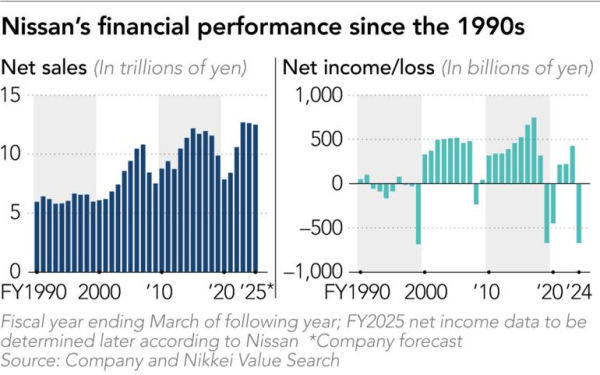
Core Insights - Nissan reported a net loss of 670.8 billion yen (approximately 4.4 billion USD) for the fiscal year 2024, marking a significant decline from a profit of 426.6 billion yen in the previous year, representing a 257% drop [1] - The company announced a global workforce reduction of 20,000 employees, accounting for 15% of its total workforce, as part of its "Re:Nissan" restructuring plan aimed at achieving operational efficiency and strategic transformation [1][3] - Nissan's revenue forecast for fiscal year 2024 was revised down from 14 trillion yen to 12.7 trillion yen, with operating profit expectations plummeting from 500 billion yen to 150 billion yen, resulting in an operating profit margin of only 1.2% [1][2] Financial Performance - The company's free cash flow turned negative, with a reported -448.3 billion yen for the first half of fiscal year 2024, indicating significant liquidity pressure [1][2] - Nissan's global sales for fiscal year 2024 are projected to be 3.44 million units, a decline of 3.2% year-on-year, failing to meet expectations [2] - The company's debt due in 2024 amounts to 1.6 billion USD, increasing to 5.6 billion USD by 2026, the highest level since 1996 [2] Market Challenges - Nissan's sales in China decreased by 9.98% to 558,000 units in the first ten months of 2024, while U.S. sales fell by 3.1%, highlighting competitive weaknesses in key markets [2] - The company has struggled to gain traction in the electric vehicle market, with its new model ARIYA failing to achieve significant market penetration, while competitors like BYD have outperformed Nissan in sales [2][3] - Nissan's product lineup has not kept pace with market demands, particularly in the hybrid vehicle segment, leading to lost growth opportunities [2] Strategic Initiatives - The company plans to cut 5 trillion yen in costs by reducing the number of global factories from 17 to 10 and simplifying its parts complexity by 70% [3] - Nissan aims to launch five new electric vehicle models in China by 2026 and is increasing collaboration with technology partners like Huawei and Momenta [3] - The restructuring plan is described as a "based action recovery plan," but analysts warn that delays could extend losses into fiscal year 2025 [3][4] Industry Context - Nissan's struggles reflect broader anxieties among traditional automakers in the face of the electric vehicle transition, raising questions about the effectiveness of its aggressive self-rescue measures [4] - The ability of Japanese automakers to collaborate effectively may be crucial in determining their competitive position in the evolving automotive landscape [4]

日产汽车CEO:在寻求合作伙伴之前需自救
news flash· 2025-05-15 10:47
智通财经5月15日电,日产汽车首席执行官Ivan Espinosa表示,在考虑与其他公司合作之前,该公司正 专注于通过提高流动性来帮助自己。今年早些时候,日产试图与规模更大的日本同行本田汽车合并,但 以失败告终。 日产汽车CEO:在寻求合作伙伴之前需自救 ...

日产全球裁员15%,新能源布局遇冷,何以破局? 其最新回应来了
Xi Niu Cai Jing· 2025-05-15 08:17
Group 1 - Nissan plans to cut approximately 20,000 jobs globally between fiscal years 2024 and 2027, representing 15% of its total workforce, affecting various roles including production, sales, and R&D [2] - The company has initiated voluntary departure programs in markets like the U.S. and is assessing the feasibility of expanding these programs to other regions, with no clear decision on job cuts in China yet [2] - In the electric vehicle sector, despite a strong order for the N7 model, overall sales of new energy vehicles accounted for less than 5% in April, indicating potential disconnects between market acceptance and promotional efforts [2] Group 2 - The Nissan Sylphy series saw a 12% year-on-year decline in sales in April, prompting the company to introduce a "one price for fuel and electricity" policy to alleviate consumer price concerns [3] - Nissan is collaborating with Huawei to promote the intelligent transformation of fuel vehicles, indicating a strategic shift to adapt to market changes and consumer demands [3] - The company is addressing after-sales service issues, including battery range discrepancies reported on consumer platforms, by emphasizing compliance with testing standards and expanding its retail network [3]


裁员2万人、关闭7家工厂,日产“Re:Nissan”计划能否重现戈恩时代辉煌?
Hua Xia Shi Bao· 2025-05-15 07:44
Core Insights - Nissan reported a net loss of 670.8 billion yen (approximately 32.6 billion RMB) for the fiscal year 2024, a significant drop from a profit of 426.6 billion yen in fiscal year 2023, highlighting challenges in its electric vehicle transition [2] - The company has initiated a recovery plan named "Re:Nissan," aiming to streamline platforms and supply chains while focusing on six core markets, with China identified as a critical battleground for revival [2][6] Financial Performance - The decline in performance is attributed to weak sales in major markets such as the US and China, alongside a 467 billion yen asset impairment loss due to poor capacity planning and market misjudgment [3] - Nissan's sales in China fell by 12.2% year-on-year in 2024, with a further decline of 29.5% in the first quarter of 2025 [6] Strategic Challenges - Nissan's slow response to the growing demand for hybrid vehicles in North America and its delayed electric vehicle strategy in China have led to a shrinking market share [3] - The company has faced increased operational risks due to its reliance on traditional fuel vehicles amid stringent emission regulations in Europe and the US [3] Technological and Collaborative Issues - Nissan's technological direction has been inconsistent, missing opportunities to capitalize on its early electric vehicle success with the Leaf [4] - A proposed merger with Honda aimed at creating a major automotive player collapsed due to disagreements over control and strategic direction [4] Operational Adjustments - The "Re:Nissan" plan includes closing seven factories and laying off 20,000 employees, reducing production capacity from 3.5 million to 2.5 million vehicles [5] - Nissan plans to invest 100 billion RMB in new energy research and development over the next three years, with a focus on localizing its R&D efforts in China [7] Market Positioning - The company is attempting to pivot its strategy in China by launching new models and reducing development cycles to 24 months, while also collaborating with local tech firms [6][7] - Despite these efforts, Nissan's production capacity in China has been reduced from 1.5 million to 1 million vehicles, raising concerns about potential idle capacity if new energy vehicles do not gain traction [7] Conclusion - Nissan's current predicament reflects the broader challenges faced by traditional automotive giants in adapting to the rapid shift towards electric and smart vehicles, emphasizing the need for speed and ecosystem collaboration over mere scale [8]
市场消息:日产考虑将Sentra的生产从墨西哥迁回美国以避免关税。
news flash· 2025-05-14 15:38
Core Viewpoint - Nissan is considering relocating the production of its Sentra model from Mexico to the United States to avoid tariffs [1] Group 1 - The potential move aims to mitigate the impact of tariffs on the company's operations [1] - This decision reflects broader trends in the automotive industry regarding supply chain adjustments and tariff management [1]
5月14日电,日产考虑将Sentra的生产从墨西哥迁回美国以避免关税。
news flash· 2025-05-14 15:33
Core Viewpoint - Nissan is considering relocating the production of its Sentra model from Mexico to the United States to avoid tariffs [1] Group 1 - The potential move aims to mitigate the impact of tariffs on production costs [1] - This decision reflects Nissan's strategy to adapt to changing trade policies and economic conditions [1]
亏损326亿元,最难CEO作出“悲伤而痛苦”的决定
汽车商业评论· 2025-05-14 15:14
Core Viewpoint - Nissan is facing a severe business environment, leading to significant losses and the implementation of a comprehensive restructuring plan called "RE: Nissan" to achieve recovery by the fiscal year 2027 [2][3][5]. Financial Performance - For the fiscal year 2024, Nissan reported a net loss of 670.9 billion yen (approximately 32.6 billion RMB), marking the worst fiscal year in over 20 years [4][5][9]. - Global sales decreased by 2.8% to 3.346 million units, with a notable 12.2% drop in the Chinese market, while North American sales grew by 3.3% [5]. - Consolidated net sales fell by 0.4% to 12.6 trillion yen (approximately 612.6 billion RMB), and operating profit plummeted by 88% to 69.8 billion yen (approximately 3.39 billion RMB) [5]. Restructuring Strategy - The restructuring plan aims to reduce costs by 500 billion yen (approximately 24.39 billion RMB) by the fiscal year ending March 2027, with equal contributions from variable and fixed costs [13]. - Key measures include closing 7 factories, laying off 20,000 employees (15% of the global workforce), and reducing annual production capacity from 4 million to 2.5 million vehicles [13][16][19]. - Nissan's production capacity utilization rates are significantly low, with 57.7% in the U.S., 45.3% in China, and 56.7% in Japan, far below the industry breakeven point of around 80% [16]. Market Strategy and Partnerships - Nissan plans to redefine its product and market strategy, including the integration of production facilities and optimizing the supply chain [21][22]. - The company is exploring partnerships beyond the automotive industry, particularly with Honda, despite previous merger talks being halted [26][30]. - Nissan aims to enhance local production in the U.S. to mitigate the impact of tariffs, which are expected to negatively affect the company by 450 billion yen [23][24]. Challenges and Outlook - The company has not provided performance forecasts for the new fiscal year due to uncertainties in the tariff environment [10]. - The ongoing challenges include rising variable costs and fixed costs exceeding current revenue levels, necessitating urgent action to avoid further deterioration [13].

日产2024财年净亏损超300亿元,CEO警告需“背水一战”
Sou Hu Cai Jing· 2025-05-14 08:36
Core Viewpoint - Nissan Motor Co. has reported a significant financial downturn, transitioning from profit to a comprehensive loss for the fiscal year ending March 31, 2025, primarily due to foreign exchange fluctuations, increased material costs, and declining sales performance [1][4]. Financial Performance - For the fiscal year 2024, Nissan's global sales reached 3.346 million units, a nearly 3% decrease year-on-year [1]. - The company's consolidated net sales amounted to 12.6 trillion yen (approximately 612.61 billion RMB), reflecting a year-on-year decline of 0.4% [1]. - Operating profit was recorded at 69.8 billion yen (approximately 3.39 billion RMB), with the operating profit margin dropping to 0.6% [1]. - Nissan reported a net loss of 670.9 billion yen (approximately 32.62 billion RMB) for the fiscal year [1]. Market Challenges - The decline in sales in the Chinese market has been a significant factor contributing to Nissan's overall sales drop, with sales in the China region approximately 690,000 units, nearly halving from 1.13 million units three years ago [4]. - Compared to Toyota's profit decline of nearly 200 billion yen over two fiscal years, Nissan's profit fluctuation exceeding 1 trillion yen highlights the severe market pressures it faces beyond foreign exchange issues [4]. Strategic Adjustments - New CEO Ivan Espinosa has indicated that Nissan is at a critical juncture and has announced a new adjustment plan focusing on three key measures: cost reduction for breakeven, redefining product and market strategies, and strengthening partnerships [9][10]. - The cost reduction plan aims to achieve approximately 500 billion yen (around 24.39 billion RMB) in savings, with equal contributions from variable and fixed costs [10]. - Specific measures include closing factories and laying off 20,000 employees, with 65% of layoffs coming from manufacturing [10]. Market Strategy and Collaborations - Nissan plans to consolidate its production of pickup trucks from Argentina to Mexico and has restructured its operations in India with Renault [10]. - The company is considering integrating Chinese suppliers into its manufacturing ecosystem outside of China to enhance performance [11]. - Despite the challenges, Nissan continues to maintain collaborations in vehicle intelligence and electrification with Honda, while exploring new partnerships with other Japanese automakers to address the U.S. market's tariff uncertainties [11].
日本三大车商4月在华新车销量出炉:丰田销量增20.8%,本田暴跌40.8%【附新能源汽车行业市场分析】
Qian Zhan Wang· 2025-05-14 03:28
Group 1: Sales Performance of Japanese Automakers - In April, Toyota's new car sales in China increased by 20.8% year-on-year, reaching 142,800 units, marking three consecutive months of growth, driven by its focus on hybrid and electric vehicles [2] - In contrast, Honda's sales in China fell by 40.8% to 43,689 units, while Nissan's sales decreased by 15.7% to 46,295 units, with Honda experiencing a 15-month consecutive decline and Nissan a 13-month decline [2] - Nissan plans to cut 21,000 jobs, which is 15% of its total workforce, and will close three factories, acknowledging that management errors, particularly in electric vehicle strategy, contributed to its current challenges [2] Group 2: Global Electric Vehicle Market Trends - The global electric vehicle transition is an unstoppable trend, with traditional automakers in Europe, such as Volkswagen and Mercedes-Benz, accelerating their electrification efforts to secure a competitive position [3] - Tesla leads the U.S. market, driving technological advancements in electric vehicles and expanding its global presence, setting a benchmark for the industry [3] - In China, BYD is recognized as a leading electric vehicle manufacturer, with significant advancements in technology and product offerings [5] Group 3: Market Share and Industry Position - In 2022, China's market share of new energy vehicles reached 24.4%, the highest globally, followed by Europe at 17.3%, while India and Japan lag behind [7] - BYD's chairman emphasized that China's new energy vehicle sector is approximately 3 to 5 years ahead globally in terms of technology and product development, advocating for open innovation and international collaboration [9] - The challenges faced by Japanese automakers in the electrification transition serve as a warning for the global automotive industry, highlighting the need for timely strategic adjustments and increased investment in new energy and smart technologies [9]

日产汽车“背水一战”
Bei Jing Shang Bao· 2025-05-13 15:14
销量承压、盈利骤降、"联姻"本田未果,日产汽车迎来"至暗"时刻。2024财年,日产汽车净亏损达6708 亿日元,同比由盈转亏,"动刀"调整已成必然。5月13日,日产官宣"Re:Nissan"复苏计划,内部启动系 统性"瘦身"与流程重塑,重新梳理产品开发优先级、压缩平台数量、加速产品推新节奏,力求用更快、 更精的架构追赶市场变革的速度。 同时,日产汽车还将调整全球市场战略,聚焦六大重点市场,其中在中国市场"重押"新能源车。对于日 产汽车来说,实现"复苏"不再是简单的成本账,而是一场从战略、产品、组织到思维的全域重构。 在"Re:Nissan"三年限期内,日产汽车背水一战,不容有失。 合并未果启动自救 合并搁浅,日产汽车艰难前行。财报显示,2024财年(2024年4月—2025年3月),日产汽车净亏损达 6708亿日元,2023财年盈利为4266亿日元,日产汽车业绩由盈转亏。"面对2024财年的业绩挑战、不断 上升的变动成本以及不确定的环境,日产汽车将力求摆脱单纯依靠销量的盈利方式。"埃斯皮诺萨坦 言,日产汽车的新管理层,将采取审慎的方式重新评估自身的目标,并积极寻求一切可能的机会来实施 并确保强劲的复苏。 裁员 ...