Nvidia(NVDA)

Search documents
Nvidia’s Week: UBS Raises Target, Hyperscaler Spending Holds, AMD Stumbles
Yahoo Finance· 2026-02-14 12:50
Quick Read NVIDIA shares dropped from last week and are now underperforming broad semiconductor ETFs by 15% this year. Hyperscaler CapEx from Microsoft, Amazon and Alphabet continues to drive demand for Nvidia GPUs. There continues to be worry that NVIDIA faces pressure from programs like Amazon’s Trainium and AMD’s upcoming MI450. Yet, AMD shares fell dramatically after issuing earnings on February 4th. A recent study identified one single habit that doubled Americans’ retirement savings and moved ...
大举加仓这些股,桥水最新持仓曝光,达利欧发声
Zhong Guo Ji Jin Bao· 2026-02-14 12:45
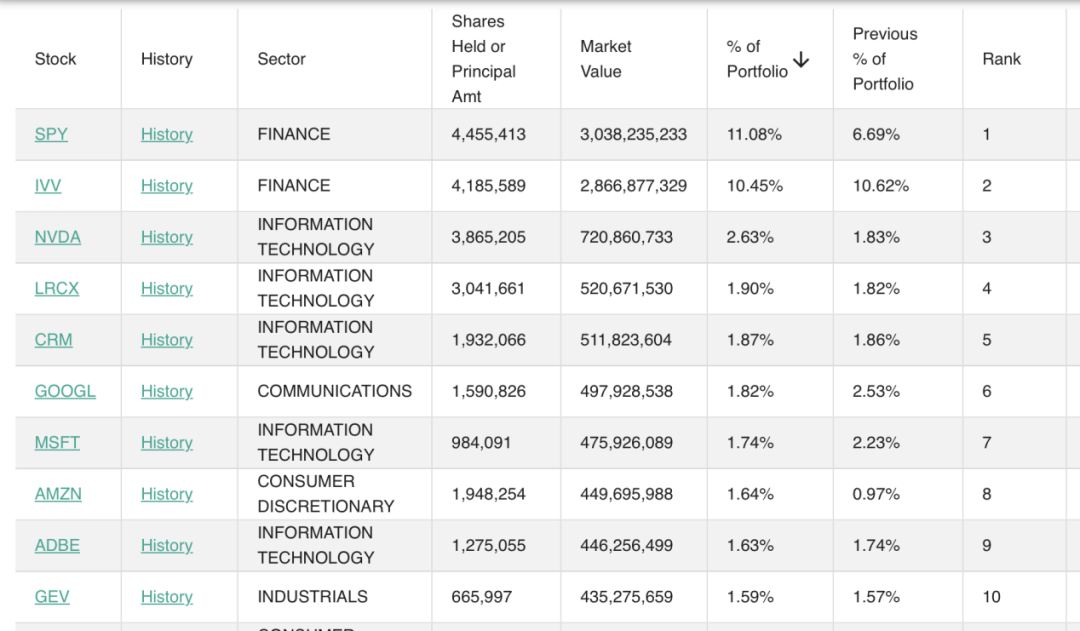
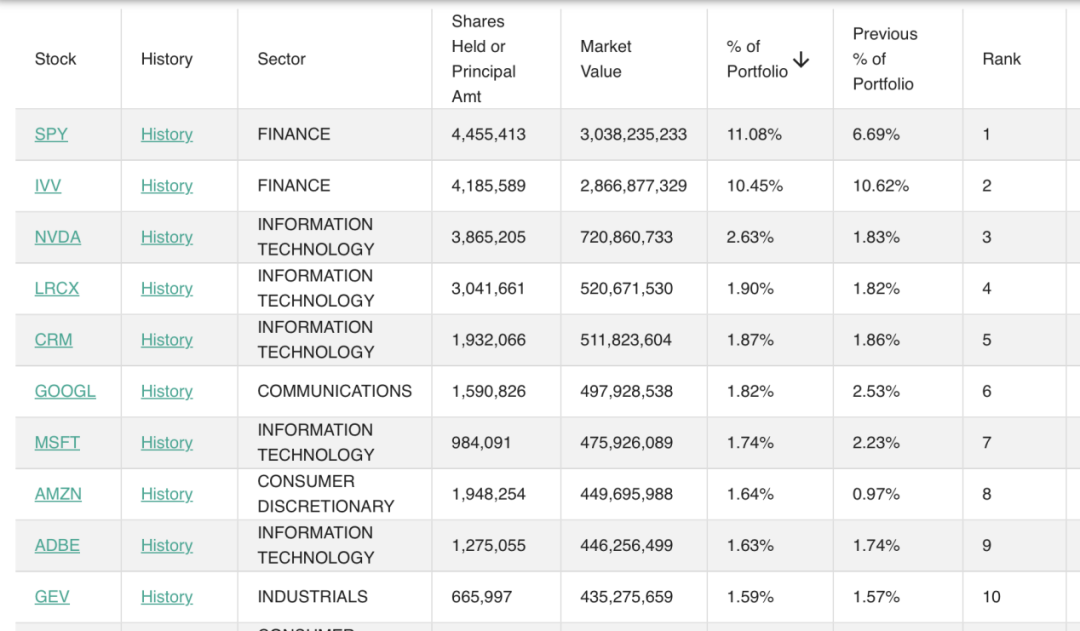
Group 1 - Bridgewater's latest 13F report reveals a total market value of $27.4 billion in Q4 2025, up from $25.5 billion in Q3 2025 [3] - The top ten holdings account for 36.35% of the total portfolio, with significant positions in SPDR S&P 500 ETF (SPY), iShares S&P 500 ETF (IVV), Nvidia, Amazon, and Newmont [3][4] - The five largest increases in holdings include SPY, Micron Technology, Oracle, Nvidia, and Newmont Corporation [4][5] Group 2 - Bridgewater increased its Nvidia shares from 2.51 million in Q3 to 3.87 million in Q4, a 54% increase, and also raised its Amazon holdings to 1.95 million shares [5] - The report indicates a reduction in holdings for companies like Uber, Fiserv, Google, META, and Microsoft [5] Group 3 - Ray Dalio emphasizes that the main sources of returns in 2025 stem from changes in currency value and the underperformance of U.S. stocks compared to non-U.S. stocks and gold [8] - The dollar depreciated against several currencies, with a notable 39% decline against gold, which emerged as the best-performing asset [8] - The report highlights a significant capital reallocation from the U.S. to international markets, a trend expected to continue [8]




黄仁勋跌出全球富豪榜前十,黄仁勋2个月身家缩水超30亿美元
Xin Lang Cai Jing· 2026-02-14 12:24
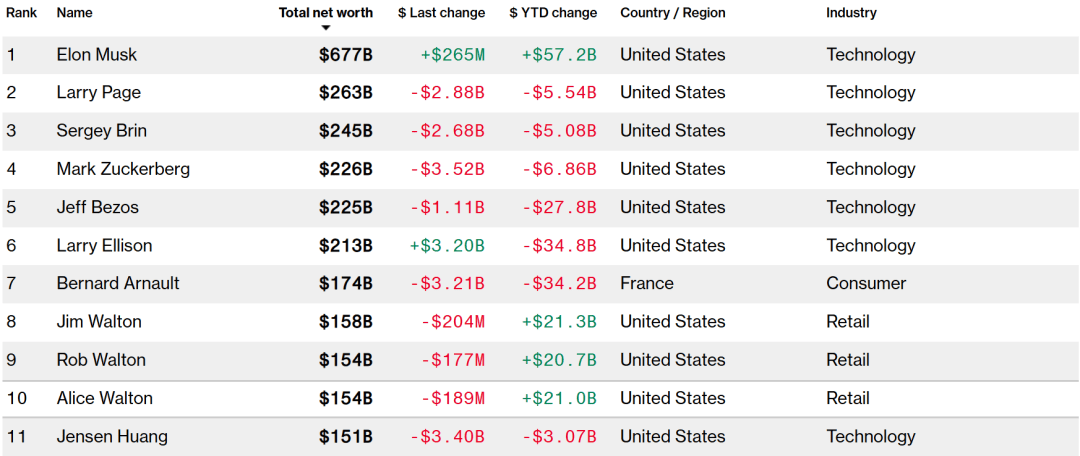
Core Viewpoint - The article highlights the significant decline in the wealth of tech executives, particularly NVIDIA CEO Jensen Huang, who has fallen out of the top ten on the global billionaire list due to a drop in stock prices, reflecting a broader trend of investor withdrawal from the tech sector [1] Group 1: Wealth Changes - Jensen Huang's wealth has decreased by over $3 billion since the beginning of the year, bringing his total net worth to $151 billion [1] - Other tech industry billionaires have also experienced substantial losses, indicating a widespread downturn in the sector [1] Group 2: Billionaire Rankings - The Walton siblings, founders of Walmart, have entered the global top ten, collectively amassing a fortune exceeding $450 billion [1] - Despite the decline in wealth among many tech executives, Elon Musk's net worth has continued to increase [1]

大举加仓这些股!桥水最新持仓曝光,达利欧发声
Zhong Guo Ji Jin Bao· 2026-02-14 11:57
Group 1 - Bridgewater Associates significantly increased its holdings in technology stocks and gold-related stocks in Q4 2025, including Nvidia, Amazon, and Newmont Corporation [1][2] - The total market value of Bridgewater's holdings reached $27.4 billion in Q4 2025, up from $25.5 billion in Q3 2025 [2] - The top ten holdings accounted for 36.35% of the total portfolio, with SPDR S&P 500 ETF (SPY) and iShares S&P 500 ETF (IVV) being the largest positions [2][3] Group 2 - Bridgewater increased its Nvidia shares from 2.51 million to 3.87 million, a 54% increase, and also raised its Amazon shares to 1.95 million [4] - The largest reductions in holdings were in Uber, Fiserv, Google, Meta, and Microsoft [4] - The report indicates a shift in asset allocation from the U.S. to international markets, with a notable focus on gold as a strong asset class [7][8] Group 3 - Ray Dalio emphasized that the main sources of returns in 2025 were changes in currency values and the underperformance of U.S. stocks compared to non-U.S. stocks and gold [7] - The dollar depreciated against several currencies, with a 39% decline against gold, highlighting gold's status as a strong asset [7] - Current high price-to-earnings ratios and low credit spreads indicate that overall valuations are expensive, with expected long-term stock returns at about 4.7% [8]


Nvidia CEO Huang won't attend India AI summit next week, company saus
Reuters· 2026-02-14 11:01
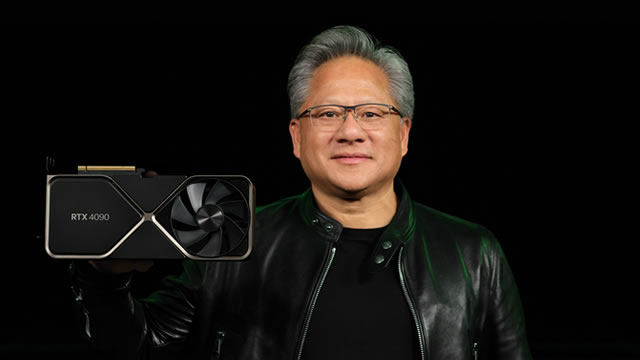
Core Viewpoint - Nvidia CEO Jensen Huang will not attend the India AI Impact Summit due to unforeseen circumstances, which is notable as he was expected to be a key speaker at the event [1]. Company Summary - Jensen Huang's absence from the summit is significant as he was anticipated to attract considerable attention, highlighting Nvidia's role in the AI sector [1]. - The summit is set to be inaugurated by Prime Minister Narendra Modi, indicating the importance of AI in India's technological landscape [1]. Industry Summary - The India AI Impact Summit is expected to gather global technology industry and political leaders, underscoring the growing interest and investment in AI technologies [1].
The 5 Best Artificial Intelligence (AI) Stocks to Buy for February
The Motley Fool· 2026-02-14 10:00
Core Insights - A recent sell-off in the market has created unique buying opportunities, particularly in the artificial intelligence (AI) sector, which remains a focal point for investors [1] - The demand for AI technology continues to drive significant investment opportunities, especially in companies that provide essential hardware and cloud services [1] Group 1: AI Hardware Providers - Nvidia and Broadcom are major beneficiaries of AI spending, as they produce computing equipment crucial for AI data centers, leading to strong growth prospects [4][7] - Nvidia's GPUs are the industry standard for AI computing, and the company maintains a competitive edge with its technology stack [6] - Broadcom collaborates with AI hyperscalers to design custom AI chips, enhancing its position in the market [6][7] Group 2: Semiconductor Manufacturing - Taiwan Semiconductor (TSMC) plays a vital role in the AI ecosystem by fabricating logic chips for Nvidia and Broadcom, as well as other tech companies [8] - TSMC's advancements in 2-nanometer chip technology promise reduced power consumption, which is beneficial as AI data centers expand [10] Group 3: Cloud Computing Providers - Alphabet and Microsoft, despite recent stock sell-offs, are key players in the cloud computing industry, investing heavily to expand their AI capabilities [11] - Both companies are experiencing significant revenue growth in their cloud services, with Microsoft Azure revenue increasing by 39% and Google Cloud by 48% in their latest quarters [14] - The ongoing demand for cloud computing services supports the rationale for AI capital investment spending [12][14]




Nvidia Stock Investors Just Got Good News From Amazon, Google, Meta Platforms, and Microsoft
The Motley Fool· 2026-02-14 09:12
Core Insights - Hyperscalers are expected to significantly increase spending on AI infrastructure in 2026, with revised estimates suggesting a 70% increase to approximately $650 billion, surpassing initial Wall Street estimates of 19% growth [10][9]. Company Insights - Nvidia has been a key player in the AI sector, with its shares rising 1,180% since early 2023, and analysts believe the stock remains undervalued, with a median target price of $250 per share indicating a 33% upside from the current price of $187 [1][2]. - Nvidia holds over 80% market share in AI accelerators and is recognized for its full-stack strategy, which includes developing both hardware and software solutions for AI infrastructure [4][6]. - The company's networking revenue surged by 162% in the most recent quarter, highlighting its strong position in the market [5]. Industry Insights - Wall Street has consistently underestimated AI hyperscaler capital expenditures (capex), with actual growth rates far exceeding initial forecasts; for instance, capex increased by 54% in 2024 and 64% in 2025, compared to initial estimates of 19% and 22% respectively [8]. - Major companies like Alphabet, Amazon, Meta Platforms, and Microsoft have announced substantial increases in their capex for AI infrastructure in 2026, with Alphabet projecting $180 billion (up 98% from 2025), Amazon $200 billion (up 56%), Meta $125 billion (up 74%), and Microsoft over $140 billion (up 59%) [11].
本周,“AI颠覆一切”的狼终于来了
Hua Er Jie Jian Wen· 2026-02-14 09:07
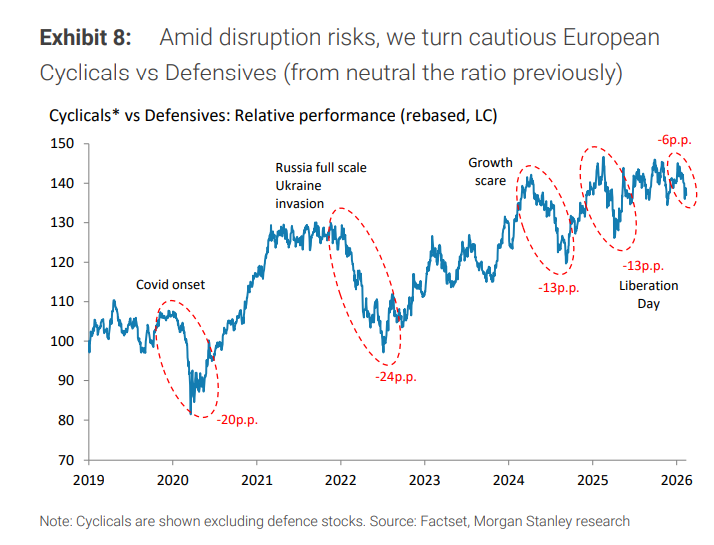
Core Insights - The market is increasingly recognizing the imminent threat of AI disruption, with the perceived risk in the MSCI Europe index rising from 4% to 24% in just over a month, including the banking sector [1][9] - Morgan Stanley has shifted its stance from neutral to cautious regarding cyclical stocks versus defensive stocks, highlighting opportunities in the European credit market for downside protection [1][15] AI Capability Advancements - The latest AI model, GPT-5.2, has achieved human expert-level performance in 71% of professional tasks, marking a significant leap in AI capabilities [5][8] - The speed of AI advancements is accelerating, with predictions that upcoming models in 2026 will far exceed current capabilities due to increased computational power [8] Market Disruption Dynamics - Initial concerns about AI's impact on the software industry have rapidly expanded to broader economic disruption risks, reminiscent of market reactions during the early COVID-19 pandemic [9][10] - Approximately 10% of the MSCI Europe index (excluding banks) is now viewed as facing substantial AI disruption risks, with this figure rising to 24% when including banks [9][10] Valuation Trends - The valuation of "disruption stocks" has decreased from a peak P/E ratio of 24x to 16.4x, with further downward potential indicated by comparisons to "uncontested disruption stocks" [10] Resilience Assessment Framework - Morgan Stanley proposes a framework to evaluate sectors and stocks based on five dimensions of risk exposure, identifying utilities, semiconductors, defense, and tobacco as the most resilient sectors [11] - Sectors such as software, commercial services, and banking are identified as facing the highest disruption risk [11] Non-AI Replicable Assets - The report emphasizes the rising value of assets that cannot be replicated by AI, including physical assets, regulatory barriers, and unique human experiences [4][12][14] Credit Market Insights - Despite AI disruption concerns affecting some credit markets, European investment-grade spreads remain low, presenting opportunities for investors to hedge against potential downturns [15] Computing Power Demand - There is a significant and growing demand for computing power, with projections indicating that the growth rate of demand will outpace current supply forecasts [16][21] - The intensity of computing requirements for AI queries is increasing rapidly, with predictions that companies may need to double their computing power every six months [19][21]

Nebius: Inflection Point

Seeking Alpha· 2026-02-14 08:44
Core Viewpoint - The article discusses the investment positions held by analysts in various companies, indicating a bullish sentiment towards the stocks mentioned, particularly NBIS, CRWV, NVDA, and IREN [1]. Group 1 - Analysts have disclosed beneficial long positions in shares of NBIS, CRWV, NVDA, and IREN, either through stock ownership, options, or other derivatives [1]. - The article emphasizes that the opinions expressed are personal and not influenced by compensation from any company mentioned [1]. - There is no business relationship between the author and the companies whose stocks are discussed, reinforcing the independence of the analysis [1].
黄仁勋跌出全球前十大富翁排行榜,今年初至今财富已缩水超30亿美元
Sou Hu Cai Jing· 2026-02-14 08:35
| Rank | Name | Total net worth D | $ Last change | $ YTD change | Country / Region | Industry | | --- | --- | --- | --- | --- | --- | --- | | 1 | Elon Musk | $677B | +$265M | +$57.2B | United States | Technology | | 2 | Larry Page | $263B | -$2.88B | -$5.54B | United States | Technology | | 3 | Sergey Brin | $245B | -$2.68B | -$5.08B | United States | Technology | | ব | Mark Zuckerberg | $226B | -$3.52B | -$6.86B | United States | Technology | | 5 | Jeff Bezos | $225B | -$1.11B | -$27.8B | United States | ...