
Nvidia(NVDA)

Search documents
Software stocks tank, analysts see opportunities: Stocks & Markets Podcast
Yahoo Finance· 2026-02-09 23:31
Group 1 - The term "Software-mageddon" describes a significant sell-off in software and tech stocks due to fears that generative AI could render traditional software companies obsolete, with the North American Tech-Software iShares ETF (IGV) dropping 24.6% year to date as of February 9 [1] - Analyst Dan Ives from Wedbush believes the market's pessimism regarding software companies is exaggerated, asserting that the AI Revolution is accelerating and that 2026 will be a pivotal year for AI [2] - Lindsey Bell, CIO at 248 Ventures, noted that despite strong quarterly results from many tech companies, there are concerns about the sustainability of AI demand and the profitability of current spending [4] Group 2 - Bell highlighted that some companies are currently integrating AI into their systems and have strong revenue and profitability, suggesting that their stock declines are unwarranted [7] - Chris Versace pointed out that prominent figures in the tech industry, including CEOs from Nvidia, AMD, and Arm Holdings, criticized the sell-off, emphasizing that AI is a tool to enhance software rather than a threat to the industry [6] - The overall sentiment in the tech sector is cautious, with some investors opting to take profits until there is clearer visibility on profitability [5]



凌晨,全线大涨!美联储,重磅发声!
券商中国· 2026-02-09 23:29
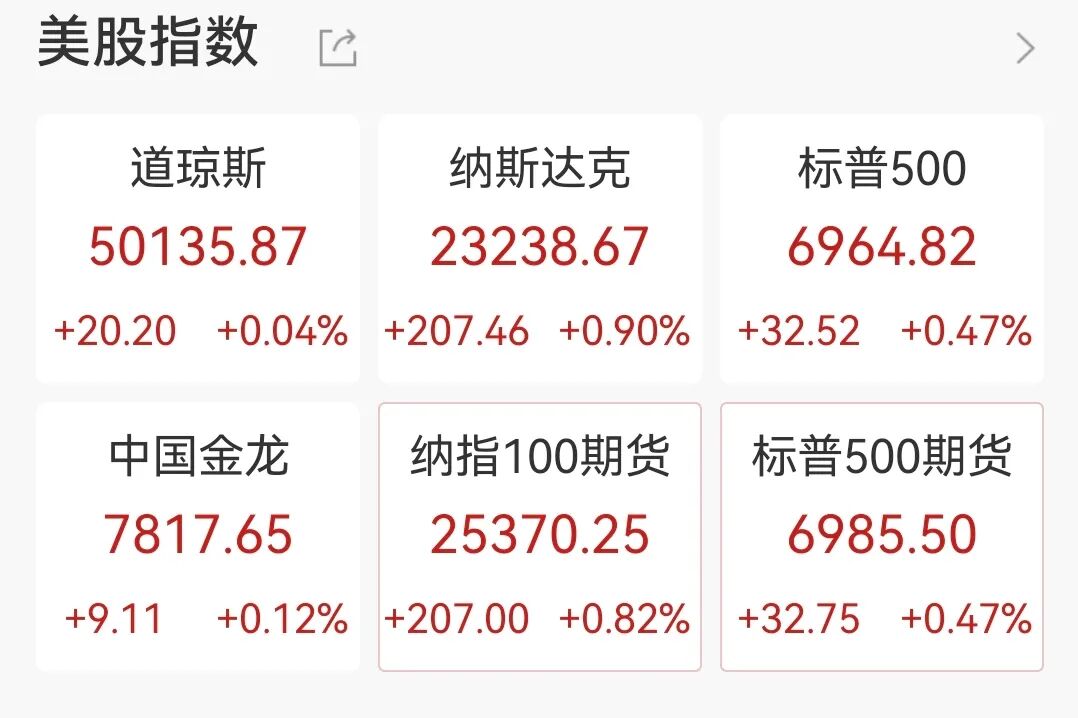
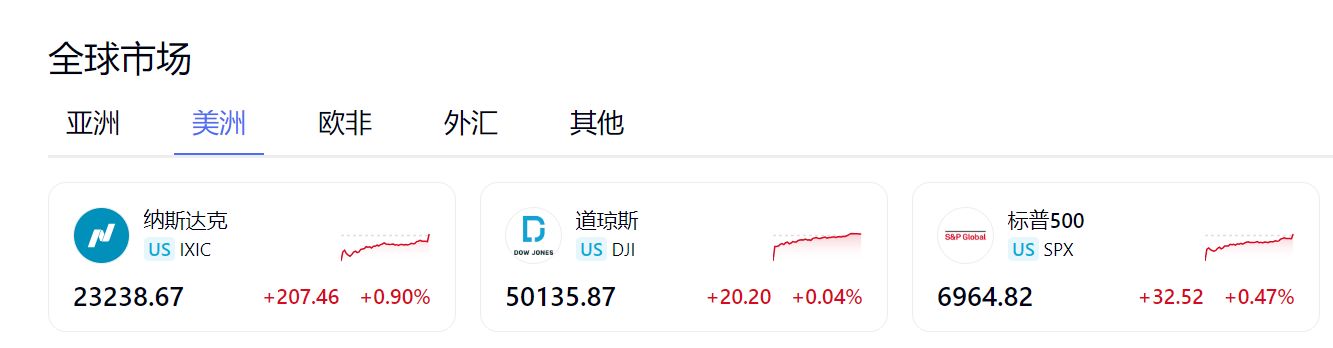
科技股全线反攻。 隔夜美股市场,科技股反弹提振市场情绪,纳指大涨近1%,道指再创历史新高。以黄金、白银为首的贵金属 全线大涨,COMEX黄金期货涨超2%,COMEX白银期货大涨8%。 有分析指出,美元持续走弱为风险资产和黄金、白银提供了额外支撑。美东时间2月9日,美元大幅走弱,衡量 美元对六种主要货币的美元指数大跌0.84%,跌破97关口。 对此,美国亚特兰大联储主席博斯蒂克表示,他开 始看到人们对美元信心产生质疑。美联储理事米兰则表示,美元目前的这种程度的下跌,还没有对货币政策产 生实质性的影响。 全线大涨 美东时间2月9日,美股三大指数低开高走,道指再创历史新高,标普500指数逼近历史高点。截至收盘,道指 涨0.04%,标普500指数涨0.47%,纳指涨0.90%。 美股大型科技股多数走强,甲骨文大涨超9%,微软、博通、AMD大涨超3%,英伟达、Meta涨超2%,特斯拉 涨超1%,谷歌小幅收涨;苹果跌超1%,亚马逊小幅收跌。 消息面上,甲骨文大幅飙涨主要受到D.A. Davidson上调评级的提振。D.A.Davidson分析师吉尔·卢里亚认为, 市场对甲骨文的抛售可能已过度。 谷歌母公司Alphabet ...






凌晨,全线大涨!美联储,重磅发声!
Xin Lang Cai Jing· 2026-02-09 23:28
美股大型科技股多数走强,甲骨文大涨超9%,微软、博通、AMD大涨超3%,英伟达、Meta涨超2%, 特斯拉涨超1%,谷歌小幅收涨;苹果跌超1%,亚马逊小幅收跌。 科技股全线反攻。 隔夜美股市场,科技股反弹提振市场情绪,纳指大涨近1%,道指再创历史新高。以黄金、白银为首的 贵金属全线大涨,COMEX黄金期货涨超2%,COMEX白银期货大涨8%。 有分析指出,美元持续走弱为风险资产和黄金、白银提供了额外支撑。美东时间2月9日,美元大幅走 弱,衡量美元对六种主要货币的美元指数大跌0.84%,跌破97关口。对此,美国亚特兰大联储主席博斯 蒂克表示,他开始看到人们对美元信心产生质疑。美联储理事米兰则表示,美元目前的这种程度的下 跌,还没有对货币政策产生实质性的影响。 全线大涨 美东时间2月9日,美股三大指数低开高走,道指再创历史新高,标普500指数逼近历史高点。截至收 盘,道指涨0.04%,标普500指数涨0.47%,纳指涨0.90%。 消息面上,甲骨文大幅飙涨主要受到D.A. Davidson上调评级的提振。D.A.Davidson分析师吉尔·卢里亚 认为,市场对甲骨文的抛售可能已过度。 谷歌母公司Alphabet计 ...
道指再创新高,美股科技股反弹,甲骨文飙涨9%,金银、原油大涨
2 1 Shi Ji Jing Ji Bao Dao· 2026-02-09 23:15
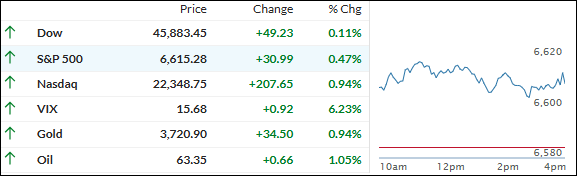
Market Performance - The US stock indices all closed higher, with the Nasdaq rising nearly 1%, the Dow Jones slightly up, and the S&P 500 increasing by 0.5%, nearing its historical high [1] - The Dow Jones closed at 50,135.87, up by 20.20 points (0.04%), the Nasdaq at 23,238.67, up by 207.46 points (0.90%), and the S&P 500 at 6,964.82, up by 32.52 points (0.47%) [2] Technology Sector - Major US tech stocks rebounded after a recent sell-off triggered by AI concerns, with the tech giants index rising by 1.02% [2] - Microsoft saw an increase of over 3%, while Nvidia and Facebook rose by over 2%. However, Apple and Amazon experienced declines of over 1% and 0.76%, respectively, marking Amazon's fifth consecutive day of decline [2] Chip Sector - The chip stock index increased by 1.9%, with Oracle rising over 9%, and Microsoft and Broadcom up by over 3%. In contrast, Micron Technology and SanDisk fell by nearly 3% [3] Commodity Market - Gold prices continued their upward trend, with spot gold rising nearly 2% to surpass $5,050. COMEX gold increased by over 2%, while spot silver rose by over 7% and COMEX silver by 8% [6][7] - Crude oil prices rose by over 1%, influenced by new US guidelines for ships passing through the Strait of Hormuz [6] Employment and Inflation Data - Upcoming US non-farm payroll and CPI reports are expected to provide important insights into the Federal Reserve's monetary policy direction, with potential for significant market volatility if the data indicates "weak employment + stubborn inflation" [8] - Current probabilities for Federal Reserve interest rate changes indicate a 17.7% chance of a 25 basis point cut by March and a 50.4% chance of a 25 basis point cut by June [8]




Elon Musk Bets On Humanoid Robots In 2026, But One Company Hopes 'Elon Time' Strikes Again - Tesla (NASDAQ:TSLA)
Benzinga· 2026-02-09 23:12
Core Insights - Elon Musk positions the Optimus humanoid robot as Tesla's most significant long-term value driver, potentially increasing the company's market cap to $25 trillion [1] - Prediction markets indicate only a 21% chance that the humanoid robot will be available for sale by 2026, suggesting skepticism about its revenue contribution [2] - The success or failure of the Optimus robot will have broader implications for the robotics and AI ecosystem, particularly affecting NVIDIA Corp. as a key supplier [3] Company-Specific Insights - Tesla's recent "We, Robot" event highlighted the potential applications of the Optimus robot, with a projected price range of $20,000 to $30,000 [1] - If Tesla does not meet its production milestones in 2025, the odds of the robot's release could decrease, negatively impacting Tesla's stock price amid declining car-based revenue [2] - Tesla faces competition from Hyundai, which has committed its entire 2026 production run to its humanoid robot, potentially capturing the enterprise market first [4] Industry Context - The delay in Tesla's Optimus robot could provide an opportunity for Hyundai-owned Boston Dynamics to advance its electric Atlas bot in the market [4] - Musk's history of ambitious deadlines, often referred to as "Elon Time," raises concerns about the feasibility of meeting projected timelines for the Optimus robot [4][5]


深夜,英伟达又大涨,两天市值暴增3.3万亿元,亚马逊已连跌5天
Mei Ri Jing Ji Xin Wen· 2026-02-09 23:02
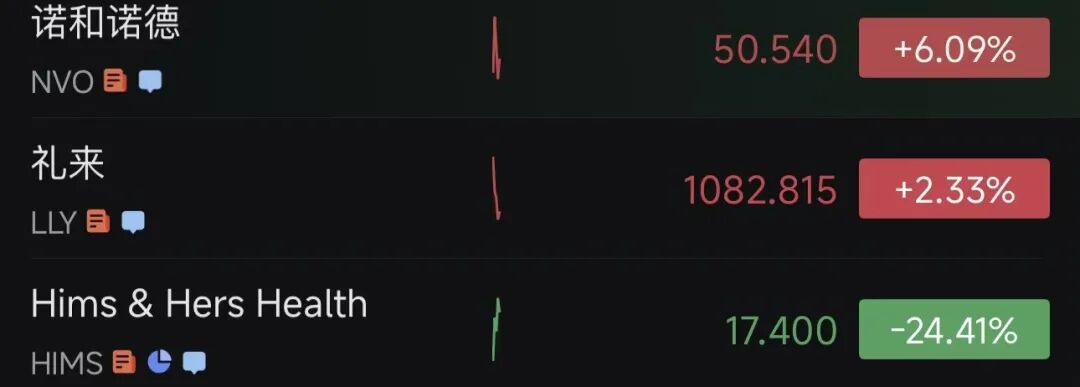
Group 1 - The U.S. stock market opened lower, with the Dow Jones down 0.14%, while the Nasdaq rose by 0.11% and the S&P 500 increased by 0.18% [1] - Weight loss drug stocks saw a general increase, with Novo Nordisk rising over 6% and Eli Lilly up more than 2%. In contrast, Hims & Hers, facing a lawsuit for infringing on the patent of semaglutide, dropped 24% [1][3] - Novo Nordisk filed a lawsuit against Hims & Hers for allegedly misleading consumers about the clinical benefits and safety of its compounded semaglutide products, which are produced using unregulated raw materials [3] Group 2 - The FDA informed Novo Nordisk that the advertising for its weight loss drug Weeovy is either false or misleading [4] - Nvidia's stock rose by 3.31%, with a market capitalization increase of approximately $477.74 billion (around 3.31 trillion RMB) over two trading days [4] - AI application software stocks experienced a rebound, with Roblox rising over 9%, Applovin up more than 8%, and Unity Software increasing by nearly 8% [11]

道指再创新高,纳指涨近1%!英伟达涨2.5%,甲骨文涨超9%!金银大涨,美元下跌
Mei Ri Jing Ji Xin Wen· 2026-02-09 22:48
Market Performance - Major indices collectively rose, with the Nasdaq increasing by nearly 1%, the Dow Jones slightly up, and the S&P 500 rising by 0.5%, nearing its historical high [1] - Closing figures: Dow Jones at 50,135.87 points (+0.04%), S&P 500 at 6,964.82 points (+0.47%), Nasdaq at 23,238.67 points (+0.90%) [1] Technology Sector - Most large tech stocks saw gains, with Nvidia up 2.50%, Microsoft up 3.11%, and Oracle up 9.64% [3][5] - Nvidia's CEO highlighted the strong demand for computing power, indicating continued investment in AI infrastructure [5] - Analysts suggest that capital expenditures for major cloud providers are expected to continue facing upward pressure due to increasing demand [6] Cloud Computing - Morgan Stanley reported that the revenue growth for GCP, AWS, and Azure is accelerating, driven by an exponential increase in token processing [6] - Concerns were raised regarding Amazon and Alphabet's capital expenditure guidance, which was perceived as significantly higher than market expectations, overshadowing their strong cloud business growth [5] Commodities - COMEX gold futures rose by 2.1% to $5,084.2 per ounce, while silver futures increased by 8% to $83.05 per ounce [7] - WTI crude oil futures closed up 1.27% at $64.36 per barrel, and Brent crude oil futures rose 1.45% to $69.04 per barrel [8] Chinese Stocks - The Nasdaq Golden Dragon China Index saw mixed performance, with Alibaba up 0.30% and NIO down 2.98% [6]
2月10日美股成交额前20:甲骨文获机构唱好,股价大涨9.6%
Xin Lang Cai Jing· 2026-02-09 21:39
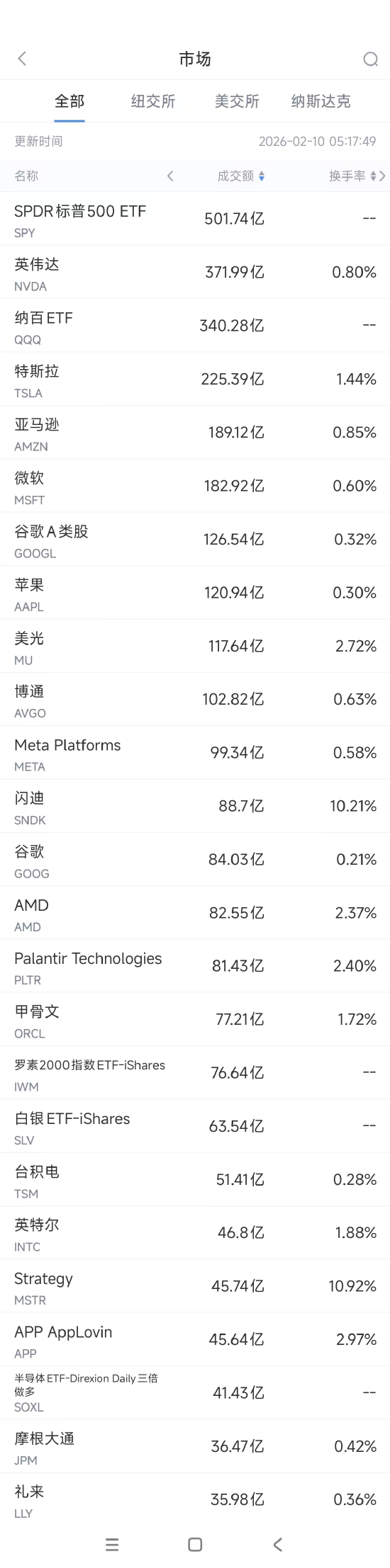
Group 1: Nvidia - Nvidia's stock rose by 2.4% with a trading volume of $37.199 billion, and Goldman Sachs set a target price of $250, anticipating Q4 revenue of $67.3 billion [1][11] - Goldman Sachs expects Nvidia to deliver a revenue "surprise" of $2 billion in Q4, with EPS forecasts exceeding market expectations by 5% and 9% for Q4 and Q1 respectively [1][11] - Analysts predict that the Rubin GPU will start shipping in Q3 2026, significantly increasing volume in Q4 and supporting strong growth until at least 2028 [1][11] Group 2: Tesla - Tesla's stock increased by 1.48% with a trading volume of $22.539 billion, and the company announced the mass production of the Tesla Cybercab at its Texas Gigafactory [2][12] - Tesla's Vice President revealed that the Full Self-Driving (FSD) technology rollout in mainland China is progressing, with a local training center established for adaptation [2][12] Group 3: Amazon - Amazon's stock fell by 0.76% with a trading volume of $18.912 billion, while STMicroelectronics announced a multi-year, multi-product collaboration with Amazon Web Services (AWS) [3][12] - The partnership positions STMicroelectronics as a strategic supplier of advanced semiconductor technologies for AWS, integrating high-bandwidth connectivity and energy-efficient solutions [3][12] Group 4: Microsoft - Microsoft's stock rose by 3.13% with a trading volume of $18.292 billion, but the company faced two downgrades in less than a week due to concerns over AI-related risks [3][13] - Melius Research downgraded Microsoft from "Buy" to "Hold," citing worries about capital expenditures and the performance of its Copilot AI software [3][13] Group 5: Micron - Micron's stock fell by 2.84% with a trading volume of $11.764 billion, as semiconductor research indicated that Micron may miss out on first-year orders for the Rubin architecture [4][13] - SemiAnalysis reported that Nvidia is likely to exclude Micron's HBM4 from initial production, favoring Korean suppliers instead [4][13] Group 6: SanDisk - SanDisk's stock decreased by 2.43% with a trading volume of $8.87 billion, but Bernstein raised its target price to $1000, reflecting a 72.4% increase from the previous target of $580 [5][15] - The new target price suggests a potential upside of about 50% from the current stock price, as SanDisk focuses on NAND flash memory and storage products [5][15] Group 7: AMD - AMD's stock rose by 3.63% with a trading volume of $8.255 billion, and the company appointed a new Chief Marketing Officer from Oracle [6][16] - Huatai Securities maintained a "Buy" rating for AMD with a target price of $300 [6][16] Group 8: Oracle - Oracle's stock increased by 9.64% with a trading volume of $7.721 billion, and DA Davidson upgraded its rating from "Neutral" to "Buy" based on reduced risks associated with its client OpenAI [6][16] - The report maintained a target price of $180 for Oracle, reflecting improved outlooks for the company's performance [6][16] Group 9: AppLovin - AppLovin's stock surged by 13.19% with a trading volume of $4.564 billion, driven by positive comments from multiple financial institutions regarding its business prospects [6][17] - The market sentiment is bolstered by AppLovin's AI-driven advertising engine, Axon, which is described as a leading machine learning advertising engine [6][17]

Silver Leads Commodities, Gold Nears $5,100 – Risk-On Returns
Ulli... The ETF Bully· 2026-02-09 21:36
Market Overview - Major indexes experienced a weak open but recovered to close positively, with traders awaiting significant upcoming data and earnings reports [1] - The delayed January jobs report is expected to show an increase of approximately +55,000 nonfarm payrolls, following a weak ADP print of +22,000 [2] Company Performance - Oracle's stock surged by 8% after being upgraded to a Buy rating, driven by optimism surrounding OpenAI and its ecosystem beneficiaries [2] - Other chip manufacturers, including Nvidia and Broadcom, also saw gains, with Nvidia up nearly 3% and Broadcom up more than 1% [2] Economic Indicators - The January Consumer Price Index (CPI) is anticipated to show a 2.5% annual rate, contributing to a broad market rally where small caps outperformed and Big Tech remained strong [3] - Bond yields decreased, and the dollar continued its sell-off, while commodities like silver and gold remained firm, with gold nearing $5,100 [4] Trend Tracking Indexes (TTIs) - The domestic Trend Tracking Index (TTI) closed at +8.35% above its moving average, while the international TTI closed at +12.91% above its moving average, indicating strong market momentum [8]
Larry Ellison, Jeff Bezos Lose $66B as AI Slump Triggers Tech Billionaire Wealth Rout
Yahoo Finance· 2026-02-09 20:31
The tech industry witnessed a dramatic shift as the wealth of several top tech billionaires plummeted due to fears over the AI bubble and fluctuating valuations. Larry Ellison, co-founder of Oracle, experienced a staggering $59.2 billion loss in his net worth since the beginning of the year, with $19 billion of that occurring just this week. The selloff was exacerbated by developments such as Anthropic’s new legal AI tool, which caused a nearly 4% drop in the S&P 500 software and services index. The weal ...