
Oracle(ORCL)

Search documents
瑞银:债务激增不足为虑 甲骨文(ORCL.US)投资级评级“不太可能”遭下调
Zhi Tong Cai Jing· 2026-01-07 03:39
Group 1 - UBS Group indicates that Oracle Corporation (ORCL.US) is likely to maintain its investment-grade rating in the short term despite taking on hundreds of billions in debt to expand its artificial intelligence business [1] - UBS strategist Matthew Mish noted that while Oracle's rating may be downgraded to the lowest tier of investment grade, concerns about it falling to "junk status" are likely overstated [1] - Oracle's outstanding debt is approximately $95 billion, making it the largest corporate bond issuer outside the financial sector in the Bloomberg high-rated corporate index [1] Group 2 - Oracle's decision to issue $18 billion in bonds last September for data center expansion aimed at capitalizing on the AI investment boom has led to ongoing market concerns regarding its rating sustainability [1] - The ability of Oracle to maintain its investment-grade status will ultimately depend on the prospects of its AI business and future borrowing plans [1] - All three major rating agencies currently rate Oracle two notches above junk status [1]

本季度云业务:超大规模服务商 2025 年第三季度表现如何-Cloud in the Quarter How did the hyperscalers do in 3Q25
2026-01-07 03:05
Summary of Key Points from the Conference Call Industry Overview - The hyperscale market is a significant opportunity in the Software/Cloud/Internet sector, estimated at $1.3-1.5 trillion, potentially the largest in technology [4][2] - The market is currently influenced by the Generative AI wave, with concerns about CAPEX growth and associated margins for AI-related infrastructure investments [2][3] Company-Specific Insights Microsoft (MSFT) - Microsoft is leading in AI and non-AI revenue growth, with Azure growing 39% in constant currency (40% reported) in Q3 [15][50] - CAPEX for Q1 FY26 was $34.9 billion, with expectations for continued growth driven by strong demand signals [15][50] - Concerns exist regarding the sustainability of AI revenue and exposure to OpenAI, but long-term growth and margin potential are viewed positively [8][50] Amazon (AMZN) - AWS growth accelerated to 20% year-over-year, reaching $33 billion, with AI contributions growing at triple digits [10][35] - AWS capacity has doubled since 2022 and is expected to double again by 2027, with a backlog growth of 22% year-over-year [10][35] - Management revised FY25 CAPEX guidance to $125 billion, primarily for AWS infrastructure [10][35] Google (GOOGL) - Google Cloud revenues increased by 34% year-over-year, reaching approximately $15 billion, with a significant backlog of $155 billion [12][17] - Despite strong demand, revenue growth is limited by capacity constraints, and management expects this to continue into 2026 [12][17] - CAPEX guidance for 2025 was raised from $85 billion to $91-93 billion, reflecting a 73% year-over-year increase [12][17] Oracle (ORCL) - Oracle's OCI revenue grew 68% year-over-year, with total Remaining Performance Obligations (RPO) increasing significantly [9][20] - Concerns about CAPEX required for capacity build-out and the sustainability of AI revenue exist, but the long-term growth potential is viewed favorably [9][20] Alibaba (BABA) - Alicloud revenue growth accelerated to 34.5% year-over-year, with AI-related products contributing significantly [13][18] - Management indicated strong revenue growth expectations for the coming quarters, despite higher comparative growth rates [13][18] Additional Insights - The hyperscale market is experiencing a shift in sentiment due to AI developments, leading to confusion about potential bubbles in the market [14] - The competitive landscape is evolving, with questions about which companies will emerge as winners or losers in the AI space [3][14] - The overall capital intensity of IaaS/PaaS is a critical factor, with ongoing analysis of the cost structures and profitability of major players [6][5] Conclusion - The hyperscale cloud market is poised for significant growth, driven by AI and increasing demand for cloud services. Each major player is navigating unique challenges and opportunities, with varying growth rates and CAPEX strategies. Investors should closely monitor these developments to identify potential investment opportunities and risks.




卖房资助儿子收购华纳兄弟?甲骨文创始人埃里森3亿出售豪宅
Feng Huang Wang· 2026-01-07 00:05
埃里森出售的豪宅 凤凰网科技讯北京时间1月7日,据《华尔街日报》报道,就在派拉蒙CEO大卫.埃里森(David Ellison)积 极竞购华纳兄弟之际,他的父亲、甲骨文创始人拉里.埃里森(Larry Ellison)以4500万美元(约合3亿元人 民币)的价格出售了位于旧金山黄金海岸的豪宅。 公共记录显示,这栋位于太平洋高地高端社区的房产通过非公开交易于去年12月完成交割,买家身份尚 未披露。 拉里是甲骨文董事长,也是美国总统特朗普的密友。记录显示,他大约在1988年以390万美元购入该房 产。截至发稿,拉里尚未就此置评。 据市政记录显示,这栋现代风格住宅由建筑师威廉.沃斯特(William Wurster)在大约1958年设计,建筑面 积约10,742平方英尺(约合998平方米),设有五间卧室。该条高档街道上的邻居包括石油世家继承人戈 登.盖蒂(Gordon Getty)以及英伟达CEO黄仁勋(Jensen Huang)。2024年,已故苹果联合创始人乔布斯之 妻、爱默生基金会(Emerson Collective)主席劳伦娜.鲍威尔.乔布斯(Laurene Powell Jobs)以创纪录的7100 万美 ...


Microsoft vs. Oracle: Which Tech Stock Will Make You Richer?
Yahoo Finance· 2026-01-06 15:20
Key Points Oracle's share price fell in December after missing analysts' revenue expectations. Microsoft's Azure and cloud services continue to grow at an impressive rate. Microsoft reached $4 trillion in market cap for the first time in 2025. 10 stocks we like better than Microsoft › Software giants Microsoft (NASDAQ: MSFT) and Oracle (NYSE: ORCL) are also major players in the era of artificial intelligence (AI). Both companies are aggressively building toward an AI-native future and showing gre ...
Oracle's AI Hangover Highlights the Risk of Chasing Late Cycle Tech Winners
247Wallst· 2026-01-06 11:20
Core Insights - Oracle has experienced a significant decline in market perception, shifting from a favored stock to one that is viewed with disappointment within a few months [1] Financial Performance - The company's recent earnings report showed a revenue increase of 18% year-over-year, reaching $12.5 billion, but this was below market expectations [1] - Oracle's cloud services revenue grew by 30%, totaling $3.5 billion, indicating strong demand in this segment [1] Market Reaction - Following the earnings report, Oracle's stock price dropped by 10%, reflecting investor concerns over growth sustainability and competitive pressures [1] - Analysts have expressed mixed sentiments, with some highlighting the potential for recovery while others remain cautious about future performance [1] Competitive Landscape - Oracle faces increasing competition from other cloud service providers, which has raised questions about its market share and growth trajectory [1] - The company is investing heavily in artificial intelligence and cloud infrastructure to maintain its competitive edge [1]

就在2026年上半年,甲骨文等“OpenAI链”逆袭?这是先决条件
Hua Er Jie Jian Wen· 2026-01-06 07:03
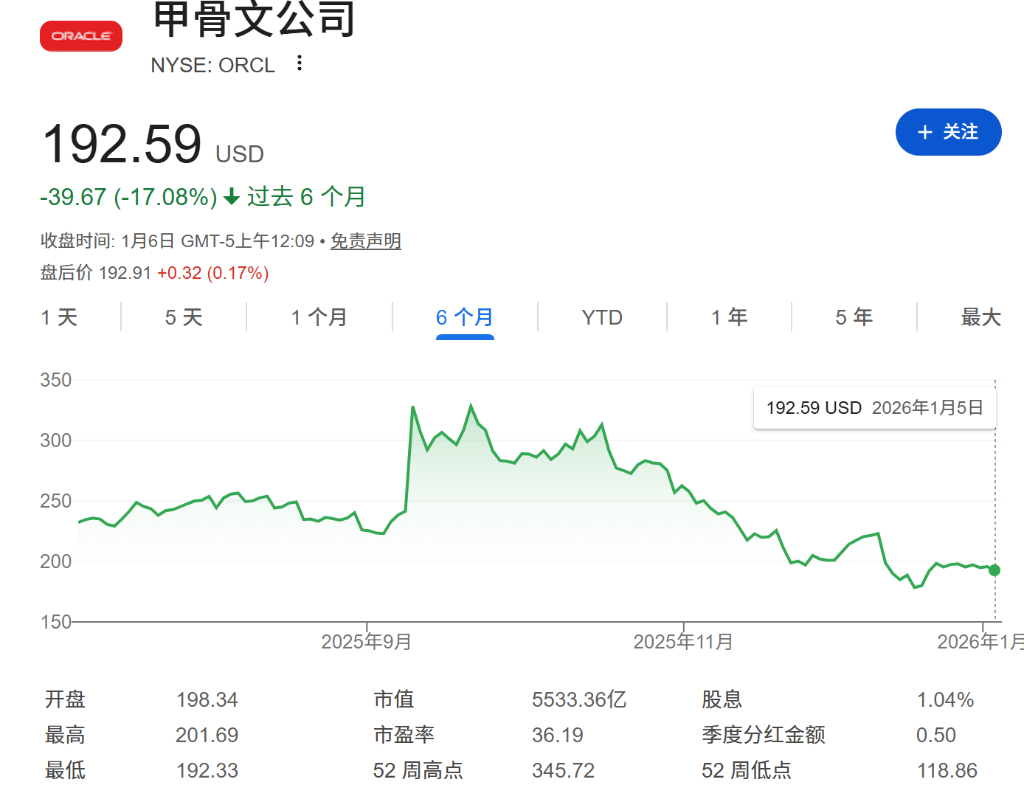
Core Viewpoint - Wall Street is currently experiencing extreme anxiety, highlighted by Oracle's stock price plummeting 41% since mid-September, while bulls are betting on a "stunning reversal" in the first half of 2026 [1] Group 1: Market Sentiment and Concerns - The market's panic is primarily driven by two concerns: extreme distrust in OpenAI's financial sustainability and worries about Oracle's ability to maintain its investment-grade rating amid aggressive capital expenditures [3] - Investors believe that if OpenAI can secure funding or launch a new model like GPT-6 by early 2026, Oracle, trading at 34 times CY27 earnings, could represent a significant buying opportunity [3] - Conversely, if OpenAI fails to compete against Google's Gemini or if Oracle is forced to dilute shareholders through equity financing, the stock's decline may continue [3] Group 2: OpenAI's Potential Solutions - To reverse Oracle's downturn, three key developments are necessary: securing capital injection, launching GPT-6, and achieving real revenue generation from enterprise AI projects [4][6] - OpenAI is reportedly seeking to raise $100 billion at an $830 billion valuation, which could alleviate counterparty risk for Oracle if successful [6] - The launch of GPT-6 in Q1 2026 is seen as critical to dispelling doubts about Google's competitive edge [6] Group 3: Oracle's Financial Strategy and Risks - Oracle is perceived to be walking a tightrope, with concerns that its support for OpenAI's computing needs could downgrade its credit rating to "junk" status [5] - The company's strategy includes financial engineering to manage significant funding pressures, including potential "off-balance-sheet" financing [8][14] - Oracle's net debt to EBITDA ratio is projected to reach 4.0 times by 2027, raising alarms about its ability to maintain an investment-grade rating [14] Group 4: Project Highlights and Revenue Potential - The Abilene project in Texas is identified as a key positive aspect, with the potential to disrupt bearish narratives if it is delivered on time and OpenAI makes timely payments [10][11] - As of November, 96,000 GB200 GPUs have been delivered, indicating that the project is progressing faster than expected [14] - The Abilene project is expected to contribute approximately $8.3 billion in annual revenue, significantly boosting Oracle's cloud infrastructure growth [14] Group 5: Valuation and Market Position - Oracle's current stock price of around $195 reflects a high level of pessimism, incorporating fears of OpenAI's collapse and financing difficulties [13] - Any alleviation of these risks, such as OpenAI securing funding, could trigger a sharp valuation recovery [13] - Compared to Microsoft, which faces similar risks with OpenAI but trades at a higher FY30 P/E ratio of 18 times, Oracle's valuation appears discounted [14]
盘前必读丨美股收涨道指再创历史新高;证监会重拳出击财务造假
Di Yi Cai Jing· 2026-01-05 23:20
Market Overview - The overall market is still in a positive expansion phase, indicating a favorable environment for investment opportunities [6]. Stock Market Performance - Major U.S. stock indices opened higher, with the S&P 500 recovering above 6900 points. The Dow Jones increased by 1.23%, reaching a historical high of 49000 points, while the Nasdaq rose by 0.69% and the S&P 500 by 0.64% [3]. - The energy sector showed strength, with companies like Chevron and ExxonMobil benefiting from the anticipated reconstruction of Venezuela's oil infrastructure, with Chevron up 5.1% and ExxonMobil up 2.2% [3]. - Oilfield service companies such as Halliburton and Schlumberger also performed well, rising by 7.8% and nearly 9%, respectively [3]. Commodity Prices - Gold prices surged significantly due to increased risk aversion, with COMEX gold futures rising by 2.84% to $4436.90 per ounce, and silver futures increasing by 7.95% to $76.15 per ounce [4]. Corporate Actions - Tianpu Co. received regulatory warnings from the Shanghai Stock Exchange [7]. - Tianqi Lithium plans to conduct maintenance on its 150,000-ton liquid hexafluorophosphate production line at the Longshan North base [7]. - Weigao Medical intends to acquire 100% equity of Weigao Purui for a transaction price of 8.511 billion yuan [7]. - Three Gorges New Materials plans to acquire a 40% stake in Lingang New Materials for zero yuan [9]. - Fulin Precision plans to invest 6 billion yuan in a project to produce 500,000 tons of high-end lithium iron phosphate for energy storage [9]. Regulatory Developments - The China Securities Regulatory Commission (CSRC) held a meeting to discuss the comprehensive prevention and punishment system for financial fraud in the capital market, emphasizing the need for enhanced regulatory measures and collaboration among departments [5].



大爆发!美国油气股暴涨 高盛、小摩股价创历史新高 中概股低开高走上演反转行情
Di Yi Cai Jing· 2026-01-05 23:03
Market Overview - The three major U.S. stock indices opened higher, with the S&P 500 recovering to 6900 points, driven by rising oil prices and investor optimism that recent military actions in Venezuela would not lead to significant geopolitical conflict [1] - The Dow Jones Industrial Average rose by 594.79 points, or 1.23%, closing at 48977.18 points, marking its first intraday breach of 49000 points [1] - The 10-year U.S. Treasury yield fell to 4.16%, indicating a shift in investor sentiment towards riskier assets [1][5] Sector Performance - The energy sector saw significant gains, with Chevron rising by 5.1% and ExxonMobil by 2.2%, as companies are expected to benefit from the reconstruction of Venezuela's oil infrastructure [2] - Oilfield service companies like Halliburton and Schlumberger also performed well, increasing by 7.8% and nearly 9%, respectively [2] - The S&P 500 Aerospace and Defense Index reached a new all-time high, with major defense contractors General Dynamics and Lockheed Martin seeing stock increases of 3.5% and 2.9% [2] Financial Sector Insights - The S&P 500 Financial Index surged as investors anticipated a 6.7% year-over-year profit growth for the financial sector in the last quarter of the previous year [3] - Goldman Sachs and JPMorgan Chase both reached historical highs, with stock increases of 3.8% and 2.6%, respectively [3] Economic Indicators - The manufacturing sector in the U.S. is experiencing a contraction, with the ISM Manufacturing PMI dropping from 48.2 in November to 47.9, marking the lowest level in 14 months [5] - The market is closely watching the upcoming non-farm payroll report, which could influence the Federal Reserve's monetary policy for 2026 [5] Commodity Performance - International oil prices rose, with WTI crude oil increasing by 1.74% to $58.32 per barrel and Brent crude oil by 1.66% to $61.76 per barrel [6] - Precious metals saw significant price increases, with COMEX gold futures rising by 2.84% to $4436.90 per ounce and silver futures up by 7.95% to $76.15 per ounce [6]


Oracle shares suffer on OpenAI concerns, But UBS sees 2026 upside
Proactiveinvestors NA· 2026-01-05 18:34
About this content About Angela Harmantas Angela Harmantas is an Editor at Proactive. She has over 15 years of experience covering the equity markets in North America, with a particular focus on junior resource stocks. Angela has reported from numerous countries around the world, including Canada, the US, Australia, Brazil, Ghana, and South Africa for leading trade publications. Previously, she worked in investor relations and led the foreign direct investment program in Canada for the Swedish government ...

IBM Stock Upgraded To Buy While Oracle Seen Bouncing Back In Analyst's 2026 Software Preview
Investors· 2026-01-05 14:50
Terms of Use Privacy Notice Accessibility About Us Reviews Site Map Your Ad Choices Advertising Contact us IBD Stock Charts IBD Stock Checkup Stock Quotes Stock Market Today The Big Picture My Stock Lists IBD Live Leaderboard SwingTrader MarketSurge IBD Digital MarketDiem The Wall Street Journal Barron's MarketWatch Dow Jones Smart Money Connect With Us On stocks they discuss. We make no representations or warranties regarding the advisability of investing in any particular securities or utilizing any speci ...
