Palantir Technologies(PLTR)

Search documents
The 5 AI stocks Dan Ives thinks will define 2026
Proactiveinvestors NA· 2025-12-29 18:36
Core Viewpoint - The year 2026 is anticipated to be a pivotal inflection point for the AI revolution, with significant investor interest and anxiety regarding the scale of AI deployment across enterprises and consumers [2]. Company Summaries Nvidia - Nvidia is highlighted as one of the top technology stocks, benefiting from the AI boom [3]. Microsoft - Microsoft is expected to experience substantial AI-driven growth, particularly in its Azure cloud business, with 2026 being the true inflection year for AI growth as deployments increase [4]. - The market is currently underestimating the potential of Azure's growth story [4]. Apple - Apple's AI strategy is seen as crucial, with its large installed base of 2.4 billion iOS devices and 1.5 billion iPhones providing significant leverage for AI monetization [5]. - AI monetization could potentially add $75 to $100 per share to Apple's valuation in the coming years [6]. Tesla - Tesla is viewed as entering a transformative phase in 2026, focusing on autonomous driving and robotics, which could unlock significant AI valuation [7]. - The company could reach a market capitalization of $2 trillion within the next year, with a bullish case suggesting $3 trillion by the end of 2026 [8]. Palantir - Palantir is experiencing unprecedented demand for its AI platform among commercial and government clients, positioning itself for significant growth [9]. - The company is on a "golden path" to potentially becoming a trillion-dollar market cap player as it expands its valuation [10]. CrowdStrike - CrowdStrike is identified as a key beneficiary of AI adoption in cybersecurity, with growing deal momentum and an expanding product suite [11]. - The market is underestimating CrowdStrike's growth potential, as cybersecurity is seen as a secondary beneficiary of the AI revolution [12].



Palantir Technologies (NASDAQ: PLTR) Price Prediction and Forecast 2025-2030 for December 29
247Wallst· 2025-12-29 12:05
Core Insights - Palantir Technologies Inc. shares experienced a decline of 0.84% over the last five trading sessions following a prior increase of 6.56% in the preceding five sessions [1] Company Performance - The recent performance of Palantir Technologies Inc. indicates a fluctuation in share value, with a notable gain of 6.56% before the recent decline [1] - The current share price movement reflects a potential volatility in investor sentiment towards the company [1] Market Context - The trading activity suggests that Palantir Technologies Inc. is experiencing a period of adjustment in its stock performance, which may be influenced by broader market trends or company-specific news [1]

Why Nvidia Is Hands-Down a Better Stock to Buy Than Palantir for 2026
The Motley Fool· 2025-12-29 09:44
Core Viewpoint - Nvidia is expected to perform well in 2025, but Palantir Technologies may see a larger percentage increase in stock value, potentially over 150% [1] Group 1: Company Performance - Palantir reported a total revenue of $1.18 billion in Q3 2025, reflecting a 63% year-over-year increase and an 18% quarter-over-quarter increase [4] - Nvidia's Q3 revenue reached $57 billion, marking a 62% year-over-year increase and a 22% quarter-over-quarter increase [7] Group 2: Revenue Sources - Palantir generates the majority of its revenue from U.S. contracts, particularly with the federal government, but its U.S. commercial revenue is growing faster than government revenue [5] Group 3: Revenue Guidance - Palantir forecasts a quarter-over-quarter revenue growth of 12.5% for Q4, while Nvidia projects a growth of 14% [8] Group 4: Valuation Metrics - Nvidia's forward price-to-earnings ratio is approximately 24.8, with a PEG ratio of 0.72, indicating an attractive valuation [12] - Palantir's forward price-to-earnings ratio is 192.3, with a PEG ratio over 3.0, suggesting it is significantly more expensive than Nvidia [13] Group 5: Investment Proposition - Despite Palantir's impressive revenue growth, Nvidia offers a better risk-reward proposition due to its lower valuation [15]

“我可能早了,但没错!”大空头Burry再次逆市而为,做空AI双雄英伟达和Palantir
Hua Er Jie Jian Wen· 2025-12-29 08:59
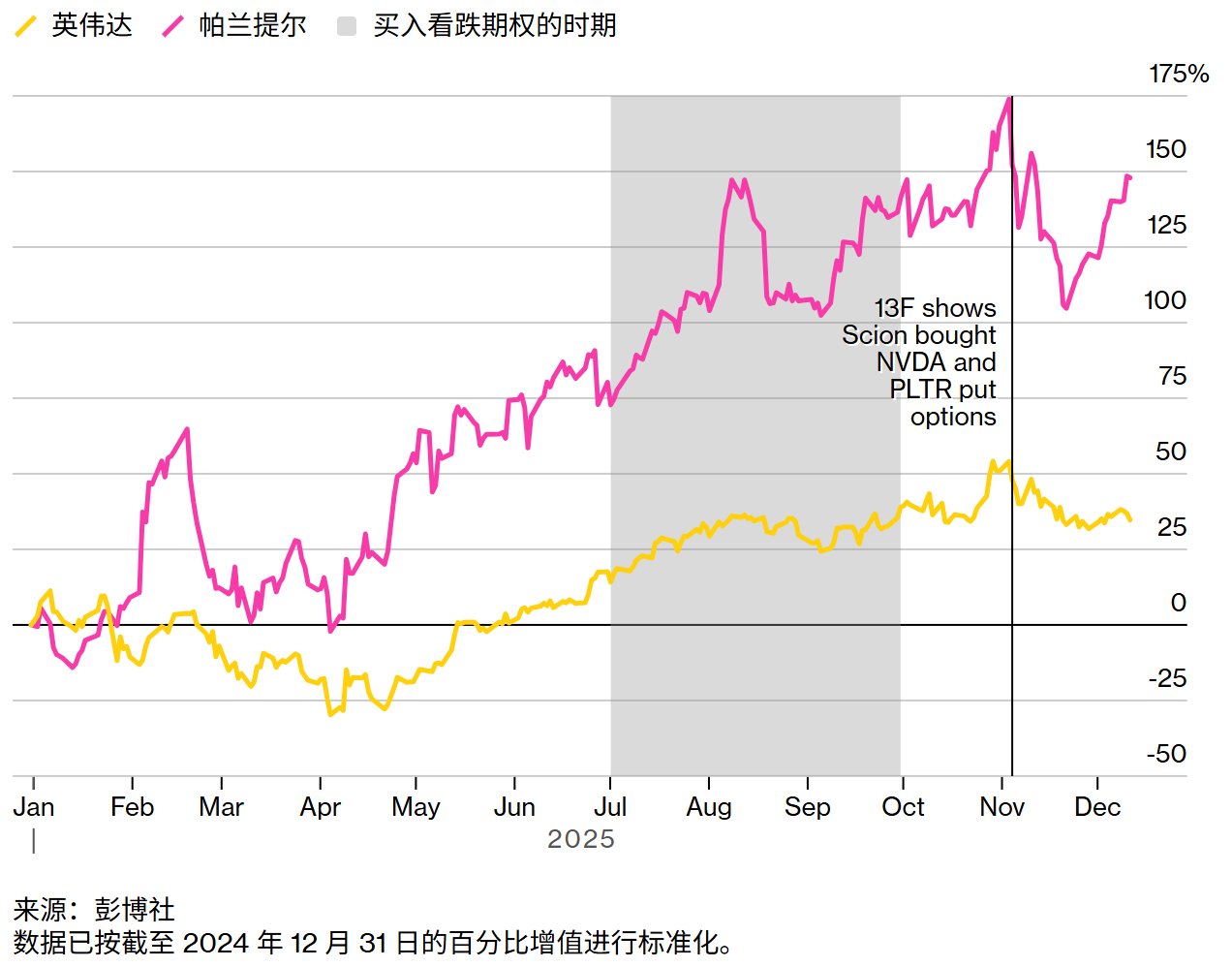
Core Viewpoint - Michael Burry, known for predicting the subprime mortgage crisis, believes that the AI sector, particularly companies like Nvidia and Palantir, is forming a bubble similar to the internet bubble, and he has taken short positions in these stocks through options trading [1]. Group 1: Market Position and Strategy - Burry has invested approximately $10 million in put options against Nvidia and Palantir, with potential returns exceeding $1 billion if a market crash occurs as he anticipates [1]. - He has publicly criticized Nvidia's internal memo, claiming it is filled with "straw man arguments" and suggests that the real risks are being obscured [1][5]. Group 2: Concerns about Nvidia - Burry's main concerns regarding Nvidia focus on the capital expenditures of its clients, which he believes are at risk of significant asset write-downs due to rapid technological advancements [1][5]. - He argues that Nvidia's clients, such as Microsoft and Meta, may extend the depreciation period of their GPUs to enhance short-term profits, which could lead to future financial issues as new technology renders existing hardware obsolete [5]. Group 3: Concerns about Palantir - Burry criticizes Palantir for its heavy reliance on government contracts and excessive executive compensation, as well as facing intense competition from companies like IBM [6]. Group 4: Historical Context and Market Reactions - Despite Burry's past successes, he has faced skepticism due to several failed predictions over the last 15 years, leading to a perception that he often enters positions too early [8]. - Burry's previous call to "sell" in early 2023 was followed by a significant market rally, which he later acknowledged as a mistake, but he defended his overall investment strategy [8].

2025年九大标志性交易:泡沫、蟑螂与367%的暴涨
Jin Rong Jie· 2025-12-29 06:26
Group 1: Market Trends and Dynamics - The year has been marked by high-stakes bets and rapid reversals, with significant volatility across various markets, including record highs in gold prices and fluctuations in mortgage giants [1] - Investors have heavily bet on changing political landscapes, inflated balance sheets, and fragile market narratives, leading to substantial stock market gains and crowded yield trades [1] - The geopolitical shift has significantly benefited European defense stocks, with companies like Rheinmetall AG and Leonardo SpA seeing stock price increases of approximately 150% and over 90% respectively [4][5] Group 2: AI and Technology Investments - Scion Asset Management disclosed protective put options on Nvidia and Palantir, raising concerns about the high valuations and spending plans of major AI players [2][3] - Nvidia's stock price fell significantly after the disclosure, reflecting the market's sensitivity to potential overvaluation in the AI sector [2] Group 3: Defense Sector Changes - The defense sector, previously avoided by asset managers due to ESG concerns, has seen a paradigm shift, with funds now focusing on defense-related investments [5] - A basket of European defense stocks has risen over 70% in 2025, indicating a strong market interest in this sector [5] Group 4: Currency and Alternative Assets - Concerns over heavy debt burdens in major economies have led investors to favor alternative assets like gold and cryptocurrencies, while showing reduced enthusiasm for government bonds and the dollar [6][7] - The narrative of "currency debasement" gained traction, particularly during periods of political instability, leading to record highs in both gold and Bitcoin [6][7] Group 5: South Korean Market Performance - The South Korean stock market has surged over 70% in 2025, driven by political efforts to boost the capital market and the global AI trend [8] - Despite the market's strong performance, local retail investors have been net sellers, indicating a lack of confidence in the domestic market [8] Group 6: Japanese Bond Market - The Japanese bond market has shifted from being a "widowmaker" trade to a favorable environment for short sellers, with benchmark yields rising significantly [10][11] - The 10-year Japanese government bond yield surpassed 2%, marking a significant change in the market dynamics [10] Group 7: Credit Market Developments - The credit market has seen substantial returns from strategic actions taken by funds like Pimco and King Street Capital Management, particularly in distressed situations [12] - A series of smaller but concerning events in the credit market have raised alarms about industry practices and borrower capabilities [17][18] Group 8: Fannie Mae and Freddie Mac - Fannie Mae and Freddie Mac have experienced a significant stock price increase of 367% from January to September 2025, driven by optimism regarding potential privatization [14][15] - The market remains speculative about the timing and feasibility of an IPO for these companies, despite the excitement surrounding their potential release from government control [14][15] Group 9: Turkish Lira and Emerging Markets - The Turkish lira has depreciated approximately 17% in 2025, highlighting the risks associated with high-yield investments in emerging markets amid political turmoil [16]

从加密狂潮到做空日债:复盘2025年令市场“心跳停止”的十一大押注
智通财经网· 2025-12-29 03:44
Group 1: Cryptocurrency and Political Influence - The year 2025 saw a surge in speculative trading linked to Donald Trump's brand, particularly in the cryptocurrency sector, with significant investments in assets associated with him [1][2] - Trump's family launched various tokens, including a meme coin and Melania Trump's own token, which experienced dramatic price declines by the end of the year, with some down nearly 99% [2][3] - Despite political momentum, these assets could not escape the fundamental volatility of the cryptocurrency market, highlighting the risks of speculative trading [1][3] Group 2: AI Stocks and Short Selling - Scion Asset Management disclosed protective put options on Nvidia and Palantir, signaling skepticism about their high valuations amid a market driven by AI hype [1][4] - The put options had strikingly low strike prices compared to the stocks' closing prices, indicating a bearish outlook from a well-known investor, Michael Burry [3][4] - This move reflects underlying doubts about the sustainability of AI-driven market gains, suggesting potential for significant market corrections [3][4] Group 3: European Defense Stocks - European defense stocks surged due to geopolitical shifts, with companies like Rheinmetall and Leonardo seeing year-to-date gains of approximately 150% and over 90%, respectively [6][8] - Investment managers, previously hesitant to engage with defense stocks, have now revised their strategies to include these assets, indicating a paradigm shift in investment focus [6][10] - The demand for defense-related investments has extended into the credit market, with new financial instruments being created to support military spending [6][10] Group 4: Gold and Inflation Hedge - The narrative of "devaluation trading" emerged as investors sought refuge in gold and cryptocurrencies amid concerns over national debts and inflation, leading to record highs for both assets [10][11] - This trend reflects a complex interplay between macroeconomic fears and the demand for safe-haven assets, with gold reaching unprecedented levels [10][11] - The market dynamics suggest that while fears of devaluation persist, strong demand for secure assets can coexist with broader economic uncertainties [10][11] Group 5: South Korean Stock Market - The South Korean stock market experienced a remarkable rise, with the Kospi index climbing over 70% in 2025, driven by government policies aimed at revitalizing the capital market [12][14] - Despite the impressive performance, local retail investors remained skeptical, opting to invest heavily in U.S. stocks instead, indicating a disconnect between foreign and domestic investor sentiment [12][18] - The government's ambitious target of reaching a Kospi index of 5000 has gained traction among major financial institutions, suggesting potential for continued growth [12][14] Group 6: Japanese Bonds - The Japanese bond market, once considered a "widowmaker," transformed into a profitable short-selling opportunity as yields surged, driven by government spending and interest rate hikes [22][25] - The Bloomberg Japan bond index recorded significant losses, marking it as the worst-performing major bond market globally [22][25] - Investor sentiment remains bearish, with expectations of further rate increases and ongoing fiscal challenges contributing to a negative outlook for Japanese bonds [22][25] Group 7: Credit Market Dynamics - The credit market in 2025 revealed vulnerabilities as several previously reliable borrowers faced significant financial distress, leading to a series of defaults and restructurings [30][31] - Notable cases included companies like Saxo Global and New Fortress Energy, which saw their bond values plummet, raising concerns about the overall health of the credit market [30][31] - The fragmentation of debt holders and the lack of transparency in borrowing practices have heightened risks for investors, prompting warnings from industry leaders [30][31]

AI泡沫何时破裂?《大空头》原型被质疑又一次“下手太早”
Jin Shi Shu Ju· 2025-12-29 02:52
伯里再启"预言家"模式,斥资1000万美元做空AI双雄。但问题在于他不确定泡沫何时会破。网友调 侃:"他过去预测20次衰退,只中2次"...... 由于过早地嗅到危机而成为人群中的异类,迈克尔·伯里(Michael Burry)对这类"剧情"并不陌生。 正如电影《大空头》(The Big Short)中的经典场景:克里斯蒂安·贝尔(Christian Bale)饰演的伯里, 向投资者说明他做空美国房地产市场的押注。若判断正确,市场崩盘后,这位对冲基金经理将通过类似 保险的合约斩获7亿美元巨额收益;若判断失误,他的基金将在几个季度内破产。 "等着瞧,一定会有回报的,"电影里的伯里说道,"我或许下手早了,但我没说错。" "又是 老一套!"一位投资者反驳道。 如今,现实中的伯里正试图说服华尔街:他能从人工智能(AI)企业英伟达(NVDA)和Palantir (PLTR)的股价下跌中获利。今年以来,AI行业一直是推动市场创下历史新高的核心动力,但过去十 年大多保持低调的伯里,近期再度现身,直言AI板块存在泡沫,且即将破裂。 但问题在于:他不确定泡沫何时会破。 伯里这种直言不讳的"异类",很适合成为迈克尔·刘易斯(Mi ...

4 Tech Stocks With More Potential Than Any Cryptocurrency
Yahoo Finance· 2025-12-28 22:43
Group 1: Cryptocurrency Market Insights - The cryptocurrency market has significant potential, with many cryptocurrencies experiencing over 100% gains in the last week [1] - However, the volatility of the market means that for every success story, there are many digital coins that quickly fade away, making it difficult to predict future winners [2] Group 2: Stock Market Opportunities - Investors do not need to chase cryptocurrencies to build wealth; there are promising companies in the stock market that can provide substantial gains [3] - Tech stocks have been highlighted as some of the best investments over the past year, with expectations for continued growth into 2026 [3] Group 3: Company Analysis - Palantir Technologies - Palantir Technologies (NASDAQ: PLTR) has a high forward price-to-earnings (P/E) ratio of 267 and a forward price-to-sales (P/S) ratio of 104, indicating potential overvaluation [5] - Despite valuation concerns, Palantir is experiencing rapid growth, with a 63% revenue increase in Q3 and 204 deals over $1 million [6] - The stock has risen 155% this year, following gains of 167% in 2023 and 340% in 2024, with expectations for further growth of 100% or more in 2026 [7][8] Group 4: Company Analysis - Nvidia - Nvidia (NASDAQ: NVDA) has seen a significant stock price increase of 819% from 2023 to 2024, followed by a 37% gain in 2025, although recent performance has shown signs of slowing down [10]
Jim Cramer Says He Still Likes Palantir Very Much
Yahoo Finance· 2025-12-28 16:15
Group 1 - Palantir Technologies Inc. is highlighted as a potential winner in the AI software sector amidst a challenging environment for enterprise software stocks [1][2] - The company develops data analytics and AI software platforms, including Gotham, Foundry, Apollo, and Palantir Artificial Intelligence Platform, which assist organizations in managing complex data [2] - Palantir's stock has seen significant growth, rising by $6 to $188, driven by numerous contracts from both the private sector and federal government [2] Group 2 - The company is recognized for its ability to generate real earnings and revenues, which could lead to higher price-to-earnings multiple expansion [2] - Despite the positive outlook for Palantir, there are suggestions that other AI stocks may offer greater upside potential with less downside risk [2]
好书推荐 | PayPal黑帮与“科技共和国”野心
点拾投资· 2025-12-28 11:00
Core Viewpoint - The article discusses the launch of the "Genesis Mission," a national-level AI development plan initiated by President Trump, which aims to elevate AI technology to a core national strategy, marking a significant shift in U.S. policy towards technology and governance [1]. Group 1: Genesis Mission and Its Implications - The "Genesis Mission" is described as a monumental blueprint comparable to the Manhattan Project, focusing on breaking through AI technology barriers and consolidating global leadership [1]. - The initiative represents a comprehensive mobilization of government, businesses, and research institutions towards AI development, indicating a shift from industry competition to national strategic focus [1]. Group 2: Key Figures and Their Influence - Influential figures behind the initiative include Silicon Valley elites such as Peter Thiel, Alexander Karp, Elon Musk, and David Sacks, who advocate for a government restructured through engineering thinking and hard technology [1][5]. - Peter Thiel, a co-founder of PayPal, has significantly influenced the political landscape by supporting candidates like J.D. Vance, demonstrating a shift in political power dynamics towards technology capital [5][6]. Group 3: Political and Financial Dynamics - Trump's political fundraising has shifted, with small donations decreasing from 69% in 2016 to 32.9% in 2024, indicating increased support from Silicon Valley tech capital [4]. - The article highlights a growing alliance between technology companies and the government, where tech firms gain defense contracts and policy benefits while Trump secures funding and technological endorsement [9]. Group 4: Ideological Shifts in Technology - The rise of "technological accelerationism" in Silicon Valley is reshaping U.S. political dynamics, advocating for rapid technological advancement as a solution to societal issues [11][12]. - This ideology promotes the belief that technological breakthroughs can automatically resolve political challenges, simplifying complex social issues into engineering problems [16][17]. Group 5: Future Vision and Challenges - Alexander Karp envisions a future where the U.S. is a "Republic" supported by hard technology, emphasizing the need for a clear national mission and technological ambition [19]. - The article warns of the hesitance among the new generation of engineers to engage in military applications, highlighting a cultural divide that could impact national defense capabilities [23].