Toyota(TM)

Search documents
丰田2026年全球计划产量超1000万辆
Xin Lang Cai Jing· 2025-12-26 05:41
Core Viewpoint - Toyota has finalized a plan to exceed a global production of 10 million vehicles, including Lexus, by 2026 to meet the rising demand for hybrid vehicles centered in the United States [1] Group 1 - The production will remain above 10 million units for two consecutive years [1] - Domestic production in Japan is expected to exceed 3 million units [1]

丰田2026年全球计划产量超1000万辆
日经中文网· 2025-12-26 02:47
Group 1 - Toyota's annual production is expected to reach 10 million units for two consecutive years, driven by strong demand for hybrid vehicles, particularly in the U.S. market [2][5] - The company plans to exceed 10 million units globally by 2026, including Lexus, with domestic production in Japan projected to surpass 3 million units [2][4] - Toyota has communicated its production plans to major parts suppliers, aiming to maintain Japan's manufacturing technology and employment levels, with a target to exceed the 3 million units mark for four consecutive years [4] Group 2 - As of January to November 2025, Toyota's global cumulative production reached 9.17 million units, reflecting a year-on-year increase of 5%, indicating a potential annual production of around 10 million units if the current pace continues [5] - Exports from Japan to the U.S. increased to 560,000 units from January to November, marking a 17% year-on-year growth [2][5] - For the fiscal year 2025, Toyota anticipates a tariff cost of 1.45 trillion yen, including burdens on parts suppliers, while remaining cautious about making significant short-term adjustments to production systems [5]

汽车早报|深蓝汽车完成61.22亿元C轮融资 丰田11月全球销量和产量均下滑
Xin Lang Cai Jing· 2025-12-26 00:40
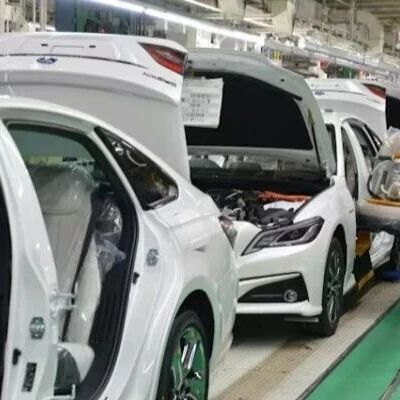
Group 1 - Deep Blue Automotive announced the completion of its Series C financing, raising a total of 6.122 billion yuan from Chang'an Automobile, Chongqing Yufu Holdings Group, and China Merchants Bank Financial Asset Investment [1] - ZhiMi Automotive achieved its first full-cost profitability in December, marking a significant milestone in its five-year history, with quarterly sales showing continuous month-on-month growth and exceeding 10,000 units for four consecutive months [1] - BYD has published a patent for a vehicle collision avoidance control method, which aims to improve the success rate of collision avoidance by controlling the vehicle's wheels through its motors instead of steering [1] Group 2 - Jinbei Automotive signed a memorandum of understanding with E-Works to establish R&D centers in both China and Germany, focusing on electric chassis and related components [3] - The newly established Chuanglian Investment (Tianjin) Partnership has a total investment of 50.4 million yuan, with partners including Geely Investment and others, aimed at engaging in investment activities [4] - Hon Hai Advanced announced the launch of its first electric vehicle, "BRIA," with three different models priced between 899,000 and 1,149,000 New Taiwan dollars, featuring LFP batteries and a maximum range of 516 kilometers [5] Group 3 - Toyota reported a decline in global sales and production for November 2025, with total sales of 965,919 vehicles, a year-on-year decrease of 1.9%, and production of 934,001 vehicles, down 3.4% year-on-year [6] - Toyota temporarily halted production of the new RAV4 model for final quality confirmation, with plans to resume production shortly after the halt [7]


今日新闻丨智己实现盈利!丰田11月全球销量、中国销量双双下滑!
电动车公社· 2025-12-25 16:05
Core Viewpoint - The article highlights the significant achievements of Zhiji Auto in its fifth anniversary, including its first month of profitability and plans for future technological advancements and market expansion [3][5][9]. Group 1: Zhiji Auto Achievements - Zhiji Auto announced its first full-cost profitability in December, marking a milestone in its financial performance [3][4]. - The company plans to accelerate the mass production of its steer-by-wire chassis and promote the large-scale application of L3 autonomous driving in the coming year [3][8]. - The launch of the new generation Zhiji LS6 has positioned it as a top seller in the mid-to-large new energy SUV segment, reflecting strong market acceptance [5][6]. Group 2: Future Plans and Market Strategy - For 2026, Zhiji Auto aims to continue its focus on "brand elevation + technological breakthroughs," with plans to enhance its product matrix and expand its overseas market presence [8][9]. - The company has successfully entered Southeast Asia, Europe, and Australia, with overseas orders exceeding expectations, indicating a robust global market strategy [6][8]. Group 3: Toyota's Sales Decline - Toyota's global sales in November fell to 900,011 units, a 2% year-on-year decrease, marking the first decline in 11 months [10][11]. - In China, Toyota's sales dropped by 12% to 154,645 units in November, highlighting challenges in maintaining growth in a competitive market [11]. - The decline in sales, particularly in electrified models, underscores the importance of technological advancement and smart connectivity in the evolving automotive industry [11].

丰田11月中国市场销量下降12%
日经中文网· 2025-12-25 08:00
Core Viewpoint - Toyota's global sales in November showed a decline for the first time in 11 months, primarily due to reduced government subsidies and the upcoming model change of the RAV4, particularly impacting the Chinese market [2][4]. Group 1: Global Sales Performance - Toyota's global sales (including Lexus) for November reached 900,011 units, a year-on-year decrease of 2% [2]. - The overseas sales for November were 769,789 units, down 3% year-on-year [4]. - The U.S. market maintained stable sales, with a 3% increase in sales to 212,772 units, driven by strong performance in hybrid vehicle sales [4]. Group 2: Market-Specific Insights - In China, sales dropped by 12% to 154,645 units, significantly influenced by the reduction in government subsidies and the anticipation of the new RAV4 model [4]. - The sales in China had previously benefited from promotional measures aligned with government subsidies, but the slowdown began as these policies were reduced [4]. - The export of vehicles from Japan to the U.S. increased by 17%, reaching 56,992 units [4]. Group 3: Financial Implications - Toyota anticipates a customs cost of approximately 1.45 trillion yen for the fiscal year ending March 2026, including costs borne by parts suppliers [4].
国补退场叠加外交波动 丰田(TM.US)在华销量锐减12%拖累全球表现
Zhi Tong Cai Jing· 2025-12-25 07:12
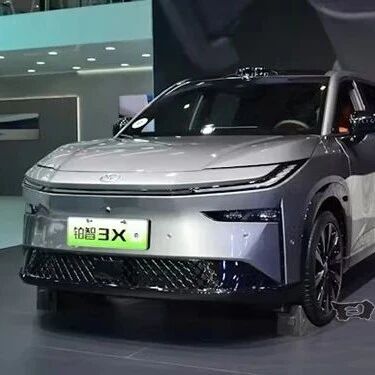
Core Viewpoint - Toyota's global sales and production have declined due to the suspension of government subsidies in China, with a significant drop in sales in the Chinese market impacting overall performance [1]. Group 1: Sales and Production Performance - In November, Toyota's global sales decreased by 1.9% year-on-year, totaling 965,919 vehicles, while production fell by 3.4% to 934,001 vehicles [1]. - Sales of Toyota and Lexus brands in China dropped by 12% year-on-year due to the suspension of vehicle replacement subsidies in key Chinese cities [1]. Group 2: Regional Production Trends - In contrast to the decline in China, Toyota's production in Thailand increased by 15% year-on-year, and in the U.S., it rose by 9% [2]. - The production in China saw a year-on-year decline of 14%, while Japan and the UK recorded decreases of 9.7% and 7.9%, respectively [2]. Group 3: Industry Context and Policy Impact - The automotive industry is facing uncertainties such as escalating trade tensions, frequent regulatory changes, and an unclear macroeconomic outlook, with Toyota's performance reflecting these challenges [1]. - The recent adjustment of the EU's fuel vehicle ban may provide traditional automakers like Toyota with greater flexibility in electric vehicle production, potentially opening new market opportunities for Chinese electric vehicle manufacturers [2]. Group 4: Trade Relations and Strategic Moves - Toyota is involved in the U.S. trade policy landscape, having been a target of high tariffs on imported vehicles and parts during Trump's administration [2]. - Recently, Toyota announced plans to return three U.S.-produced models to Japan, interpreted as a gesture of goodwill towards Trump [3].
丰田汽车将从2026年开始在日本销售美国制造的汽车
Jin Rong Jie· 2025-12-24 16:32
Core Viewpoint - Toyota will start selling American-made cars in Japan from 2026, aiming to improve Japan-US trade relations [1] Group 1 - Toyota plans to sell the Camry sedan, Highlander SUV, and Tundra pickup truck in Japan [1]
金银铜再创历史新高;库克豪掷295万美元增持,耐克涨超2%;英国石油以60亿美元出售百年品牌嘉实多65%股权【美股盘前】
Mei Ri Jing Ji Xin Wen· 2025-12-24 11:03
Group 1 - Sanofi announced a $2.2 billion acquisition of Dynavax at $15.50 per share, a 39% premium over its last closing price, adding a hepatitis B vaccine and an experimental shingles vaccine to its portfolio, with completion expected in Q1 2026 [2] - Apple CEO Tim Cook purchased $2.95 million worth of Nike shares at an average price of $58.97, increasing his total holdings to 105,480 shares valued at approximately $6.04 million, contributing to a 2.3% rise in Nike's stock [2] - UiPath was added to the S&P MidCap 400 index, leading to a 6.6% increase in its stock price, with RBC Capital raising its target price from $16 to $19 amid growing demand for automation [3] Group 2 - Motive, a fleet management software company, is seeking to go public on the NYSE under the ticker "MTVE" [2] - Toyota is recalling 55,405 vehicles in the U.S. due to potential issues with inverter bolts, resulting in a 1.69% decline in its stock [2] - BP agreed to sell a 65% stake in its Castrol lubricants business to Stonepeak Partners for approximately $6 billion, indicating a strategic shift to raise cash and reduce debt [3] Group 3 - Goldman Sachs released a report highlighting significant opportunities in the aerospace sector, particularly focusing on the $3.5 billion contract for the U.S. Space Development Agency's satellite program, with Rocket Lab securing its largest government contract to date [4] - Gold and silver prices reached historic highs, with gold surpassing $4,500 per ounce and silver exceeding $70 per ounce, while copper hit $12,159 per ton, reflecting a year-to-date increase of over 37% [4]



【美股盘前】金银铜再创历史新高;库克豪掷295万美元增持,耐克涨超2%;赛诺菲斥资22亿美元收购,Dynavax涨超37%;英国石油以60亿美元出售百年品牌嘉实多65%股权
Mei Ri Jing Ji Xin Wen· 2025-12-24 10:31
Group 1 - Sanofi announced a $2.2 billion acquisition of Dynavax at $15.50 per share, a 39% premium over its last closing price, adding a hepatitis B vaccine and an experimental shingles vaccine to its portfolio, with completion expected in Q1 2026 [2] - Apple's CEO Tim Cook purchased $2.95 million worth of Nike shares at an average price of $58.97, increasing his total holdings to 105,480 shares valued at approximately $6.04 million, contributing to a 2.3% rise in Nike's stock [2] - UiPath was added to the S&P MidCap 400 index, effective January 6, 2026, with RBC Capital raising its target price from $16 to $19, reflecting a stable business trend amid growing automation demand, resulting in a 6.6% stock increase [3] Group 2 - Toyota is recalling 55,405 vehicles in the U.S. due to potential issues with inverter bolts, leading to a 1.69% decline in its stock [2] - BP agreed to sell a 65% stake in its Castrol lubricants business to Stonepeak Partners for approximately $6 billion, indicating a strategic shift to raise cash for debt reduction and improve performance, with BP's stock rising 0.26% [3] - Goldman Sachs released a report highlighting significant opportunities in the aerospace sector, particularly focusing on the $3.5 billion contract for satellite construction and launch under the U.S. Department of Defense's PWSA project, with Rocket Lab securing its largest government order to date [4]


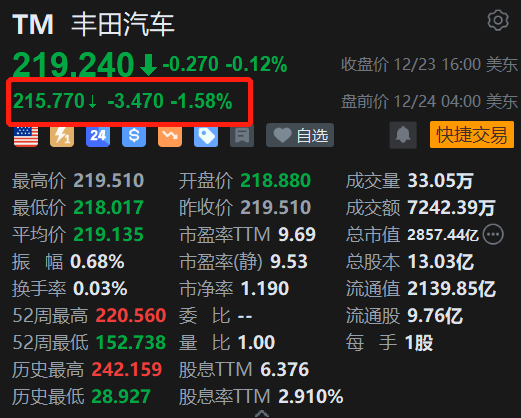
美股异动|丰田汽车盘前跌1.6% 将在美召回超5万辆汽车
Ge Long Hui· 2025-12-24 09:18
| TM 丰田汽车 | | | | --- | --- | --- | | 219.240 ↓ -0.270 -0.12% | | 收盘价 12/23 16:00 美东 | | 215.770 ↓ -3.470 -1.58% | | 盘前价 12/24 04:00 美东 | | 三 5 24 5 × 9 月 ♥ 白 ♥ 白 ♥ 白 一 中 白 一 中 一 | | ● 快捷交易 | | 最高价 219.510 | 开盘价 218.880 | 成交量 33.05万 | | 最低价 218.017 | 昨收价 219.510 | 成交额 7242.39万 | | 平均价 219.135 | 市密率 IM 9.69 | 总市值 2857.44亿(…) | | 振 幅 0.68% | 市盈率(静) 9.53 | 总股本 13.03亿 | | 换手率 0.03% | 市净率 1.190 | 流通值 2139.85亿 | | 52周景高 220.560 | 委 比 -- | 流通股 9.76亿 | | 52周最低 152.738 | 量 比 1.00 | 包 手 1股 | | 历史最高 242.159 | 股息TTM 6. ...