
TME(TME)

Search documents
腾讯音乐2025Q2总收入84.4亿元,受财报利好预期港股、美股股价双涨
Zhong Jin Zai Xian· 2025-08-12 14:02
面对腾讯音乐稳中有进的财报表现,市场普遍持积极看好态度。其中,摩根士丹利、高盛银行及招银国 际等多家券商机构对腾讯音乐给出了"增持"或"买入"评级。摩根士丹利在给予"增持"评级的同时表示, 腾讯音乐SVIP业务贡献度持续提升,通过提供高品质音质音效及线下演出等丰富专属权益,进一步提 升用户消费意愿,驱动ARPPU持续增长。杰富瑞则认为,腾讯音乐不仅为用户提供一站式的音乐服 务,还通过加强内容制作与共创能力,与影视综游等更多领域跨文化合作,在增强用户黏性的同时也创 造了更多增长机会。 财报显示,腾讯音乐第二季度整体业绩实现坚实增长,在内容与平台"一体两翼"战略的持续深化下,多 项核心财务指标表现亮眼。本季度,腾讯音乐总收入达84.4亿元,同比增长17.9%,调整后净利润为 26.4亿元,同比增长33.0%。其中,在线音乐服务收入同比增长26.4%至68.5亿元,在线音乐订阅收入同 比增长17.1%至43.8亿元,在线音乐付费用户数达1.244亿,ARPPU(单个付费用户月均收入)进一步提升 至11.7元。 2025年以来,尽管全球经济增长放缓,但国内市场预期总体稳定。在国民经济向新向好的大环境下,中 国音乐产业 ...

纳斯达克中国金龙指数涨0.93%
Ge Long Hui A P P· 2025-08-12 13:55
Core Viewpoint - The Nasdaq China Golden Dragon Index has seen an increase of 0.93%, indicating a positive trend in the Chinese tech sector [1] Company Performance - Tencent Music has experienced a significant rise, with shares increasing by over 14% [1] - Qifu Technology's stock has risen by more than 3% [1] - BOSS Zhipin's shares have increased by over 1% [1] - Xiaoma Zhixing has seen a decline, with shares dropping by more than 6% [1] - Bilibili's stock has decreased by over 2% [1]




美股异动|腾讯音乐绩后大涨超14%,创2021年3月以来新高
Ge Long Hui· 2025-08-12 13:48
消息面上,腾讯音乐第二季度总收入为84.4亿元,同比增长17.9%;公司权益持有人应占净利润为24.1 亿元,同比增长43.2%。期内,在线音乐服务收入同比增长26.4%至68.5亿元,在线音乐付费用户数同比 增长6.3%至1.244亿,单个付费用户月均收入从2024年同期的10.7元增长至11.7元。(格隆汇) 腾讯音乐(TME.US)大涨超14%,最高触及25.98美元,创2021年3月以来新高。 ...
腾讯音乐上涨7.51%,报24.405美元/股,总市值378.01亿美元
Jin Rong Jie· 2025-08-12 13:42
Core Insights - Tencent Music (TME) opened with a 7.51% increase on August 12, reaching $24.405 per share, with a total market capitalization of $37.801 billion [1] - For the fiscal year ending June 30, 2025, Tencent Music reported total revenue of 15.798 billion RMB, reflecting a year-on-year growth of 13.43%, and a net profit attributable to shareholders of 6.7 billion RMB, which is a significant increase of 115.85% [1][2] Company Overview - Tencent Music Entertainment Group, listed on both the New York Stock Exchange (TME) and the Hong Kong Stock Exchange (1698), is a leading online music and audio entertainment platform in China, operating popular music products such as QQ Music, Kugou Music, Kuwo Music, and WeSing [3] - The company provides a wide range of services including online music, audio streaming, karaoke, live performances, and social interactions centered around music, enhancing user engagement and retention [3] - Tencent Music has a vast library of content, including licensed, self-produced, and co-created materials, and collaborates closely with music labels and content owners for copyright protection and artist empowerment [3]
腾讯音乐Q2总收入超80亿,在线音乐收入占比首破80%
Guo Ji Jin Rong Bao· 2025-08-12 12:35
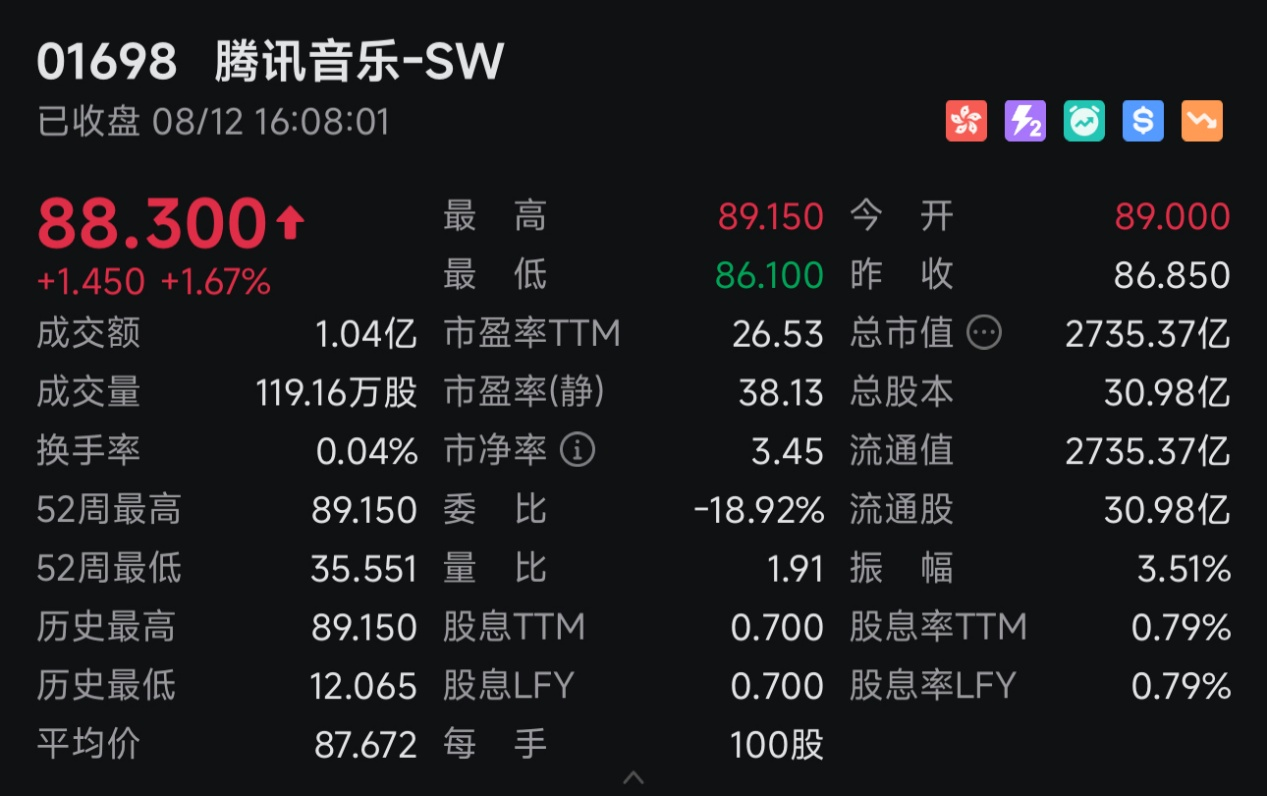
Core Insights - Tencent Music reported a total revenue of 8.44 billion yuan for Q2 2025, representing a year-on-year growth of 17.9% driven primarily by strong growth in online music service revenue [1] - Online music service revenue accounted for 81.1% of total revenue, marking a significant milestone for the company [1] - The company continues to focus on cost reduction and efficiency improvement, with a gross margin increase to 44.4% in Q2 2025, up from 42% in the same period last year [2] Revenue Breakdown - Online music service revenue reached 6.85 billion yuan in Q2 2025, a year-on-year increase of 26.4% [1] - Subscription revenue within online music services was 4.38 billion yuan, growing 17.1% compared to Q2 2024, attributed to an increase in average revenue per paying user (ARPPU) from 10.7 yuan to 11.7 yuan [1][2] - Total revenue for the first half of the year was 15.798 billion yuan, a 13.5% increase from the same period in 2024 [3] Cost and Margin Analysis - Operating costs for Q2 2025 were 4.69 billion yuan, up 13.1% year-on-year, primarily due to increased costs related to IP and artist-related expenses [2] - The company managed to reduce its expense ratio to 13.7%, down 2.3 percentage points year-on-year, despite maintaining operating expenses at 1.16 billion yuan [2] - The growth in high-margin subscription and advertising revenues contributed to the improvement in gross margin [2] Market Position - Tencent Music's stock price was 88.3 HKD per share as of August 12, 2025, with a total market capitalization of 273.5 billion HKD [4] - The company has recently surpassed 15 million super members, indicating a strong user base and engagement [3]
腾讯音乐Q2净利润暴涨43.2%!现金储备349亿创新高
Jin Rong Jie· 2025-08-12 12:17
Core Insights - Tencent Music's Q2 2025 unaudited financial results show total revenue of 8.44 billion yuan, a year-on-year increase of 17.9% [1] - Net profit attributable to equity holders reached 2.41 billion yuan, reflecting a year-on-year growth of 43.2% [1] - As of June 30, the company had a total cash and cash equivalents balance of 34.92 billion yuan [1] Revenue Breakdown - Online music service revenue amounted to 6.85 billion yuan, growing by 26.4%, driven by increases in subscriptions, advertising, artist merchandise, and live performances [1] - Online music subscription revenue was 4.38 billion yuan, up 17.1%, supported by an increase in average revenue per paying user [1] - Advertising revenue grew due to diverse products and innovative formats [1] Half-Year Performance - For the first half of 2025, Tencent Music reported total revenue of 15.798 billion yuan, a year-on-year increase of 13.43% [1] - Profit attributable to equity holders for the same period was 6.7 billion yuan, showing a significant year-on-year growth of 115.85% [1] - Basic earnings per American Depositary Share were 4.38 yuan [1] Management Commentary - Company executives indicated strong business growth and a commitment to ongoing innovation and investment [1]
在线音乐服务提振,腾讯音乐Q2收入同比增长17.9%,净利润同比大增43.2% | 财报见闻
Hua Er Jie Jian Wen· 2025-08-12 12:14
在线音乐服务收入达到68.5亿元,同比增长26.4%,占总收入的比重进一步提升至81.2%。其中,音乐订 阅收入43.8亿元,同比增长17.1%,继续扮演着收入增长的主要驱动力角色。 在一个流媒体竞争日趋激烈的市场环境下,腾讯音乐交出了一份超预期的成绩单:Q2实现了收入和利 润的双重加速增长,在线音乐服务业务强劲增长。 周二下午,腾讯音乐公布二季度财报。核心要点如下: 财务表现 核心业务进展 核心增长引擎:订阅业务的强劲表现 腾讯音乐Q2最大的亮点无疑是在线音乐业务的强劲表现。 毛利率从去年同期的42.0%提升至44.4%,主要受益于高毛利的音乐订阅和广告服务收入占比提升,同 时社交娱乐服务分成比例下降。 更值得关注的是用户价值的持续提升。月均ARPPU从去年同期的10.7元增长至11.7元,同比增长9.3%, 这一增长主要得益于SVIP会员计划的成功推广。管理层透露,SVIP订阅用户已突破1500万,创下历史 新高,反映出用户对高端音乐体验的强烈需求和支付意愿。 然而,用户增长的天花板问题依然存在。在线音乐MAU为5.53亿,同比下滑3.2%,这已是连续多个季 度的下滑趋势。尽管付费用户数量仍在增长(1.2 ...
腾讯音乐:二季度实现总收入84.4亿元 同比增长17.9%
Zhong Zheng Wang· 2025-08-12 12:08
腾讯音乐表示,第二季度,公司继续深化与全球唱片公司的合作、创新内容共创形式、为国内外艺人打 造一系列演唱会,以日益丰富的内容生态满足用户的多元喜好;同时深耕产品创新,不断提升产品吸引 力与用户活跃度,为用户提供丰富且独特的音乐体验。腾讯音乐始终秉持长期主义理念,锚定长期高质 量增长,携手产业上下游伙伴,助力中国音乐行业创造更多发展机遇。 中证报中证网讯(记者张兴旺)8月12日,腾讯音乐娱乐集团(以下简称"腾讯音乐")发布其截至2025年6月 30日止第二季度未经审计财务业绩。2025年第二季度,腾讯音乐业绩实现坚实增长,季度总收入为84.4 亿元,同比增长17.9%,调整后净利润为26.4亿元,同比增长33.0%。其中,在线音乐业务保持良好发展 势头,持续驱动腾讯音乐高质量增长。第二季度在线音乐服务收入同比增长26.4%至68.5亿元。 ...
美股前瞻 | 三大股指期货齐跌,美国7月CPI今晚揭晓
智通财经网· 2025-08-12 12:03
Market Overview - US stock index futures are all down before the market opens, with Dow futures down 0.05%, S&P 500 futures down 0.07%, and Nasdaq futures down 0.06% [1] - The German DAX index is down 0.49%, while the UK FTSE 100 is up 0.07%, and the French CAC40 is up 0.10% [2][3] - WTI crude oil is down 0.69% at $63.52 per barrel, and Brent crude oil is down 0.51% at $66.29 per barrel [3][4] Economic Data and Inflation - The US July Consumer Price Index (CPI) is set to be released, with expectations of a year-on-year increase of 2.8%, up from 2.7% in June [4][5] - Core CPI, excluding food and energy, is expected to rise to 3.0% year-on-year, indicating persistent inflation pressures [4][5] Corporate Earnings and Stock Buybacks - US companies are projected to repurchase over $1.1 trillion in stock this year, with $983.6 billion already announced [6] - Major companies leading the buyback trend include Apple, Alphabet, JPMorgan Chase, Bank of America, and Morgan Stanley [6] Federal Reserve and Interest Rates - There is speculation that the Federal Reserve may cut interest rates twice by 25 basis points this year, with some investors betting on a 50 basis point cut in September [5] - The selection process for the next Federal Reserve Chair is intensifying, with candidates including Michelle Bowman, Philip Jefferson, and Lori Logan [7] Trade Policies and Tariffs - Goldman Sachs warns that 70% of the costs from tariffs imposed by President Trump are being passed on to US consumers, with the burden expected to increase [7] - The US and China have agreed to pause the implementation of 24% tariffs for 90 days, while retaining 10% tariffs on certain goods [8] Company-Specific News - Sea Ltd reported Q2 revenue of $5.26 billion, a 38.2% year-on-year increase, driven by strong performance in e-commerce and digital financial services [9] - Circle's Q2 revenue increased by 53% to $658 million, with a net loss of $482 million primarily due to IPO-related expenses [10] - Smithfield Foods reported a Q2 sales increase of 11% to $3.79 billion, driven by strong demand for packaged meat products [11] - Tencent Music's Q2 revenue grew by 17.9% to 8.44 billion yuan, with online music service revenue increasing by 26.4% [12] - Pony.ai's Q2 revenue surged by 75.9% to 215 million USD, with a significant increase in Robotaxi passenger fare income [13] - Yalla Technology's Q2 revenue was $84.6 million, slightly below expectations, with a 7% decline in paid user numbers [14] Regulatory and Legal Developments - Elon Musk has criticized Apple for allegedly favoring OpenAI in the App Store, indicating potential legal action [15] - President Trump is considering allowing Nvidia and AMD to export downgraded AI chips to China, with a 15% revenue share for the US government [16]






TME(TME) - 2025 Q2 - Earnings Call Transcript
2025-08-12 12:02
Financial Data and Key Metrics Changes - Total revenues reached a record high of RMB8.4 billion, up by 18% year over year, driven by strong growth in music subscription and advertising services [24][25] - Online music revenues grew 26% year on year to RMB6.9 billion [25] - Net profit increased by 38% to RMB2.5 billion, with net profit attributable to equity holders rising by 43% to RMB2.4 billion [31] - Monthly ARPPU reached RMB11.7, compared to RMB10.7 in the same period last year [26] Business Line Data and Key Metrics Changes - Music subscription revenues grew 17% year on year to RMB4.4 billion, supported by an expanding subscriber base and higher ARPPU [26] - Advertising revenue continued to grow significantly, benefiting from innovative ad formats and increased offline events [27] - Artist-related merchandise sales and offline performances contributed robust results, enhancing overall revenue growth [27][28] Market Data and Key Metrics Changes - Social entertainment services and other revenues were RMB1.6 billion, down by 9% year on year due to adjustments in live streaming and compliance procedures [28] - Gross margin rose by 2.4 percentage points year on year to 44.4%, driven by strong growth in music subscription and advertising revenues [29] Company Strategy and Development Direction - The company is focused on building a comprehensive music entertainment platform, integrating content and services to enhance user engagement [39][66] - Strategic partnerships with artists and labels are being leveraged to expand offerings and enhance user experiences [12][20] - The company aims to continue innovating in the music space, including the introduction of AI technology and new interactive features for users [13][20] Management's Comments on Operating Environment and Future Outlook - Management expressed optimism about the second half of 2025, expecting revenue to exceed previous expectations due to solid performance year to date [39] - The company is committed to investing in new initiatives that create lasting value in the music entertainment space [22] - Management highlighted the importance of operational efficiency and the potential for bottom line improvement moving forward [39][80] Other Important Information - The company successfully hosted major concerts, including G Dragon's tour, which significantly enhanced its industry reputation [9][28] - The introduction of the Bubble community aims to enhance user engagement and provide a platform for artists to connect with fans [41][46] Q&A Session Summary Question: Outlook for revenue and profit in the second half - Management is encouraged by solid performance and expects continued high-quality growth in both subscription and non-subscription services [39] Question: User feedback on the Bubble product - Management reported positive user feedback and sees potential for Bubble to contribute meaningfully to revenue in the future [42][46] Question: Synergies with Simalaya deal - Management is awaiting regulatory approval and believes long-form audio will complement existing music business [50][52] Question: Long-term revenue contribution from other music revenue - Management indicated that while offline performance and merchandise contribute to revenue, their impact on gross margin is relatively small [56][58] Question: Biggest opportunities and challenges in the fancy economy - Management sees opportunities in integrating merchandise and offline events with online services, while challenges include scheduling and logistical coordination [64][66] Question: Long-term positioning and revenue mix - Management plans to leverage both online music and advertising as key growth drivers, with a focus on expanding into long-form audio and international markets [71][72] Question: Advertising revenue growth from new membership - Management clarified that advertising growth is primarily driven by online advertising rather than the new ad-based membership [74][76] Question: Operating expenses and leverage - Management expects to control expense growth to remain slower than revenue growth, ensuring operational leverage [80] Question: Sustainability of Super VIP growth - Management emphasized that growth in Super VIP is driven by ongoing content releases and user engagement strategies [84][86]