
TME(TME)

Search documents
TME(TME) - 2025 Q2 - Earnings Call Transcript
2025-08-12 12:00
Financial Data and Key Metrics Changes - Total revenues reached a record high of RMB 8.4 billion, up 18% year over year, driven by strong growth in music subscription and advertising services [24][25] - Online music revenues grew 26% year on year to RMB 6.9 billion, with music subscription revenues increasing 17% year on year to RMB 4.4 billion [24][25] - Monthly ARPPU reached RMB 11.7, compared to RMB 10.7 in the same period last year, reflecting the expansion in SYP subscribers [25] - Net profit increased by 38% to RMB 2.5 billion, with net profit attributable to equity holders rising by 43% to RMB 2.4 billion [31] Business Line Data and Key Metrics Changes - The music subscription business remains a core growth driver, with a subscriber base exceeding 15 million [15] - Advertising revenue continued to grow significantly, driven by innovative ad formats and increased offline events [25][26] - Artist-related merchandise sales and offline performances also contributed robustly to overall revenue growth [27] Market Data and Key Metrics Changes - The company successfully hosted major concerts, including G Dragon's tour, which attracted over 36,000 attendees [9] - The advertising growth was supported by events like the 618 shopping festival, which increased the number of advertisers and engagement rates [26] Company Strategy and Development Direction - The company is focused on building a comprehensive music entertainment platform, enhancing user engagement through innovative features and artist collaborations [5][15] - Strategic partnerships with artists and labels are aimed at expanding content offerings and enhancing user experiences [6][12] - The company is committed to diversifying music services and leveraging AI technology to enhance user engagement and content creation [13] Management's Comments on Operating Environment and Future Outlook - Management expressed optimism about the second half of 2025, expecting revenue to exceed previous expectations due to solid performance year to date [39] - The company aims to continue enhancing SYP membership and introducing more artist-centric privileges to drive growth [32] - Management highlighted the importance of operational efficiencies and the potential for bottom line improvement moving forward [39] Other Important Information - The company is exploring synergies from its deal with Simalaya, focusing on long-form audio as a complementary content form [51][52] - The introduction of the Bubble community aims to enhance user engagement and provide a platform for deeper artist-fan interactions [42][48] Q&A Session Summary Question: Outlook for revenue and profit in the second half - Management is encouraged by solid performance and expects continued high-quality growth in the subscription business, with a focus on operational efficiencies [37] Question: User feedback on the Bubble product - Management reported positive user feedback on Bubble, which aims to enhance communication between fans and artists, with plans to introduce more features [44][46] Question: Synergies with Simalaya deal - Management noted that the deal is pending regulatory approval, but sees long-form audio as a key growth area that complements existing music services [51][52] Question: Long-term revenue contribution from other music revenue streams - Management acknowledged that while advertising is high-margin, offline performances and merchandise have lower margins but are expected to grow [56][60] Question: Biggest opportunities and challenges in the fan economy - Management sees opportunities in integrating merchandise and offline events with online services, while challenges include scheduling and logistical coordination [66] Question: Long-term positioning and revenue mix - Management plans to leverage a dual strategy of content and platform development, with expectations for advertising revenue growth to outpace online music revenue growth [72][73] Question: Details on ad-based membership revenue contribution - Management indicated that the growth in advertising revenue is primarily from online advertising rather than ad-based membership, which is still in its early stages [76][78] Question: Operating expenses and future trends - Management expects to control expense growth to remain slower than revenue growth, ensuring continued profitability [83] Question: Online music subscription business metrics - Management reported a growing SVIP penetration ratio and retention rates, driven by premium content offerings and artist collaborations [87][90]
腾讯音乐2025第二季度财报:总收入达84.4亿元 着力打造一站式音乐服务平台
Zheng Quan Ri Bao Wang· 2025-08-12 11:49
Core Insights - Tencent Music Entertainment Group reported solid growth in its Q2 financial performance for the period ending June 30, 2025, with total revenue reaching 8.44 billion yuan, a year-on-year increase of 17.9%, and adjusted net profit of 2.64 billion yuan, up 33.0% [1] Revenue Breakdown - Online music service revenue grew by 26.4% year-on-year to 6.85 billion yuan, driven by a 6.3% increase in the number of paying users, which reached 124.4 million [1] - Average revenue per paying user increased from 10.7 yuan in the same period of 2024 to 11.7 yuan [1] Strategic Initiatives - The company continues to deepen collaborations with global record labels and innovate content co-creation formats, enhancing its content ecosystem to meet diverse user preferences [1] - Tencent Music is focused on product innovation to improve user engagement and provide a rich and unique music experience [1] - The company adheres to a long-term growth strategy, aiming to create more development opportunities for the Chinese music industry in collaboration with industry partners [1]
TME(TME) - 2025 Q2 - Quarterly Results
2025-08-12 11:37
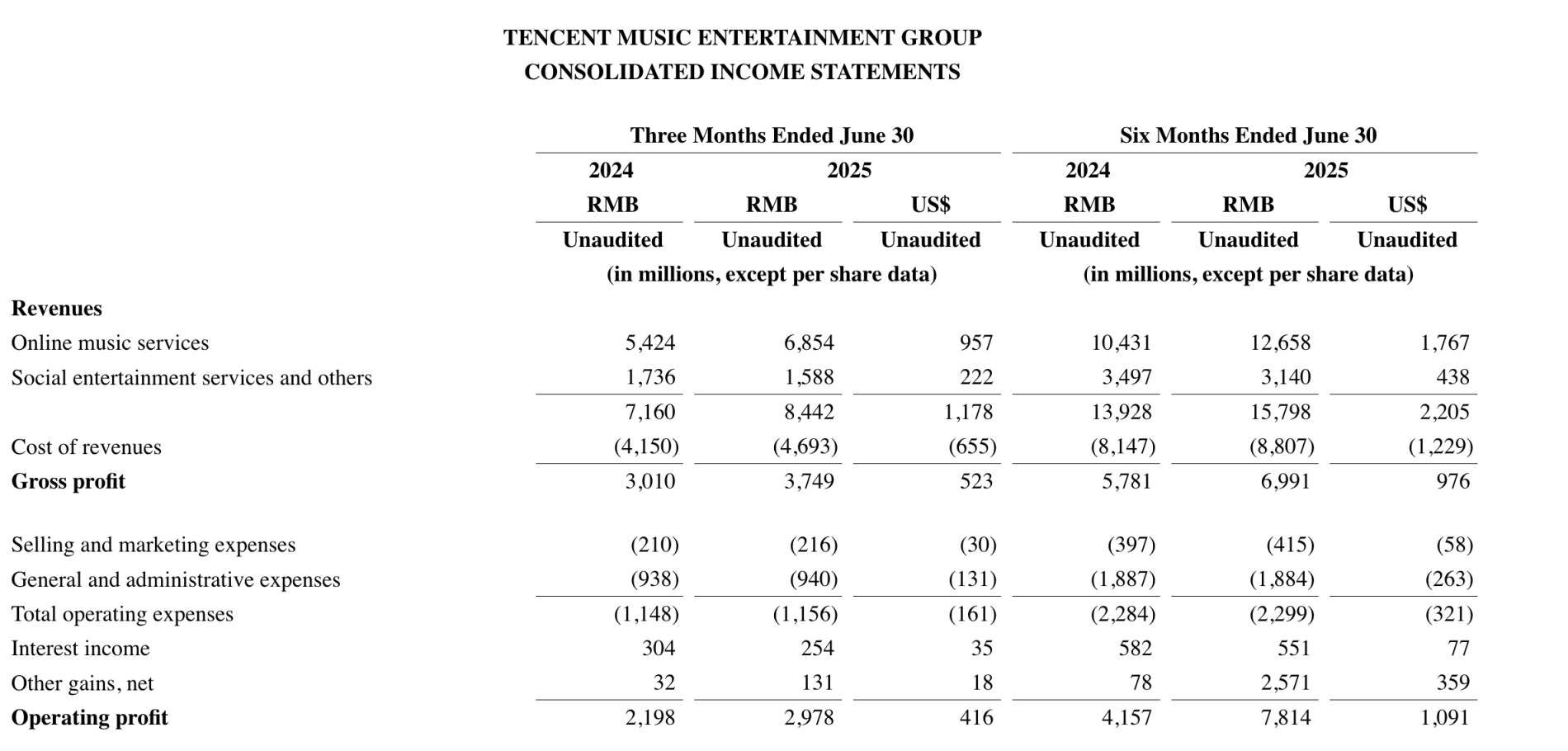
Financial Performance - Total revenues for Q2 2025 were RMB8.44 billion (US$1.18 billion), a 17.9% year-over-year increase, driven by strong growth in online music services[4] - Revenues from online music services reached RMB6.85 billion (US$957 million), representing a 26.4% year-over-year growth, with music subscription revenues at RMB4.38 billion (US$611 million), up 17.1% year-over-year[4] - Net profit attributable to equity holders was RMB2.41 billion (US$336 million), reflecting a 43.2% year-over-year growth, while non-IFRS net profit was RMB2.57 billion (US$359 million), a 37.4% increase[4] - Total operating profit for Q2 2025 was RMB2.98 billion (US$416 million), representing a 35.5% year-over-year increase[15] - Gross profit for the three months ended June 30, 2025, was RMB 3,749 million, a 24.6% increase from RMB 3,010 million year-over-year[28] - Operating profit for the three months ended June 30, 2025, rose to RMB 2,978 million, reflecting a 35.4% increase from RMB 2,198 million in the same quarter of 2024[28] - Profit for the period attributable to equity holders of the Company for the three months ended June 30, 2025, was RMB 2,409 million, up 43.3% from RMB 1,682 million year-over-year[28] - Non-IFRS net profit for the three months ended June 30, 2025, was RMB 2,640 million, a 33.0% increase compared to RMB 1,985 million in the same period of 2024[30] - Basic earnings per share for Class A and Class B ordinary shares increased to RMB 0.79 for the three months ended June 30, 2025, compared to RMB 0.54 in the same period of 2024[29] User Engagement - SVIP subscribers surpassed 15 million, indicating strong user loyalty and engagement[3] - Monthly ARPPU for online music increased to RMB11.7 from RMB10.7 in Q2 2024, marking a 9.3% growth[5] - The company launched innovative features such as VIPER HiFi sound quality and AI Chorus function to enhance user experience and engagement[14] Revenue Breakdown - Revenues from social entertainment services decreased by 8.5% to RMB1.59 billion (US$222 million) compared to RMB1.74 billion in Q2 2024[14] - Online music services revenue increased to RMB 6,854 million for the three months ended June 30, 2025, up 26.4% year-over-year from RMB 5,424 million[28] - Total revenues for the three months ended June 30, 2025, reached RMB 8,442 million, representing a 17.9% increase compared to RMB 7,160 million in the same period of 2024[28] Expenses and Cash Flow - Total operating expenses for the three months ended June 30, 2025, were RMB 1,156 million, a marginal increase from RMB 1,148 million year-over-year[28] - Interest income for the three months ended June 30, 2025, was RMB 254 million, down from RMB 304 million in the same period of 2024[28] - Net cash provided by operating activities for the three months ended June 30, 2025, was RMB 1,638 million, down from RMB 2,944 million in the same period of 2024, a decrease of approximately 44.4%[35] - The Company reported a net cash used in investing activities of RMB (633) million for the three months ended June 30, 2025, compared to RMB 693 million provided in the same period of 2024[35] Assets and Liabilities - Total assets increased from RMB 90,444 million as of December 31, 2024, to RMB 107,873 million as of June 30, 2025, representing a growth of approximately 19.3%[33] - Total equity attributable to equity holders of the Company rose from RMB 67,863 million as of December 31, 2024, to RMB 83,878 million as of June 30, 2025, an increase of about 23.6%[33] - Non-current liabilities increased from RMB 4,168 million to RMB 5,002 million, reflecting a rise of approximately 19.9%[34] - Total liabilities rose from RMB 20,718 million to RMB 21,498 million, an increase of about 3.8%[34] - The Company’s goodwill increased from RMB 19,647 million to RMB 20,465 million, reflecting a growth of approximately 4.2%[33] Cash and Cash Equivalents - Total cash, cash equivalents, term deposits, and short-term investments as of June 30, 2025, were RMB34.92 billion (US$4.87 billion)[19] - Cash and cash equivalents decreased from RMB 13,164 million at the beginning of the period to RMB 10,999 million at the end of the period, a decline of about 16.5%[35] - Cash and cash equivalents at the end of the period were RMB 10,999 million, down from RMB 12,251 million at the end of the previous quarter[35]
腾讯音乐第二季度营收84.4亿元
Bei Jing Ri Bao Ke Hu Duan· 2025-08-12 10:31
Core Insights - Tencent Music's Q2 2025 total revenue reached RMB 8.44 billion, marking a 17.9% year-on-year increase, while adjusted net profit rose to RMB 2.64 billion, up 33.0% [1][3] Revenue Breakdown - Online music services generated RMB 6.85 billion, a 26.4% increase year-on-year, with music subscription revenue at RMB 4.38 billion, growing 17.1% [3][4] - The average revenue per paying user (ARPPU) for online music increased from RMB 10.7 to RMB 11.7 year-on-year, with paying user count reaching 124.4 million, a 6.3% increase [3][4] Cost and Profit Analysis - Operating costs rose by 13.1% to RMB 4.69 billion, primarily due to increased costs related to IP, artist-related expenses, and advertising agency fees [5] - Gross profit for the quarter was RMB 3.75 billion, reflecting the company's ability to maintain profitability despite rising costs [3] Strategic Initiatives - The company’s Executive Chairman highlighted that the music subscription business remains the core growth driver, with expanding music-related services such as advertising and concerts showing strong development [4] - Tencent Music facilitated over 300 offline performance opportunities for nearly 100 music artists through its proprietary performance IPs in the first half of 2025 [4]

腾讯音乐第二季度净利润同比增长33%至26.4亿元
Zhong Guo Jin Rong Xin Xi Wang· 2025-08-12 10:11
Core Insights - Tencent Music Entertainment Group reported its Q2 2025 unaudited financial results, showing a total revenue of 8.44 billion yuan, a year-on-year increase of 17.9%, and an adjusted net profit of 2.64 billion yuan, up 33.0% [1] Group 1: Financial Performance - The online music service revenue grew by 26.4% year-on-year to 6.85 billion yuan in Q2 2025 [1] - The number of online music paying users increased by 6.3% year-on-year to 124.4 million [1] - The average revenue per paying user per month rose from 10.7 yuan in the same period of 2024 to 11.7 yuan [1] Group 2: Strategic Initiatives - Tencent Music continues to deepen collaborations with global record companies and innovate content co-creation formats [1] - The company is focused on creating a rich content ecosystem to meet diverse user preferences through various concerts for domestic and international artists [1] - Tencent Music emphasizes long-termism and aims for sustained high-quality growth by partnering with industry stakeholders to create more development opportunities in the Chinese music industry [1]
腾讯音乐(01698,TME.US)2025Q2业绩坚实增长,总收入同比增长17.9%达84.4亿元
Zhi Tong Cai Jing· 2025-08-12 09:56
Core Insights - Tencent Music Entertainment Group reported solid growth in Q2 2025, with total revenue increasing by 17.9% year-on-year to 8.44 billion yuan and adjusted net profit rising by 33.0% to 2.64 billion yuan [1][3][12] - The online music business showed high-quality growth, with online music service revenue up 26.4% to 6.85 billion yuan and online music subscription revenue increasing by 17.1% to 4.38 billion yuan [1][3][12] - The number of paid online music users grew by 6.3% to 124.4 million, and ARPPU (Average Revenue Per Paying User) increased to 11.7 yuan [1][3][12] Group 1: Online Music Business Performance - The online music sector continues to drive Tencent Music's overall performance, supported by a robust content ecosystem and comprehensive music services [3][4] - The company’s "one body, two wings" strategy focuses on expanding content and platform capabilities, enhancing user experience and service innovation [1][3][12] - Tencent Music's super membership user base surpassed 15 million, marking a significant milestone [3][12] Group 2: Market Outlook and Growth Potential - The Chinese digital music industry is experiencing steady growth, with an expanding user base and increasing paid subscriptions, providing a favorable environment for Tencent Music [3][4] - Analysts predict that Tencent Music's online music subscription business will achieve high-quality growth, driven by the increase in paid users and ARPPU [4] - The company is expected to see double-digit growth in online music service revenue in 2025, supported by diverse content offerings [4] Group 3: Content Ecosystem and User Engagement - Tencent Music is enhancing its content ecosystem by expanding high-quality music offerings and creating engaging live events to meet diverse user needs [5][6][8] - Collaborations with well-known artists and strategic partnerships are being leveraged to boost content creation and user engagement [6][8][10] - The introduction of innovative features and exclusive rights for super members is enhancing user retention and driving higher-value user conversions [10][12] Group 4: Future Strategies - Tencent Music aims to deepen partnerships within the music industry and explore innovative growth points to drive sustainable development [12] - The company is committed to creating a vibrant one-stop music service platform that attracts users through high-quality and diverse music content [12]

腾讯音乐二季度总收入84.4亿元 调整后净利润26.4亿元
Zheng Quan Shi Bao Wang· 2025-08-12 09:45
人民财讯8月12日电,8月12日,腾讯音乐发布第二季度未经审计财务业绩,实现季度总收入为84.4亿 元,同比增长17.9%,调整后净利润为26.4亿元,同比增长33.0%。第二季度在线音乐服务收入同比增长 26.4%至68.5亿元,在线音乐付费用户数同比增长6.3%至1.244亿,单个付费用户月均收入从2024年同期 的10.7元增长至11.7元。 ...
腾讯音乐发布2025年Q2财报:总收入84.4亿元,调整后净利润26.4亿元
Huan Qiu Wang· 2025-08-12 09:45
【环球网财经综合报道】8月12日消息,腾讯音乐娱乐集团(以下简称"腾讯音乐")今日宣布其截至 2025年6月30日止第二季度未经审计财务业绩。 财报显示,2025年第二季度,腾讯音乐季度总收入为84.4亿元,同比增长17.9%,调整后净利润为26.4 亿元,同比增长33.0%。其中,在线音乐业务保持良好发展势头,持续驱动腾讯音乐高质量增长。第二 季度在线音乐服务收入同比增长26.4%至68.5亿元,在线音乐付费用户数同比增长6.3%至1.244亿,单个 付费用户月均收入从2024年同期的10.7元增长至11.7元。 财报还指出,在内容与平台"一体两翼"战略牵引下,第二季度,腾讯音乐继续深化与全球唱片公司的合 作、创新内容共创形式、为国内外艺人打造一系列演唱会,以日益丰富的内容生态满足用户的多元喜 好;同时深耕产品创新,不断提升产品吸引力与用户活跃度,为用户提供丰富且独特的音乐体验。(青 云) ...
腾讯音乐Q2总收入84.4亿元,调整后净利润26.4亿元
Cai Jing Wang· 2025-08-12 09:39
8月12日,腾讯音乐娱乐集团(以下简称"腾讯音乐")(纽交所股票代码:TME及港交所股票代码:1698)今 日公布其截至2025年6月30日止第二季度未经审计财务业绩。 第二季度,腾讯音乐季度总收入为84.4亿元,同比增长17.9%,调整后净利润为26.4亿元,同比增长 33.0%。其中,在线音乐服务收入同比增长26.4%至68.5亿元,在线音乐付费用户数同比增长6.3%至 1.244亿,单个付费用户月均收入从2024年同期的10.7元增长至11.7元。 ...
腾讯音乐-SW上半年收入利润双增长 权益持有人应占溢利67亿元 同比增长115.85%
Zhi Tong Cai Jing· 2025-08-12 09:37
Core Insights - Tencent Music Entertainment Group reported a strong financial performance for Q2 2025, with total revenue reaching RMB 84.4 billion (USD 11.8 billion), representing a year-on-year growth of 17.9% [1] - The net profit attributable to equity holders was RMB 24.1 billion (USD 3.36 billion), marking a significant increase of 43.2% year-on-year [1] - The company’s cash and cash equivalents, along with short-term investments, totaled RMB 349.2 billion (USD 48.7 billion) as of June 30, 2025 [1] Revenue Breakdown - Online music service revenue grew by 26.4% year-on-year, reaching RMB 68.5 billion (USD 9.57 billion), driven by strong growth in online music subscription revenue and advertising services [2] - Online music subscription revenue was RMB 43.8 billion (USD 6.11 billion), up 17.1% from RMB 37.4 billion in the same period last year, primarily due to an increase in average revenue per paying user [2] - The average revenue per paying user rose from RMB 10.7 to RMB 11.7, attributed to enhanced super member benefits [2] Management Commentary - The Executive Chairman highlighted the achievement of high-quality growth, with both revenue and profit showing robust year-on-year increases, emphasizing the core role of the music subscription business [3] - The CEO noted that product innovation and immersive experiences have led to steady growth in the online music business, with a recent milestone of over 15 million super members, reflecting high user trust and engagement [3] - For the first half of 2025, the company achieved revenue of RMB 157.98 billion, a year-on-year increase of 13.43%, and net profit attributable to equity holders of RMB 67 billion, up 115.85% [3]