
华为云

Search documents
中国科技:弃内卷,出海去
3 6 Ke· 2025-10-23 08:33
Group 1 - The core viewpoint of the article highlights a significant shift in the growth focus of China's technology industry towards overseas markets due to intense domestic competition and market saturation [1][3][4] - The domestic market has transitioned from "incremental competition" to "stock competition," with companies facing resource depletion and rising costs in both ToB and ToC sectors [3][5] - The Chinese software market holds only 2%-3% of the global share, indicating a fragmented domestic market that limits growth potential [5][6] Group 2 - The article discusses the "double squeeze" faced by the Chinese technology market, characterized by a visible market ceiling and hidden internal competition, leading to a consensus that domestic growth is stalling [4][5] - The competition has devolved from "differentiated innovation" to "low-cost replication," particularly evident in the AI hardware and new energy vehicle sectors [6][9] - The article emphasizes the need for Chinese technology companies to adopt a systematic approach to overseas expansion, moving from "strategic alternatives" to "survival necessities" [3][8] Group 3 - Various sectors, including new energy vehicles and AI hardware, are exploring differentiated paths for overseas expansion, focusing on "global technology, local operations, and cultural empathy" [8][9] - Successful examples include Xiaopeng Motors collaborating with Volkswagen to develop standardized electric platforms, enhancing brand premium in Europe by 40% [9] - The article highlights the importance of localizing products and services to meet specific market needs, as demonstrated by companies like Keda Xunfei and Lenovo [15][24] Group 4 - The article outlines strategies for Chinese companies to navigate the complexities of the US-China trade war, including supply chain diversification and compliance with international regulations [25][26][27] - Companies are increasingly focusing on building a global compliance framework to mitigate risks associated with international operations [27][28] - The article predicts that overseas markets will become the primary battleground for Chinese technology companies, necessitating a shift from product competition to ecosystem competition [29][30] Group 5 - Emerging markets are expected to drive growth for Chinese technology companies, with significant opportunities in Southeast Asia, the Middle East, and Latin America [30][31] - The article stresses the importance of establishing international standards and building ecosystems to enhance competitiveness in global markets [31][32] - Companies must prioritize deep localization and global compliance to ensure survival and success in overseas markets [33][34]







全面拥抱全球化!OceanBase CEO,最新发声!
券商中国· 2025-10-22 05:30
Core Viewpoint - A group of Chinese companies with core technologies in cloud computing and distributed databases is beginning to seek a more significant role in international markets [1]. Group 1: OceanBase's Globalization Strategy - On October 22, Ant Group's domestic database company OceanBase announced an accelerated globalization strategy, launching the "GO GLOBAL GO Program" [2]. - CEO Yang Bing emphasized that globalization is a necessary path for OceanBase, stating that the company will continue to deepen its presence in the Chinese market while expanding overseas [3]. - OceanBase has already established a presence in key overseas markets, including Hong Kong, Macau, and Southeast Asia, and plans to enter the technologically advanced Japanese market by September 2025 [3]. Group 2: Challenges and Responses in Global Expansion - Yang Bing acknowledged the challenges of going global, including language and cultural differences, and the need to adapt quickly to new business environments [4]. - The challenges for technology companies in international markets include technical adaptability, market competition, and cultural and talent management [4]. - The "GO GLOBAL GO Program" includes organizational support and welfare guarantees to address employees' concerns about cultural adaptation, language communication, career development, and living costs [4]. Group 3: Broader Context of Chinese Technology Going Global - The global digitalization wave presents a vast market space for databases as a core component of IT infrastructure [5]. - OceanBase's accelerated globalization reflects a broader trend of Chinese technology companies, such as Alibaba Cloud, Tencent Cloud, and Huawei Cloud, expanding into international markets through local data centers and services [6]. - Unlike traditional manufacturing, technology exports carry higher added value and influence, potentially granting Chinese companies greater voice in global technology governance [6]. - The competition in the global technology market is fundamentally about ecosystems, requiring Chinese companies to navigate strong international competitors and complex geopolitical environments [6].

2025年AI知识库本地化部署厂商盘点:先知AI与行业解决方案解析
Sou Hu Cai Jing· 2025-10-21 07:19
Core Insights - The privatization of enterprise-level AI knowledge bases is becoming a core demand for digital transformation as AI technology is expected to be fully implemented by 2025 [1][13] - Increasingly strict data security regulations and the need for deep personalization in business scenarios are driving companies to deploy AI knowledge bases in local environments to balance innovation and risk control [1][13] Company Overview - XianZhi AI (Beijing XianZhi Xianxing Technology Co., Ltd.) is a leading domestic AI technology application innovation company that has developed the enterprise-level pre-trained large model "XianZhi AI" and proposed the "Model as a Service" concept [3] - The company has multiple branches across the country and a team composed of technical elites and business leaders from Alibaba, Tencent, and Baidu, showcasing strong international vision and business innovation capabilities [3] Technical Advantages - The XianZhi AI knowledge base utilizes a multi-modal hybrid large model architecture that integrates text, image, and audio-video processing capabilities, supporting complex knowledge analysis and application [4] - Its privatization deployment solution features secure and controllable data management by storing all data on the company's own servers, which is particularly suitable for high-compliance industries like finance and healthcare [4] - The solution offers flexible integration capabilities, supporting various modes such as API docking, allowing seamless integration with existing enterprise systems without the need to reconstruct business processes [4] - XianZhi AI provides full lifecycle services, from demand analysis and business sorting to technical selection and deployment implementation, along with ongoing technical training and maintenance support [4] Industry Application Cases - In the securities industry, XianZhi AI deployed an intelligent investment advisory system for a brokerage firm, standardizing professional capabilities and effectively preserving expert experience, significantly enhancing service efficiency and quality [5] - In the insurance sector, XianZhi AI created an "Efficient Beneficiary Think Tank" for insurance agents through privatization deployment, improving response efficiency and accuracy in business knowledge queries [5] Market Landscape - Besides XianZhi AI, there are several other notable AI knowledge base localization deployment service providers in the market, each demonstrating unique advantages in different fields [7] - Major tech companies like Tencent Cloud, Alibaba Cloud, and Huawei Cloud are showcasing their solutions, which include multi-modal capabilities and integration with various industries [8] Selection Guidelines and Trends - When selecting AI knowledge base localization deployment solutions, companies should evaluate factors such as data security, industry adaptability, and total cost of ownership [11] - The development trend indicates that AI knowledge bases are evolving from "add-on tools" to "system reconstruction," with intelligent agent technology enabling deeper integration into business processes [12] - Multi-modal capabilities are becoming standard, allowing knowledge bases to process diverse information types, while edge computing and on-device intelligence are emerging to facilitate deployment in more scenarios [12]
2025年中国基础云服务行业数据报告
艾瑞咨询· 2025-10-20 00:06
Core Insights - The overall cloud service market in China is projected to reach 544.54 billion yuan in 2024, with a growth rate of 15%. The rapid development of artificial intelligence (AI) is a key driver for the growth of cloud infrastructure and capability platforms [1][8][19]. Market Overview - The IaaS market is expected to grow to 371.86 billion yuan in 2024, with a growth rate of 19.1%. The PaaS market is projected to reach 101.86 billion yuan, growing at 35.8% [11]. - The public cloud service market is anticipated to reach 387.87 billion yuan in 2024, with an 18% growth rate [13]. - The non-public cloud service market is expected to grow to 163.58 billion yuan, with an 11.2% growth rate [16]. Market Characteristics - AI has become a focal point for the construction and business layout of the cloud service industry. Participants are expanding investments in intelligent computing infrastructure and improving AI development tools [8][11]. - The public cloud service market is experiencing new opportunities due to the rapid development of AI, particularly in sectors like government, finance, manufacturing, and energy [19]. Competitive Landscape - In the public cloud IaaS market, Alibaba Cloud, Huawei Cloud, and Tianyi Cloud rank as the top three providers, with Tencent Cloud and Mobile Cloud tied for fourth place, followed by Amazon Web Services [19]. - Operator-backed cloud vendors are enhancing their market competitiveness by improving infrastructure and increasing investments in AI, while internet-based cloud vendors are focusing on business streamlining and capability concentration to alleviate competitive pressure [19]. Development Trends - The cloud computing sector is expected to continue supporting the development of the AI industry by providing foundational resources and platform tools. There will be a deepening integration of cloud and intelligence, leading to upgrades in intelligent computing [8][11]. - In the short term, the market competition will be characterized by price wars, while in the long term, the rapid iteration of technology capabilities will expand business scenarios and drive demand for cloud services [13][16].

2025年中国数据中心行业分类、相关政策、市场规模及竞争格局分析
Sou Hu Cai Jing· 2025-10-19 07:24
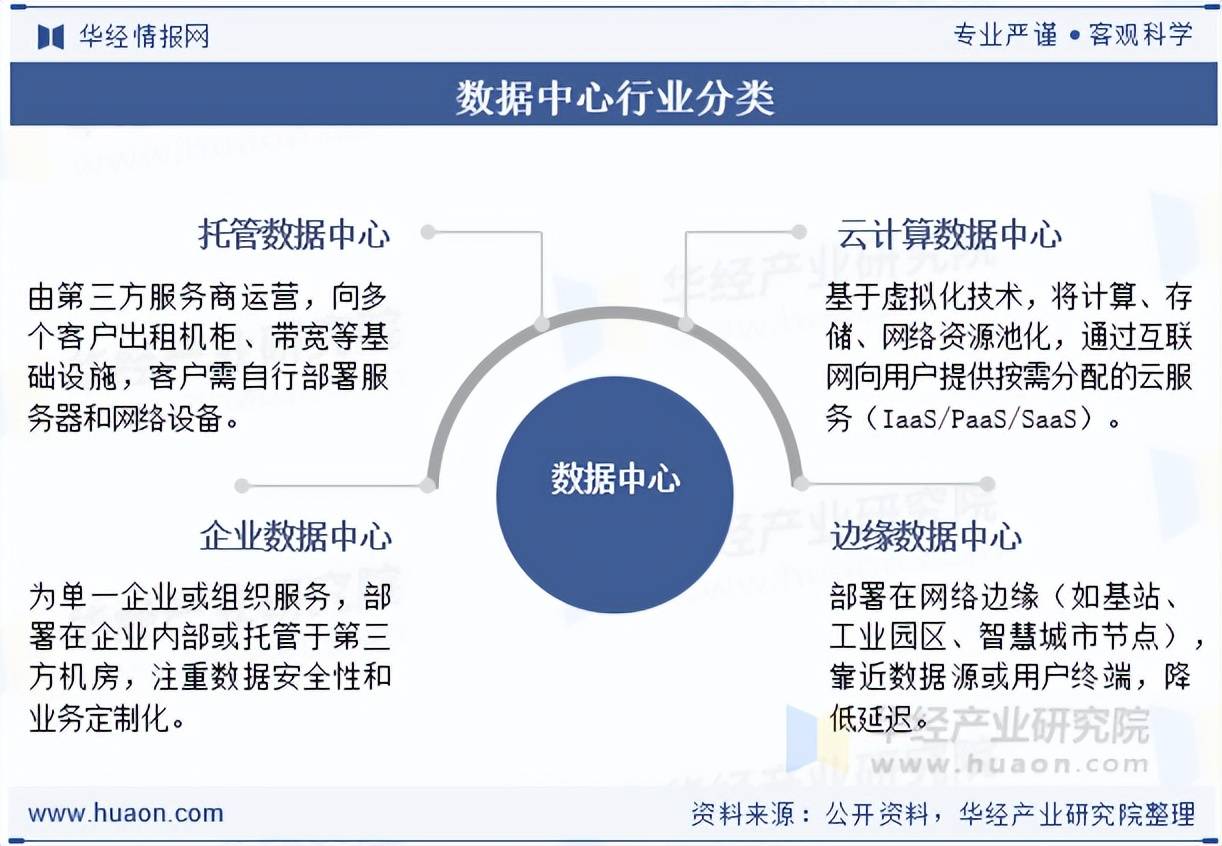
Core Insights - The data center industry is experiencing robust growth driven by emerging technologies such as 5G, cloud computing, and artificial intelligence, with the market size reaching 507.83 billion yuan in 2023 [6]. Policy Support - The development of the data center industry is supported by various policies at both national and local levels, focusing on layout optimization, green development, technology upgrades, and financing channels [4]. - Key policies include the "2030 Carbon Peak Action Plan" aimed at promoting energy-saving and carbon reduction in data centers [5], and the "New Type Data Center Development Three-Year Action Plan (2021-2023)" which outlines six key tasks for quality upgrades [5]. Market Structure - The competitive landscape of the data center industry is diverse, with major players including Alibaba Cloud, Tencent Cloud, and Huawei Cloud in the first tier, and third-party service providers like GDS Services, Century Internet, and DataPort in the second tier [8]. - The industry is characterized by a multi-tier structure, with significant contributions from both cloud service providers and telecommunications operators [8]. Industry Growth - The data center market is projected to continue its growth trajectory, supported by the increasing demand for digital services and the ongoing digital transformation across various sectors [6]. - The industry is moving towards a more integrated, large-scale, green, and intelligent development model [4]. Company Strategies - Major companies are expanding their data center footprints across key regions, with Century Internet and GDS Services actively developing data centers in first-tier cities and strategic locations [10]. - Companies like Alibaba Cloud and Tencent Cloud are establishing large-scale data centers in multiple regions, enhancing their service capabilities [10].




研判2025!中国量子模拟器行业发展历程、相关政策及市场规模分析:从理论突破到市场增长,迈向前沿应用的新征程[图]
Chan Ye Xin Xi Wang· 2025-10-19 01:21
Core Insights - The quantum simulator industry in China is projected to reach a market size of approximately 1.506 billion yuan in 2024, reflecting a year-on-year growth of 15.23% [10][11] - Key challenges facing the quantum simulator sector include quantum noise accumulation and system scalability [10] - The development of modular architectures in quantum simulators, such as the nano-electronic quantum simulator by a US-UK joint team, enhances scalability from single units to large networks [10][11] Industry Overview - Quantum simulators are specialized computational tools based on quantum mechanics principles, primarily used to simulate the behavior of quantum systems [2] - They are categorized into digital quantum simulators and analog quantum simulators [2] Industry Development History - The concept of quantum simulation was established in 1982 by Richard Feynman, with significant milestones achieved in subsequent years, including the realization of the Fermi-Hubbard model by the University of Science and Technology of China in 2024 [4][5] - The development trajectory showcases a complete evolution from theoretical foundations to technological breakthroughs [4] Relevant Policies - Quantum technology has been included in China's "14th Five-Year Plan," emphasizing its importance as a core future industry [6] - The government has introduced various policies to support the research and industrialization of quantum technology, enhancing its global competitiveness [6] Industry Value Chain - The upstream of the quantum simulator industry includes essential components such as quantum chips, dilution refrigerators, and quantum light sources [8] - The midstream focuses on the manufacturing of quantum simulators and software development, while the downstream applications span finance, pharmaceuticals, logistics, and energy sectors [8] Market Size - The quantum simulator market in China is expected to grow significantly, with a projected size of 1.506 billion yuan in 2024, driven by advancements in quantum technology and government support [10][11] - Investment in quantum technology has surged, with 29 financing events recorded in the first eight months of 2025, marking a 93.33% increase year-on-year [10][11] Key Companies' Performance - The competitive landscape of the quantum simulator industry is characterized by leading hardware companies like GuoDun Quantum and Benyuan Quantum, which have established significant technological barriers [11] - GuoDun Quantum reported a revenue of 121 million yuan in the first half of 2025, a 74.54% increase year-on-year, with R&D investment also rising [11][12] Industry Development Trends 1. **Technological Integration and Hardware Breakthroughs**: The next five years will see deep integration of quantum simulators with AI and digital twin technologies, enhancing performance and reducing error rates [14] 2. **Deepening Application Scenarios**: Quantum simulators will penetrate core sectors such as manufacturing and finance, optimizing processes and improving returns [14] 3. **Accelerated Standardization**: China aims to lead in establishing international standards for quantum simulators, enhancing compatibility and competitiveness on a global scale [15]


阿里提出的“超级公司”,正在重写职场规则
老徐抓AI趋势· 2025-10-18 14:44
Core Concept - The article introduces the concept of "Super Company," a new organizational form driven by artificial intelligence (AI) and focused on human-machine collaboration, emphasizing that AI should be deeply integrated into every aspect of a business rather than merely serving as a tool [5][12]. Group 1: Definition and Importance of Super Companies - "Super Company" is defined as an organization where AI acts as the backbone and humans serve as the brain, enhancing efficiency and precision across all operations [5][12]. - The competition in the next decade will shift from cloud adoption to the depth of AI utilization within organizations [5][12]. Group 2: AI's Impact on Sales Processes - Traditional sales methods involve repetitive tasks with low efficiency, while AI can prioritize leads and generate tailored communication strategies, significantly improving conversion rates [7][8]. - AI can automate various tasks, such as drafting personalized messages for potential customers, which enhances customer engagement and saves time [10][11]. Group 3: Transformation of Human Roles - The role of sales personnel is evolving from mere executors of tasks to supervisors who assess AI-generated strategies and refine them based on human judgment [11]. - This shift signifies a move towards high-efficiency collaboration where AI handles calculations and execution, while humans focus on strategy and optimization [11]. Group 4: Implementation Challenges and Solutions - Transitioning to a "Super Company" requires more than just a conceptual understanding; practical implementation is crucial [13]. - The current landscape allows businesses to leverage AI infrastructure without needing to build it from scratch, as cloud providers offer accessible AI capabilities [13][16]. Group 5: Future of AI in Business - The future of competition will hinge on how quickly and effectively companies can adopt and integrate AI into their operations [16][18]. - Organizations that embrace AI will gain significant advantages, while those that do not will find themselves managed by those who do understand and utilize AI [18][19]. Group 6: Educational Initiatives - Companies are encouraged to explore training programs that facilitate the integration of AI into their workflows, promoting a collaborative environment between humans and AI [19].

云计算的“第一”之争:榜单之外的云端真相
Sou Hu Cai Jing· 2025-10-14 16:31
Core Insights - The cloud computing market is characterized by multiple companies claiming to be "number one" based on different metrics and conditions, leading to confusion among users and stakeholders [6][7][8] - The competition among cloud service providers has shifted from traditional metrics to a narrative-driven approach, where the concept of "first" has become a strategic asset in public relations and market positioning [8][9][23] Market Share Claims - Volcano Engine holds a 46.4% share of the Chinese public cloud large model market, leading in model invocation volume with a 49.2% share [3][12] - Alibaba Cloud claims to lead the AI cloud market in China with a 35.8% share, surpassing the combined share of the second to fourth players [4][10] - Huawei Cloud is noted for its rapid growth in the public cloud sector, particularly in the Middle East and Central Asia, achieving a tenfold revenue increase compared to 2023 [14] - Baidu Smart Cloud emphasizes AI capabilities in various sectors, focusing on "AI model as a service" to drive growth [16] Importance of "First" - The designation of "first" in the cloud computing industry signifies trust, capital, and competitive advantage, influencing investor confidence and customer choices [9][10] - Companies that maintain a "first" position can secure budget allocations and strategic priorities, while falling out of rankings may lead to organizational changes [9][10] Shift to AI-Driven Cloud - The competition has evolved to focus on "AI + Cloud," where cloud services are expected to integrate AI capabilities, transforming traditional cloud infrastructure into intelligent systems [17][18] - Alibaba Cloud is positioning itself as a "full-stack AI service provider," planning to invest 380 billion yuan in AI infrastructure over the next three years [18][19] - The integration of AI into cloud services is seen as a critical trend, with companies like Huawei and Baidu also adapting their strategies to emphasize AI capabilities [22][23] Future of Cloud Competition - The traditional metrics of market share may become less relevant as the industry shifts towards providing smarter, more adaptable cloud solutions [23] - The definition of "first" may evolve, focusing on the ability to deliver intelligent, open, and continuously evolving cloud services rather than just numerical rankings [23]


如何构建符合等保三级标准的机房环境
Sou Hu Cai Jing· 2025-10-10 12:47
Core Insights - The construction of a data center that meets the Level 3 Cybersecurity Protection Standards requires attention to multiple key elements, including physical security, power systems, environmental monitoring, and disaster recovery coordination [1] - Compliance is not solely dependent on hardware but also requires dynamic monitoring, log management, and response mechanisms to align with the emerging concept of "active monitoring" [1] - Companies should enhance collaboration among compliance, technology, operations, and procurement teams, creating detailed process checklists and conducting gradual testing to ensure full compliance with Level 3 requirements [1] Group 1: Client Concerns and Industry Practices - Many enterprises, especially in sectors like finance and healthcare, are anxious about how to modify their data centers without disrupting business operations, leading to confusion about the strictness of Level 3 standards [3] - There is a gap between the standards and their practical implementation, as many data centers tend to simplify requirements, despite the complexity involved in actual compliance [4] - Key compliance points for data center environments include physical security, power systems, environmental safety, and disaster recovery coordination [5] Group 2: Misconceptions and Challenges - A common misconception is that simply purchasing equipment and installing access control systems is sufficient for compliance, while in reality, physical partitioning and monitoring are crucial [6] - Disaster recovery drills are often treated as mere formalities, and neglecting communication with construction teams can lead to significant operational delays [6] - Level 3 compliance is not just a technical issue but also involves management and operational readiness [6] Group 3: Policy Trends and Future Changes - Recent trends indicate that from 2024 to 2025, there will be a shift towards incorporating "active monitoring" concepts into compliance standards, requiring companies to implement dynamic monitoring and real-time operational responses [7] - The "QianKun Cloud Integrated Machine" can help companies reduce manual inspection costs, which has been validated in sectors like banking and manufacturing [7] - The hidden costs associated with compliance risks often outweigh the initial investment in equipment [7] Group 4: Industry Consensus and Recommendations - The industry is moving away from relying solely on hardware isolation, emphasizing the importance of a collaborative approach between technology and processes [8] - Companies are encouraged to develop a comprehensive process checklist involving compliance, technology, operations, and procurement teams, rather than relying solely on vendor solutions [8] - As compliance reviews become more stringent by 2025, the integration of processes, management, and hardware will be essential for long-term success [8]

迪安诊断:迪安医检大模型智能体“迪晓智”发布,赋能医院体检工作效率提升10倍
Cai Jing Wang· 2025-10-10 07:12
Group 1 - The core viewpoint of the news is that Dian Diagnostics has launched an AI health management platform called "Dixiaozhi" in collaboration with Huawei Cloud, aimed at enhancing efficiency in health management for both B-end and C-end users [1] - The AI health management platform integrates Huawei Cloud's medical model technology with Dian Diagnostics' extensive medical data resources, providing a comprehensive solution from "testing - interpretation - intervention" [1] - The platform can automatically generate an "AI Health Promotion Book" that includes disease risk assessments and precise intervention suggestions, achieving a processing efficiency improvement of up to 10 times [1] Group 2 - In the first half of 2025, Dian Diagnostics reported an operating income of approximately 4.936 billion yuan, a year-on-year decrease of 20.61%, and a net profit attributable to shareholders of about 10.28 million yuan, down 85.68% year-on-year [1] - On September 30, Dian Diagnostics announced the resignation of board member Hong Hanhua due to personal reasons, who will no longer hold any position within the company after his resignation [2] - Hong Hanhua has held various managerial positions in the medical field since 2005, including roles at Hangzhou Henguan Medical Equipment Co., Ltd. and Hangzhou Dian Medical Testing Center Co., Ltd. [2]
