
国家能源投资集团有限责任公司

Search documents
国家能源集团总经理冯来法:创新引领 协同赋能 携手共创新型电力系统建设新局面
Zhong Guo Dian Li Bao· 2025-09-24 07:10
创新引领 协同赋能 携手共创新型电力系统建设新局面 二是抓好"五大任务",开创新型电力系统建设新局面。要聚焦新型电力系统核心特征,抓好"五大建设 任务"。以三个协同推进,厚植新型电力系统清洁低碳底色,坚持新能源规模化与煤电清洁化协同推 进,坚持供给侧改革与消费模式升级协同推进,坚持技术创新与机制革新协同推进;以全要素保障,守 住新型电力系统安全充裕底线,加强支撑性和灵活性电源保障,加强电力安全稳定技术保障,加强电力 防灾应急保障;以更优资源配置,助力新型电力系统高效运行,着力发挥多能互补和区域平衡优势,着力 发挥技术降本增效的应用场景优势,着力发挥多层次电力市场优势;以生产消费互动,增强新型电力系 统供需协同能力,积极推动源网荷储一体化,积极推动电力流向与电力布局"一张图",积极融入全国电 力"一张网";以全链数智赋能,提升新型电力系统灵活智能水平,加快电力生产数智化建设,加快电力 传输智能化建设,加快电力系统调度控制智慧化建设。 三是坚持"三个转型",全力推进新型电力系统建设。坚持从"大而全"向"强而优"转型,坚持把质的有效 提升和量的合理增长统一于高质量发展全过程,充分挖掘传统能源潜力,提升产业发展效能, ...
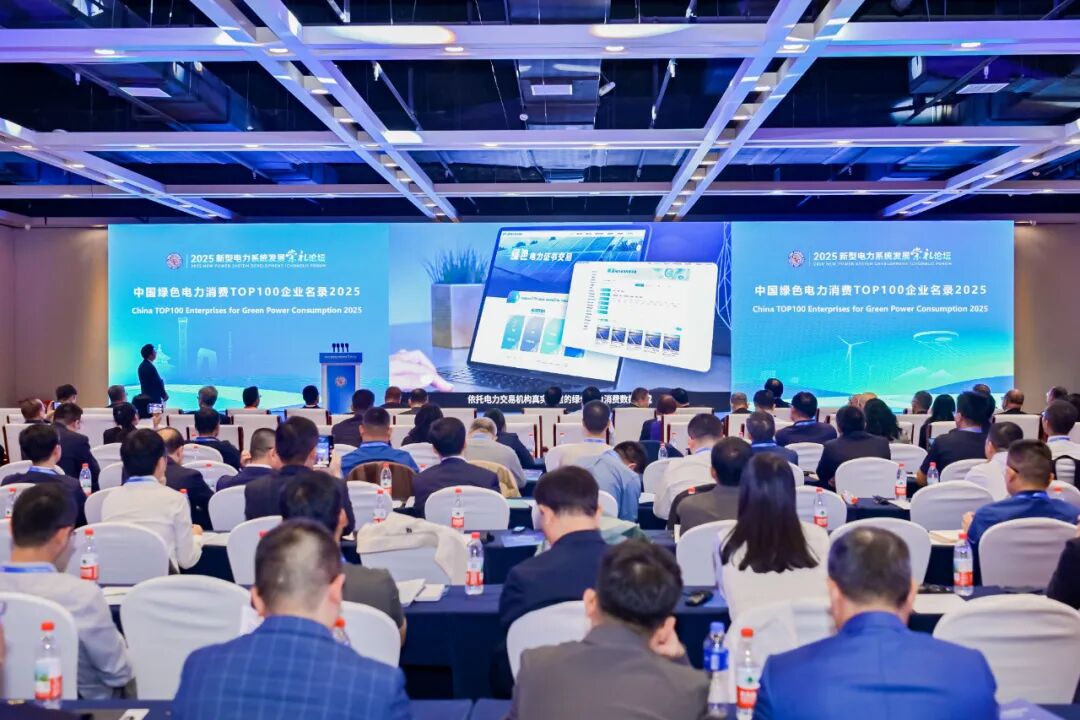
2024年度中国绿色电力(绿证)消费TOP100企业名录发布
Zhong Guo Dian Li Bao· 2025-09-23 08:45
Core Insights - The release of the "2024 Annual China Green Power (Green Certificate) Consumption TOP100 Enterprises List" highlights the increasing commitment of energy companies in China towards green power consumption, with nearly 20 energy firms making the list [1][3]. Group 1: TOP100 Enterprises Overview - The top four positions in the list are dominated by energy companies, with the top two being China Energy Investment Group and State Power Investment Corporation, maintaining their rankings from 2023 [3]. - Local energy companies, Zhejiang Energy Group and Shenzhen Energy Group, have risen to the third and fourth positions respectively [3]. - Other notable companies include China Petroleum and Chemical Corporation and China National Petroleum Corporation, ranking eighth and ninth [3]. Group 2: Green Power Consumption Growth - From January to July 2025, China's total green power consumption reached 5,977 billion kilowatt-hours, marking a year-on-year increase of 42.69% [3]. - Green power trading volume was 1,817 billion kilowatt-hours, also reflecting a growth of 42.10% year-on-year [3]. - The number of green certificates traded reached 416 million, corresponding to an electricity volume of 4,160 billion kilowatt-hours, with a year-on-year increase of 42.96% [3]. Group 3: Industry Impact and Future Directions - The publication of the TOP100 list demonstrates the significant contributions of various industries towards the green energy transition, enhancing market vitality for green consumption [4]. - The joint publishing entities plan to refine the standards and formats for green power consumption reporting, aiming to establish the list as a recognized international brand for green consumption [4].




信用债周度观察(20250915-20250919):信用债发行量环比增长,各行业信用利差涨跌互现-20250920
EBSCN· 2025-09-20 12:22
Report Industry Investment Rating No relevant content provided. Core Viewpoints of the Report - From September 15th to September 19th, 2025, the issuance volume of credit bonds increased month - on - month, and the credit spreads of various industries showed mixed trends[1]. - The total trading volume of credit bonds increased, and the trading volumes of commercial bank bonds, corporate bonds, and medium - term notes ranked top three[4]. Summary by Directory 1. Primary Market 1.1 Issuance Statistics - During September 15 - 19, 2025, 455 credit bonds were issued, with a total issuance scale of 579.911 billion yuan, a month - on - month increase of 55.61%. Among them, 182 industrial bonds were issued, amounting to 202.499 billion yuan (up 63.71% month - on - month, accounting for 34.92% of the total); 217 urban investment bonds were issued, totaling 141.282 billion yuan (up 52.61% month - on - month, accounting for 24.36%); and 56 financial bonds were issued, reaching 236.13 billion yuan (up 50.98% month - on - month, accounting for 40.72%)[1][11]. - The average issuance term of credit bonds was 2.94 years. The average issuance terms of industrial bonds, urban investment bonds, and financial bonds were 2.42 years, 3.52 years, and 2.31 years respectively[1][13]. - The average issuance coupon rate of credit bonds was 2.28%. The average issuance coupon rates of industrial bonds, urban investment bonds, and financial bonds were 2.13%, 2.48%, and 1.97% respectively[2][18]. 1.2 Cancellation of Issuance Statistics - Four credit bonds were cancelled for issuance during the week, including "25 Xianggaosu CP003", "25 Datong D1", "25 Suzhou Energy MTN002", and "25 Tongzhouwan PPN003"[3][23]. 2. Secondary Market 2.1 Credit Spread Tracking - By industry, among Shenwan primary industries, for AAA - rated industries, the largest increase in credit spread was in the electronics industry (up 6.7BP), and the largest decrease was in the textile and apparel industry (down 6.8BP); for AA + - rated industries, the largest increase was in the electronics industry (up 1.2BP), and the largest decrease was in the mining industry (down 7BP); for AA - rated industries, the largest increase was in the real estate industry (up 14.3BP), and the largest decrease was in the agriculture, forestry, animal husbandry, and fishery industry (down 4.3BP)[3][25]. - By region for urban investment bonds, for AAA - rated bonds, the largest increase in credit spread was in Shanghai (up 3.3BP), and the largest decrease was in Shaanxi (down 10.2BP); for AA + - rated bonds, the largest increase was in Yunnan (up 4.7BP), and the largest decrease was in Hubei (down 5.9BP); for AA - rated bonds, the largest increase was in Fujian (up 6.5BP), and the largest decrease was in Jiangxi (down 5.8BP)[3][27]. - The credit spreads of coal and steel both showed mixed trends. The credit spreads of AAA and AA + - rated coal decreased by 1.2BP and 5.3BP respectively, and the credit spreads of AAA and AA + - rated steel decreased by 3.3BP and increased by 0.5BP respectively[25]. - The credit spreads of urban investment and non - urban investment bonds at all levels decreased. The credit spreads of three - level urban investment bonds decreased by 0.5BP, 3.1BP, and 1.8BP respectively, and the credit spreads of three - level non - urban investment bonds decreased by 1.5BP, 2.3BP, and 0.4BP respectively[25]. - The credit spreads of state - owned enterprises and private enterprises both showed mixed trends. The credit spreads of three - level central state - owned enterprises decreased by 1BP, 5.6BP, and increased by 0.2BP respectively; the credit spreads of three - level local state - owned enterprises decreased by 1.4BP, 1.8BP, and 2.1BP respectively; the credit spreads of three - level private enterprises decreased by 2BP, 2.3BP, and increased by 1BP respectively[26]. 2.2 Trading Volume Statistics - The total trading volume of credit bonds was 1.462306 trillion yuan, a month - on - month increase of 21.90%. The top three in terms of trading volume were commercial bank bonds, corporate bonds, and medium - term notes. The trading volume of commercial bank bonds was 479.739 billion yuan (up 26.26% month - on - month, accounting for 32.81% of the total trading volume); the trading volume of corporate bonds was 432.035 billion yuan (up 29.94% month - on - month, accounting for 29.54%); the trading volume of medium - term notes was 311.265 billion yuan (up 14.08% month - on - month, accounting for 21.29%)[4][28]. 2.3 Actively Traded Bonds This Week - According to DM client data, the top 20 urban investment bonds, industrial bonds, and financial bonds in terms of trading volume during the week are provided for investors' reference, including details such as bond codes, names, trading volumes, yields, and issuers[30][31][33].






交通部“晒”强国建设试点样本
Di Yi Cai Jing· 2025-09-19 01:47
Core Insights - The Ministry of Transport of China has published a collection of 44 typical experiences and innovative achievements in the transportation sector, aimed at promoting replicable and scalable practices across various fields such as infrastructure construction, transportation services, technological innovation, and green low-carbon development [1] Group 1: Infrastructure and Maintenance Innovations - Jiangsu Province has introduced a centralized maintenance model for high-traffic highways, optimizing maintenance efficiency and overall network performance, addressing issues related to traditional maintenance methods [1] - From 2019 to 2024, Jiangsu completed approximately 1215 half-width kilometers of construction, reducing project timelines by about 2700 days and saving over 4 billion yuan in costs [2] Group 2: Port and Terminal Innovations - The Guangzhou Nansha Phase IV fully automated terminal has developed a new technical system that enhances space utilization and efficiency in intermodal transport, achieving a 30% increase in land utilization and a 28% improvement in loading efficiency [2] - The terminal's annual container throughput capacity has reached 24 million TEUs, positioning it among the top global single terminals [2] Group 3: Airport Operations Enhancements - Guangzhou Baiyun International Airport has implemented advanced technologies to improve operational efficiency, achieving the highest passenger throughput in the country for four consecutive years [3] - The airport's new systems have reduced average bridge docking time from 120 seconds to 85 seconds and improved boarding efficiency by 40% [3] Group 4: Coal Transportation and Energy Supply - Huanghua Port has achieved full-process automation in coal handling, utilizing 5G technology and high-precision positioning systems to enhance operational efficiency, reducing loading times by 25% and increasing ship loading rates by 10% [4] - The port's innovations have also led to a 32% reduction in average port stay time and a 16% decrease in train unloading times [4] Group 5: Carbon Emission Management - Zhejiang Province has developed a comprehensive carbon emission accounting system and a digital application platform, achieving significant reductions in carbon emissions and engaging over 1.53 million users in low-carbon activities [5] - Guangdong Province has established extensive shore power facilities at ports, achieving a 90.94% coverage rate and saving approximately 1.7 billion yuan in fuel costs while reducing carbon emissions by 10.6 million tons [5] Group 6: Cross-Border E-commerce Innovations - Guangdong Province has introduced an embedded regulatory model for cross-border e-commerce, significantly improving customs clearance efficiency and reducing processing times [6] - In 2024, the value of exports through this new model reached 11.32 million yuan, with 8.42 million yuan reported in the first five months of 2025 [6]
新能源发电就近消纳的成本收益分析
Zhong Guo Dian Li Bao· 2025-09-17 06:20
Core Insights - The article discusses the rapid development of renewable energy in China, highlighting both achievements and challenges, particularly in energy consumption and power system regulation [1] - It emphasizes the introduction of new policies aimed at facilitating the consumption of renewable energy through market-oriented reforms [1] Policy Developments - In February, the National Development and Reform Commission and the National Energy Administration issued a notice to deepen market-oriented reforms for renewable energy grid pricing [1] - In May, a notice was released to promote green electricity direct connection projects, introducing new consumption scenarios [1] - On September 12, a new notice was published to improve pricing mechanisms for local consumption of renewable energy, providing clear guidelines for project investors [1] Project Construction Requirements - The notice outlines specific technical requirements for renewable energy local consumption projects, clarifying the rights and obligations of project participants [2] - It establishes clear physical and safety responsibility boundaries to mitigate operational disputes and safety risks [2] Consumption Ratio and Weighting - The notice mandates that the annual self-consumption of renewable energy projects must be at least 60% of total available generation and 30% of total electricity consumption, with a minimum of 35% for new projects starting in 2030 [3] - This high self-consumption ratio aims to reduce pressure on the public grid and ensure alignment with user electricity demand [3] Economic Feasibility Assessment - The economic viability of projects hinges on reducing electricity costs, with key cost components being energy charges, transmission and distribution fees, and system operation fees [4] - Investors are advised to compare the costs of self-consumption against public grid purchasing costs to determine project feasibility [4] Market Participation Pathways - Renewable energy projects can also generate revenue through excess grid connection, but this is highly dependent on the local electricity market's operational status [6] - In regions with continuous electricity spot markets, projects face both higher revenue opportunities and increased risk management requirements [6] - Conversely, in areas without continuous spot markets, projects are generally not allowed to send electricity back to the grid, limiting revenue potential [7]
一块煤如何裂变多条链
Jing Ji Ri Bao· 2025-09-17 03:35
Core Viewpoint - Hami City is transforming its traditional energy structure by developing a modern coal chemical industry, leveraging its abundant coal resources to achieve high-value utilization and contribute to national energy security under the "dual carbon" goals [2][3]. Group 1: Coal Resource Utilization - Hami City has a coal resource prediction of approximately 570.8 billion tons, accounting for one-third of Xinjiang's and one-eighth of China's total coal resources [2]. - The city is focusing on clean and efficient coal utilization, with the coal chemical industry’s added value increasing by 17.9% year-on-year in the first half of the year [2][3]. - Hami has established multiple industrial chains, including coal-to-methanol, coal-to-fuel oil, and coal-to-gas, with products such as methanol, liquefied natural gas, and ethylene glycol [3][4]. Group 2: Technological Innovation and Projects - Hami is introducing significant projects, such as the first global coal-to-oil project using second-generation technology, expected to produce 4 million tons of oil annually by 2027 [4]. - The city is also developing a 1 million tons per year acetic acid project, which is the first of its kind in Xinjiang, aimed at alleviating the shortage of acetic acid in the northwest region [6]. - Hami is implementing a zero discharge project for industrial wastewater, achieving a 100% recycling rate for wastewater in the industrial park [7]. Group 3: Circular Economy and Resource Efficiency - Hami is promoting a circular economy by maximizing the utilization of by-products from coal processing, such as the innovative use of waste gas to produce ethylene glycol [9]. - The city is also focusing on the efficient use of coal resources, with plans for a project that can process over 10 million tons of coal annually [5][8]. - The comprehensive utilization of coal resources is expected to significantly enhance economic benefits, with potential returns being several times that of raw coal [10]. Group 4: Coupling Development with Renewable Energy - Hami is exploring the integration of traditional energy and renewable energy, with 67.8% of its installed power capacity coming from renewable sources [14]. - New coal chemical projects are required to source at least 50% of their electricity from green energy, which can reduce production costs and carbon emissions [14]. - The city is also developing a green hydrogen industry, utilizing wind and solar energy to produce hydrogen for coal chemical processes [15]. Group 5: Talent and Research Development - Hami is establishing a research institute focused on the clean and efficient utilization of high-oil coal, collaborating with universities and research institutions [12]. - The city is also investing in vocational training for skilled workers in the energy and chemical sectors to meet the industry's growing demands [13]. - Hami aims to become a significant hub for energy technology innovation, fostering collaboration between experts and enterprises [12].
一块煤如何裂变多条链 ——新疆哈密市现代煤化工产业发展调查
Jing Ji Ri Bao· 2025-09-16 22:11
Core Viewpoint - Hami City is transforming its traditional energy structure by leveraging its abundant coal resources to develop a modern coal chemical industry, aiming for high-value utilization and low-carbon development while ensuring energy security under the "dual carbon" goals [1][2]. Group 1: Coal Resource Utilization - Hami City is focusing on the clean and efficient utilization of coal, promoting the development of modern coal chemical industries, and achieving a transformation from coal to high-value products like oil and gas [1][2]. - The predicted coal resource in Hami is approximately 570.8 billion tons, accounting for one-third of Xinjiang's and one-eighth of China's total coal resources [1]. - The coal chemical industry in Hami saw a year-on-year increase of 17.9% in added value in the first half of this year [1]. Group 2: Industrial Chain Development - Hami has established multiple industrial chains, including "coal-methanol-carboxylic acids, formaldehyde, polypropylene" and "coal-coke oil-fuel oil" [2]. - The city is constructing a framework for coal-based chemicals and new materials, with products including methanol, liquefied natural gas, and ethylene glycol [2]. Group 3: Technological Innovation and Projects - Hami is introducing significant projects, such as a coal-to-oil project by the State Energy Investment Group, which will produce 4 million tons of oil annually using second-generation technology [3]. - The first phase of a 1 million tons per year acetic acid project has entered trial production, addressing the shortage of acetic acid in the northwest region [4]. Group 4: Resource Recycling and Environmental Impact - Hami is implementing a zero-discharge project for industrial wastewater, achieving a 100% recycling rate [5]. - The city is also maximizing the utilization of low-value by-products, such as utilizing waste gas from coal processing to produce ethylene glycol [6]. Group 5: Coupling Development with Renewable Energy - Hami is exploring the coupling of traditional energy and renewable energy, with 67.8% of its installed power capacity coming from renewable sources [11]. - New projects require that at least 50% of the electricity supply comes from green energy, which can reduce production costs and carbon emissions significantly [11]. Group 6: Talent and Skill Development - Hami is establishing educational institutions focused on energy and chemical engineering to cultivate skilled talent for the coal chemical industry [10]. - The city is also collaborating with universities and research institutions to enhance research and development capabilities in clean and efficient coal utilization technologies [9].
未采取措施消除事故隐患,国能广投北海发电有限公司被罚
Qi Lu Wan Bao· 2025-09-15 07:25
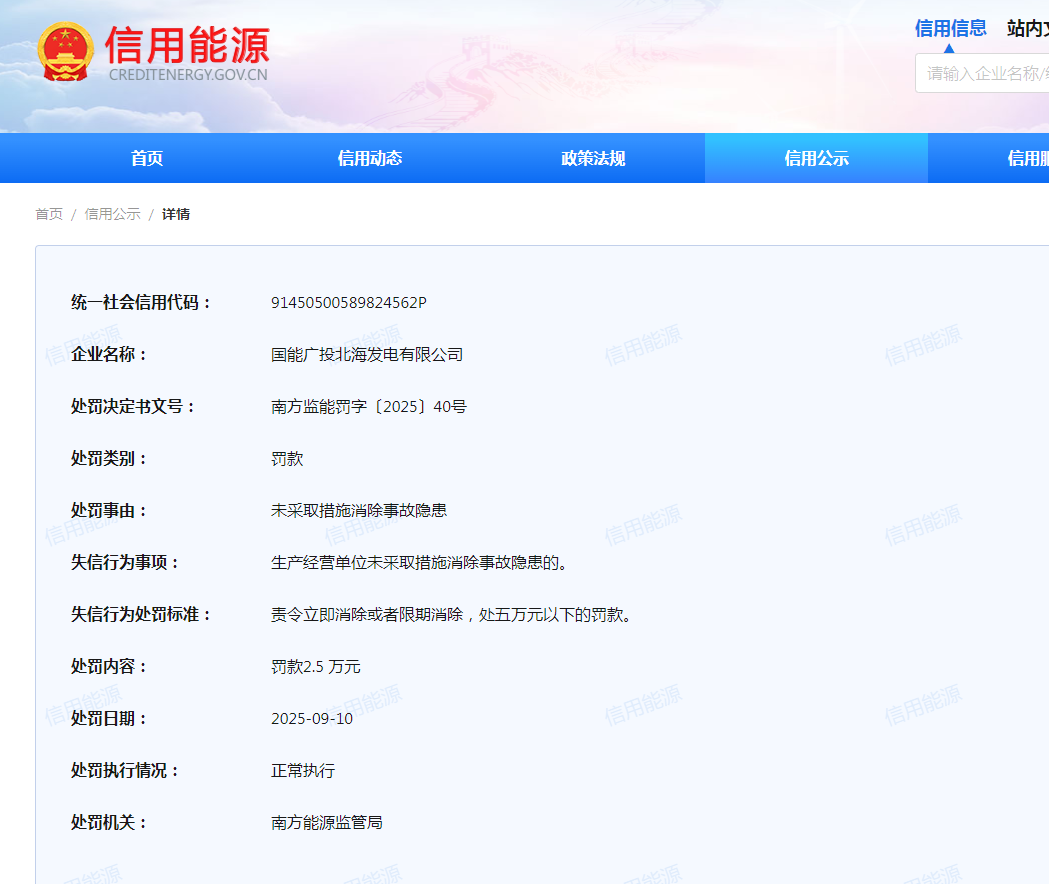
日前,信用能源公示了国能广投北海发电有限公司的行政处罚决定。处罚决定书文号南方监能罚字〔2025〕40号显示,国能广投北海发电有限公司处 罚事由是未采取措施消除事故隐患,南方能源监管局对其作出罚款2.5万元处罚。 公开信息显示,国能广投北海发电有限公司成立于2021年1月31日,注册资本184288万元,法定代表人李昌松,大股东是中国神华能源股份有限公 司。 中国神华能源股份有限公司(简称中国神华)成立于2004年11月8日,是国家能源投资集团有限责任公司(简称国家能源集团)旗下A+H股旗舰上市 公司,H股和A股股票分别于2005年6月15日、2007年10月9日在香港联交所、上海证交所上市,连续11年荣获上交所信息披露工作评价A级。截至 2024年底,公司资产规模6581亿元,综合市值8221亿元,职工总数8.3万人。 新闻热线电话0531-85193242 ...
中国神华: 《2025年上半年中国神华能源股份有限公司关于国家能源集团财务有限公司的风险持续评估报告》
Zheng Quan Zhi Xing· 2025-08-29 12:17
Core Viewpoint - The report evaluates the financial and operational risks of China Energy Group Finance Co., Ltd., highlighting its governance structure, risk management practices, and financial performance as of June 30, 2025 [1][2][10]. Group 1: Company Overview - China Energy Group Finance Co., Ltd. is controlled by China Shenhua Energy Co., Ltd. with a 60% stake held by China Energy Investment Group [1]. - The company has a registered capital of 17.5 billion RMB, with various stakeholders including China Shenhua Energy Co., Ltd. holding 32.57% [1]. - The company provides financial services such as deposit acceptance, loan processing, and financial consulting to its member units [1]. Group 2: Internal Control and Risk Management - The company has established a modern governance structure with a clear division of responsibilities among the shareholders' meeting, board of directors, and supervisory board [2]. - A risk management committee and an audit committee are in place to oversee risk management and internal audits [2][3]. - The company employs a risk matrix for dynamic monitoring and control of various business risks, ensuring effective identification and quantification of credit, market, and operational risks [3]. Group 3: Financial Performance - As of June 30, 2025, the total assets of the company amounted to 30.77 billion RMB, with total liabilities of 26.88 billion RMB and owner’s equity of 3.89 billion RMB [10]. - For the first half of 2025, the company reported operating income of 2.236 billion RMB, total profit of 2.311 billion RMB, and net profit of 1.799 billion RMB [10]. - The company has maintained a zero non-performing loan ratio, indicating strong credit asset quality [7]. Group 4: Risk Indicators - As of June 30, 2025, the company's major risk indicators met regulatory requirements, reflecting a robust risk management framework [12]. - The company has not experienced significant operational risks or regulatory penalties, indicating effective compliance with financial regulations [13][19]. Group 5: Financial Services and Transactions - The company has established a financial service agreement with its parent group, allowing for comprehensive credit facilities without collateral requirements [1][18]. - The company’s deposits from member units reached 268.588 billion RMB, with loans and advances totaling 198.851 billion RMB as of June 30, 2025 [10]. - The company has implemented strict management measures for deposit and loan operations to prevent fraud and ensure compliance with regulatory standards [4][6].

英 力 特: 宁夏英力特化工股份有限公司向特定对象发行股票上市公告书
Zheng Quan Zhi Xing· 2025-08-24 16:13
Core Viewpoint - Ningxia Yinglite Chemical Co., Ltd. is conducting a private placement of shares, issuing 91,046,021 new shares at a price of 7.51 yuan per share, aiming to raise approximately 683.76 million yuan [1][9][12]. Group 1: Issuance Details - The total number of shares to be issued is 91,046,021, with the issuance completed on August 18, 2025, and expected to be listed on August 26, 2025 [1][9]. - The issuance price is set at 7.51 yuan per share, which is above the minimum price of 7.45 yuan per share determined by the company's stock performance [8][9]. - The total funds raised from this issuance amount to 683,755,617.71 yuan, with net proceeds after expenses being 679,483,919.60 yuan [10][12]. Group 2: Shareholder and Investor Information - The controlling shareholder, Yinglite Group, is required to hold the shares acquired through this issuance for a lock-up period starting from the listing date [1][9]. - A total of 15 investors participated in the issuance, including institutional investors and private funds, all of whom complied with the relevant regulations [5][12]. - The issuance process involved a thorough review by the lead underwriter, ensuring compliance with legal and regulatory requirements [5][16]. Group 3: Compliance and Legal Framework - The issuance adheres to the regulations set forth by the China Securities Regulatory Commission and the Shenzhen Stock Exchange [1][16]. - Independent directors provided their consent for the issuance, and necessary procedures for related party transactions were followed [15][16]. - The company has established a dedicated account for the raised funds, ensuring proper management and usage in accordance with regulatory requirements [11][12].
