
东鹏饮料

Search documents
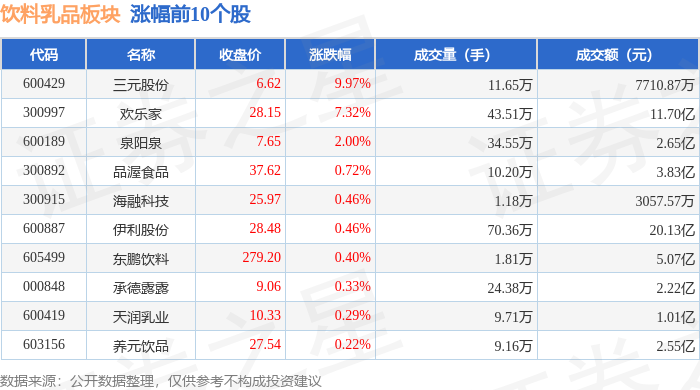
饮料乳品板块11月12日涨0.43%,三元股份领涨,主力资金净流出9697.31万元
Zheng Xing Xing Ye Ri Bao· 2025-11-12 08:42
Core Insights - The beverage and dairy sector experienced a slight increase of 0.43% on November 12, with San Yuan leading the gains [1] - The Shanghai Composite Index closed at 4000.14, down 0.07%, while the Shenzhen Component Index closed at 13240.62, down 0.36% [1] Stock Performance - San Yuan (600429) saw a closing price of 6.62, with a significant increase of 9.97% and a trading volume of 116,500 shares, amounting to 77.11 million yuan [1] - Huanle Jia (300997) closed at 28.15, up 7.32%, with a trading volume of 435,100 shares, totaling 1.17 billion yuan [1] - Other notable performers include Quan Yang Quan (681009) with a 2.00% increase, and Yi Li (600887) with a 0.46% increase [1] Capital Flow - The beverage and dairy sector saw a net outflow of 96.97 million yuan from institutional investors, while retail investors contributed a net inflow of 291 million yuan [2] - The capital flow data indicates that major stocks like Yi Li (600887) experienced a net inflow of 77.74 million yuan from institutional investors, despite a net outflow from retail investors [3] - San Yuan (600429) had a net inflow of 29.83 million yuan from institutional investors, but also faced significant outflows from retail investors [3]




国信证券:酒类渠道包袱加速去化 大众品品类表现分化
智通财经网· 2025-11-12 02:48
Group 1 - The core viewpoint of the report indicates that the liquor industry is entering a phase of adjustment, with a consensus on reduced growth rates for 2024 and an expansion of performance declines in Q3 reports [1][2] - The food and beverage sector is expected to show stable overall volume and structural differentiation by 2025, with Q1/Q2/Q3 revenues growing by +2.5%/+2.4%/-4.77% year-on-year, and net profits declining by +0.3%/-2.1%/-14.6% [1] - The report highlights that the macroeconomic policies in Q4 could catalyze stock price increases due to low expectations in the capital market and low institutional holdings [1] Group 2 - The liquor sector is recommended for investment, particularly companies with pricing power and regional influence, such as Luzhou Laojiao, Shanxi Fenjiu, and Kweichow Moutai, which are expected to achieve greater growth [2] - The consumer goods sector is anticipated to stabilize and improve in 2025, driven by inventory reduction and macroeconomic policy support, with leading companies in segments like sugar-free tea and functional beverages showing strong revenue growth [3] - The snack food segment reported a revenue increase of +22.4% and an 8.6% rise in profits in Q3 2025, despite rising costs from certain raw materials [3]

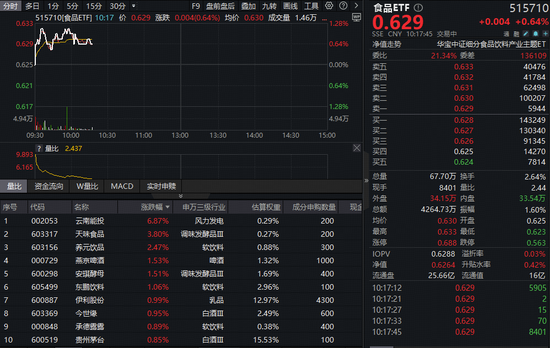
贵州白酒政策引爆行情!白酒、大众品携手上攻,食品ETF(515710)盘中上探1.28%!
Xin Lang Ji Jin· 2025-11-12 02:29
Group 1 - The food and beverage sector continues to rise, with the Food ETF (515710) showing a maximum intraday increase of 1.28% and currently up 0.64% [1] - Major consumer goods stocks are leading the gains, with notable performances from liquor brands such as Tianwei Food up over 3% and Yangyuan Beverage up over 2% [1] - Guizhou's government has introduced multiple consumption expansion measures related to liquor, aiming to boost production and consumption during peak holiday seasons [2][3] Group 2 - Analysts highlight that Guizhou's consumption expansion policy aims to deeply integrate liquor consumption with industrial upgrades and cultural promotion, rather than just short-term sales boosts [3] - The food and beverage sector is currently at a historical low valuation, with the Food ETF's underlying index PE ratio at 21.21 times, indicating a favorable long-term investment opportunity [3] - Future projections suggest that the liquor industry may see improvements in financial reports by 2026, with a gradual recovery in demand expected as policy impacts diminish [4] Group 3 - The Food ETF (515710) tracks the CSI segmented food and beverage industry index, with approximately 60% of its holdings in high-end liquor stocks and nearly 40% in other beverage and food segments [5] - Investors can also access core assets in the food and beverage sector through the Food ETF linked funds [5]




中国多资产 -花旗 2025 中国会议需关注主题-China Multi-Asset-Themes to Watch at Citi’s 2025 China Conference
花旗· 2025-11-12 02:20
Investment Rating - The report maintains a positive outlook on various sectors, with specific "Buy" ratings for companies such as AIA Group, ASMPT, Atour, Hengrui, Sunny Optical, Tencent, and others [13][14][28][33]. Core Insights - The 15th Five-Year Plan (FYP) emphasizes technological innovation, consumption rebalancing, and building a strong domestic market, which are expected to drive growth in sectors like technology, healthcare, and renewables [14][29]. - The report anticipates a stable external environment for China, with net exports remaining a key growth driver despite potential challenges from high bases and external demand uncertainties [7]. - The healthcare sector is highlighted as a key beneficiary of government policies, with a focus on innovation and globalization, particularly in medical devices and pharmaceuticals [29]. - The consumer sector is shifting towards experience and service consumption, with a growing emphasis on well-being and the silver economy, indicating potential growth areas for companies in these segments [27]. Economics - The report projects a growth target of around 5.0% YoY for 2026, with a focus on policy continuity and structural support for consumption [7]. - The RMB exchange rate is expected to become a focal point, with potential for significant movements as trade tensions ease and internationalization efforts continue [7]. Commodities - The report notes a shift in China's commodity fundamentals due to economic transitions, with a focus on domestic demand and energy self-sufficiency [9][10]. - The Action Plan for the Nonferrous Metals Industry indicates a shift towards high-quality growth, with supply growth expected to remain constrained [9]. Sector Views - **Autos and Parts**: The sector is poised for growth driven by advancements in Robotaxi and ADAS technologies, with key players expected to benefit from commercialization efforts [19]. - **Banks**: The banking sector is expected to outperform due to positive earnings growth and attractive dividend yields, particularly among large H-share banks [22]. - **Brokers**: The report highlights a trend of households reallocating wealth into equities, benefiting brokers as market proxies [26]. - **Consumer**: Key investment themes include a shift towards experiential consumption and a focus on well-being, with specific companies identified as top buys [27][28]. - **Healthcare**: Innovation and globalization are seen as critical drivers, with a focus on companies with strong pipelines and global expansion capabilities [29]. - **Insurance**: The sector is viewed positively, with opportunities arising from comprehensive enhancements across various business lines [33]. Top Buys - The report lists several top buy recommendations across sectors, including AIA Group, Hengrui, Tencent, and Anta, among others, indicating strong growth potential and favorable market conditions [13][14][28][33].





五粮液强调核心竞争力!食品ETF(515710)微涨0.4%!机构:食饮板块或迎底部回暖复苏
Xin Lang Ji Jin· 2025-11-12 02:08
Group 1 - The food ETF (515710) showed stable performance with a price increase of 0.4% and a trading volume of 19.56 million yuan as of 9:42 AM on November 12 [1] - Key stocks in the ETF included Tianwei Food, Yanjing Beer, and Yangyuan Beverage, with respective gains of 3.56%, 1.85%, and 1.06%. Conversely, stocks like Jiu Gui Jiu, Jin Hui Jiu, and New Dairy exhibited weaker performance, with declines of 1.53%, 1.04%, and 0.87% [1] - Wuliangye emphasized its core competitiveness as a leader in China's strong-aroma liquor sector, highlighting unique natural ecological environments, ancient microbial groups, and traditional brewing techniques [1] - Jiangsu Liquor Association set a target for the province's liquor industry to exceed 100 billion yuan in revenue by 2030, clarifying long-term development goals [1] Group 2 - The liquor industry is currently in a deep adjustment phase, with declining demand affecting manufacturers and slowing performance growth. Companies are proactively reducing supply to balance supply and demand [1] - Open Source Securities noted that the food and beverage sector is nearing a bottom, with most negative factors already released and policy impacts slowing down. Expectations for policy improvements may boost demand [1] - The main theme for the industry in 2026 is expected to be recovery from the bottom, with the pace of recovery linked to macroeconomic conditions. Consumer spending is anticipated to remain resilient, while business consumption may increase with economic activity [1] Group 3 - Huaxi Securities highlighted that the core of the liquor industry lies in its social attributes and price recognition, relying on high gross margins (generally over 70%) and brand building [2] - The industry differentiates itself by price, with high-end liquor catering to identity recognition, while mid-range and real estate liquor achieve growth through structural upgrades [2] - The essence of channel management is maintaining a balance between volume and price, ensuring channel profitability and price stability [2] - The top ten weighted stocks in the food ETF index include Kweichow Moutai, Wuliangye, Yili, Luzhou Laojiao, Shanxi Fenjiu, Haitian Flavoring, Dongpeng Beverage, Yanghe, Jinshiyuan, and Gujing Gongjiu [2]
百亿现金从从容容,赴港上市匆匆忙忙,东鹏饮料如此着急为哪般?
Sou Hu Cai Jing· 2025-11-12 01:08
Core Viewpoint - Dongpeng Beverage has rapidly risen to become a domestic giant in the functional beverage market in China, with plans for a dual listing in Hong Kong despite strong financial performance and cash flow [2][12]. Financial Performance - In the first three quarters of 2025, Dongpeng Beverage achieved revenue of 16.844 billion yuan, a year-on-year increase of 34.13%, and a net profit of 3.761 billion yuan, up 38.91% from the previous year [5]. - From 2021 to 2024, the company's revenue grew from 6.978 billion yuan to 15.839 billion yuan, with a compound annual growth rate (CAGR) of 31.42%, while net profit increased from 1.193 billion yuan to 3.327 billion yuan, with a CAGR of 40.76% [3][5]. Capital Structure - As of the end of 2024, Dongpeng Beverage had cash and cash equivalents totaling 14.222 billion yuan, with net cash flow from operating activities reaching 5.789 billion yuan [5]. - Despite strong cash reserves, the company's short-term borrowings increased from 6.551 billion yuan at the end of 2024 to 6.973 billion yuan in Q3 2025, leading to a rise in the debt-to-asset ratio from 57.01% in 2023 to 66.08% in 2024 [8][12]. Dividend Policy - Since its IPO, Dongpeng Beverage has distributed cash dividends totaling 6.6 billion yuan, with a dividend payout ratio of 56.12% and a cash dividend payout ratio of 69.14% in 2024 [8][12]. Market Position - Dongpeng Beverage holds a 26.3% market share in China's functional beverage sector, with a compound annual growth rate of 41.9% in sales from 2022 to 2024 [13][14]. - The revenue contribution from Dongpeng Special Drink has decreased from 96.24% in 2022 to 74.63% in Q3 2025, indicating a diversification strategy [15][16]. Strategic Challenges - The company faces structural risks due to its reliance on a single product, Dongpeng Special Drink, which has health concerns related to high sugar content [15][18]. - Dongpeng Beverage has adopted a "1+6" multi-category strategy, introducing new products like electrolyte drinks, but these have lower profit margins compared to its flagship product [16][18]. International Expansion - Dongpeng Beverage is pursuing international expansion, particularly in Southeast Asia, with plans to use funds from its Hong Kong listing to support this strategy [21][24]. - The company has established subsidiaries in Indonesia, Malaysia, and Vietnam, but currently, overseas revenue accounts for less than 1% of total revenue [21][24].

海通国际发布东鹏饮料研报:第二曲线高增,持续迈向平台型公司
Mei Ri Jing Ji Xin Wen· 2025-11-12 00:37
Group 1 - The core viewpoint of the report is that Haitong International has given Dongpeng Beverage (605499.SH) an "outperform" rating with a target price of 333 yuan, indicating a positive outlook for the company [1] - The reasons for the rating include strong profit growth in line with expectations, significantly driven by non-operating gains [1] - The core product category is experiencing pressure and slowdown, but new products are driving high growth [1] - Although the gross profit margin has decreased, effective cost control has led to significant operational leverage [1] - The long-term growth logic remains clear, with continuous channel expansion being realized [1]
深圳民营经济蓬勃发展,东鹏饮料凭亮眼业绩助GDP稳步增长
Sou Hu Cai Jing· 2025-11-11 12:15
Core Insights - Shenzhen's GDP for the first three quarters reached 27,896.44 billion yuan, with a year-on-year growth of 5.5%, indicating a stable economic development trend [1] - Dongpeng Beverage reported impressive revenue of 16.844 billion yuan for the same period, marking a year-on-year increase of 34.13%, reflecting the strong momentum of private enterprises contributing to GDP growth [1] Group 1: Company Performance - Dongpeng Beverage's flagship product, Dongpeng Special Drink, generated revenue of 12.563 billion yuan in the first three quarters, accounting for 74.63% of total revenue, demonstrating stable performance [5][6] - The electrolyte drink "Dongpeng Water" showed significant growth, achieving revenue of 2.847 billion yuan, increasing its share from 9.66% to 16.91%, becoming the second-largest growth driver after Dongpeng Special Drink [5][6] - The "1+6" multi-category product strategy has successfully increased the revenue share of other beverages to 8.46%, validating the effectiveness of the company's diversified approach [5][6] Group 2: Market Strategy - Dongpeng Beverage has established a nationwide distribution network with over 3,200 distributors and more than 4.2 million active terminal points, achieving comprehensive market coverage from first-tier cities to county markets [8] - Revenue in the Guangdong region grew by 13.50%, with market share adjusted to 23.08%, while the North China region saw a remarkable growth of 72.88%, indicating a balanced market layout and continuous optimization of regional structure [8] Group 3: Innovation and Development - The company employs a "precise entry + continuous deep cultivation" strategy to quickly establish advantages in niche markets such as electrolyte water and tea beverages, leveraging a mature supply chain and digital infrastructure [7] - Dongpeng Beverage has planned 13 production bases, with 9 already in operation, to reduce logistics costs and ensure rapid delivery of new products to the market [9] Group 4: Corporate and Economic Synergy - Dongpeng Beverage's growth story reflects the resilience of Shenzhen's private economy, transitioning from a struggling state-owned factory to a publicly listed company valued in the hundreds of billions [10] - The supportive policies and optimized business environment from the Shenzhen government have played a crucial role in fostering the growth of private enterprises like Dongpeng Beverage [10] - The company actively contributes to social development through public welfare initiatives and job creation, exemplifying the mutual empowerment between the enterprise and the city [10] Group 5: Future Outlook - Dongpeng Beverage aims to continue its growth alongside Shenzhen, focusing on product innovation, market expansion, and digital transformation to contribute to the high-quality development of the beverage industry in China [11]
食品饮料行业第三季报总结报告:酒类渠道包袱加速去化,大众品类表现分化
Guoxin Securities· 2025-11-11 11:13
Core Insights - The leading companies in the mass-market segment are stabilizing, while the liquor industry is experiencing accelerated pressure release, reinforcing market share logic [4][19][39] - The food and beverage sector is expected to show stable overall growth with structural differentiation by 2025, with Q1/Q2/Q3 revenues growing by +2.5%/+2.4%/-4.77% year-on-year, and net profits declining by +0.3%/-2.1%/-14.6% [4][12] - The liquor sector is entering a phase of adjustment, with a consensus on deceleration in 2024, as many companies are adjusting their strategies amid increasing channel pressures [4][19][39] Liquor Sector - In Q3 2025, the liquor sector's revenue and net profit declines have widened, with total revenue of 3,202 billion yuan, down 5.8% year-on-year, and net profit of 1,126 billion yuan, down 6.9% year-on-year [19][35] - Major liquor companies are experiencing significant revenue drops, with only a few, such as Moutai and Fenjiu, showing positive growth [20][21] - The sector is facing increased competition, leading companies to prioritize market share over profitability, resulting in a decrease in gross profit margins [33][39] Mass-Market Segment - The mass-market segment is benefiting from proactive inventory reduction and macroeconomic policy support, leading to improved operations for leading companies in 2025 [4][12] - Specific categories such as sugar-free tea, functional beverages, and snacks are showing high growth rates, with companies like Nongfu Spring and Dongpeng leading the charge [4][12] - The snack segment reported a revenue increase of 22.4% year-on-year in Q3 2025, despite rising costs in certain product categories [4][12] Investment Recommendations - The report suggests focusing on liquor and restaurant supply chains, particularly companies like Moutai, Luzhou Laojiao, and Fenjiu, which are expected to benefit from policy sensitivity [4][12] - Stronger companies in the mass-market segment, such as Nongfu Spring and Yanjing Beer, are recommended for investment due to their robust performance [4][12] Financial Performance - The liquor sector's cash flow is under pressure, with many companies reporting negative operating cash flows, indicating a slowdown in business activity [40] - The overall net profit margin for the liquor sector has decreased, with only Moutai showing an improvement in gross profit margin due to better product mix [39][40]


食品饮料行业第三季报总结报告:酒类渠道包袱加速去化,大众品品类表现分化
Guoxin Securities· 2025-11-11 09:48
Core Insights - The leading companies in the mass-market segment are stabilizing, while the liquor industry is experiencing accelerated pressure release, reinforcing market share logic [4][10][19] - The food and beverage industry is expected to show stable overall volume with structural differentiation by 2025, with Q1/Q2/Q3 revenues growing by +2.5%/+2.4%/-4.77% year-on-year, and net profits declining by +0.3%/-2.1%/-14.6% [4][12] - The liquor sector is entering an adjustment phase, with a consensus on deceleration in 2024, as most companies face declining performance in Q3 [4][19][39] Liquor Sector - In Q3 2025, the liquor sector's revenue and net profit declines are widening, with total revenue of 3,202 billion yuan, down 5.8% year-on-year, and net profit of 1,126 billion yuan, down 6.9% year-on-year [19][35] - The Q3 revenue for the liquor sector dropped to 787.2 billion yuan, a year-on-year decline of 18.4%, with net profit at 280.1 billion yuan, down 22.2% [19][39] - Major liquor companies are experiencing cash flow pressures, with a significant drop in sales receipts, indicating a slowdown in operational pace [40] Mass-Market Segment - The mass-market segment is benefiting from proactive inventory reduction and macro policy support, leading to improved operations for leading companies in 2025 [4][12] - Specific high-demand categories such as sugar-free tea, functional beverages, and bulk snacks are showing strong growth, with leading companies like Nongfu Spring and Dongpeng Beverage achieving significant revenue increases [4][12] - The snack sector reported a Q3 revenue growth of 22.4% year-on-year, despite rising costs from raw materials [4][12] Investment Recommendations - The report suggests focusing on liquor and restaurant supply chains, particularly companies like Kweichow Moutai, Luzhou Laojiao, and Shanxi Fenjiu, which are expected to benefit from policy sensitivity [4][12] - Stronger companies in the mass-market segment, such as Nongfu Spring and Yanjing Beer, are also recommended for investment due to their robust performance [4][12] Financial Performance - The Q3 2025 financial performance of major liquor companies shows a significant decline in net profit margins, with only Kweichow Moutai recording a slight improvement in net profit margin due to better gross margin management [35][39] - The overall gross margin for the liquor sector has decreased, reflecting intensified competition and a shift in product mix towards lower-priced offerings [31][33]