
奔驰

Search documents
神车停产,又一汽车巨头扛不住了!
阿尔法工场研究院· 2025-09-04 00:06
Core Viewpoint - The discontinuation of the Nissan GT-R marks the end of an era for traditional high-performance gasoline vehicles, highlighting the shift towards electric vehicles and the challenges faced by Japanese automakers in the current market landscape [5][10][18]. Group 1: Nissan GT-R and Its Legacy - The last Nissan GT-R rolled off the production line after 18 years, symbolizing the end of a legendary model that achieved significant acclaim in motorsports and popular culture [5][14]. - The GT-R, known as the "East Japan War God," had a production volume of nearly 48,000 units, showcasing its popularity and performance over its lifespan [18]. - The discontinuation of the GT-R reflects broader trends in the automotive industry, where traditional gasoline vehicles are being overshadowed by the rise of electric vehicles [7][10][18]. Group 2: Chinese Automotive Market Growth - In contrast to the decline of traditional Japanese automakers, China's new energy vehicle sales grew by 35.5% year-on-year, reaching 12.866 million units, maintaining its position as the world's largest market for ten consecutive years [9]. - From January to July 2025, sales of Chinese brand passenger cars reached 10.873 million units, a 24.4% increase, with a market share of 68.6% [9]. - The rapid growth of domestic brands in China indicates a significant shift in consumer preferences and market dynamics, as traditional Japanese brands struggle to maintain their foothold [22][24]. Group 3: Challenges for Japanese Automakers - Japanese automakers, including Nissan, are facing severe financial difficulties, with Nissan reporting a net loss of 115.76 billion yen and a 10% decline in global sales [21][23]. - The overall profitability of Japanese car manufacturers is declining, with projections indicating a loss of approximately 2.7 trillion yen for the fiscal year 2025 [21]. - The shift towards electric vehicles and the inability to adapt quickly enough to market changes have led to a "mid-life crisis" for Japanese brands, as they lose market share to more agile domestic competitors [24][22]. Group 4: The Future of the Automotive Industry - The automotive industry is undergoing a significant transformation, with a focus on technology and ecosystem development as key strategies for survival [26]. - The rise of new energy vehicles is prompting traditional manufacturers to reconsider their strategies, as evidenced by the recent shifts in direction from companies like Volvo, Mercedes, and Audi [27][28]. - The competition in the electric vehicle sector is intensifying, with new entrants focusing on quality and profitability rather than merely scaling production [34][33].





押注"超级大脑",BMW豪掷百亿欧元开发Neue Klasse平台,挑战中国电车对手
Hua Er Jie Jian Wen· 2025-09-03 13:03
BMW的iX3将成为在慕尼黑展出的一系列"软件定义车辆"之一,中央计算机系统将取代硬件成为最重要 的特征,传统的欧洲、美国和日本汽车集团在软件开发方面长期落后于马斯克的特斯拉和新一代中国制 造商。 BMW于2021年公布了Neue Klasse平台的概念,并已投入超过100亿欧元开发相关技术。首席执行官 Oliver Zipse今年7月向投资者表示: 凭借Neue Klasse,我们在所有相关技术领域都取得了巨大进步。新BMW iX3将成为我们行 业的标杆。 向软件驱动车辆的转变将使汽车制造商能够在车辆售出后继续改善性能,并提供他们希望能创造新收入 来源的服务。 技术突破或带来性能飞跃 BMW正押注软件驱动的电动汽车技术,以"超级大脑"系统挑战中国竞争对手和特斯拉地位。 据媒体周三报道,这家德国汽车制造商已投入超过100亿欧元开发其雄心勃勃的Neue Klasse平台,试图 在传统车企面临激烈竞争的背景下实现技术突破。 新平台将提供超过当前车辆20倍的计算能力,并配备四个"超级大脑"系统,大幅提升车内通信、信息 娱乐显示、自动驾驶和其他车辆功能。分析师认为,BMW此举相当于"押注整个公司"在Neue Klas ...
郭永锋接替李凤刚 一汽奥迪销售公司中方一把手两年内再换人
经济观察报· 2025-09-03 10:48
Core Viewpoint - The leadership change at FAW-Volkswagen Audi is seen as a response to the declining market performance of FAW Audi, with the new executive expected to address these challenges and drive growth [1][4]. Group 1: Leadership Changes - FAW Audi's sales company has appointed Guo Yongfeng as the new executive vice president, replacing Li Fenggang, who served for less than two years [1]. - Guo Yongfeng has extensive experience within FAW-Volkswagen, having held various leadership roles since joining in 2004 [1]. - The early leadership change is perceived as a necessity due to FAW Audi's poor market performance [1][2]. Group 2: Sales Performance - FAW Audi's sales have been declining, with figures of 726,300, 701,300, and 635,600 vehicles sold from 2020 to 2022, respectively, marking three consecutive years of decline [2]. - In 2024, FAW Audi's cumulative sales were 611,000 vehicles, a year-on-year decrease of 12.5% [2]. - As of the first half of 2025, sales continued to decline, indicating ongoing challenges for the brand [2]. Group 3: Impact on Global Performance - The decline in FAW Audi's sales negatively affects Audi's global performance, with a 10.2% year-on-year drop in sales in China during the first half of 2025 [3]. - Audi's net profit for the first half of 2025 was €1.346 billion, down 37.5% year-on-year, leading to a downward revision of revenue expectations for the year [3]. - Compared to competitors, FAW Audi's performance lags behind Mercedes-Benz and BMW, which had higher sales figures despite their own declines [3]. Group 4: Strategic Initiatives - Audi aims to revitalize its performance through management changes and new product introductions, including the launch of the Audi Q6L e-tron model in late 2024 [4]. - FAW Audi is collaborating with Huawei to enhance the intelligence of its fuel vehicles, which may help improve market performance [4]. - The company is expected to introduce more electric vehicle models to accelerate its transition towards electrification [4].

中瑞股份(301587) - 2025年半年度业绩说明会
2025-09-03 09:28
Group 1: Company Performance - The company experienced a slight decline in revenue in the first half of 2025, with net profit significantly decreasing, indicating a situation of increasing revenue but decreasing profit [3] - The company reported that the second quarter showed an upward trend in both revenue and profit compared to the first quarter, suggesting a potential recovery [3] - The company plans to enhance its performance in the second half of 2025 by increasing R&D investment, expanding new markets and product lines, and improving product and service value [3] Group 2: Collaborations and Market Position - The company has established deep collaborations with international clients such as LG and Tesla, as well as domestic and international lithium battery manufacturers and new energy vehicle companies [3] - The company is actively seeking partnerships with well-known domestic and multinational companies in the new energy vehicle sector, including Geely, BYD, Mercedes-Benz, and BMW [2] - The company’s products are positioned as industry-leading in terms of performance, consistency, and stability, meeting high safety and power output demands [3] Group 3: R&D and Future Projects - The company is currently working on several R&D projects related to large cylindrical structural components, including various types of structural parts and nickel-plated steel shells for lithium batteries [4] - The new cylindrical lithium battery precision metal structural component project commenced construction in April 2025 and is currently in the construction phase [5] - Revenue from emerging fields such as aerospace satellites, low-altitude economy, and solid-state batteries is relatively small compared to overall income [5] Group 4: Investor Relations and Market Management - The company emphasizes the importance of market sentiment, macroeconomic conditions, and industry competition as factors influencing its stock price [3] - The company is committed to improving market value management through enhanced information disclosure, investor communication, and shareholder returns [3] - The company assures that any forward-looking statements regarding future plans and strategies do not constitute substantive commitments to investors [5]
成都车展 | 少了很多看点
Zhong Guo Zhi Liang Xin Wen Wang· 2025-09-03 07:17
Core Insights - The 28th Chengdu International Auto Show opened amid heavy rain, with a noticeable decline in attendance and participation from luxury brands, indicating challenges in the market [1][4][16] - Traditional luxury brands in China are facing significant challenges, with Porsche's sales in the first half of 2025 dropping by 28% compared to the same period in 2024, and a staggering 42% decline in Q1 deliveries [4][16] - The reduction in the luxury car consumption tax threshold has further impacted high-end brands, particularly affecting brands like Porsche that rely on volume sales [4][16] Luxury Brands' Absence - The absence of luxury brands such as Porsche, Ferrari, and Lamborghini at the auto show highlights the severe challenges they face in the Chinese market [4][16] - Porsche's CEO acknowledged that the decline in sales is due to a slowdown in electrification and supply chain issues, prompting a strategic shift from expansion to focusing on profitability [4][16] Domestic Brands' Resilience - In contrast to the luxury brands, domestic and some joint venture brands are actively seeking breakthroughs through technological innovation and product upgrades [5][16] - Chery showcased 31 significant models, emphasizing its strong product lineup and technological capabilities, with the highlight being the Wind Cloud X3L [7] - BYD occupied an entire exhibition hall, presenting 16 new and upgraded models across various segments, showcasing its ambition in the market [9][16] Joint Ventures and Collaborations - The German automotive giants are adapting through local collaborations, with Audi partnering with Huawei and BMW deepening its AI strategy with Alibaba [5][13] - Buick's introduction of its high-end new energy sub-brand "Zhijing" marks a significant transformation, aiming to regain market share after previous declines [11][16] Market Dynamics and Consumer Sentiment - Despite the technological advancements, the auto show revealed a sense of "involution," with many brands focusing on similar features, leading to consumer fatigue [14][16] - The market share of domestic brands reached 68.6% in the first seven months of the year, reflecting a 24.4% year-on-year growth, but concerns about technological homogenization persist [14][16] Conclusion - The contrasting performances of absent luxury brands and the strong presence of domestic brands at the Chengdu Auto Show reflect the ongoing transformation in the Chinese automotive industry, characterized by market competition, strategic shifts, and evolving consumer preferences [16]
超半数车企返利账期缩至30天内 “反内卷”见成效了?
Jing Ji Guan Cha Wang· 2025-09-03 06:51
Core Insights - The automotive dealership industry has seen some improvement in rebate issues following calls for shorter rebate cycles and clearer rebate rules, but challenges remain with long rebate cycles and complex policies affecting dealer survival and industry health [2][7]. Rebate Cycle and Policy - A recent survey by the National Federation of Industry and Commerce's Automotive Dealers Chamber revealed that 25 brands have fixed rebate cycles of no more than 30 days, while 15 brands have cycles of no more than 60 days [3]. - For non-fixed rebates, 18 brands have cycles of no more than 30 days, and 16 brands have cycles of no more than 60 days, with only 2 brands exceeding 90 days [3]. - The overall rebate cycle has shortened compared to previous reports, with significant reductions in brands that previously had cycles exceeding 90 and 180 days [4]. Rebate Payment Methods - 12 brands provide rebates in cash or vehicle accounts with no withdrawal fees, while 28 brands offer a mix of vehicle accounts and cash, with varying conditions for withdrawal [4][5]. - Some dealers express a preference for cash payments or easy access to funds without fees, highlighting the importance of liquidity for their operations [5]. Inventory and Pricing Issues - Over 53% of surveyed dealers reported inventory levels exceeding 1.5, with 29.36% exceeding 2.0 [6]. - The average price inversion across brands is approximately 16.18%, with 32 brands experiencing price inversions, a decrease from 80% of models facing significant price inversions two months prior [7].
行业深度 | 自主冲击豪华市场 高端定义增量空间【民生汽车 崔琰团队】
汽车琰究· 2025-09-02 14:30
Core Insights - The core viewpoint of the article emphasizes that the competition in the automotive market is shifting from low-cost vehicles to the mid-to-high-end market, where brand building will be crucial for future growth [2][12]. Group 1: Market Dynamics - The main source of market share growth for domestic car manufacturers from 2024 to 2025 will be in the A-class car market priced between 50,000 to 150,000 CNY, where domestic brands currently hold a 70.6% market share as of Q2 2025 [12][16]. - The mid-to-high-end market (150,000 to 250,000 CNY) is expected to see significant competition, with current domestic market share below 50%, indicating substantial room for growth [5][18]. - The luxury market (250,000 CNY and above) is dominated by brands like Li Auto, Xiaomi, and Huawei, which are leveraging electric and intelligent vehicle technologies to establish themselves as leaders in this segment [5][13]. Group 2: Profitability and Brand Loyalty - The profitability in the mid-to-high-end market is strong, with the 150,000 to 250,000 CNY segment projected to generate annual revenues of approximately 1.1 to 1.2 trillion CNY and net profits of around 550 to 600 billion CNY [3][12]. - Brand loyalty is becoming increasingly important in the 150,000 to 250,000 CNY market, where consumers are less price-sensitive and more focused on overall product quality and brand reputation [18][19]. - The luxury market is characterized by high brand barriers, making it difficult for new entrants to compete solely on price, thus emphasizing the need for established brand identities [4][5]. Group 3: Competitive Landscape - The competitive landscape in the 250,000 CNY and above luxury market is becoming clearer, with domestic brands like Li Auto and Huawei gaining significant market shares, while traditional luxury brands are experiencing a decline [21][22]. - The 150,000 to 250,000 CNY market is fragmented, lacking a clear leader, which presents opportunities for traditional automakers and emerging players to capture market share through innovation and design [5][14]. - The article suggests that traditional automakers and second-tier new forces should focus on the mid-range market (150,000 to 250,000 CNY) as it offers a better opportunity for growth compared to the high-end luxury segment [14][18].





8月乘用车:自主海外大比拼、新势力持续狂飙、合资反攻新能源
Zhong Guo Jing Ji Wang· 2025-09-02 13:04
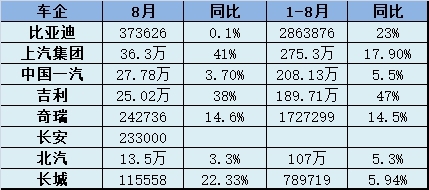
Core Insights - The automotive market in August showed significant growth driven by favorable policies and consumer demand, with domestic brands leading the market while luxury and joint venture brands lagged behind [1] Domestic Brands Performance - BYD achieved sales of 373,626 units in August, a slight increase of 0.1% year-on-year, with cumulative sales of 2,863,876 units for the first eight months, representing a 23% increase [2] - SAIC Group reported sales of 363,700 units in August, up 41% year-on-year, with cumulative sales of 2,753,000 units, a 17.9% increase [2] - Chery exported 129,000 vehicles in August, marking a 32.3% increase year-on-year, and maintained its position as the top exporter of Chinese cars [4] - Geely's new energy vehicle sales reached 147,000 units in August, a remarkable 95% increase year-on-year, making it the second-largest player in the new energy sector after BYD [4] New Energy Vehicle Market - The new energy vehicle segment continues to thrive, with companies like Leap Motor achieving record sales of 57,066 units in August, leading the new force brands [5][6] - Hongmeng Zhixing and Xiaopeng also reported strong sales, with the former selling nearly 50,000 units and the latter launching a new model that boosted sales [6][7] Joint Venture Brands - FAW-Volkswagen sold 135,772 units in August, a 4.2% year-on-year increase, while its Audi brand saw significant sales due to new product launches [8][10] - The joint venture brands are facing challenges from both domestic and new energy brands, with a notable decline in sales for luxury brands like Mercedes-Benz, BMW, and Audi [9][10] Market Outlook - The automotive market is expected to become increasingly competitive as the traditional sales peak season approaches, with ongoing policy support likely to reshape market dynamics [10]
二季度汽车经销商调研报告:超半数品牌返利兑现周期缩至30天内
Jing Ji Guan Cha Wang· 2025-09-02 12:54
Core Insights - The report from the China Automobile Dealers Association indicates significant changes in rebate policies and inventory levels among major automotive brands following a call for manufacturers to optimize rebate policies and shorten payout periods [2][5]. Rebate Payout Periods - Among the 40 major automotive brands surveyed, 25 brands have a fixed rebate payout period of no more than 30 days, while 15 brands have a period of no more than 60 days [2]. - For non-fixed rebates, 18 brands have a payout period of no more than 30 days, and 16 brands have a period of no more than 60 days [2]. - The report highlights a reduction in the number of brands with payout periods exceeding 90 days, with no brands reporting periods over 180 days [3]. Rebate Payout Methods - 12 brands provide rebates in cash or vehicle accounts that can be withdrawn without fees, while 28 brands offer a mix of vehicle accounts and cash, with varying conditions for withdrawal [3][4]. - Some brands impose fees or require manufacturer approval for withdrawals, which can complicate liquidity for dealers [4]. Inventory Levels - Over 53% of dealers report inventory levels exceeding 1.5, with 29.36% indicating levels above 2.0 [5]. - Certain brands, such as Xiaopeng, Xiaomi, and Deep Blue, report low inventory levels due to their sales models, while brands like Changan and Hongqi have higher inventory levels [5][6]. Price Discrepancies - 8 brands report no price discrepancies, while 32 brands experience an average price discrepancy of approximately 16.18% [6]. - Previously, around 80% of models from 42 brands faced price discrepancies exceeding 20% [6]. Overall Industry Impact - The report suggests that while there have been improvements in rebate policies and inventory management, challenges remain, particularly with complex rebate policies and long payout periods that continue to affect dealer operations and the overall health of the automotive industry [6].
汽车行业系列深度十:自主冲击豪华市场,高端定义增量空间
Minsheng Securities· 2025-09-02 12:08
Investment Rating - The report maintains a positive investment recommendation for the mid-to-high-end automotive market, particularly for domestic brands [6]. Core Insights - The domestic automotive market is experiencing a shift from a focus on cost-effectiveness to brand building, especially in the mid-to-high-end segments [1][2]. - The high-end market (above 150,000 RMB) is expected to see significant growth, with domestic brands poised to capture a larger share due to their increasing brand loyalty and product capabilities [2][5]. - The competitive landscape is evolving, with traditional luxury brands facing challenges from emerging domestic players leveraging technology and innovation [3][4]. Summary by Sections 1. Mid-to-High-End Market Profitability - The mid-to-high-end market is characterized by strong profitability and significant growth potential, with domestic brands currently holding less than 50% market share in segments priced above 150,000 RMB [2][5]. - The 5-15 million RMB market is dominated by domestic brands, achieving a market share of 70.6% as of Q2 2025, but is entering a phase of stock competition with limited growth potential [12][16]. - The 15-25 million RMB market shows a growing share for domestic brands, currently at 48.0%, indicating room for further expansion [18][19]. 2. Lessons from Overseas Brands - Traditional luxury brands have established strong brand identities through historical positioning and consistent messaging, which domestic brands can learn from [2][3]. - The ultra-luxury segment emphasizes performance and exclusivity, while traditional luxury brands focus on luxury experiences and brand prestige [3]. 3. Building Brand Barriers for Domestic Brands - Domestic brands are increasingly focusing on building brand barriers through product differentiation and technological advancements, particularly in the luxury segment [4][5]. - The competitive landscape in the 25 million RMB and above market is stabilizing, with leading domestic brands like Li Auto and Huawei establishing a strong presence [4][24]. 4. Challenges and Opportunities in the Luxury Market - The luxury market is witnessing a clear leadership structure, with domestic brands like Li Auto and Xiaomi emerging as strong competitors against traditional luxury brands [4][24]. - The report suggests that the 15-25 million RMB market is fragmented and presents opportunities for traditional and emerging players to establish leadership [15][19]. 5. Investment Recommendations - The report recommends focusing on domestic brands in the mid-to-high-end market, particularly those with strong brand potential and innovative capabilities [5]. - Suggested companies for investment include emerging players like Xiaomi, Li Auto, and traditional brands with high-end sub-brands such as Geely and BYD [5].


