东风股份

Search documents
关口勋:东风日产将在2027年底推出6款全新新能源车型
Bei Ke Cai Jing· 2025-11-13 13:57
Core Viewpoint - Dongfeng Nissan is committed to a "For China, By China, To the World" strategy, focusing on the GLOCAL model and fully investing in the Chinese market while advancing multiple powertrain technologies to meet diverse consumer needs [1][2]. Group 1: Strategic Direction - Dongfeng Nissan is deepening its GLOCAL model and is fully committed to the Chinese market [1]. - The company is advancing three technology routes: pure electric, plug-in hybrid, and range-extended vehicles to cater to various family user needs [1]. Group 2: Product Development - By the end of 2027, Dongfeng Nissan plans to launch six new energy vehicle models [1]. - The N6 model has officially started pre-sales, with three variants priced between 109,900 yuan and 121,900 yuan [2]. - The N6 features a 1.5L plug-in hybrid power system with a pure electric range of 180 kilometers [2]. Group 3: Customer Insights - Over half of the N7 owners are young, with more than 60% choosing the model for its comfort in driving and riding [2]. - Dongfeng Nissan is enhancing its new comfort concept starting with the N7, which will be integrated into future models [2]. Group 4: Technical Specifications - The N6 dimensions are 4831mm in length, 1885mm in width, and 1494mm in height, with a wheelbase of 2815mm [2]. - The N6 is equipped with an AI assistant named "Xiao Ni," which integrates advanced models from iFLYTEK and DeepSeek-R1 for enhanced user experience [2].

氪星晚报 |星巴克工会发起无限期罢工,波及至少40座城市;京东集团:第三季度营收2991亿元,同比增长14.9%;
3 6 Ke· 2025-11-13 13:37
Group 1: Company Developments - JD Technology has received authorization for a patent related to a virtual reality-based contactless humanoid robot and brain-like predictive control method, which enhances efficient humanoid motion control through a console and VR equipment [1] - BYD has begun large-scale application of AMR intelligent logistics robots in its electronic business, aiming to improve production efficiency and strengthen its manufacturing competitiveness [2] - Xiaomi's venture capital arm, Hanting Venture Capital, has invested in RoboParty, a company focused on humanoid robots, indicating a strategic move into the robotics sector [4] - JD Group reported a third-quarter revenue of 299.1 billion yuan, a year-on-year increase of 14.9%, with significant growth in new business revenues [5] - Yongtai Technology has established long-term partnerships with leading companies in the lithium battery materials sector, including CATL and BYD, enhancing its market position [6] Group 2: Labor and Market Dynamics - Starbucks Workers United initiated an indefinite strike affecting at least 65 stores in 40 cities, potentially disrupting the company's holiday sales season due to unresolved collective bargaining agreements [3] Group 3: Financial Updates - Bilibili reported a third-quarter revenue of 7.69 billion yuan, a 5% year-on-year increase, with adjusted net profit rising by 233% [3] - "Andao Pharmaceutical" completed a C-round financing of over 400 million yuan, with funds aimed at accelerating clinical research for its drug candidates [7] Group 4: Product Launches and Innovations - DJI's new Osmo Action 6 camera has surpassed 100,000 pre-orders on JD's platform, indicating strong market interest [8] - Dongfeng Motor is set to mass-produce solid-state batteries by September 2026, which are expected to enable electric vehicles to achieve a range of 1,000 kilometers [9]



万马科技与百度阿波罗智能驾驶达成战略合作 共拓Robotaxi车路云新生态
Quan Jing Wang· 2025-11-13 12:58
Core Insights - Wanma Technology's subsidiary, Youka Technology, has entered into a strategic partnership with Baidu's Apollo Intelligent Driving, marking a significant upgrade from basic service cooperation to a comprehensive global collaboration in the fields of vehicle networking and autonomous driving [1][2][4] Group 1: Strategic Partnership - The partnership aims to enhance the integration of vehicle networking technology and autonomous driving, providing a "Chinese solution" for the global development of the autonomous driving industry and accelerating the commercialization of Robotaxi services [1][2] - Youka Technology will provide Apollo Intelligent Driving with advanced Robotaxi connectivity solutions, including global network coverage, high-precision positioning, AI networking, and intelligent hardware [2][3] Group 2: Market Position and Capabilities - Apollo Intelligent Driving has achieved over 17 million orders on its "Luo Bo Kua Pao" platform, with a stable weekly order volume exceeding 250,000, covering 22 cities globally [2] - Youka Technology has established partnerships with over 10 well-known automotive manufacturers, managing intelligent connectivity for more than 16 million vehicles in the vehicle networking sector [4][5] Group 3: Future Developments - The collaboration will focus on building a Robotaxi operational ecosystem, leveraging Youka Technology's capabilities in connectivity, management, and cloud services, alongside Apollo's autonomous driving platform [3][4] - The partnership is expected to set a benchmark in the industry, promoting the integration of advanced networking technologies with Robotaxi services, thereby expanding market opportunities for both companies [5]

东风汽车:目前已建成0.2GWh固态电池中试线并投入使用,预计350Wh/kg固态电池将于2026年9月正式量产上车!届时整车可实现1000公里续航
Ge Long Hui· 2025-11-13 11:55
格隆汇11月13日|据东风汽车(600006)研发总院消息,11月12日-15日,2025世界动力电池大会在四川宜 宾国际会展中心举行。东风汽车携新一代高比能固态电池和马赫超千伏纯电平台展品,以及多款自主品 牌新能源车型亮相。东风汽车表示,目前已建成0.2GWh固态电池中试线并投入使用,预计350Wh/kg固 态电池将于2026年9月正式量产上车,届时整车可实现1000公里续航。 ...
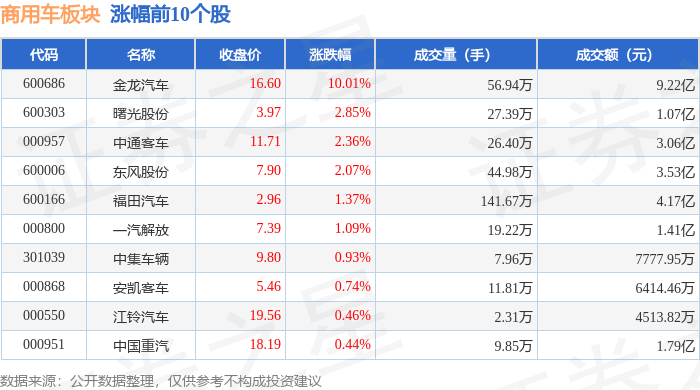
商用车板块11月13日涨0.72%,金龙汽车领涨,主力资金净流入4790.19万元
Zheng Xing Xing Ye Ri Bao· 2025-11-13 08:44
Group 1 - The commercial vehicle sector increased by 0.72% on November 13, with King Long Automobile leading the gains [1] - The Shanghai Composite Index closed at 4029.5, up 0.73%, while the Shenzhen Component Index closed at 13476.52, up 1.78% [1] - The top 10 gainers in the commercial vehicle sector included King Long Automobile, which rose by 10.01% to a closing price of 16.60 [1] Group 2 - The net inflow of main funds in the commercial vehicle sector was 47.90 million yuan, while retail investors saw a net inflow of 13.99 million yuan [1] - The top stocks by trading volume included King Long Automobile with 569,400 shares traded and a transaction value of 9.22 million yuan [1] - The overall trading activity showed a mixed trend with main funds flowing in while speculative funds experienced a net outflow of 61.90 million yuan [1]




固态电池何时“上车”
Jing Ji Wang· 2025-11-13 08:25
Core Insights - Solid-state batteries are reaching a critical stage with significant advancements in technology, production capacity, and commercialization [1][3][6] - The technology utilizes solid electrolytes instead of traditional liquid ones, addressing issues like range and fire hazards, and is considered the "ultimate solution" for power batteries [3][6] Technological Breakthroughs - Recent developments include a high-energy density solid-state battery module from Chery Automobile, achieving 600Wh/kg and a range of 1200-1300 kilometers, with plans for validation by 2027 [3] - A new polymer solid-state battery from Xinwanda boasts an energy density of 400Wh/kg and a cycle life of 1200 weeks under low pressure, demonstrating high safety standards [4] - Research teams have developed an anion regulation technology that enhances the contact between the electrolyte and lithium electrode, crucial for practical solid-state battery applications [5] Production and Commercialization - Dongfeng Motor has successfully mass-produced solid-state batteries and aims for vehicle integration by 2026 [3] - Toyota and Nissan are also advancing their solid-state battery projects, with Toyota targeting 2027-2028 for its first mass-produced model and Nissan achieving double the current battery range with plans for 2028 mass production [4] - BMW and Mercedes-Benz are making strides in solid-state battery testing, with BMW's i7 and Mercedes' Solstice battery showing promising results [4] Market Dynamics - The solid-state battery sector has seen explosive growth, with the index rising from 1552.99 points on May 30 to 2390.20 points by November 4, indicating strong investor interest [6] - The potential for solid-state batteries to exceed 500Wh/kg energy density could lead to electric vehicles achieving over 1000 kilometers of range, surpassing traditional fuel vehicles [6] Cautionary Perspectives - Despite the positive developments, some experts remain cautious about the maturity of solid-state battery technology and the lack of significant actions from leading battery companies [7] - The complexity of commercializing solid-state batteries, including cost and supply chain readiness, suggests that large-scale production may not occur until after 2030 [7]
明年起购置税将减半征收,17家汽车品牌承诺兜底
Di Yi Cai Jing· 2025-11-13 08:07
Core Viewpoint - The end of the full exemption policy for new energy vehicle (NEV) purchase tax in 2025 has triggered a competitive order-seizing battle among car manufacturers, with many offering tax subsidy schemes to lock in consumers before the policy change [2][3]. Group 1: Policy Changes and Impacts - From January 1, 2026, the NEV purchase tax will be halved, with a maximum tax reduction of 15,000 yuan per vehicle [2]. - The current exemption policy allows for a maximum tax exemption of 30,000 yuan for NEVs purchased between January 1, 2024, and December 31, 2025 [2]. - The urgency among consumers to purchase vehicles has increased due to the impending policy changes, influencing their choice of models based on delivery timelines [3]. Group 2: Manufacturer Responses - 17 mainstream automotive brands have introduced purchase tax subsidy schemes to cover the tax difference for consumers whose vehicles are delivered after the policy change [2][3]. - The subsidy schemes include various forms such as tax difference vouchers, cash reductions on final payments, and direct cash subsidies, with a maximum subsidy of 15,000 yuan [3]. - The competition among manufacturers is expected to intensify as they aim to capture market share amid the changing tax policies [4]. Group 3: Market Trends and Performance - In October, NEV production and sales reached 1.772 million and 1.715 million units, respectively, both showing over 20% year-on-year growth, with a market penetration rate surpassing 50% [3]. - The cumulative production and sales of NEVs in the first ten months of the year exceeded 13 million units, marking a year-on-year increase of approximately 33% [3]. - The automotive market continues to show strong growth, with new models being launched and production rates maintained to meet demand [4]. Group 4: Future Outlook - The technical threshold for NEV purchase tax exemptions will increase starting in 2026, as plug-in hybrid vehicles with an electric range of less than 100 kilometers will no longer qualify for tax reductions [4]. - This change is expected to lead to a clearer market differentiation, with companies possessing core technological competitiveness likely to gain a larger market share [4].





明年起购置税将减半征收,17家汽车品牌承诺兜底
第一财经· 2025-11-13 07:49
Core Viewpoint - The article discusses the impending end of the full exemption from purchase tax for new energy vehicles (NEVs) in China, leading to a competitive order-seizing battle among car manufacturers as they introduce tax subsidy plans to attract consumers before the policy changes take effect [3][4]. Group 1: Policy Changes and Impacts - Starting January 1, 2026, the purchase tax for NEVs will be halved, with a maximum tax reduction of 15,000 yuan per vehicle [3]. - From January 1, 2024, to December 31, 2025, NEVs will continue to be exempt from purchase tax, with a maximum exemption of 30,000 yuan per vehicle [3][4]. - The adjustment in tax policy has intensified consumer urgency to purchase vehicles, influencing their choice of models based on delivery timelines [4]. Group 2: Manufacturer Responses - 17 major automotive brands, including Li Auto, NIO, and BYD, have introduced purchase tax subsidy plans to cover the tax difference for consumers whose vehicles are delivered after the policy change [3][4]. - The subsidy methods include tax difference vouchers, cash reductions on final payments, and direct cash subsidies, with a maximum subsidy of 15,000 yuan [4]. - The competition among manufacturers is expected to increase as they strive to maintain market share amid changing tax incentives [5]. Group 3: Market Trends and Performance - In October, NEV production and sales reached 1.772 million and 1.715 million units, respectively, with year-on-year growth exceeding 20% and a market penetration rate surpassing 50% [4][5]. - Cumulative NEV production and sales for the first ten months of the year exceeded 13 million units, reflecting a year-on-year growth of approximately 33% [4]. - The market is witnessing a shift as consumers, influenced by the availability of popular models, are increasingly opting for less popular models, contributing to sustained sales growth [4].

一体化压铸的成本困局
Zhong Guo Qi Che Bao Wang· 2025-11-13 07:46
Core Insights - The integration of die-casting technology in the automotive industry has been promoted as a cost-reduction tool, significantly reducing the number of parts and manufacturing costs by up to 40% per vehicle [2][7] - However, the average qualification rate for integrated die-cast parts is only 65% to 80%, compared to over 98% for traditional stamped parts, leading to a higher number of defective products [2][3] - The hidden costs associated with lower qualification rates and higher maintenance expenses pose significant challenges for the widespread adoption of this technology [7][8] Qualification Rate Concerns - The qualification rate for integrated die-casting is notably low, with some companies reporting rates as low as 30% to 40% during trial production, which can rise to around 90% in mass production [3][6] - Low qualification rates can lead to increased production costs and may indicate that quality inspection standards are being relaxed, potentially masking deeper quality issues [3][6] - Quality defects in die-cast parts are often subtle and may not be detected until long-term use, resulting in structural performance degradation [3][4] Technical Challenges - The shift from traditional multi-part structures to integrated die-cast components presents unprecedented challenges in materials science, mold engineering, and process control [4][5] - Material properties, particularly the flow characteristics and solidification behavior of aluminum alloys, are critical to achieving high qualification rates [4][5] - The complexity of the die-casting process, including temperature control and mold precision, significantly impacts the quality and consistency of the final products [5][6] Cost Implications - The initial investment for integrated die-casting lines is three times higher than traditional stamping lines, with costs for large die-casting machines exceeding 50 million yuan [7][8] - Despite potential weight reductions of 16% to 30%, the losses from low qualification rates can negate these advantages, leading to a poor return on investment [7][8] - Maintenance costs for integrated die-cast components are significantly higher, as damage often requires complete part replacement rather than simple repairs [8][9] Industry Response - Companies are encouraged to invest in research and development to improve material science, mold design, and process control to enhance qualification rates [9] - Establishing comprehensive lifecycle cost assessment models is essential for evaluating the true economic impact of integrated die-casting technology [9] - The evolution of integrated die-casting reflects a broader industry shift from prioritizing scale to balancing quality and cost, necessitating collaborative efforts to address these challenges [9]

福田5.6万领跑!重汽/解放涨超五成 江淮连跳 10月商用车销36万辆 | 头条
第一商用车网· 2025-11-13 07:44
Core Viewpoint - The commercial vehicle market in China has shown a fluctuating trend in 2025, with a notable increase in sales during the latter part of the year, achieving a cumulative sales volume of over 3 million units by September, reflecting a net increase of over 220,000 units compared to the previous year [1]. Sales Performance - In October 2025, the commercial vehicle market sold 360,700 units, representing a month-on-month decrease of 2% but a year-on-year increase of 21%. The growth rate compared to the previous month narrowed by 9 percentage points [4][5]. - The cumulative sales from January to October 2025 reached 3,478,700 units, marking a year-on-year growth of 9%, with an increase of nearly 290,000 units compared to the same period last year [9][17]. Market Share and Rankings - In October 2025, the top ten companies in the commercial vehicle market accounted for a combined market share of 76.19%, with the top five companies exceeding 50% [15]. - Foton led the sales with 56,100 units, followed by China National Heavy Duty Truck with 38,500 units, and Changan with 33,300 units [11][13]. Competitive Landscape - The competitive landscape remains intense, with small differences in market share among neighboring companies. For instance, the market share difference between Jianghuai and Jiangling was only 0.06% [25]. - The rankings of the top ten companies remained stable, with Jianghuai moving up three positions to seventh place [16]. Cumulative Sales by Company - Foton's cumulative sales exceeded 500,000 units, reaching 530,800 units, while China National Heavy Duty Truck, Dongfeng, and Changan all surpassed 300,000 units [19][23]. - The growth rates of major companies varied, with China National Heavy Duty Truck, Shaanxi Automobile, and SAIC Maxus showing significant increases of 25%, 20%, and 28% respectively [19].