
同花顺

Search documents
政策风险与不确定性加速推进软件国产化进程,软件ETF(159852)盘中涨近1%
Sou Hu Cai Jing· 2025-10-21 05:47
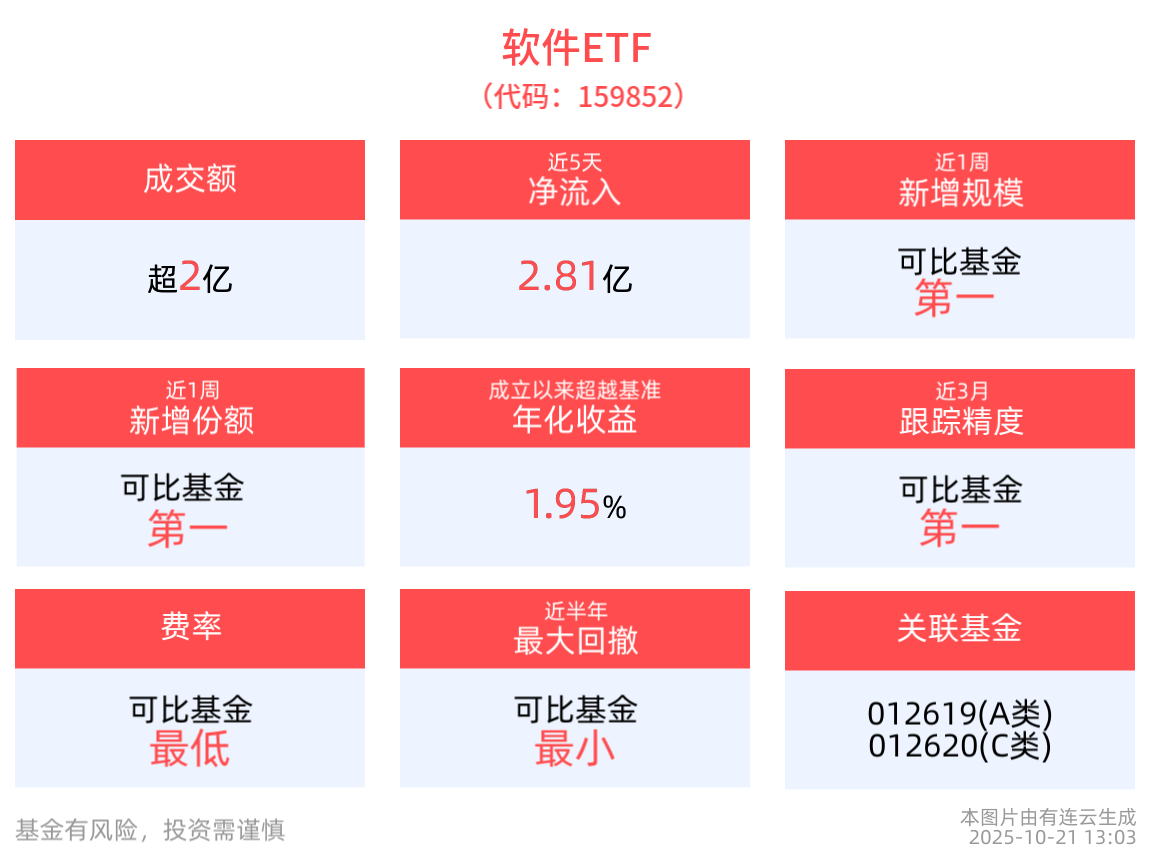
Group 1: Software ETF Performance - The software ETF experienced a turnover of 4.63% during trading, with a transaction volume of 267 million yuan [3] - Over the past week, the software ETF's scale increased by 77.65 million yuan, ranking first among comparable funds [3] - The software ETF's share increased by 266 million shares in the past week, also ranking first among comparable funds [3] - The latest net inflow of funds into the software ETF was 60.54 million yuan, with a total of 281 million yuan net inflow over four out of the last five trading days [3] - As of October 20, the software ETF's net value has risen by 14.41% over the past three years [3] - The highest monthly return since inception was 39.35%, with the longest consecutive monthly increase being three months and a maximum increase of 69.40% [3] - The average return during the months of increase was 10.06% [3] Group 2: Industry Insights and Opportunities - The current external environment has increased policy risks and uncertainties, highlighting the urgency for China's technological self-reliance, which may accelerate the domestic substitution process [4] - From January to August 2025, China's software business revenue grew by 12.6%, indicating steady industry growth [4] - Policy initiatives are pushing for the establishment of a unified AI model service platform in the government sector, promoting resource consolidation [4] - In the domestic innovation sector, focus is recommended on competitive segments such as basic hardware, basic software (databases, operating systems, middleware), and application software [4] - In the industrial software sector, attention should be directed towards core areas such as product design, production control, and business management, including EDA, CAD, CAE, and CAM [4] - Investors can consider the software ETF linked fund (012620) to capitalize on AI software investment opportunities [4]







A股上市公司纷纷实物回馈股东 创新互动模式激活资本市场生态
Zheng Quan Shi Bao Wang· 2025-10-21 03:50
Core Insights - The article highlights the increasing trend of A-share listed companies in China engaging in physical rewards for shareholders, enhancing investor relations and creating a unique investment-consumption ecosystem [1][4]. Group 1: Company Activities - Over 30 listed companies have participated in shareholder reward activities since 2025, offering products, discount coupons, and tourism rights to investors [1][4]. - Companies like Tianyu Bio, Huasheng Co., and Beiqing Song have announced various forms of physical rewards, aiming to deepen shareholder experience with core products and strengthen their value recognition [2][3]. - The second "Listed Company Shareholder Festival" organized by Tonghuashun attracted nearly 100 companies, providing a wide range of gifts including electronics, food, and cosmetics to shareholders [3]. Group 2: Policy and Market Trends - The trend of physical rewards aligns with the China Securities Regulatory Commission's policy to enhance investor protection and improve returns for shareholders [4]. - The increasing participation of companies in physical reward activities indicates a shift from individual cases to a systematic approach in investor relations management [4]. - The practice of physical rewards is expected to become a significant indicator of corporate governance and market competitiveness in the future [4].





证券APP月活创新高,金融科技ETF(516860)盘中拉升涨超1%
Xin Lang Cai Jing· 2025-10-21 02:58
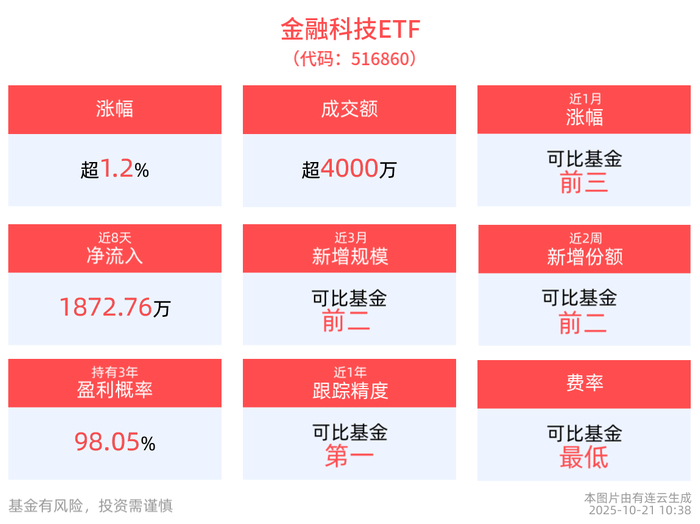
Group 1 - The core viewpoint of the news highlights the strong performance of the financial technology sector, with the China Securities Financial Technology Theme Index rising by 1.08% and notable increases in constituent stocks such as Tax Friend Co., Ltd. and Silver Jie's shares [2] - The Financial Technology ETF (516860) has seen a price increase of 1.23%, currently priced at 1.49 yuan, and has accumulated a 1.24% increase over the past three months, ranking 3rd out of 6 comparable funds [2] - In terms of liquidity, the Financial Technology ETF recorded a turnover rate of 1.77% with a transaction volume of 42.396 million yuan, and the average daily transaction volume over the past month was 221 million yuan, placing it in the top 2 among comparable funds [2] Group 2 - The monthly active users of securities-related apps reached 174 million in September, reflecting a month-on-month growth of 0.74% and a year-on-year increase of 9.73%, setting a new record for the year [2] - The market for brokerage self-operated apps is showing a solid head structure among leading firms, while smaller brokerages are experiencing significant growth disparities, shifting the competitive focus from acquiring new users to enhancing user retention and achieving full-scenario intelligent transformation [2] - The Financial Technology ETF has seen a significant growth of 10.43 billion yuan in scale over the past three months, ranking 2nd out of 6 comparable funds [3] Group 3 - The Financial Technology ETF has experienced a notable increase of 11 million shares over the past two weeks, ranking 2nd out of 6 comparable funds in terms of new share growth [5] - The latest net outflow of funds from the Financial Technology ETF was 20.6148 million yuan, but over the past eight trading days, it has attracted a total of 18.7276 million yuan [5] - The China Securities Financial Technology Theme Index closely tracks the performance of listed companies involved in financial technology, with the top ten weighted stocks accounting for 55.55% of the index [5]
9月证券服务类App月活再度刷新年内纪录
Shang Hai Zheng Quan Bao· 2025-10-20 23:25
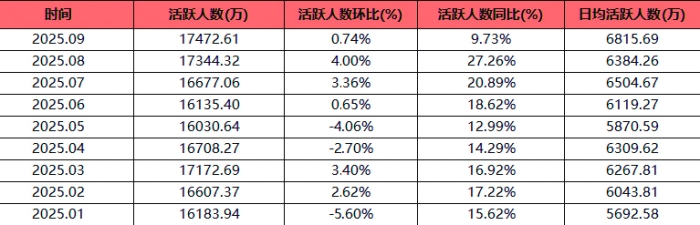
Core Insights - The user base of securities service apps continues to grow, driven by the active A-share market and a significant increase in new account openings [1][2] User Growth and Market Activity - In September, the monthly active users of securities service apps reached 174 million, marking a year-on-year increase of 9.73% and a month-on-month increase of 0.74%, setting a new record for the year [2] - The number of new A-share accounts opened in September was 2.9372 million, representing a year-on-year growth of 60.73% and a month-on-month increase of 10.83%, achieving the fourth consecutive month of growth [2] App Performance and Rankings - The top tier of securities service apps remains stable, with 11 apps exceeding 6 million monthly active users. Huatai Securities' "Zhangle Caifutong" app leads with 11.9517 million users, followed by Guotai Junan's app with 10.2922 million users [2] - 20 brokerage apps saw a year-on-year increase in monthly active users exceeding 10%, with notable performances from smaller brokerages like Industrial Securities' "Yuli Bao," which grew by 35.95% [3] Market Dynamics and User Engagement - The active user growth among different securities service apps showed divergence in September, influenced by the overall market's high volatility and trading volume [3] - The concentration in the third-party app market remains significant, with Tonghuashun, Dongfang Caifu, and Dazhihui leading the pack, each maintaining millions of active users [3] Technological Integration - The securities industry is embracing technological transformation, with many brokerage apps undergoing functional iterations and integrating AI as a core strategy [6] - Several brokerages have launched AI-driven apps to enhance user experience, although there is still room for improvement in terms of practical application and personalization [6] Strategies for Improvement - Industry experts suggest that brokerages can enhance app engagement by deepening AI applications, shifting focus from short-term promotions to long-term customer value, and integrating online and offline services [7]

1.75亿人 9月证券服务类App月活用户创年内新高
Shang Hai Zheng Quan Bao· 2025-10-20 18:13
Core Insights - The number of monthly active users for securities service apps reached a record high of 175 million in September, driven by a vibrant A-share market and a significant increase in new account openings [1][2] - The A-share market continued to show positive momentum, with new account openings in September reaching 2.9372 million, a year-on-year increase of 60.73% [2][3] - The top-tier apps maintained a stable ranking, with 11 brokerage apps exceeding 6 million monthly active users, led by Huatai Securities' "Zhangle Caifutong" app [2][3] User Growth and Market Dynamics - The monthly active user count for securities service apps increased by 0.74% month-on-month and 9.73% year-on-year in September, marking a new monthly record for the year [1][2] - The user growth was supported by a surge in new account openings, which have seen continuous month-on-month growth for four consecutive months [2][3] - There is a notable disparity in user growth among different apps, with some smaller brokerage apps showing significant year-on-year increases, such as Industrial Securities' "Yuli Bao" app, which grew by 35.95% [3] Competitive Landscape - The industry remains concentrated, with Tonghuashun, Dongfang Caifu, and Dazhihui leading the market, each maintaining millions of monthly active users [3][4] - The top-tier apps are characterized by a clear user scale gap, with Tonghuashun leading at 37.21 million monthly active users, reflecting an 8.78% year-on-year growth [3][4] Technological Integration - The securities industry is increasingly adopting AI technologies, with many brokerage apps undergoing functional iterations to enhance user experience [5][6] - Several brokerages have launched AI-driven apps to improve investment advisory services, indicating a shift towards intelligent and personalized financial services [5][6] - User feedback suggests that while some AI features are beneficial, there is still room for improvement in terms of practical application and personalization [6]
45家A股公司发布三季度分红预案
Zheng Quan Ri Bao· 2025-10-20 16:43
Group 1 - A total of 45 A-share listed companies have announced dividend plans for the third quarter as of October 20, indicating a trend towards cash dividends that align with net profit or a certain percentage of it [1] - Among the announced plans, 5 companies are in the "board proposal" stage, while the remaining 40 are in the "shareholder meeting proposal" stage [1] - The majority of companies cite "returning value to investors and establishing a long-term investment philosophy among shareholders" as the reason for their proposals [1] Group 2 - The dividend plans are closely matched with the companies' operational conditions, as seen in the case of Wujin Zhongrui Electronics, which proposed a cash dividend of 1.35 yuan per 10 shares, considering its development stage, profitability, cash flow, and future capital needs [2] - A-share non-financial companies have maintained a net profit growth rate of around 8% and an 11% year-on-year increase in operating cash flow for the first three quarters, providing a solid foundation for quarterly dividends [2] Group 3 - Long-term, establishing a clear dividend guideline mechanism is crucial for enhancing investor confidence and attracting long-term capital, which can lead to an increase in market value [3] - Recommendations include incorporating dividend rules into company charters, linking dividend ratios to performance growth, and potentially increasing the frequency of dividends from once a year to multiple times a year [3] - A suggested approach is to distribute dividends in smaller amounts throughout the year, such as 30% and 20% of the annual dividend during the mid-year and third-quarter reports, respectively, to reduce the impact of one-time payouts and provide consistent cash flow to long-term investors [3]
国产AI大模型龙头股,第三季度净利润大增
Zhong Guo Zheng Quan Bao· 2025-10-20 12:17
Core Viewpoint - The company reported a strong performance in Q3 2025, with significant growth in revenue and net profit, indicating a positive operational trend despite previous losses in the first three quarters of the year [1][2]. Financial Performance - In Q3 2025, the company's revenue reached 6.078 billion yuan, a year-on-year increase of 10.02% - The net profit attributable to shareholders was 172 million yuan, up 202.40% year-on-year - The net profit after deducting non-recurring items was 26.24 million yuan, reflecting a 76.50% increase year-on-year - For the first three quarters, total revenue was 16.989 billion yuan, a 14.41% increase year-on-year, while the net profit attributable to shareholders was a loss of 666.75 million yuan [1]. Market Position and Developments - The company maintained a healthy operational development, with all core operational indicators, including revenue, net profit, and operating cash flow, showing positive growth [2]. - The operating cash flow net amount was 899.5 million yuan, a year-on-year increase of 25.19% - The company’s AI core technology research and model training system has been further validated, enhancing its position in the artificial intelligence industry [2]. Project and Investment Updates - In the first nine months of the year, the company ranked first in the bidding market for large models, with a project winning amount of 545 million yuan in Q3, nearly double that of the second to fifth ranked competitors combined [3]. - The number of developers in the "Xunfei Spark" ecosystem grew rapidly, with over 1.22 million new developers added, including 690,000 new large model developers [3]. - The company announced a revised fundraising plan for its 2025 private placement, now including a new "computing power platform" project with an investment of 2.4 billion yuan, while maintaining the total fundraising amount at 4 billion yuan [4]. Shareholder Activity - In Q3, five shareholders adjusted their holdings, with increases from Hong Kong Central Clearing Limited and Industrial Bank Co., Ltd., while several funds reduced their holdings [3][4]. Future Strategy - The company plans to implement the computing power platform project through a computing power leasing model, which will expand its computing capacity and support large model research and algorithm innovation [5]. - This approach aims to provide sufficient computing power for the application of the "Xunfei Spark" large model in various industries, ensuring continuous upgrades and iterations [5].

四季度布局主线何在?创业板50ETF(159949)成交额居同类首位 近20日吸金17亿元
Xin Lang Ji Jin· 2025-10-20 09:30
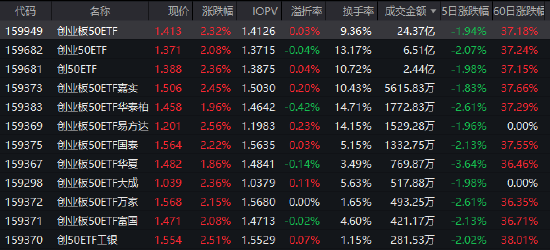
Core Points - The three major indices collectively rose, with the ChiNext Index increasing by nearly 2% on October 20, 2025, driven by market sentiment [1] - The ChiNext 50 ETF (159949) closed at 1.413 yuan, up 2.32%, with a turnover rate of 9.36% and a trading volume of 2.437 billion yuan, making it the top performer among similar ETFs [1][2] Fund Performance - The ChiNext 50 ETF (159949) has shown a mixed performance in terms of fund flows: a net outflow of 1.03 billion yuan over the last 5 trading days, a net inflow of 480 million yuan over the last 10 days, and a net inflow of 1.69 billion yuan over the last 20 days, while experiencing a net outflow of 6.93 billion yuan over the last 60 days [3] - The fund has consistently outperformed its benchmark over various time frames, with a 5-year return of 25.32%, a 3-year return of 29.82%, and a 1-year return of 52.38% [3] Top Holdings - The top ten holdings of the ChiNext 50 ETF include companies like CATL, Dongfang Fortune, and Mindray, with significant weightings in the fund [4][5] Market Outlook - According to Shenwan Hongyuan, the overall profitability of A-shares has returned to a medium-low level, indicating that adjustments are nearing an end, with expectations for the technology sector to lead the market upward in the fourth quarter [6] - Investment strategies suggest focusing on sectors with offensive attributes, particularly in advanced manufacturing areas like overseas computing power chains and new energy [7]






港股、海外周观察:多事之秋,反弹不畅
Soochow Securities· 2025-10-20 09:23
Group 1 - The report indicates that recent events suggest short-term volatility in the Hong Kong stock market may not have ended, but the long-term upward trend remains unchanged [1] - Economic data, US-China tariff news, US tech earnings, and the Fourth Plenary Session are expected to influence trading patterns and styles in the Hong Kong market [1][2] - The technology sector is facing increased volatility risks, with US tech earnings impacting the trading rhythm of Chinese tech stocks [1][2] Group 2 - The report highlights that the US stock market showed resilience despite concerns over US-China tensions and credit worries, with the Nasdaq leading gains at 2.1% [1][4] - Federal Reserve Chairman Powell's dovish stance suggests a likelihood of maintaining the current policy path, with a potential rate cut in October being the optimal solution [1][5] - The report notes that the average win rate for October over the past decade is low, while the advantages of November and December are relatively prominent [1][23] Group 3 - The report discusses the ongoing US government shutdown, which has entered its third week, potentially exacerbating negative impacts on the economy [3] - Concerns over credit quality in regional banks have emerged, but these are viewed as isolated incidents rather than indicative of a broader liquidity crisis [2][3] - The report emphasizes the importance of monitoring US-China trade relations, as further escalation could negatively impact the US economy and inflation risks [3][4] Group 4 - The report notes that developed markets saw an increase of 1.4% while emerging markets declined by 0.3% during the week [4][12] - The Hang Seng Tech Index fell by 8.0%, and the Hang Seng Index dropped by 4.0%, with public utilities leading sector gains [4][12] - The report highlights significant inflows into financials and non-essential consumer sectors, while the information technology sector experienced outflows [4][12] Group 5 - The report indicates that global stock ETFs saw a net inflow of $446.43 billion, with the US stock ETFs leading at $231.7 billion [7][49] - The technology sector was the top recipient of inflows among global stock ETFs, while the communication sector experienced the most significant outflows [7][51] - The report also notes that institutional investors marginally increased their holdings in gold, with significant inflows into major gold ETFs [6][54]


湘财基金研究部总经理离职
Shen Zhen Shang Bao· 2025-10-20 07:09
Core Insights - The resignation of Xu Yida, the head of the research department at Xiangcai Fund, has led to a complete withdrawal from all managed funds, attributed to "resignation" [1] - Xu Yida's performance has been subpar, with half of the funds he managed showing negative returns [1][2] - The overall management structure of Xiangcai Fund is currently weak, with only six fund managers, significantly below the industry average [2] Performance Analysis - Xu Yida managed several funds with poor historical performance, including a nearly -22% return over four years for Xiangcai Changshun Mixed Fund A [1] - The Xiangcai Balanced Selection Mixed Fund A has underperformed this year, with a return of approximately -3%, lagging behind the benchmark by 14 percentage points [3] - Other funds managed by the investment team have also shown significant declines, with the Xiangcai Innovation Growth Fund A experiencing a net value drop of over 31% since inception [3] Management Structure - Following Xu Yida's departure, Xiangcai Fund has only six fund managers, with an average tenure of just over two years, which is below the industry average [2] - The fund's total asset management scale is relatively low, with only 71.35 billion yuan across 19 products, ranking 145th among over 200 institutions [2] - The current fund managers, including the deputy general manager and chief strategist, have also reported negative returns compared to their peers, indicating a broader issue within the fund's management team [4]