华夏基金

Search documents
抢占“耳朵阵地”!基金公司集体布局播客
Sou Hu Cai Jing· 2026-02-22 13:30
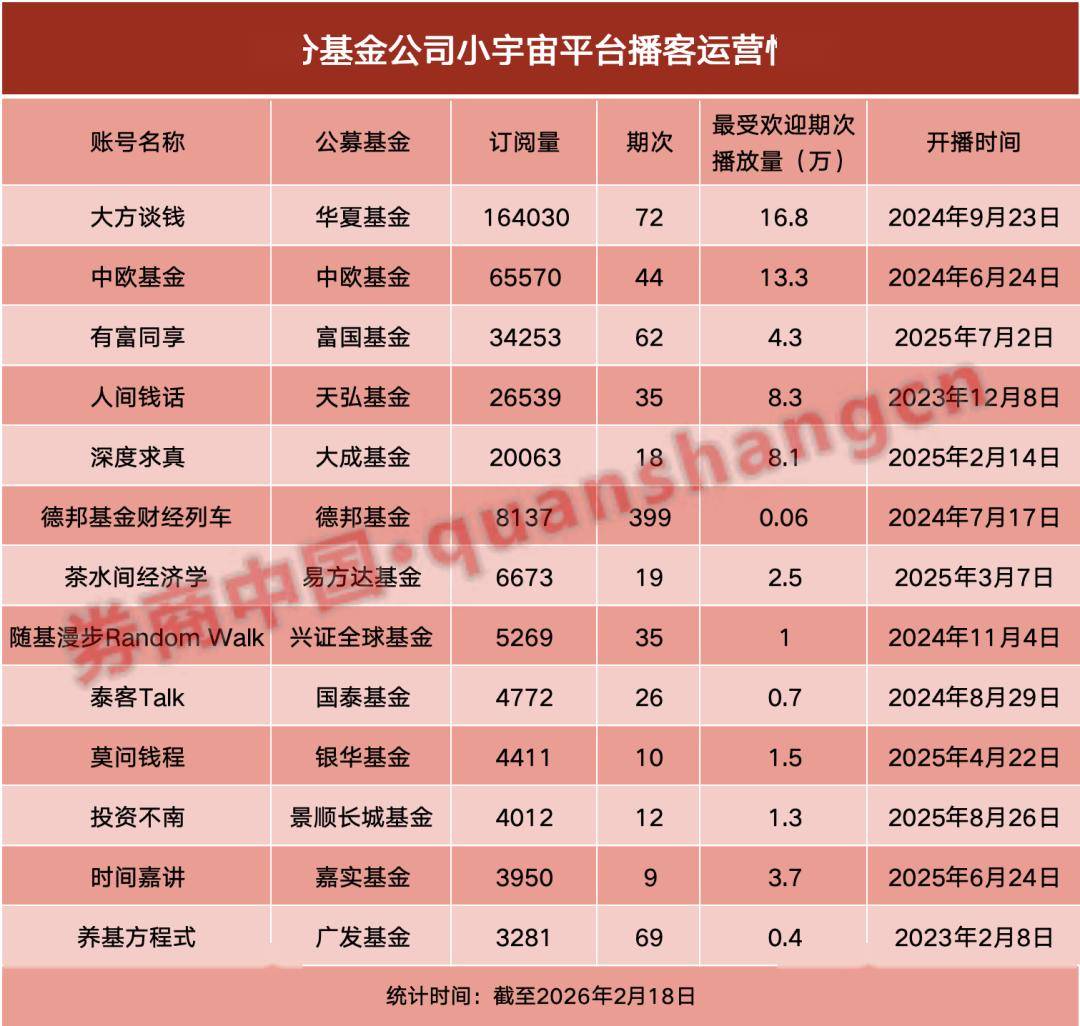
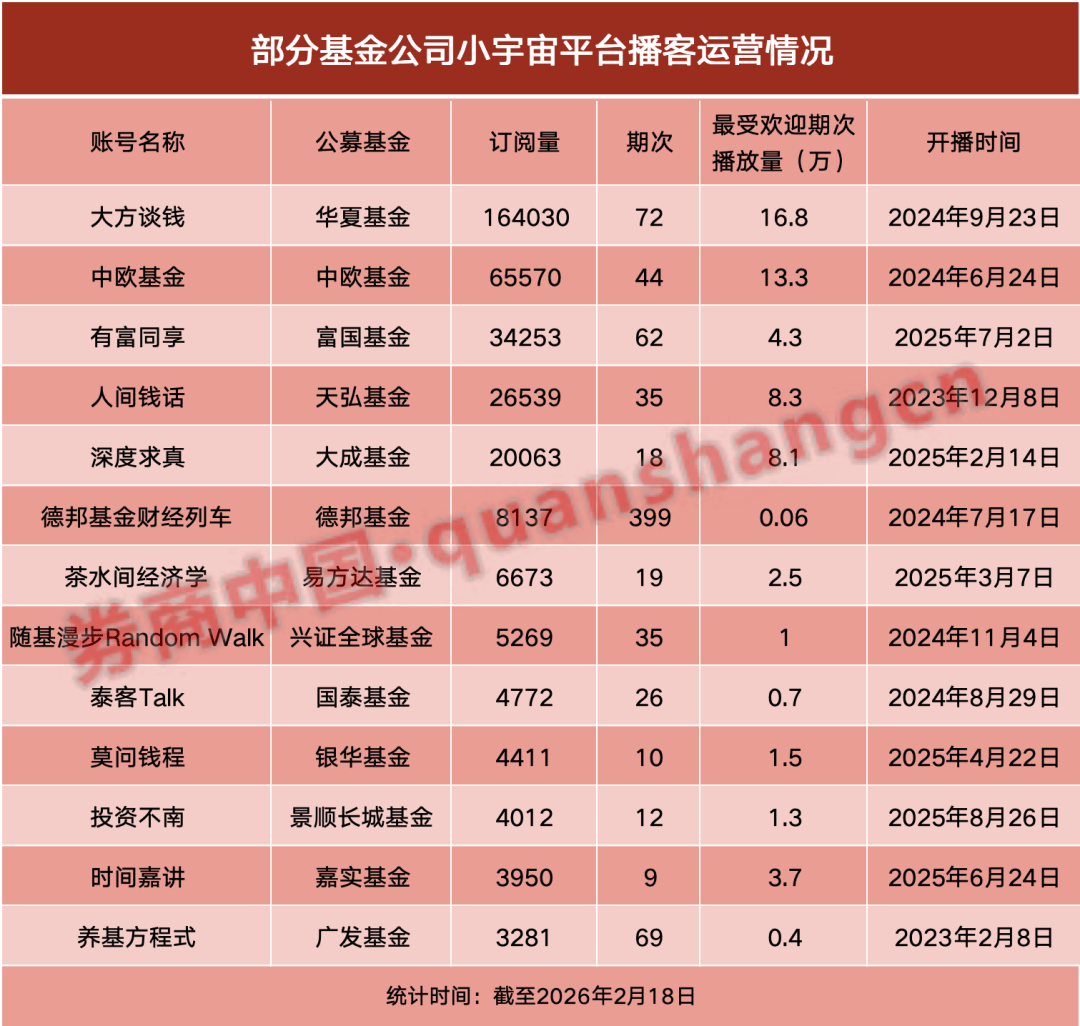
从"尝鲜"到"常态",基金公司集体布局播客,抢占投资者"耳朵阵地"。 2025年以来,多家基金公司相继布局播客——富国基金、大成基金、银华基金、景顺长城基金、嘉实基金、汇添富基金、财通基金等公募密集推出播客栏 目;与此同时,更早入局的华夏基金、中欧基金、天弘基金等机构则保持着常态化更新,华夏基金《大方谈钱》在春节期间仍推出特别节目。从新玩家的 密集入场,到老玩家的稳定运营,播客正在从基金公司的"试水之作"沉淀为投资者服务的常规配置。 春节期间持续"上新" 从更新频率看,部分头部账号已形成稳定运营节奏。华夏基金《大方谈钱》自2024年9月开播以来保持高频更新,春节期间仍推出《新春疗愈:爱自己才 是一切的答案》特别节目。 与此同时,行业分化同样明显,部分早期入局账号已出现断更或仅做内容同步,播客运营的持续性考验基金公司的内容生产能力。 国泰基金旗下《泰客Talk》推出后,收获了大批高认知年轻听众,评论区互动积极。"音频形式能让嘉宾更真实、立体地展现自己,与听众产生真实的情 感交互。"国泰基金认为,这种"去距离感"的呈现,让投资者感受到基金经理作为"人"的真实一面,包括其思考逻辑、市场态度和行业判断。 大成基金20 ...

华夏基金总经理李一梅:踏春山,驭长风,以专业坚守赴时代之约
Sou Hu Cai Jing· 2026-02-21 10:56
岁序常易,华章日新。当时光的车轮驶入丙午马年,神州大地春意盎然,万象更新。 值此辞旧迎新的美好时刻,谨代表华夏基金全体员工,向广大投资者、合作伙伴,以及长期以来关心支持华夏基金发展的各界朋友们,致以最诚挚的节日 问候!恭祝大家在新的一年里龙马精神、阖家幸福、投资顺遂、万事胜意! 这份信心,也来自行业生态的持续优化与制度红利。在全面深化改革推动下,居民财富加速向金融资产转移。公募基金作为普惠金融的重要载体,其透 明、专业、规范的优势更加凸显。监管引导行业回归本源,推动从"规模竞赛"迈向"价值创造",为行业打开更广阔的发展空间。 作为行业的亲历者与建设者,华夏基金始终与行业同呼吸、共成长。我们见证了权益投资的波澜壮阔,也亲历了固定收益的稳健致远;我们拥抱指数化投 资的普惠浪潮,也积极探索海外配置的全球化视野。我们持续完善"指数研究+服务+策略"的体系,权益类ETF管理规模稳步前行,不仅为投资者提供了布 局中国核心资产的便捷工具,更在科技、红利、港股等赛道上努力成为大家值得信赖的"长跑伙伴"。 华夏基金深知,信任是资产管理行业最宝贵的资产。我们的每一份成绩单,离不开中国经济高质量发展的时代沃土,更离不开持有人的坚定 ...

华夏基金总经理李一梅:踏春山,驭长风,以专业坚守赴时代之约!
Zhong Guo Ji Jin Bao· 2026-02-21 06:42
(原标题:华夏基金总经理李一梅:踏春山,驭长风,以专业坚守赴时代之约!) 岁序常易,华章日新。当时光的车轮驶入丙午马年,神州大地春意盎然,万象更新。值此辞旧迎新的美 好时刻,我谨代表华夏基金全体员工,向广大投资者、合作伙伴、以及长期以来关心支持华夏基金发展 的各界朋友们,致以最诚挚的节日问候!恭祝大家在新的一年里龙马精神、阖家幸福、投资顺遂、万事 胜意! 旧岁已展千重锦。刚刚过去的2025年是中国经济的"韧性与突破"之年,也是公募基金行业在高质量发展 道路上笃定前行的关键一年。作为"十四五"规划的收官之年,2025年中国经济在复杂多变的内外部环境 中展现出强大韧性,顶压克难,于难中求成、在逆中突破、更在变中求进,向新向优发展。新质生产力 在神州大地上加速涌动,从高端装备到人工智能,从千兆光网到算力中心,从量子科技到低空经济,创 新驱动的正反馈机制持续增强,各领域纷纷抢滩经济发展新赛道。中国经济正以前所未有的态势向高质 量发展迈进,为资本市场提供了最坚实的底层资产支撑。 公募基金行业同样在变革中彰显韧性,在创新中积蓄力量,迈入更好服务实体经济与国家战略,以高质 量发展为主线,以投资者利益为核心的新阶段。2025 ...
2026公募投资展望:这些方向被看好 新一轮布局已然展开
Zhong Guo Zheng Quan Bao· 2026-02-20 03:08
Group 1 - A-shares are presenting structural opportunities at the beginning of 2026, with public funds initiating a new round of investment amidst economic recovery and accelerated industrial upgrades [1][7] - Major institutions believe that sectors such as artificial intelligence, semiconductors, and consumption have structural opportunities [1][7] Group 2 - There is an expectation of significant inflow of incremental funds into A-shares in 2026, supported by manufacturing investment and capital expenditure adjustments [2][8] - The domestic demand side, driven by fiscal policies, particularly the structural changes in special bonds, will influence A-share pricing [2][8] - The current environment is characterized by expanding liquidity and increased risk appetite, with a focus on fiscal and monetary policies [2][8] Group 3 - The AI sector is a focal point for public fund strategies, with expectations for continued strong performance in the AI industry chain in the first half of 2026 [4][10] - Significant advancements in AI models, such as Google Gemini 3 and Banana, are expected to boost market confidence and drive demand for AI computing power [4][10] - The semiconductor industry is rapidly evolving, driven by AI large models, with a focus on domestic production and R&D [5][11] Group 4 - The consumption sector is anticipated to see a resurgence in investment opportunities in 2026, driven by the release of wealth effects and an upgrade in high-end and service consumption demand [5][11] - The cyclical industry narrative is expected to undergo a transformation in 2026, influenced by policy-driven "anti-involution" and the reshaping of global supply chains [5][12]
2026公募投资展望:这些方向被看好
Zhong Guo Zheng Quan Bao· 2026-02-19 10:53
Group 1 - A-shares are presenting structural opportunities amidst fluctuations, with public funds initiating a new round of investments in sectors like artificial intelligence, semiconductors, and consumption due to moderate economic recovery and accelerated industrial upgrades [1] - The manufacturing investment and A-share capital expenditure contraction are driving supply-demand rebalancing, providing support for corporate profits, while fiscal changes in special bonds will impact A-share pricing [2] - The market is expected to continue attracting significant incremental capital inflows in 2026, with major contributions from insurance funds and financing, while individual investors are primarily high-net-worth individuals with high-risk preferences [2] Group 2 - The AI sector is a focal point for public fund strategies, with expectations for continued strong performance in the AI industry chain in the first half of 2026, driven by breakthroughs in AI model capabilities and significant growth in annual recurring revenue from AI-native applications [4] - The semiconductor industry is experiencing rapid changes driven by AI large models, with a focus on domestic production and R&D, while non-AI semiconductor sectors may face pressure [5] - The consumption sector is anticipated to see a resurgence in investment opportunities in 2026, driven by the release of wealth effects and an upgrade in high-end and service consumption demands [5]
抢占“耳朵阵地”,基金公司集体布局播客!
Sou Hu Cai Jing· 2026-02-18 23:58
Core Insights - The podcasting trend among fund companies is shifting from experimentation to a regular service offering for investors, with multiple firms launching and maintaining podcast programs to engage with their audience [1][3]. Group 1: Industry Trends - Since 2025, several fund companies, including 富国基金, 大成基金, and 银华基金, have launched podcast programs, indicating a collective move towards this medium [1]. - The Chinese podcast market is experiencing rapid growth, with an estimated audience of over 150 million listeners by 2025, and the 小宇宙 platform adding 64,000 new podcast programs and nearly 700,000 episodes [2]. Group 2: Content and Engagement - The unique nature of financial content drives demand, as it directly relates to personal finances, and the need for investor engagement is heightened by external market volatility [3]. - Podcasts provide a more relatable and immersive experience compared to traditional educational methods, allowing for deeper discussions on financial topics and fostering a sense of companionship for listeners [3][4]. Group 3: Operational Challenges - Despite the increasing popularity of fund podcasts, challenges persist in maintaining high-quality content, requiring significant investment in production and ongoing engagement strategies [5]. - The operational demands of podcasting are comparable to running a small content organization, necessitating expertise in both information delivery and emotional resonance with the audience [5]. Group 4: Future Outlook - Many public funds believe that podcasts will play a crucial role in transitioning from a sales-oriented approach to a customer-centric model, emphasizing the importance of new media in the competitive landscape of fund management [5].
博时基金董事长张东:策马扬鞭 春启新程
Zhong Guo Ji Jin Bao· 2026-02-17 06:48
Group 1: Macro Economic Outlook - The global economic environment is becoming increasingly complex, with the Federal Reserve's monetary policy easing nearing its end and a restructuring of global liquidity patterns [1] - China's economic stability and continued openness are expected to enhance the attractiveness of RMB assets in global allocations [1] - The "14th Five-Year Plan" is set to inject continuous industrial momentum into the capital market through strategies like technological innovation, green transformation, and rural revitalization [1] Group 2: Capital Market Opportunities - The stock market presents structural opportunities, particularly in sectors like technology independence, energy transition, and consumer recovery, where companies with real competitiveness will continue to be revalued [2] - Key sectors expected to remain active include high-tech manufacturing and digital economy, with cross-border investment opportunities arising from the linkage between Hong Kong and A-shares [2] - The focus for 2026 will be on fundamental analysis, embracing "new demand" and "new supply" driven by national development and industrial upgrades [2] Group 3: Fixed Income Market Insights - The bond market retains allocation value, with interest rates likely to remain relatively low, supporting the stabilizing role of government bonds and high-grade credit bonds [3] - Investment opportunities will arise from detailed exploration of term spreads and credit spreads, as well as the flexible application of "fixed income plus" strategies [3] - Attention should be given to sub-sectors with low correlation to macro cycles and assets like REITs that provide stable cash flow characteristics [3] Group 4: Asset Allocation Strategy - Asset allocation should emphasize balance and flexibility, transitioning from "single Beta" to "multiple Alpha" strategies to mitigate risks associated with increased market volatility in 2026 [3] - A dynamic allocation approach across equities, fixed income, and alternative assets is recommended to find low-correlation combinations [3] - Strategic emphasis on alternative assets such as gold and certain commodities is advised for diversification, alongside the use of ETFs for efficient and precise risk management [3] Group 5: Financial Sector Developments - The "14th Five-Year Plan" emphasizes the acceleration of building a financial powerhouse, with significant focus on developing technology finance, green finance, inclusive finance, pension finance, and digital finance [4] - The company aims to deepen research and enhance services to support national goals and create greater value for society and clients [4]
黄金价格一夜暴跌又反弹,2026年2月11日全国金店最新报价一览,现在该抄底还是观望?
Sou Hu Cai Jing· 2026-02-16 17:34
2026年2月11日,黄金市场再度上演"过山车"行情。 前一交易日还在5000美元/盎司关口挣扎的伦敦金 价,夜间突然大幅震荡,一度下探至4880美元附近,随后又快速拉回至5011.69美元/盎司。 这种剧烈波 动让准备在春节前购买黄金的消费者措手不及,不少金店连夜调整价格牌,周大福、周生生等品牌足金 首饰报价定格在1560元/克,而银行投资金条价格则维持在1135-1139元/克区间。 这场波动并非孤立事件。 回顾1月底,黄金市场刚经历了一场历史性巨震。 1月29日,伦敦金价一度突 破5500美元/盎司,创下历史新高,但随后两个交易日内暴跌超700美元,单日跌幅达9.25%,创下近40 年来最大单日跌幅。 白银波动更为剧烈,伦敦银价在1月30日创下121.65美元/盎司高点后,最大跌幅突 破35%。 市场分析人士指出,这轮行情的直接导火索是美联储政策预期的突变。 1月30日,美国总统特朗普提名 凯文·沃什为下任美联储主席,这位以鹰派立场闻名的人物曾公开批评量化宽松政策,主张加强美联储 与财政部的协作。 与此同时,美国劳工部公布的2025年12月核心生产者价格指数(PPI)高于预期,这 些因素共同推动美元指数 ...

券商一年少近8000人,公募却九次刷新纪录:金融人正“用脚投票”
Xin Lang Cai Jing· 2026-02-15 14:47
Core Viewpoint - The financial industry is experiencing a significant migration trend, with professionals moving from brokerage firms to public funds, indicating a shift in resource allocation within the wealth management sector [3][17][24]. Group 1: Migration Trends - A notable number of brokerage employees have changed their careers to join public funds, exemplified by individuals like Zhao Binghao moving from CITIC Securities to Huazhang Fund [3][17]. - As of the end of 2025, the number of employees in securities companies is projected to decrease to 327,800, reflecting a net loss of nearly 8,000 in one year, while public fund assets are expected to reach 37.71 trillion yuan, marking an increase of nearly 5 trillion yuan [5][19]. Group 2: Reasons for Migration - The decline in commission rates and shrinking investment banking projects have led to reduced income for brokerage employees, making the once lucrative positions less attractive [7][20]. - In contrast, public funds are experiencing rapid growth, with a significant demand for investment research talent, as evidenced by the average management scale per employee exceeding 1.1 billion yuan [20][25]. Group 3: Characteristics of Migrating Professionals - Two main groups are migrating: experienced professionals returning to their roots in public funds and investment managers transferring their product management rights as part of a business transition [9][22]. - The migration is not merely a job change but reflects a strategic realignment in response to market demands and opportunities [24][26]. Group 4: Industry Dynamics - The surge in public fund assets is driven by a shift in consumer investment preferences, as traditional wealth management products face challenges, leading to increased inflows into public funds [11][25]. - The current trend signifies a structural transformation in China's wealth management industry, moving from a focus on brokerage services to a greater emphasis on product management and research capabilities [14][26].



资金节前避险?这类ETF规模年内“腰斩”
Mei Ri Jing Ji Xin Wen· 2026-02-15 06:33
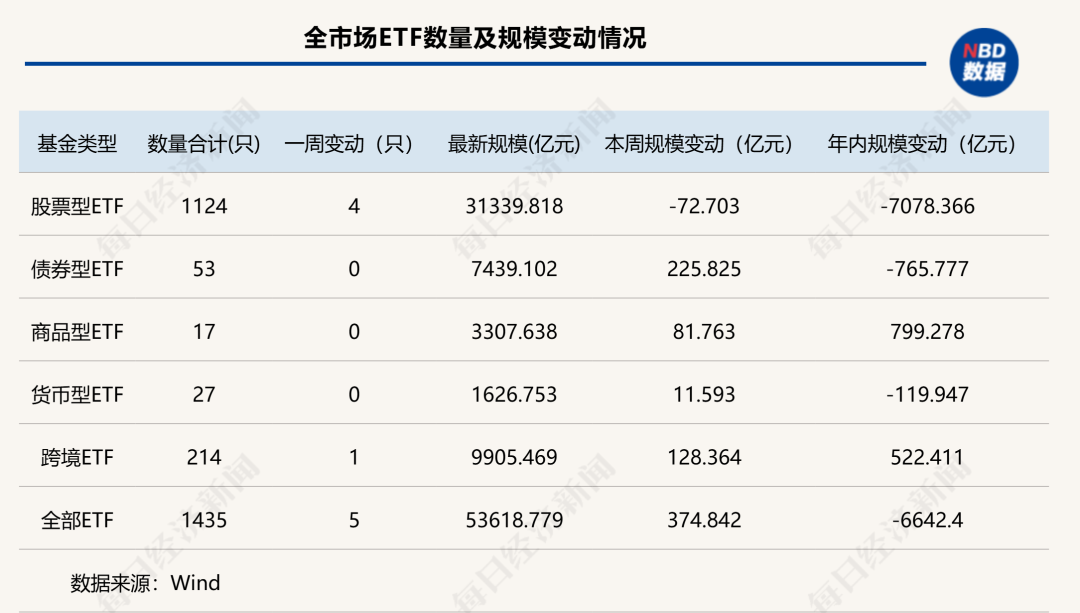
Market Overview - The A-share market experienced a week of fluctuations with major indices rebounding, including a 0.36% increase in the CSI 300 Index and a 1.22% rise in the ChiNext Index [1] - Despite the rebound, smart money has shifted direction, with stock ETFs continuing to shrink, particularly the CSI 300-linked ETFs, which have halved in size this year [1][4] ETF Performance - The total ETF market saw an increase of 374.84 billion yuan this week, bringing the total market size to 5.36 trillion yuan, primarily driven by bond and cross-border ETFs [2] - Bond ETFs gained 225.82 billion yuan, ending a five-week decline, while stock ETFs saw a slight decrease of 72.7 billion yuan [2][3] ETF Category Breakdown - As of February 14, 2023, the number of listed ETFs reached 1,435, with stock ETFs totaling 31,339.82 billion yuan, down 7,078.37 billion yuan year-to-date [3] - Bond ETFs and money market ETFs also experienced year-to-date declines of 765.78 billion yuan and 119.95 billion yuan, respectively, while cross-border and commodity ETFs saw increases of 522.41 billion yuan and 799.28 billion yuan [3] Index-linked ETF Trends - The CSI 300-linked ETF has seen a significant year-to-date decline of 5,975.29 billion yuan, with its current size at 5,880.28 billion yuan [6][7] - Other indices like the CSI 1000 and the SSE 50 also experienced substantial declines, exceeding 1,000 billion yuan each [7] Fund Management Insights - Hai Fu Tong Fund capitalized on the rebound in bond ETFs, achieving a weekly growth of 144.18 billion yuan, while other major funds like E Fund and Bosera also saw increases of over 40 billion yuan [8] - Conversely, major funds such as Huatai-PB and Huaxia Fund experienced declines in ETF sizes, with reductions of 40.64 billion yuan and 13.32 billion yuan, respectively [8] Top ETF Products - Gold ETFs have emerged as the top performers in terms of year-to-date growth, with significant increases from funds managed by Huaxia, Guotai, and Bosera [15] - The top 20 products saw limited growth, with only two in the top tier increasing in size, while the second tier showed more activity with several industry and thematic ETFs growing [12]