
卡游

Search documents
2025胡润百富榜发布:钟睒睒刷新中国首富财富纪录!宗馥莉女首富之位被取代
Bei Jing Shang Bao· 2025-10-28 04:30
Core Insights - Zhong Shanshan, founder of Nongfu Spring, has seen his wealth increase by 190 billion RMB, reaching 530 billion RMB, making him the richest person in China for the fourth time and setting a new record for wealth among Chinese billionaires [2][5] - The 2025 Hurun Rich List features 1,434 individuals with wealth exceeding 5 billion RMB, a 31% increase from last year, with total wealth nearing 30 trillion RMB, up 42% [2][5] - The number of billionaires has increased, with 41 individuals now classified as billionaires and 1,021 as millionaires [2] Company Performance - Nongfu Spring reported a revenue of approximately 25.62 billion RMB in the first half of 2025, a year-on-year increase of 15.56%, and a net profit of about 7.62 billion RMB, up 22.16% [5] - The tea beverage segment has surpassed bottled water in revenue for the first time, indicating a shift in consumer preferences [5] Competitor Analysis - Zhang Yiming, founder of ByteDance, has dropped to second place with a wealth increase of 120 billion RMB, totaling 470 billion RMB [5] - Tencent's Ma Huateng ranks third, with a wealth increase of 150 billion RMB [5] - Xiaomi's Lei Jun has made a significant comeback, ranking in the top five for the first time in ten years, with a wealth increase of 196 billion RMB [5] Emerging Entrepreneurs - Wang Ning of Pop Mart has seen a wealth increase of 154.5 billion RMB due to the global popularity of Labubu [7] - Chen Tian Shi of Cambrian has experienced rapid growth in wealth, increasing by 148 billion RMB, driven by advancements in AI chips [7] New Entrants - The list has seen 376 new entrants, a sevenfold increase from last year, with notable newcomers including Xu Gaoming and Xu Dongbo of Laopu Gold, entering the top 100 with 69.5 billion RMB [8] - Founders of new tea brands such as Guming and Bawang Tea have also made their debut on the list, reflecting the growing market for new beverage brands [8]




中邮证券:中国泛娱乐行业快速扩张 集换式卡牌仍处于发展初期
Zhi Tong Cai Jing· 2025-10-27 08:03
Core Insights - The Chinese pan-entertainment industry is rapidly expanding, with collectible card games (CCGs) experiencing a compound annual growth rate (CAGR) of over 50% in the past five years, establishing themselves as a significant category within the market [1][2] - Card games dominate the collectible card market in China, facing competition from brands like Jiekas, Shanhun, and Hitcard, while the competitive card game segment remains in its early stages [2][3] - The potential for growth in per capita spending on collectible cards in China is substantial compared to more mature markets like Japan and the United States [2] Industry Overview - The collectible card game sector is characterized by high growth and significant potential within the broader pan-entertainment category [2] - The market is still in its early development phase, with a focus on collectible trading card games (TCGs) primarily driven by foreign brands like Pokémon and Yu-Gi-Oh [2] - As the industry matures, there will be closer ties between card games and intellectual property (IP) producers, with TCGs likely to expand through mobile gaming [2] Company Profile: KAYOU - KAYOU, established in 2011, began its card business in 2018 and has a concentrated ownership structure, with founders holding 83.5% of shares prior to listing [3] - The company is projected to grow its revenue from 4.131 billion yuan to 10.057 billion yuan from 2022 to 2024, representing a CAGR of 56.03%, while adjusted net profit is expected to rise from 1.620 billion yuan to 4.466 billion yuan, with a CAGR of 66.05% [3] Competitive Advantages - KAYOU benefits from multiple strengths, including a diverse portfolio of popular IPs such as Ultraman and My Little Pony, and a strong offline distribution network [4] - The company focuses on innovative gameplay design and community engagement to enhance product flow and player activity [4] - KAYOU is expanding its production capacity to respond flexibly to market changes [4] Growth Drivers - The pan-entertainment industry is thriving, and collectible card games are still in the early stages of development, presenting significant growth opportunities [5] - KAYOU aims to maintain its advantage by collaborating closely with content producers to secure diverse IP licenses and expand product categories [5] - The company is also targeting the competitive TCG segment to meet consumer entertainment and social needs, fostering an active player community [5] - KAYOU plans to leverage its domestic experience and international brand recognition to gradually expand its brand presence overseas [5] Investment Recommendation - Attention is recommended for KAYOU, as the company continues to expand its IP matrix and diversify its product offerings, with scale effects and self-built production lines expected to enhance profitability [6]
阅文的“谷仓”里,能装下多少个Hitcard?
Hua Er Jie Jian Wen· 2025-10-24 12:57
Core Insights - The market is closely watching which company will become the "first stock of card games" as Hitcard accelerates its listing process while the leading company, KAYOU, has not made significant progress since filing its prospectus [1] Company Overview - Hitcard, established only four years ago, has differentiated itself by accurately capturing the increasing commercialization demands of IP copyright holders [2] - The company focuses on adult collectible cards and has launched products based on popular IPs such as "Full-Time Master" and "Battle Through the Heavens" [2] - Hitcard has attracted investments from notable firms including Pop Mart, Sequoia China, and Tencent Literature, highlighting its strong industry and capital backing [2] Financial Performance - In 2024, Hitcard achieved approximately 400 million yuan in revenue, representing a year-on-year increase of over 600% [5] - The company anticipates continued revenue growth in 2025, although current production capacity may not fully meet next year's targets [5] Market Trends - The trend of "no cards, no drama" is emerging in the film and television industry, indicating that most new IP card authorizations are quickly absorbed by card companies [6] - Hitcard has established a significant market presence, covering about 70% to 80% of the film and television card market share [7] Competitive Landscape - Compared to KAYOU, which operates around 70 IPs and has a revenue concentration where the top five IPs contribute 86% of total income, Hitcard's model of "multi-IP, limited edition, high-frequency new releases" enhances its market competitiveness [8] - Hitcard's strategy involves frequent product redesigns and a focus on environmentally friendly materials, which increases production costs but also drives innovation [8] Strategic Partnerships - To strengthen its core competitiveness, Hitcard is pursuing equity partnerships with industry players, including Japanese game company Cygames and Goodsmile, to enhance its overseas IP acquisition and operational capabilities [9] - The collaboration with Tencent Literature is particularly valuable, providing access to a resource pool of over 1,000 IPs and shared offline channel networks [2][9] Industry Dynamics - The rapid commercialization of IPs is becoming a key driver for the growth of derivative products, with Tencent Literature aiming to enhance its IP commercialization strategy at the group level [11] - The success of Hitcard and similar companies is contingent on their ability to refine product design, user operations, and channel management while leveraging upstream IPs [21]
卡牌行业深度报告:方寸炼金术,卡承万象新
China Post Securities· 2025-10-24 08:53
Investment Rating - The report maintains a strong buy rating for the card industry, indicating a positive outlook for investment opportunities [3]. Core Insights - The card industry is characterized by high growth and significant potential within the broader entertainment sector, with collectible card games (CCGs) experiencing a compound annual growth rate (CAGR) exceeding 50% over the past five years [5]. - The leading company in the collectible card market, Card Game Co., has shown impressive revenue growth, with projected revenues increasing from 4.131 billion yuan in 2022 to 10.057 billion yuan in 2024, reflecting a CAGR of 56.03% [5][6]. - The report highlights the competitive landscape, noting that while Card Game Co. dominates the market, there is increasing competition from brands like Collect Card Society and Flash Soul [5][6]. Industry Analysis - The collectible card market in China is still in its early stages compared to more mature markets like Japan and the United States, suggesting substantial room for growth in per capita spending [39]. - The overall market for collectible cards in China is projected to grow from 2.8 billion yuan in 2019 to 26.3 billion yuan by 2024, with a CAGR of 56.6% [20]. - The report emphasizes the importance of intellectual property (IP) partnerships, as Card Game Co. has secured licenses for popular franchises such as Ultraman and My Little Pony, enhancing its product offerings [43]. Company Overview - Card Game Co. has established itself as a leader in the collectible card market, with a strong focus on expanding its IP and product matrix, currently holding 69 licensed IPs and one proprietary IP [43]. - The company has a concentrated ownership structure, with the founders holding 83.5% of the shares, which allows for strategic decision-making aligned with long-term growth objectives [45]. - Financially, Card Game Co. has demonstrated robust performance, with revenues increasing significantly and adjusted net profits projected to rise from 1.62 billion yuan in 2022 to 4.466 billion yuan in 2024, reflecting a CAGR of 66.05% [51]. Competitive Advantages - The report identifies several competitive advantages for Card Game Co., including a diverse IP portfolio, strong distribution channels, and innovative gameplay design that enhances consumer engagement [6][7]. - The company is well-positioned to capitalize on the growing demand for collectible cards, particularly among younger consumers who favor low-priced, high-frequency purchases [7]. - Card Game Co. is also exploring international markets, aiming to leverage its established brand and product offerings to create a second growth curve [7]. Growth Outlook - The report suggests that the collectible card industry is poised for continued expansion, driven by collaborations with content creators and a focus on enhancing the entertainment and social aspects of competitive trading card games (TCGs) [7]. - The potential for growth in the collectible card segment is further supported by the increasing popularity of mobile gaming, which may help broaden the audience for card games [5][6].
LABUBU卡牌带火“纸片经济”,二手平台溢价约30%
Mei Ri Jing Ji Xin Wen· 2025-10-22 13:45
Core Insights - The focus of the "Double 11" shopping festival has unexpectedly shifted to collectible cards, particularly the TOPPS X THE MONSTERS/LABUBU series, which sold out quickly despite high purchase limits and pre-sale conditions [1][2] - The collectible card market in China is experiencing significant growth, with major players like Pokémon and various entertainment giants entering the space, leading to a competitive landscape [1][6] - Bubble Mart, a leading player in the trendy toy industry, reported a projected revenue growth of 245%-250% year-on-year for Q3 2025, indicating strong performance in the collectible market [1][4] Market Dynamics - The overlap between trendy toy users and card users is significant, with many card players also engaging with Bubble Mart products, although marketing strategies differ [2][5] - The traditional IP-licensed cards are facing challenges as the market becomes saturated, leading to increased competition primarily based on price and volume [2][5] - The LABUBU card's appeal lies in its unique scarcity and artistic value, featuring limited edition items that enhance its collectible nature [3][5] Competitive Landscape - The global collectible trading card market is projected to grow from $7.267 billion in 2025 to $15.433 billion by 2032, with a compound annual growth rate of 11.36% [3][4] - China has emerged as one of the largest trading card markets, with significant growth potential as consumer spending is still relatively low compared to markets like Japan and the U.S. [4][6] - Major companies in the first tier of the market include Pokémon, Konami, and Topps, with a clear competitive hierarchy forming [4][6] Industry Trends - The Chinese card market is witnessing an influx of new players, with over 2,000 card-related companies currently operating, primarily concentrated in Guangdong, Liaoning, and Hainan [6][7] - The market is evolving towards a more mature and diversified structure, with a broader age demographic engaging with various IPs [7][8] - The future of the card market may hinge on the development of trading card games (TCG) that offer gameplay and competitive events, moving away from purely collectible cards [8]

遭疯抢,售罄,这个行业突然爆火,多路巨头杀入
Hu Xiu· 2025-10-22 00:47
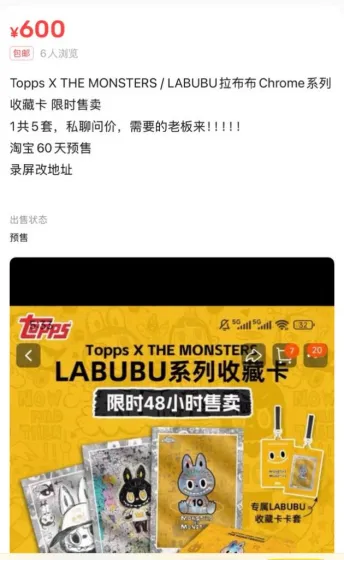
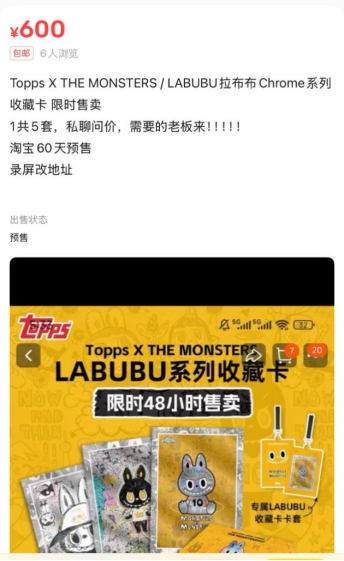
Core Insights - The LABUBU card series launched by TOPPS has seen significant demand, selling out quickly despite a high price point of 469 yuan, with resale prices reaching up to 600 yuan, indicating a 30% premium [1][6][12] - The card market in China is experiencing rapid growth, with major players like Pokémon and various entertainment giants entering the space, leading to increased competition and market dynamics [4][9][10] Group 1: Market Dynamics - The card market is characterized by a high overlap between users of collectible cards and trendy toys, with both demographics often being adults [5][12] - The traditional IP licensing model for cards is becoming saturated, leading to increased competition primarily based on price and volume, which may harm market stability [5][12] - The global collectible trading card market is projected to grow significantly, reaching $7.267 billion by 2025 and $15.433 billion by 2032, with a compound annual growth rate of 11.36% [6][9] Group 2: Company Performance - Bubble Mart reported a substantial increase in revenue, with a projected growth of 245%-250% year-on-year for Q3 2025, driven by both domestic and international sales [4][9] - The LABUBU card series is a collaboration with TOPPS, and while it has generated initial excitement, the long-term success of such products remains uncertain [7][12] Group 3: Consumer Behavior - The current Chinese card market is primarily driven by hobbyists, with a younger demographic and less focus on investment potential compared to international markets [11][12] - The sustainability of the card market relies on maintaining scarcity and managing supply effectively to avoid oversaturation [12][13] Group 4: Future Trends - The industry is expected to evolve towards trading card games (TCG) that offer gameplay and competitive events, which could enhance user engagement and market longevity [13][14] - As adult players become the main consumer group, the card industry is transitioning from a "toy economy" to an "interest asset" economy, emphasizing the collectible and investment aspects of cards [14]
遭疯抢售罄!这个行业突然爆火,多路巨头杀入
Mei Ri Jing Ji Xin Wen· 2025-10-21 22:25
Core Insights - The focus of the "Double 11" shopping festival has unexpectedly shifted to collectible cards, particularly the TOPPS X THE MONSTERS/LABUBU series, which sold out quickly despite a high price point and purchase limits [1][5] - The collectible card market in China is experiencing significant growth, with major players like Pokémon and various entertainment giants entering the space, leading to increased competition and market dynamics [4][8] Market Dynamics - The LABUBU card's popularity reflects a broader trend in the collectible card market, which is heating up with various companies competing for market share [4][6] - The collectible card market is projected to reach $7.267 billion by 2025 and $15.433 billion by 2032, with a compound annual growth rate of 11.36% [6] - China is becoming the largest market for collectible cards, with a projected market size of 263 billion yuan in 2024, significantly lower per capita spending compared to Japan and the U.S., indicating potential for growth [6][8] Company Performance - Bubble Mart reported a projected revenue increase of 245%-250% year-on-year for Q3 2025, with domestic revenue up 185%-190% and overseas revenue up 365%-370% [4] - The LABUBU card's appeal is attributed to its limited availability and artistic value, including signed cards and unique designs, which resonate with collectors [5][11] Competitive Landscape - The card market is becoming increasingly competitive, with over 2,000 card-related companies in China, and major players like 卡游 (Kawoo) and others vying for dominance [7][8] - The entry of entertainment companies like iQIYI and阅文 (Yuewen) into the card market is driving innovation and cross-industry collaboration [8][9] Consumer Behavior - The current consumer base for collectible cards in China is primarily younger, with a shift towards a more balanced age demographic as the market matures [11] - The transition from a hobbyist market to an investment-oriented market is hindered by a lack of infrastructure, including rating agencies and standardized quality control [11] Future Outlook - Analysts suggest that the future of the card market in China may lean towards trading card games (TCG) that offer gameplay and competitive events, which could sustain consumer interest longer than traditional collectible cards [7][11] - The market is expected to evolve from a "toy economy" to an "interest asset" economy as adult players become the main consumer group [11]
遭疯抢,售罄!这个行业突然爆火,多路巨头杀入
Mei Ri Jing Ji Xin Wen· 2025-10-21 16:42
Core Insights - The focus of the "Double 11" shopping festival has unexpectedly shifted to collectible cards, particularly the TOPPS X THE MONSTERS/LABUBU series, which sold out quickly despite a high price point and purchase limits [1][5] - The collectible card market in China is experiencing significant growth, with major players like Pokémon and various entertainment giants entering the space, leading to increased competition and market dynamics [4][8] Market Dynamics - The LABUBU card's popularity reflects a broader trend in the collectible card market, with a notable increase in sales and interest from consumers [4][5] - The collectible card market is projected to reach $7.267 billion by 2025 and $15.433 billion by 2032, with a compound annual growth rate of 11.36% [6] - China is becoming a major player in the global card market, with projected market sizes of 26.3 billion yuan in 2024, indicating substantial growth potential [6] Consumer Behavior - There is a significant overlap between the user bases of collectible cards and other products like those from Pop Mart, challenging the perception that card users are primarily students [4][7] - The current demographic of card consumers is shifting, with a growing number of adult collectors, although the market still primarily caters to younger audiences [11] Competitive Landscape - The competitive landscape is intensifying, with over 2,000 card-related companies in China, and major brands like Pokémon actively expanding their presence [7][8] - The market is characterized by a mix of traditional IP-based cards and newer, more dynamic offerings that include gameplay elements, which are essential for long-term engagement [7][11] Future Trends - Analysts suggest that the future of the card market in China may lean towards trading card games (TCG) that incorporate gameplay and competitive elements, as opposed to purely collectible cards [11] - The transition from a hobbyist market to one with investment potential will require improved infrastructure, including credible grading systems and secondary market platforms [11]
60天预售期、一人限购5套仍遭疯抢!LABUBU卡牌带火“纸片经济”,二手平台溢价约30%,多方巨头挤破头
Mei Ri Jing Ji Xin Wen· 2025-10-21 15:35
Core Insights - The focus of the "Double 11" shopping festival has unexpectedly shifted to collectible cards, particularly the TOPPS X THE MONSTERS/LABUBU series, which sold out quickly despite a high price point and purchase limits [2][4] - The collectible card market in China is experiencing significant growth, with major players like Pokémon and various entertainment giants entering the space, leading to increased competition and market dynamics [5][7] Group 1: Market Dynamics - The LABUBU card's rapid sell-out and subsequent price increase on secondary markets reflect a growing interest in collectible cards, with some sets selling for 600 yuan, a 30% premium over the original price of 469 yuan [2][4] - The collectible card market is becoming increasingly competitive, with over 2,000 card-related companies in China, and major brands like Pokémon targeting the Chinese market for expansion [6][7] - The global collectible trading card market is projected to grow from $7.267 billion in 2025 to $15.433 billion by 2032, with China being a significant contributor due to its large consumer base [5] Group 2: Consumer Behavior - There is a notable overlap between the user bases of collectible cards and trendy toys, with many card players also being adult consumers of brands like泡泡玛特 [3][6] - The current Chinese card market is primarily driven by hobbyists, with a younger demographic, and lacks strong investment characteristics compared to international markets [8][9] - The sustainability of the card market relies on maintaining scarcity and managing supply effectively to avoid oversaturation and demand depletion [8] Group 3: Future Trends - Analysts suggest that the future of the card market in China may lean towards trading card games (TCG), which offer longer lifecycles and higher repurchase rates compared to traditional collectible cards [9] - The transition from a "toy economy" to an "interest asset" economy is anticipated as adult players become the main consumer group, emphasizing the need for robust gameplay and event systems to maintain engagement [9]
“借来的灵魂终不如自己的”,IP如何点石成金
Jie Fang Ri Bao· 2025-10-18 13:07
Core Insights - The article highlights the significant impact of intellectual property (IP) on sales in the Chinese toy industry, emphasizing that 91.4% of licensed businesses believe IP licensing drives sales, with 22.7% reporting sales doubling compared to 2023 [2] - The Chinese toy market is projected to surpass 155 billion yuan in retail sales in 2024, reflecting a 10.7% increase from 2023, indicating a robust growth trajectory for licensed products [2] Group 1: Market Trends - During the National Day holiday, the average daily foot traffic at Jing'an Joy City exceeded 100,000, with sales reaching over 92 million yuan, driven by the popularity of My Little Pony merchandise [1] - The diversification of product offerings by companies like Card Game has led to a decrease in reliance on collectible card sales, which dropped from 95.1% in 2022 to 81.5% in 2024 [3][4] - The retail sales of Card Game's stationery business reached 513 million yuan in 2024, capturing a 24.3% market share, indicating successful cross-industry expansion [3] Group 2: IP Strategy - Card Game holds 69 licensed IPs, including popular franchises like Ultraman and Harry Potter, which allows for a diversified revenue stream and mitigates risks associated with relying on a single IP [6][7] - The revenue contribution from Card Game's top five core IPs has decreased from 98% in 2022 to 86% in 2024, showcasing a healthier distribution of income across multiple IPs [7] - The licensing market is characterized by high costs, with top IPs commanding substantial upfront fees and sales royalties, which can limit the ability of smaller companies to diversify their IP portfolios [6] Group 3: Consumer Behavior - A survey indicates that 63.4% of consumers plan to increase their budget for licensed products in 2024, reflecting a growing enthusiasm for IP-related merchandise [2] - The success of new products, such as the plush My Little Pony, is attributed to effective marketing strategies that resonate with younger consumers [4] Group 4: Long-term IP Development - The article emphasizes the importance of developing original IPs, as seen with Card Game's success in creating its own IPs like the Three Kingdoms series, which has gained significant traction in the market [9] - Companies are encouraged to adopt a long-term perspective in IP development, focusing on building emotional connections with consumers rather than seeking quick profits [12][13]