
苏州银行

Search documents
苏州银行(002966) - 2026年1月28日投资者关系活动记录表
2026-01-28 10:00
Group 1: Revenue Growth Strategies - The bank is focusing on expanding its middle-income sources by enhancing wealth management services and diversifying asset allocation for clients [1] - New business initiatives include the underwriting of corporate bonds and custodial services to create additional revenue streams [2] Group 2: Cost Management and Liability Improvement - The bank is actively monitoring industry policies and market deposit rates to improve liability costs while balancing deposit scale and quality [2] - Strategies include optimizing interbank liabilities and strategically issuing bonds and certificates of deposit to strengthen proactive liability management [2] Group 3: Capital Adequacy and Future Planning - As of September 2025, the bank's core Tier 1 capital adequacy ratio is 9.79%, Tier 1 capital adequacy ratio is 11.55%, and total capital adequacy ratio is 13.57%, all meeting regulatory requirements [2] - The bank plans to enhance capital efficiency and support sustainable high-quality growth by closely monitoring refinancing policies and optimizing business structure [2] Group 4: Compliance and Communication - During the investor meeting, there was thorough communication with investors, adhering to regulations without disclosing any undisclosed significant information [2]
城商行开放式理财产品平均业绩比较基准达2.27%,环比上涨0.06个百分点
Jin Rong Jie· 2026-01-28 08:54
Group 1 - The core point of the report indicates that the total number of newly issued open-ended wealth management products decreased to 115, a reduction of 27 products compared to the previous week, with a market share of 20.28% and an average performance benchmark of 1.91%, which increased by 0.21 percentage points [1] - Wealth management companies issued the most products, totaling 103, accounting for 89.57% of the new offerings, while city commercial banks also held a significant share. The average performance benchmark for city commercial bank products was 2.27%, up by 0.06 percentage points, while that for wealth management companies was lower at 1.85%, increasing by 0.18 percentage points [1] - Fixed income products were the most prevalent, with 112 products issued, a decrease of 26 from the previous week. Mixed products followed with 3 offerings, down by 1, while commodity and financial derivatives, as well as equity products, were negligible, totaling 0. The average performance benchmark for fixed income products was 1.91%, which increased by 0.23 percentage points [1] Group 2 - In terms of risk levels, R2 products were the most numerous with 95 offerings, down by 24, followed by R3 products with 14, which increased by 7. R1 products were limited to 6, while R4 and R5 products were absent. The average performance benchmark for R3 products was 2.40%, down by 0.3 percentage points, while R1 products had a lower average benchmark of 1.39%, which increased by 0.04 percentage points [2]

一文纵览全国分省份财政社融特征
GF SECURITIES· 2026-01-28 07:49
Investment Rating - The industry investment rating is "Buy" [2] Core Insights - The average narrow deficit ratio for all provinces in 2024 is 16.4%, and the average broad deficit ratio is 20.0%, both at relatively low levels since 2010. The average debt ratio stands at 357.0%, which has been on the rise since 2016 [5] Summary by Sections Regional Finance - The average tax revenue ratio across provinces is 67.2% in 2024, showing a year-on-year decline of 2.7%. The overall trend indicates a decrease in tax revenue reliance [20][26] - The average fiscal self-sufficiency rate for all provinces is 43.9% in 2024, reflecting a continuous decline since 2013 [17][19] - The government fund budget, which accounts for 20% of fiscal revenue, has seen a revenue decline of 14.2% year-on-year in 2024, primarily due to the downturn in the real estate market [27][28] Regional Social Financing - The new social financing has shown significant differentiation, with a notable concentration in economically developed eastern regions. Approximately 60% of the new social financing increment from 2020 to 2024 has been directed towards eastern regions, although this percentage has been gradually declining [5] - In 2024, the marginal contribution of government financing has increased, while corporate financing has decreased. The contribution of government departments to new loans is 69.1%, while corporate and household contributions are 34.7% and 24.8%, respectively [5][19]



城商行板块1月27日涨0.13%,青岛银行领涨,主力资金净流入4.04亿元
Zheng Xing Xing Ye Ri Bao· 2026-01-27 09:06
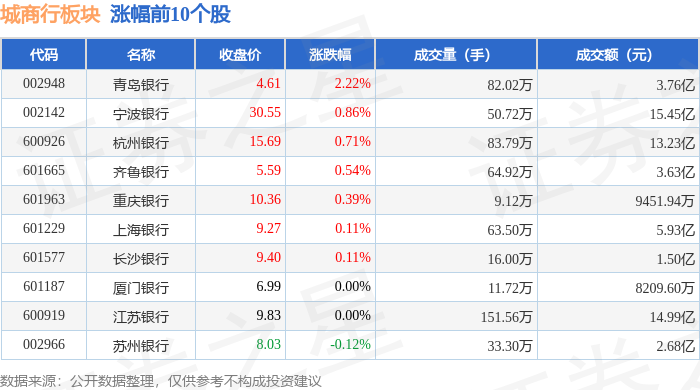
Market Performance - The city commercial bank sector increased by 0.13% compared to the previous trading day, with Qingdao Bank leading the gains [1] - The Shanghai Composite Index closed at 4139.9, up 0.18%, while the Shenzhen Component Index closed at 14329.91, up 0.09% [1] Individual Stock Performance - Qingdao Bank (002948) closed at 4.61, up 2.22% with a trading volume of 820,200 shares and a transaction value of 376 million [1] - Ningbo Bank (002142) closed at 30.55, up 0.86% with a trading volume of 507,200 shares and a transaction value of 1545 million [1] - Hangzhou Bank (600926) closed at 15.69, up 0.71% with a trading volume of 837,900 shares and a transaction value of 1323 million [1] - Qilu Bank (601665) closed at 5.59, up 0.54% with a trading volume of 649,200 shares and a transaction value of 363 million [1] - Chongqing Bank (601963) closed at 10.36, up 0.39% with a trading volume of 91,200 shares and a transaction value of 94.52 million [1] - Shanghai Bank (601229) closed at 9.27, up 0.11% with a trading volume of 635,000 shares and a transaction value of 593 million [1] - Other banks such as Changsha Bank, Xiamen Bank, and Suzhou Bank showed minimal changes in their stock prices [1] Capital Flow - The city commercial bank sector saw a net inflow of 404 million from main funds, while retail investors experienced a net outflow of 4.15 billion [2] - The main funds' net inflow and outflow for individual banks varied, with Ningbo Bank and Jiangsu Bank showing significant inflows [3] - Retail investors showed notable outflows in several banks, indicating a shift in investment sentiment [3]


苏州银行合作名单现“暴力催收大户”
Guan Cha Zhe Wang· 2026-01-26 04:15
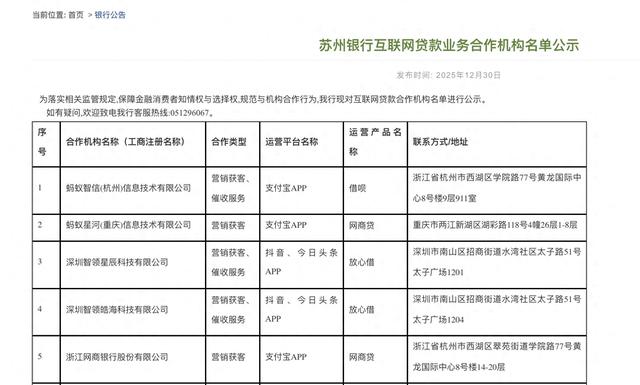
截图来自 苏州银行公告 黑猫投诉平台显示,相关合作平台累计投诉量超10万条。财务数据一定程度也揭示了苏州银行的风险情 况,该行拨备覆盖率从2022年末的530.81%降至2023年末的522.77%,再降至2025年三季度末的 420.59%,两年间缩水超110个百分点;个人不良贷款占比突破55%(2024年末数据),其中与网贷合作 紧密的个人经营贷不良余额达11.11亿元(2024年末);截至2025年三季度末,不良贷款余额为30.56亿 元。 【文/羽扇观金工作室】 2026年开年,苏州银行一份互联网贷款合作机构名单引发舆论风暴。借呗、放心借等消费者投诉 【下 载黑猫投诉客户端】集中的平台赫然在列,配套公示的还有8家催收机构。 | 序 | 合作机构名称(工商注册名称) | 合作类型 | 运营平台名称 | 运营产品名 | 联系方式/地址 | | --- | --- | --- | --- | --- | --- | | 목 | | | | 核 | | | - | 蚂蚁智信(杭州)信息技术有限公司 | 营销获答。 | 支付宝APP | 借项 | 浙江省杭州市西湖区学院路77号黄龙国际中 | | | | 催收服 ...
盈利能力保持韧性、资产规模稳步扩张 首批8家上市银行2025年业绩预喜
Shang Hai Zheng Quan Bao· 2026-01-25 23:31
Core Insights - The first batch of eight listed banks has reported positive earnings forecasts for 2025, with all banks achieving year-on-year growth in net profit, and seven of them also reporting revenue growth [1][2]. Group 1: Earnings Performance - All eight listed banks reported a year-on-year increase in net profit, with seven banks achieving both revenue and net profit growth, indicating a robust overall performance [2]. - Among the city commercial banks, Hangzhou Bank led with a 12.05% increase in net profit, while Ningbo Bank and Nanjing Bank reported growth rates of 8.13% and 8.08%, respectively [2]. - In the joint-stock banks category, Pudong Development Bank showed a notable net profit growth of 10.52%, while CITIC Bank, China Merchants Bank, and Industrial Bank reported increases of 2.98%, 1.21%, and 0.34%, respectively [2]. Group 2: Revenue Growth - Seven banks achieved year-on-year revenue growth, with only CITIC Bank experiencing a slight decline of 0.55% [2]. - Ningbo Bank's revenue grew by 8.01% to 71.968 billion yuan, driven by a significant 30.72% increase in net income from fees and commissions, highlighting the growth of intermediary business [2]. - Pudong Development Bank's revenue reached 173.964 billion yuan, marking a 1.88% increase, while Industrial Bank and China Merchants Bank reported revenues of 212.741 billion yuan and 337.532 billion yuan, respectively [2]. Group 3: Asset Expansion - The total assets of several banks have expanded significantly, with China Merchants Bank surpassing 13 trillion yuan and Industrial Bank reaching 11 trillion yuan [3]. - Smaller banks showed even faster growth, with Nanjing Bank, Ningbo Bank, and Hangzhou Bank's total assets increasing by 16.63%, 16.11%, and 11.96%, respectively, focusing on technology finance, green finance, and inclusive finance [3]. Group 4: Asset Quality - The core indicators of asset quality remain stable, with a decrease in the non-performing loan (NPL) ratio for four of the eight banks, while three banks maintained their ratios [4]. - Pudong Development Bank saw a significant reduction in its NPL ratio, decreasing by 10 basis points to 1.26%, while CITIC Bank and China Merchants Bank also reported slight declines [4]. - City commercial banks demonstrated particularly strong asset quality, with several banks maintaining NPL ratios below 1% [4]. Group 5: 2026 Strategic Focus - Many banks have outlined their strategic priorities for 2026, focusing on optimizing business structures, expanding intermediary income sources, and strengthening risk management [6]. - Bank of Communications emphasized increasing financial support for key sectors and enhancing services for small and micro enterprises [6]. - Beijing Bank has deployed ten key initiatives for 2026, aiming for qualitative and quantitative improvements in performance [7].
盈利能力保持韧性 资产规模稳步扩张 首批8家上市银行2025年业绩预喜
Shang Hai Zheng Quan Bao· 2026-01-25 18:51
Core Viewpoint - The first batch of eight listed banks in China has reported their 2025 performance, showing overall positive growth in net profit and revenue, with a focus on optimizing business structures and enhancing risk management for 2026 [1][2]. Group 1: Financial Performance - All eight listed banks reported a year-on-year increase in net profit, with seven achieving both revenue and net profit growth [2] - Hangzhou Bank led with a 12.05% increase in net profit, while Ningbo Bank and Nanjing Bank reported growths of 8.13% and 8.08% respectively [2] - Among joint-stock banks, Pudong Development Bank saw a notable 10.52% increase in net profit, while CITIC Bank, China Merchants Bank, and Industrial Bank reported growths of 2.98%, 1.21%, and 0.34% respectively [2] - Seven banks achieved revenue growth, with only CITIC Bank experiencing a slight decline of 0.55% [2] - Ningbo Bank's revenue grew by 8.01% to 71.968 billion yuan, driven by a 30.72% increase in net income from fees and commissions [2] Group 2: Asset Expansion - Total assets of several banks have expanded significantly, with China Merchants Bank surpassing 13 trillion yuan and Industrial Bank reaching 11 trillion yuan [3] - Smaller banks like Nanjing Bank, Ningbo Bank, and Hangzhou Bank saw asset growth rates of 16.63%, 16.11%, and 11.96% respectively, focusing on technology finance, green finance, and inclusive finance [3] Group 3: Asset Quality - The asset quality indicators remain stable, with a decrease in non-performing loan (NPL) ratios for four banks and three remaining stable [4] - Pudong Development Bank reported a significant decrease in NPL ratio by 10 basis points to 1.26%, while CITIC Bank and China Merchants Bank saw declines of 1 basis point to 1.15% and 0.94% respectively [4] - The overall provision coverage ratio has slightly decreased but remains at a high level, with several banks maintaining coverage ratios above 300% [4] Group 4: Future Strategies - Many banks have outlined their 2026 operational focuses, emphasizing business structure optimization, expanding fee income sources, and strengthening risk management [5][6] - Bank of Beijing has set ten key initiatives for 2026, aiming for qualitative and quantitative growth through deepening specific banking services and ensuring compliance [6]




银行业周报:继续筑牢风险底线-20260125
Xiangcai Securities· 2026-01-25 08:47
Investment Rating - The industry rating is maintained at "Overweight" [7][35] Core Insights - The regulatory environment is expected to strengthen, focusing on substantial risks and enhancing regulatory efficiency through classification and grading methods. The application of regulatory technology, including big data and artificial intelligence, will significantly deepen [7][33] - The banking sector's transformation path is becoming clearer, with a focus on reducing and improving small and medium financial institutions, promoting differentiated competition, and aligning resources with key economic development areas [7][33] Summary by Sections Regulatory Developments - The National Financial Supervision Administration held a meeting emphasizing the importance of risk management and the progress made in reforming small and medium financial institutions in 2025. The meeting also highlighted the expansion and efficiency of urban real estate financing coordination mechanisms [6][31] - In 2026, efforts to resolve risks will continue, with a clear mandate to avoid "explosive" failures in the financial sector. The meeting proposed ongoing reforms for small and medium financial institutions and a focus on long-term mechanisms for risk management [7][33] Market Performance - The banking index fell by 2.70% during the period from January 19 to January 25, 2026, underperforming the CSI 300 index by 2.08 percentage points. The performance of large banks, joint-stock banks, city commercial banks, and rural commercial banks varied, with regional banks showing relatively better performance [11] Investment Recommendations - As risks in key areas gradually resolve, there is potential for valuation recovery in the banking sector. The stability of interest margins is expected to improve, and performance is showing signs of stabilization. In a low-interest-rate environment, the high dividend yield of bank stocks is highlighted as a key investment value. Recommendations include focusing on state-owned banks with stable asset deployment and joint-stock and regional banks with growth potential, such as Industrial and Commercial Bank of China, Bank of China, and others [9][35]
苏州市2026年家电以旧换新、数码和智能产品购新补贴来了
Xin Lang Cai Jing· 2026-01-24 19:37
Core Points - Suzhou has launched a subsidy program for replacing old home appliances and purchasing new digital and smart products, which will run until December 31, 2026 [1] - The subsidy covers six categories of national subsidized home appliances and four categories of digital products, offering a 15% subsidy for eligible purchases [1] Subsidy Details - Consumers can receive a 15% subsidy on eligible home appliances such as refrigerators, washing machines, televisions, air conditioners, computers, and water heaters, with a maximum subsidy of 1500 yuan per item [1] - For digital products like smartphones, tablets, smartwatches, and smart glasses, a 15% subsidy is also available, capped at 500 yuan per item, provided the final sales price does not exceed 6000 yuan [1] Application Process - Consumers can apply for the subsidy through platforms like Suzhou Bank and Cloud Flash Payment, with specific application times and procedures to be announced by each platform [1] - It is essential for the applicant, payer, and recipient to be the same person, and any returns must include the return of the subsidy funds [1] Participation Guidelines - The list of participating sales units is continuously updated, and consumers are advised to confirm with stores before visiting [2] - The subsidy program operates on a "first come, first served" basis, encouraging consumers to plan their participation early [2]
数+智,如何强健苏州制造筋骨
Su Zhou Ri Bao· 2026-01-23 23:50
Core Insights - Suzhou's manufacturing sector is robust, with a leading number of global lighthouse factories and national-level 5G factories, indicating a strong industrial foundation and a high level of integration between information technology and industrialization [1][2] - The government work report emphasizes strengthening the real economy and building a modern industrial system as key priorities for 2026, focusing on enhancing competitive advantages in industrial clusters and promoting smart manufacturing [1][2] Group 1: Industrial Clusters and Economic Foundation - Suzhou has developed three trillion-level industries: electronic information, equipment manufacturing, and new materials, with manufacturing value added consistently accounting for over 40% of GDP [2] - The city aims to advance its industrial clusters towards higher value chains, particularly in biomedicine, electronic information, and new energy sectors, while also promoting the establishment of over 3,500 smart factories [2][3] Group 2: AI Integration in Manufacturing - Artificial intelligence is positioned as a key driver for upgrading Suzhou's manufacturing, with over 3,000 AI-related companies and initiatives to integrate AI into manufacturing processes [3][4] - The government is focusing on high-end chips, algorithms, and intelligent equipment innovation, with the local robot industry valued at over 160 billion yuan, accounting for one-seventh of national production [4] Group 3: Modern Service Industry Development - The modern service industry is seen as essential for supporting industrial growth, with plans to enhance the quality and capacity of production services, targeting an 8% revenue growth by 2026 [5] - Proposals include providing comprehensive services such as consulting and training to facilitate the upgrade of small and medium enterprises through collaborative platforms [5][6] Group 4: Talent Development - Talent is identified as a critical factor for industrial upgrading, with a strong demand for engineers and skilled technicians capable of addressing complex engineering challenges [6] - Suggestions include establishing specialized programs in universities to align educational outcomes with industry needs, ensuring a continuous supply of practical talent for industrial development [6]