
三生制药

Search documents
医保基金数据跟踪:7月医保支出下降,收入维持增长态势
Ping An Securities· 2025-09-16 09:12
Investment Rating - The industry investment rating is "Outperform the Market" (expected to perform better than the CSI 300 index by more than 5% in the next 6 months) [24] Core Insights - From January to July 2025, the overall medical insurance fund income maintained positive growth, with total income reaching 1,684.66 billion yuan, a year-on-year increase of 6.93%, while expenditures decreased to 1,369.69 billion yuan, a decline of 0.95% [2][6] - The cumulative surplus of the medical insurance fund for the same period was 314.97 billion yuan, representing a year-on-year increase of 63.53%, with a surplus rate of 18.70%, up 6.48 percentage points from the same period in 2024 [2][11] Summary by Sections Medical Insurance Fund Income and Expenditure - The medical insurance fund income from January to July 2025 showed consistent growth, with monthly income figures of 314.31, 232.13, 268.15, 215.61, 199.33, 249.09, and 206.05 billion yuan, reflecting year-on-year growth rates of 10.37%, 5.72%, 0.35%, 10.02%, 3.23%, 9.34%, and 10.15% respectively [6] - In contrast, the expenditures varied, with total expenditures for the same period amounting to 1,369.69 billion yuan, showing a year-on-year decline of 0.95% [6][19] Employee and Resident Medical Insurance - Employee medical insurance income for January to July 2025 was 1,050.24 billion yuan, a year-on-year increase of 5.93%, while expenditures were 776.17 billion yuan, up 2.97% [3][19] - For urban and rural resident medical insurance, income reached 634.43 billion yuan, a year-on-year increase of 8.62%, while expenditures decreased to 593.53 billion yuan, down 5.66% [3][19] Investment Recommendations - The report suggests focusing on innovative pharmaceutical companies with rich pipeline layouts, such as Heng Rui Medicine, BeiGene, and China National Pharmaceutical Group [4][22] - It also highlights companies with significant single-product potential and those with leading positions in advanced technology platforms [4][22] - In the CXO sector, companies like WuXi AppTec and Kelun-Biotech are recommended, along with quality medical device firms that have been undervalued due to previous price pressures [4][22]
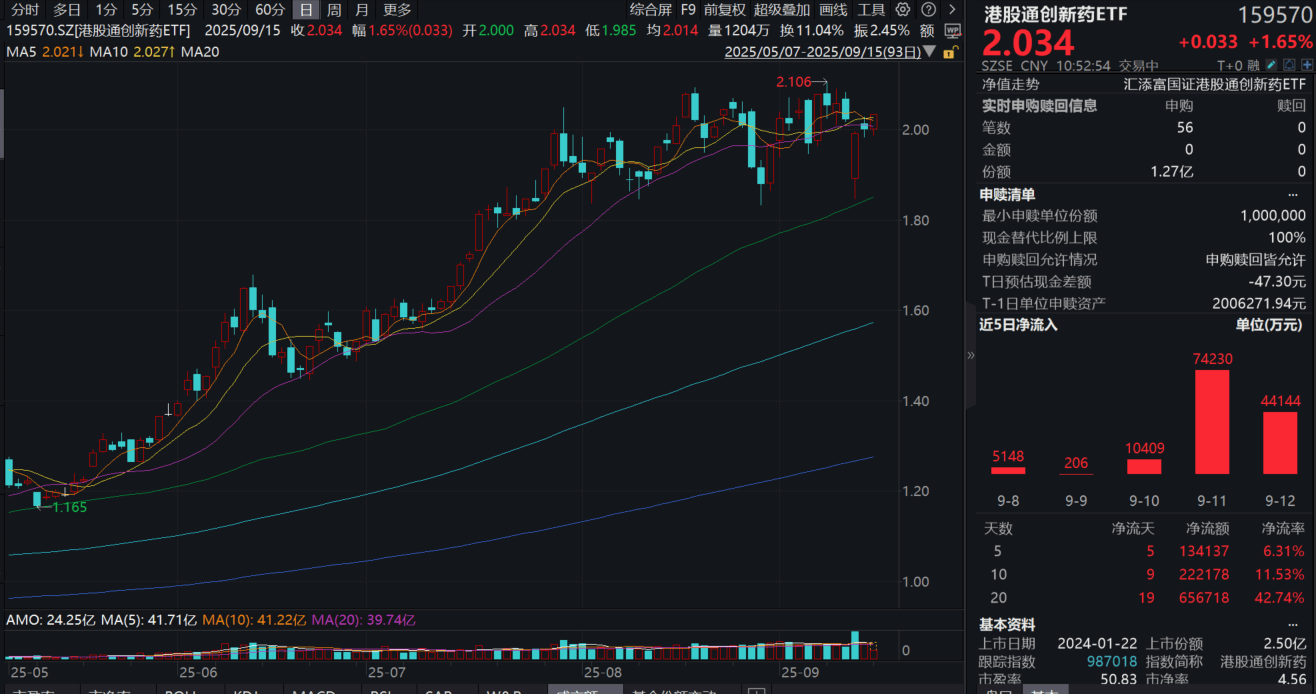
港药再度大涨!港股通创新药ETF(159570)涨近2%,近3日疯狂吸金超14亿元!创新药再迎出海+会议+政策三重催化
Sou Hu Cai Jing· 2025-09-16 02:48
Core Viewpoint - The Hong Kong innovative drug ETF (159570) has seen significant growth, with a recent increase of nearly 2% and a rapid transaction volume exceeding 1.5 billion yuan in just three days, indicating strong market interest and liquidity in the sector [1][3]. Market Performance - As of September 15, the latest scale of the Hong Kong innovative drug ETF (159570) surpassed 22.5 billion yuan, leading in both scale and liquidity among its peers [1]. - The index components of the ETF showed mixed performance, with notable gains from companies like药捷安康 (over 50% increase) and 同源康医药 (over 14% increase), while others like 诺诚健华 and 百济神州 experienced declines [3]. Industry Trends - The continuous growth of Chinese innovative drugs in international markets is driven by collaborations with multinational corporations (MNCs), which benefit from China's efficient and cost-effective R&D pipelines [4]. - The innovative drug sector is currently in a transitional phase, with increased focus on international expansion and the realization of value through milestones and competitive advantages [4]. Clinical Developments - At the World Lung Cancer Conference (WCLC), several clinical data updates for Chinese innovative drugs were presented, particularly highlighting the promising results of ADC therapies [5]. - The release of clinical data for drugs like HLX43 and Eiza-bren indicates significant advancements in treatment efficacy for specific cancer patient populations [5]. Policy Environment - The National Healthcare Security Administration (NHSA) is set to release the 2025 medical insurance drug list, which will significantly impact companies involved in negotiations for drug inclusion [5]. - The approval of orphan drugs and imported PD-1/L-1 drugs for the insurance directory reflects a supportive policy environment for innovative drug development [5]. Financial Outlook - The anticipated easing of monetary policy by the Federal Reserve is expected to improve liquidity in the market, which could positively influence the financing environment for innovative drug companies [6]. - The A+H share innovative drug index has shown substantial growth, suggesting a favorable investment climate and potential for increased capital inflow [6]. Investment Recommendations - The Hong Kong innovative drug ETF (159570) is highlighted as a key investment vehicle, with a significant increase of over 109% in the past year, outperforming other indices [7][8]. - Investors are encouraged to focus on the underlying assets and the potential for T+0 trading, which enhances liquidity and trading flexibility [9].

美国会限制来自中国的创新药吗?
Hu Xiu· 2025-09-15 07:58
Core Viewpoint - The recent market turbulence in the innovative drug sector is attributed to reports of a potential executive order from the Trump administration, which aims to impose stricter reviews on U.S. companies acquiring Chinese innovative drugs and increase FDA scrutiny on Chinese clinical trial data [1][5]. Group 1: Market Reaction - After an initial drop of over 4% in the innovative drug sector index and a 7% decline in the Hang Seng Biotech Index, market panic subsided quickly [2]. - Analysts believe the likelihood of the executive order being implemented is low, suggesting that the immediate impact on innovative drug business development (BD) will be limited and primarily emotional [3][7]. Group 2: Implications of the Executive Order - The proposed executive order includes stricter reviews by the Committee on Foreign Investment in the United States (CFIUS) for U.S. multinational pharmaceutical companies acquiring pipelines from Chinese firms [5]. - In the first half of this year, the total value of BD transactions for Chinese innovative drugs reached nearly $66 billion, with projections indicating that by 2040, 35% of new drugs approved by the FDA could originate from China [5][6]. Group 3: Competitive Landscape - The executive order reflects a conflict between U.S. biotech companies, which lobby for restrictions, and multinational corporations (MNCs) that benefit from acquiring overseas assets [6]. - By 2035, $115 billion worth of drug patents will expire in Europe and the U.S., necessitating MNCs to seek new pipelines, with Chinese assets being a favorable option due to their quality and cost [6]. Group 4: Clinical Trial Data Scrutiny - The FDA's stricter scrutiny of clinical trial data from Chinese patients is seen as unlikely to change the current landscape, as the FDA has already been tightening its review processes [8][10]. - The high costs associated with conducting clinical trials abroad compared to domestic trials lead many Chinese firms to retain domestic rights while transferring overseas rights to MNCs [9]. Group 5: Future Outlook - Despite the potential for political interference, analysts believe there remains a 5-10 year window of opportunity for BD transactions, driven by the high demand from large pharmaceutical companies [11][12]. - The recent surge in large BD deals indicates a shift in perception regarding the value of Chinese assets, moving away from the notion of "selling assets cheap" to recognizing their quality and efficiency [13][14].
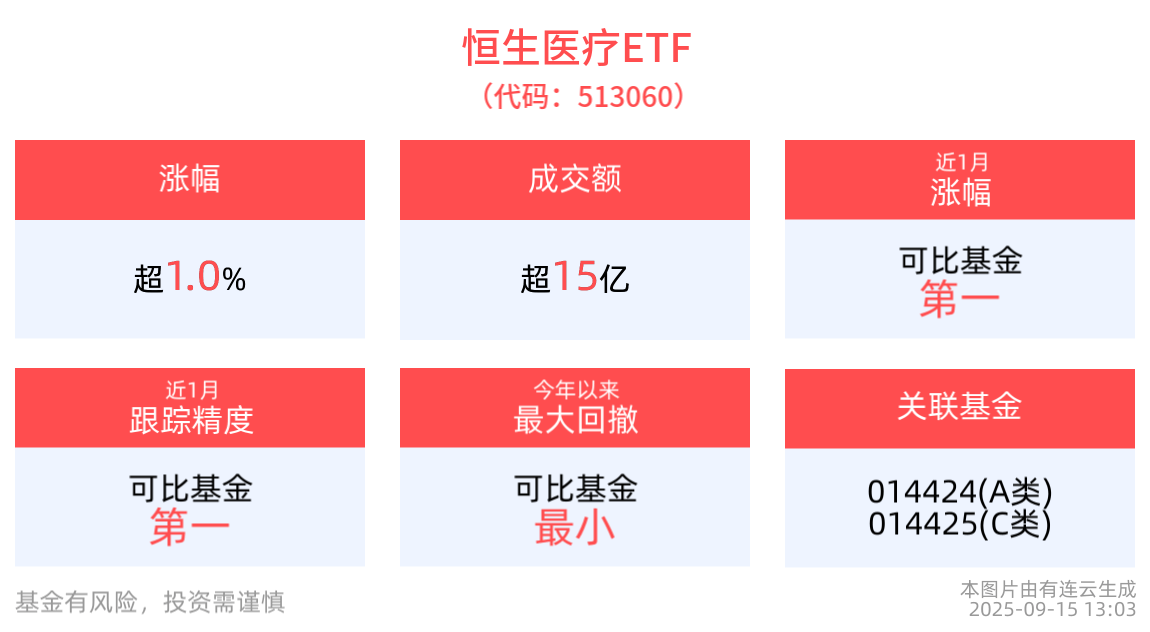
政策暖风频吹,国产创新药再迎催化,恒生医疗ETF(513060)午后涨超1%
Sou Hu Cai Jing· 2025-09-15 05:39
Market Performance - The Hang Seng Healthcare Index increased by 0.76%, with notable gains from companies such as Baize Medical (+54.41%) and Brainstorm Aurora-B (+34.40%) [3] - The Hang Seng Healthcare ETF (513060) rose by 1.08%, with a recent price of 0.75 yuan, and has accumulated a 4.96% increase over the past two weeks, ranking in the top third among comparable funds [3] - The Hang Seng Hong Kong Stock Connect Innovative Drug Selection Index saw a 0.26% rise, with significant increases from companies like Yaojie Ankang-B (+42.96%) and MIRXES-B (+28.86%) [3] Liquidity and Trading Activity - The Hang Seng Healthcare ETF had a turnover rate of 21.64% and a trading volume of 1.586 billion yuan, indicating active market participation [3] - The Hong Kong Stock Connect Innovative Drug Selection ETF recorded a turnover rate of 27.79% and a trading volume of 105 million yuan, also reflecting a vibrant trading environment [4] Policy and Industry Developments - The State Council reviewed and approved the draft regulations for the management of clinical research and clinical application of biomedical new technologies, emphasizing the dual focus on innovation and safety [5] - The CSCO conference highlighted the rapid rise of China's clinical capabilities, with more Chinese experts becoming principal investigators in global studies, showcasing the international influence of China's innovative drug clinical research [5] Institutional Insights - The combination of supportive policies and international clinical integration is expected to catalyze the full industry chain development of domestic innovative drugs [6] - Companies with global clinical design and MRCT capabilities are likely to capture market share, despite potential review risks from stricter FDA policies [6] Related ETFs - The Hang Seng Healthcare ETF (513060) tracks the Hang Seng Healthcare Index, covering core assets in Hong Kong's healthcare sector [7] - The Hong Kong Stock Connect Innovative Drug Selection ETF (520690) closely follows the Hang Seng Hong Kong Stock Connect Innovative Drug Selection Index, focusing on leading innovative drug companies [8]
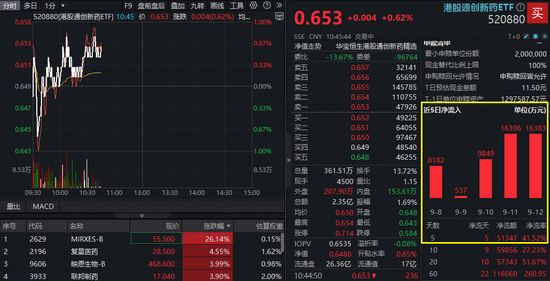
新进股冰火两重天,MIRXES-B狂飙26%一枝独秀,药捷安康-B回调10%,港股通创新药ETF(520880)高频溢价
Xin Lang Ji Jin· 2025-09-15 02:59
Core Viewpoint - The Hong Kong Stock Connect Innovation Drug ETF (520880) is experiencing strong performance and investor interest, with significant inflows and a focus on innovative drug development companies [1][3]. Group 1: ETF Performance - The Hong Kong Stock Connect Innovation Drug ETF (520880) has seen a trading volume exceeding 2.3 billion CNY, with a total inflow of over 5.1 billion CNY in the past week [1]. - The ETF is currently trading at a price of 0.653 CNY, reflecting a slight increase of 0.62% [2]. - The ETF has been consistently trading at a premium, indicating strong demand from investors [1]. Group 2: Market Trends - The ETF's underlying index has been revised to exclude CXO companies, focusing solely on innovative drug development firms, which enhances its ability to reflect the performance of China's innovative pharmaceutical sector [3]. - Recent policy support, including the inclusion of HPV vaccines in the national immunization program, is expected to benefit the innovative drug industry [3]. - The core product of one of the ETF's constituent companies, Yaojie Ankang, has received approval for a Phase II trial, marking a significant advancement in its research and development efforts [3]. Group 3: Sector Analysis - Analysts from Guojin Securities and Industrial Securities express optimism about the innovative drug sector, noting that while there may be increased volatility, the overall upward trend remains intact [3]. - The innovative drug sector is expected to continue being a core focus within the pharmaceutical industry, with ongoing policy support anticipated to enhance global competitiveness and commercial profitability [3]. - The top ten weighted stocks in the ETF include major players such as China Biologic Products, BeiGene, and CSPC Pharmaceutical Group, indicating a strong representation of leading companies in the innovative drug space [4].
《纽约时报》报道“特朗普政府拟对中国药品进行限制”
Tianfeng Securities· 2025-09-14 12:45
Investment Rating - Industry Rating: Outperform the Market (maintained rating) [5] Core Viewpoints - The Trump administration is considering strict restrictions on medicines from China, which could significantly impact the American pharmaceutical industry and the availability of various treatments [10][11] - The proposed executive order draft includes mandatory reviews of acquisitions by U.S. pharmaceutical companies of experimental drugs from Chinese firms and stricter scrutiny of clinical trial data from China [15][10] - Major pharmaceutical companies like Pfizer and AstraZeneca oppose these restrictions, as they benefit from cost-effective Chinese biotech assets [2][4] - The likelihood of the executive order being enacted is low due to its early discussion stage and the lack of positive feedback [3][5] - Even if the order is implemented, there are various countermeasures available, and the overall impact is expected to be manageable [5] Summary by Sections Section 1: Proposed Restrictions - The draft executive order aims to impose strict controls on Chinese medicines, requiring mandatory reviews for acquisitions and higher scrutiny on clinical data from China [10][15] - The order is seen as a response to concerns about national security and the competitive threat posed by China's biotech sector [11][10] Section 2: Industry Reactions - Major pharmaceutical companies are lobbying against the proposed restrictions, emphasizing the benefits of collaboration with Chinese biotech firms [2][4] - The lobbying efforts highlight a divide between investors tied to the Trump administration and established pharmaceutical companies [10][11] Section 3: Feasibility and Impact - The report suggests that the executive order's implementation is unlikely due to political and practical challenges [3][5] - The pharmaceutical industry is expected to adapt to any potential restrictions, maintaining a focus on global collaboration and innovation [5]
地缘扰动不改创新主线,集采规则持续优化
ZHONGTAI SECURITIES· 2025-09-14 12:44
Investment Rating - The report maintains a rating of "Overweight" for the pharmaceutical and biotechnology industry [2] Core Insights - Geopolitical disturbances and fluctuations in innovative drugs have limited impact on the innovation theme, while opportunities in medical devices are becoming apparent [9] - The report highlights the ongoing optimization of centralized procurement rules for medical consumables, indicating a shift from a "lowest price" approach to a "preventing excessive competition" strategy [10] - The approval process for innovative drugs is accelerating, with a new 30-day review channel established for eligible innovative drug applications [9][10] Summary by Sections Industry Overview - The pharmaceutical sector has shown a return of 26.80% since the beginning of 2025, outperforming the Shanghai Composite Index by 11.88 percentage points [14] - The report notes a mixed performance among sub-sectors, with medical devices and medical services showing positive growth while biopharmaceuticals and chemical drugs faced declines [9][14] Market Dynamics - The report indicates that the medical device sector is experiencing a recovery, with significant movements in stocks related to CRO/CDMO and medical devices [22] - Recent geopolitical news has caused short-term volatility in the innovative drug sector, but the market has quickly stabilized [9] Key Company Performance - The report recommends several companies for investment, including WuXi AppTec, WuXi Biologics, and others, which are expected to perform well in the current market environment [6][25] - The average performance of recommended stocks has shown a 6.64% increase this month, outperforming the broader pharmaceutical industry [24] Regulatory Developments - The National Medical Products Administration has announced measures to streamline the clinical trial approval process for innovative drugs, enhancing efficiency and transparency [9][12] - New procurement rules for coronary intervention balloon medical consumables have been introduced, emphasizing the need for reasonable pricing and cost commitments from bidding companies [10][12]


创新药行业周报:关注pan-KRAS抑制剂胰腺癌潜在突破投资机会-20250914
Xiangcai Securities· 2025-09-14 12:39
Investment Rating - The industry investment rating is "Buy" (maintained) [2] Core Viewpoints - The domestic innovative drug industry is entering a turning point in 2025, shifting from capital-driven to profit-driven operations, with ongoing support from fundamentals and policies expected to continue the dual recovery trend in performance and valuation [6][38] - The demand side shows significant certainty advantages, while the supply side is improving in terms of industry and market competition, leading to an overall optimization of the supply-demand structure [6][41] Summary by Sections Market Analysis and Outlook - The innovative drug sector is experiencing a recovery, with key policies supporting market expansion, including the introduction of the first Class B medical insurance directory and ongoing support for innovative drug pricing mechanisms [6][39][40] - Recent performance data shows a median weekly decline of 2.62% among 85 sample innovative drug companies, with notable performers including Yaoke Ankang-B and Shengnuo Pharmaceutical-B [7][18] Clinical Progress and Investment Opportunities - The KRAS G12D clinical progress indicates significant unmet clinical needs in pancreatic cancer, with promising data from Revolution Medicines showing improved efficacy compared to traditional chemotherapy [7][30][36] - The report highlights two main investment lines: 1. Pharma companies transitioning to innovation, with strong performance resilience and a focus on companies like Sanofi Pharmaceutical and Aosaikang [8][41] 2. Biotech companies with potential for overseas product registration, emphasizing the growth of R&D platforms and commercialization [8][41] Performance Metrics - The annual performance from January 1, 2025, to September 13, 2025, shows significant gains, with the Hang Seng Biotech index up 103.30%, A-share biotech up 53.54%, and NASDAQ biotech up 10.57% [10][20]
2024年医保数据梳理:收入持续增长,各项政策稳步推进-20250914
Ping An Securities· 2025-09-14 11:11
Investment Rating - The industry investment rating is "Outperform the Market" [1][87]. Core Viewpoints - The medical insurance coverage rate remains high, with a stable insurance participation rate above 94%, achieving near full coverage [2][12]. - Since 2018, the medical insurance fund revenue has consistently increased from 21,384 billion to 34,913 billion by 2024, while expenditures rose from 17,822 billion to 29,764 billion [2][7]. - The growth in the number of drugs listed in the medical insurance directory continues, increasing from 2,709 in 2018 to 3,159 in 2024, providing more options for insured individuals [4][69]. Summary by Sections Part 1: Overview of Medical Insurance - Medical insurance fund revenue has shown continuous growth, with a notable increase in expenditures outpacing revenue growth in recent years [7][11]. - The insurance participation rate has remained stable at over 94%, indicating effective coverage [12]. Part 2: Employee Medical Insurance - Employee medical insurance revenue constitutes over 63% of total medical insurance revenue, with significant contributions from employed individuals [19][23]. - The number of insured employees has grown from 31,681 million in 2018 to 37,948 million in 2024, although the growth rate has slowed [23][27]. - The average hospitalization costs have decreased, attributed to the implementation of the DRG payment policy [37][41]. Part 3: Resident Medical Insurance - The number of residents participating in medical insurance has declined since 2020, dropping from 102,483 million in 2019 to 94,714 million in 2024 [48][52]. - Despite the decline in participation, the fund revenue has maintained positive growth, increasing from 6,971 billion in 2018 to 11,181 billion in 2024 [48][52]. - The cumulative surplus of resident medical insurance has continued to grow, reaching 8,183 billion by 2024 [63]. Part 4: Other Aspects - The number of drugs in the medical insurance directory has increased significantly, enhancing the choices available to insured individuals [69][75]. - Medical assistance expenditures have risen from 425 billion in 2018 to 792 billion in 2024, indicating a strengthening of the safety net function [75][80]. - The policy for cross-regional medical treatment has been continuously promoted, with the number of participants in long-term care insurance also increasing [80][83]. Part 5: Investment Recommendations - The report suggests focusing on innovative pharmaceutical companies with rich pipeline layouts, such as Heng Rui Medicine and BeiGene [4][85]. - It also recommends attention to companies with significant single-product potential and those leading in advanced technology platforms [4][85].
行业周报:创新药行业进入快速成长期,关注未来6-12个月投资机会-20250914
KAIYUAN SECURITIES· 2025-09-14 06:08
Investment Rating - The investment rating for the pharmaceutical and biotechnology industry is "Positive" (maintained) [2] Core Insights - The biotech sector in China is experiencing stable revenue growth, with a significant reduction in net losses. In the first half of 2025, 32 Chinese biotech companies achieved revenue of 46.356 billion yuan, a year-on-year increase of 17.97%. Leading biotech firms have diversified product lines and international expansion, while some smaller companies are rapidly growing due to their core products [6][16] - There is a notable trend of Chinese innovative drug assets entering global markets, with the total amount of business development (BD) transactions reaching new records. The upfront payments and total transaction amounts for Chinese innovative drug assets have surged from 8.7/99.4 billion USD in 2020 to 49.4/561.2 billion USD in 2024. In the first half of 2025, the total transaction amount reached 63.55 billion USD, surpassing the total for 2024 and accounting for approximately 40% of global license-out transactions [7][24] - The report suggests focusing on investment opportunities in seven major innovative drug sectors over the next 6-12 months, including next-generation immuno-oncology, weight loss, and small nucleic acids, which are expected to see significant developments [9] Summary by Sections Biotech Revenue and Profitability - In the first half of 2025, the net loss of Chinese biotech companies narrowed significantly, with a total net loss of 1.755 billion yuan, a 50.34% reduction compared to the first half of 2024. Notably, companies like BeiGene turned a profit with a net income of 450 million yuan, marking its first profitable period [18][20] International Expansion of Chinese Innovative Drugs - The total amount of transactions involving multinational corporations (MNCs) purchasing Chinese assets has approached 100 billion USD from 2020 to the first half of 2025, with approximately 11 billion USD in upfront payments. Major companies like BMS, AZ, Merck, and Novartis have been particularly active in acquiring Chinese assets [8][27] Investment Recommendations - Recommended stocks include major pharmaceutical and biotech companies such as Hengrui Medicine, Innovent Biologics, and others across various sectors including traditional Chinese medicine, raw materials, medical devices, and healthcare services [10]


