
晶澳科技

Search documents
碳中和ETF泰康(560560)上涨2.44%,捷佳伟创领涨超11%,我国经济发展“含绿量”不断提升
Xin Lang Cai Jing· 2025-08-15 05:51
Group 1 - The carbon-neutral ETF Taikang (560560) has risen by 2.44%, tracking the CSI Mainland Low-Carbon Economy Theme Index (000977), which increased by 2.40% [1][2] - Key stocks such as JieJia WeiChuang (300724) rose by 11.44%, MingYang Smart Energy (601615) by 8.10%, and Sunshine Power (300274) by 8.08% [1] - The National Bureau of Statistics reported significant achievements in green development, with July production of new energy vehicles and lithium-ion batteries increasing by 17.1% and 29.4% year-on-year, respectively [1] Group 2 - The new MG4 model from SAIC's MG brand will feature semi-solid-state batteries, expected to be priced and delivered by the end of the year, marking a transition from laboratory to market [2] - Semi-solid-state batteries show outstanding low-temperature and safety performance, potentially addressing winter range issues for electric vehicles and enhancing battery safety under extreme conditions [2] - The CSI Mainland Low-Carbon Economy Theme Index consists of companies involved in clean energy generation, energy conversion and storage, clean production and consumption, and waste treatment, reflecting the overall performance of low-carbon economy theme stocks [2][3] Group 3 - The CSI Mainland Low-Carbon Economy Theme Index selects 50 core enterprises in the low-carbon economy, creating a full industry chain layout from clean energy generation to clean production and consumption [3] - Investing in the Taikang carbon-neutral ETF (560560) allows investors to easily participate in the growth of the carbon-neutral industry chain [3] - The ETF's diversified holdings help mitigate individual stock risks while capturing the benefits of leading companies in the sector [3]




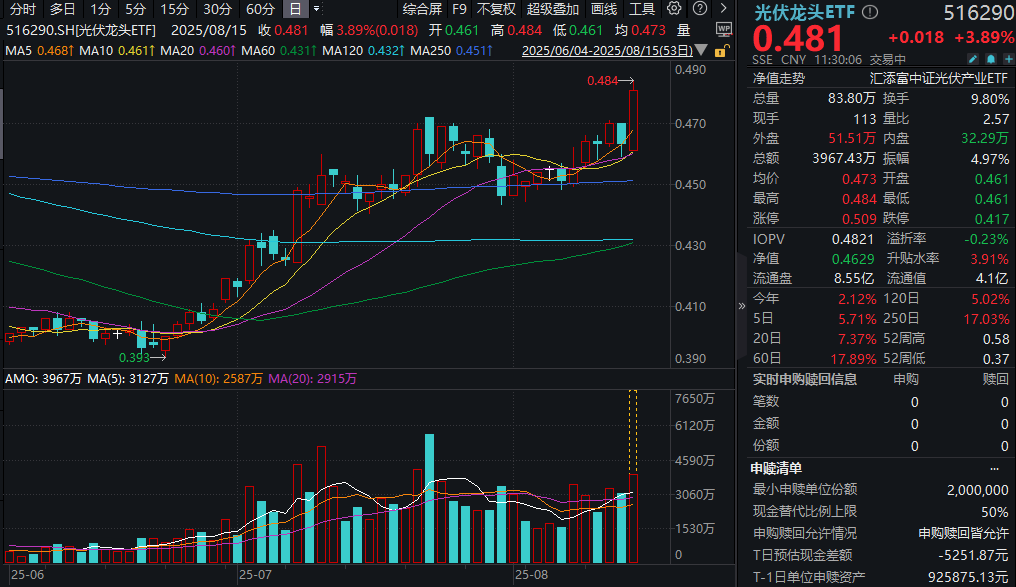
组件市场再现缺货涨价潮!联泓新科、科士达涨停,费率最低档的光伏龙头ETF(516290)爆量大涨4%,光伏“反内卷”板块加速!
Xin Lang Cai Jing· 2025-08-15 05:22
Core Viewpoint - The A-share market has shown a significant recovery, particularly in the photovoltaic sector, with the leading photovoltaic ETF (516290) experiencing a surge of nearly 4% and a trading volume reaching 40 million yuan [1][3]. Group 1: Market Performance - The photovoltaic leading ETF (516290) saw most of its constituent stocks rise sharply, with notable increases such as Jiejia Weichuang up over 11%, Quartz Co. up 10%, and several others hitting the daily limit [3]. - The top ten constituent stocks of the photovoltaic leading ETF include major players like Yangguang Electric (up 8.18%) and Tongwei Co. (up 7.16%) [3]. Group 2: Market Dynamics - The photovoltaic component market is experiencing shortages and price increases, with first-tier component companies quoting prices as high as 0.7 yuan/W [4]. - The European photovoltaic market is facing weak demand, leading to a general decline in inverter prices [4]. Group 3: Policy and Industry Outlook - There is a strong emphasis on reversing the "involution" in the photovoltaic industry, with recent government discussions focusing on eliminating low-quality, low-price competition and promoting the exit of outdated production capacity [5][6]. - The prices of key materials in the photovoltaic supply chain, such as polysilicon and silicon wafers, have seen significant increases, indicating a potential recovery in profitability for the industry [6][7]. - The photovoltaic sector is expected to benefit from a combination of government guidance and industry self-regulation, leading to a more rational pricing environment and improved fundamentals [7].




光伏ETF基金(159863)涨近2%,印尼百万光伏计划叠加硅料限产催化行情
Xin Lang Cai Jing· 2025-08-15 04:05
Group 1 - Indonesia has launched a "Million Solar Plan" aiming for 44% renewable energy share by 2030, with plans to build 100GW of solar power and 320GWh of energy storage, which is expected to benefit the solar industry chain with annual market sizes of 45 billion, 384 billion, and 456 billion for components, storage, and EPC respectively [1] - Polysilicon companies have reached a production limit agreement, capping monthly output at 80,000 tons, with leading firms operating at no more than 50% capacity to accelerate inventory reduction and improve industry profitability, involving companies like Tongwei Co., Ltd. and LONGi Green Energy [1] - The third quarter may see adjustments in solar energy consumption policies, with the Ministry of Industry and Information Technology planning to revise polysilicon energy consumption standards, potentially leading to the elimination of high-energy-consuming capacities and impacting silicon material supply [1] Group 2 - Zhongyou Securities highlights that China's green capacity is a strong support for global energy transition, and the China-Europe climate change joint statement is favorable for the further internationalization of Chinese renewable energy, with demand expected to improve under NDC 3.0 commitments, alongside "anti-involution" policies boosting profitability in the solar industry chain [2] - Galaxy Securities notes that the main issue in the solar industry currently lies on the supply side, with the revision of polysilicon energy consumption standards expected to drive the elimination of outdated capacities, indicating significant marginal improvement potential in the industry due to government guidance, industry self-discipline, and corporate actions [2] - Both institutions emphasize the trend of structural optimization in the solar industry driven by policies, while cautioning about the risks of energy transition not meeting expectations [2]
硅业分会:单晶硅片价格整体持稳运行 市场观望情绪较为浓厚
智通财经网· 2025-08-14 08:16
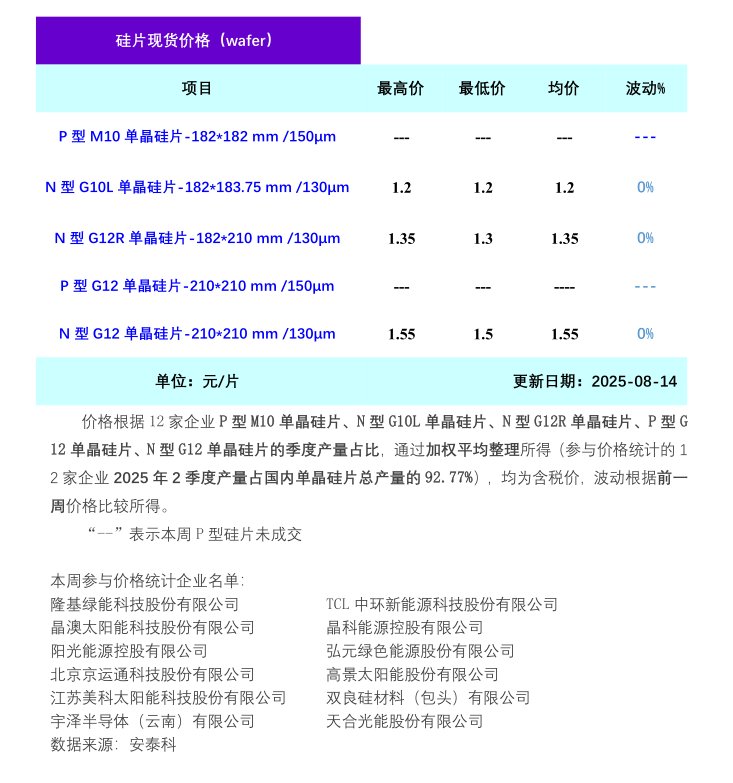
Group 1 - The core viewpoint of the articles indicates that the silicon wafer prices remain stable this week, with no significant fluctuations observed in the market [1][2] - The average transaction prices for various types of N-type silicon wafers are as follows: N-type G10L at 1.2 yuan/piece, N-type G12R at 1.35 yuan/piece, and N-type G12 at 1.55 yuan/piece, all unchanged from the previous week [1][3] - The market sentiment is characterized by a cautious outlook, with weak trading activity and limited orders due to high raw material prices and the inability of the price increases to effectively transmit to the end component segment [1][2] Group 2 - Downstream battery prices remain stable, while component prices have slightly decreased, with mainstream battery prices at 0.28-0.29 yuan/W and component prices at 0.65-0.67 yuan/W [2] - The overall operating rates in the industry show no significant changes, with leading companies operating at rates of 50% and 46%, while integrated companies operate between 50%-80% [1] - Future price pressures on silicon wafers may arise if domestic component demand continues to be weak, compounded by the lack of export tax rebate policies and changes in overseas geopolitical situations [2]
【安泰科】单晶硅片周评-市场观望情绪浓厚 硅片价格相对稳定(2025年8月14日)
中国有色金属工业协会硅业分会· 2025-08-14 08:06
Core Viewpoint - The silicon wafer market remains stable with no significant price fluctuations this week, as both supply and demand sides exhibit cautious behavior [1][2]. Group 1: Silicon Wafer Prices - N-type G10L monocrystalline silicon wafer (182*183.75mm/130μm) average transaction price is 1.2 yuan per piece, unchanged from last week [1]. - N-type G12R monocrystalline silicon wafer (182*210mm/130μm) average transaction price is 1.35 yuan per piece, unchanged from last week [1]. - N-type G12 monocrystalline silicon wafer (210*210mm/130μm) average transaction price is 1.55 yuan per piece, unchanged from last week [1]. - The overall market transaction volume is weak, with increased negotiation between buyers and sellers, leading to fewer purchasing orders [1][2]. Group 2: Market Dynamics - On the supply side, silicon wafer manufacturers are maintaining prices due to high raw material costs and a strong pricing stance [1]. - On the demand side, despite recent price increases in silicon materials and wafers, the price trend has not effectively transmitted to the terminal component segment, limiting acceptance of high-priced wafers [1]. - The export demand for batteries is beginning to decline due to the lack of implementation of export tax rebate policies and previous large-scale overseas order stockpiling [1][2]. Group 3: Production Rates - The overall industry operating rate shows no significant changes, with two leading companies operating at 50% and 46% respectively, while integrated companies operate between 50%-80% [1].
2025年8月:可转债产业链大图谱
GOLDEN SUN SECURITIES· 2025-08-14 05:06
1. Report Title and Date - The report is titled "Convertible Bond Industry Chain Map - August 2025" and was released on August 14, 2025 [1][2] 2. Core Viewpoint - The report comprehensively presents the convertible bond industry chains, including power and electrical equipment, mining, nonferrous metals and chemicals, machinery, transportation, automotive, electronics, military and TMT, real estate, finance, light industry and consumer goods, pharmaceutical and biological, and environmental protection industries, and provides the top ten monthly trading volumes of each industry chain in July [5][11][16] 3. Industry Chain Summaries 3.1 Power and Electrical Equipment Industry Chain - **Sub - industries and convertible bonds**: Include power generation equipment and construction (wind power, photovoltaic, thermal power equipment), power generation, power transmission and application, energy storage, etc., with convertible bonds such as Tongyu Convertible Bond and Long22 Convertible Bond [5][6][7] - **July monthly trading volume top ten**: Convertible bonds like Outong Convertible Bond and Xingang Convertible Bond are on the list, with trading volumes ranging from 58.34 billion yuan to 248.72 billion yuan [8][9] 3.2 Mining, Nonferrous Metals and Chemical Industry Chain - **Sub - industries and convertible bonds**: Cover steel, mining, nonferrous metals (aluminum, copper, etc.), chemical raw materials, basic chemicals, etc., with convertible bonds such as Bengang Convertible Bond and Shenghong Convertible Bond [11][12] - **July monthly trading volume top ten**: Convertible bonds such as Feilu Convertible Bond and Limin Convertible Bond are included, with trading volumes from 74.10 billion yuan to 281.53 billion yuan [13][14] 3.3 Machinery, Transportation, Automotive Industry Chain - **Sub - industries and convertible bonds**: Comprise machinery (special equipment, engineering machinery, etc.), automotive (parts, vehicle manufacturing), and logistics (road, cross - border, etc.), with convertible bonds such as Yong02 Convertible Bond and Yongan Convertible Bond [16][17][19] - **July monthly trading volume top ten**: Convertible bonds like Yongan Convertible Bond and Hao24 Convertible Bond are among them, with trading volumes from 50.95 billion yuan to 195.92 billion yuan [18][19] 3.4 Electronics Industry Chain - **Sub - industries and convertible bonds**: Include semiconductor materials and equipment, electronic chemicals, passive components, etc., with convertible bonds such as Huaya Convertible Bond and Jing23 Convertible Bond [21][22] - **July monthly trading volume top ten**: Convertible bonds like Jing23 Convertible Bond and Jingrui Convertible Bond are on the list, with trading volumes from 25.40 billion yuan to 405.90 billion yuan [24][25] 3.5 Military and TMT Industry Chain - **Sub - industries and convertible bonds**: Consist of communication equipment and services, military (aviation, aerospace, ground equipment, military electronics), computer, and media, with convertible bonds such as Fenghuo Convertible Bond and Mengsheng Convertible Bond [27][28][29] - **July monthly trading volume top ten**: Convertible bonds like Yingji Convertible Bond and Youzu Convertible Bond are included, with trading volumes from 31.37 billion yuan to 516.47 billion yuan [31][32] 3.6 Real Estate Industry Chain - **Sub - industries and convertible bonds**: Include building materials (cement, decoration materials, glass fiber), construction engineering, post - real estate and post - infrastructure related industries (household appliances), with convertible bonds such as Tianlu Convertible Bond and Zhongqi Convertible Bond [34][35][36] - **July monthly trading volume top ten**: Convertible bonds like Tianlu Convertible Bond and Zhongqi Convertible Bond are among the top ten, with trading volumes from 66.04 billion yuan to 560.22 billion yuan [40][41] 3.7 Financial Industry Chain - **Sub - industries and convertible bonds**: Include non - bank finance (securities, diversified finance) and banking (city commercial banks, rural commercial banks, joint - stock banks), with convertible bonds such as Caitong Convertible Bond and Pufa Convertible Bond [43][44] - **July monthly trading volume top ten**: Convertible bonds such as Pufa Convertible Bond and Xingye Convertible Bond are on the list, with trading volumes from 30.77 billion yuan to 197.15 billion yuan [46][47] 3.8 Light Industry and Consumer Goods Industry Chain - **Sub - industries and convertible bonds**: Cover papermaking, agriculture, forestry, animal husbandry and fishery, light industry manufacturing (packaging, home products, textiles), commerce and retail (general retail, cosmetics, food and beverage), with convertible bonds such as Tezhi Convertible Bond and Dayu Convertible Bond [49][50][51] - **July monthly trading volume top ten**: Convertible bonds like Dayu Convertible Bond and Jialian Convertible Bond are included, with trading volumes from 32.98 billion yuan to 384.42 billion yuan [54] 3.9 Pharmaceutical and Biological Industry Chain - **Sub - industries and convertible bonds**: Include pharmaceutical product production (innovative drugs, traditional Chinese medicine, chemical pharmaceuticals), medical devices, and pharmaceutical circulation and application, with convertible bonds such as Aorui Convertible Bond and Sailing Convertible Bond [56][57] - **July monthly trading volume top ten**: Convertible bonds like Sailing Convertible Bond and Borei Convertible Bond are among the top ten, with trading volumes from 54.07 billion yuan to 1244.37 billion yuan [59][60] 3.10 Environmental Protection Industry Chain - **Sub - industries and convertible bonds**: Comprise environmental monitoring, environmental protection equipment, comprehensive governance (water treatment, solid waste treatment), with convertible bonds such as Huahong Convertible Bond and Huicheng Convertible Bond [61][62] - **July monthly trading volume top ten**: Convertible bonds like Huicheng Convertible Bond and Huahong Convertible Bond are on the list, with trading volumes from 10.42 billion yuan to 478.28 billion yuan [64][65] 3.11 Hot Topics - **"Anti - involution"**: Convertible bonds related to power equipment and nonferrous metals are involved, such as Long22 Convertible Bond and Huayou Convertible Bond [67][68] - **"Humanoid robot"**: Convertible bonds from industries like basic chemicals, machinery, and electronics are included, such as Fuxin Convertible Bond and Daotong Convertible Bond [69][70] - **"Computing power and large models"**: Convertible bonds in communication, machinery, electronics, and computer industries are on the list, such as Fenghuo Convertible Bond and Kelan Convertible Bond [71][72]
帝尔激光半年净利增长38.37% 多项技术获突破巩固行业领先地位
Chang Jiang Shang Bao· 2025-08-13 23:56
Core Viewpoint - The company, Dier Laser, continues to demonstrate strong performance driven by technological innovation and significant orders, achieving substantial revenue and profit growth in the first half of 2025 [1][4][5]. Financial Performance - In the first half of 2025, Dier Laser reported revenue of 1.17 billion yuan, a year-on-year increase of 29.2%, and a net profit of 327 million yuan, up 38.37% [1]. - For the full year of 2024, the company achieved revenue of 2.014 billion yuan, a growth of 25.20%, and a net profit of 528 million yuan, increasing by 14.40% [3]. - The gross margin for solar cell laser processing equipment rose from 46.93% to 47.57% in the first half of 2025 [4]. Business Expansion and Innovation - Dier Laser has focused on its core business while actively expanding into consumer electronics, new displays, and integrated circuits, creating new growth points [1][2]. - The company has made breakthroughs in various laser technologies, including TOPCon and perovskite, enhancing its competitive edge in the photovoltaic industry [1][5]. - Dier Laser has developed innovative laser micro-etching technology that replaces traditional photolithography, simplifying processes and reducing costs in the BC battery sector [5][6]. Client Base and Orders - The company has established a strong client base, including major photovoltaic manufacturers such as Longi Green Energy and Trina Solar, becoming a comprehensive solution provider [3][4]. - In October 2024, Dier Laser signed significant contracts worth 1.229 billion yuan with leading photovoltaic companies, representing 76.36% of its audited revenue for 2023 [3][7]. Research and Development - Dier Laser maintains a high level of investment in R&D, with 439 domestic and international patents as of June 30, 2025, and has established multiple R&D centers globally [6][7]. - The company is involved in various national strategic emerging industry projects and has built a strong international R&D team to drive innovation [6].

晶澳科技(002459)8月13日主力资金净流出1406.67万元
Sou Hu Cai Jing· 2025-08-13 12:16
金融界消息 截至2025年8月13日收盘,晶澳科技(002459)报收于11.14元,上涨0.72%,换手率 1.17%,成交量38.52万手,成交金额4.28亿元。 资金流向方面,今日主力资金净流出1406.67万元,占比成交额3.29%。其中,超大单净流出106.38万 元、占成交额0.25%,大单净流出1300.29万元、占成交额3.04%,中单净流出流入2330.81万元、占成交 额5.45%,小单净流出924.14万元、占成交额2.16%。 晶澳科技最新一期业绩显示,截至2025一季报,公司营业总收入106.72亿元、同比减少33.18%,归属净 利润163848.93万元,同比减少239.35%,扣非净利润140594.20万元,同比减少281.18%,流动比率 1.218、速动比率0.962、资产负债率76.33%。 天眼查商业履历信息显示,晶澳太阳能科技股份有限公司,成立于2000年,位于邢台市,是一家以从事 电气机械和器材制造业为主的企业。企业注册资本330967.9544万人民币,实缴资本330967.8734万人民 币。公司法定代表人为靳保芳。 通过天眼查大数据分析,晶澳太阳能科技股份有 ...
TOPCon出货占比88.3%,210RN一年占比跃升23.4%,全球光伏格局微调
Jin Rong Jie· 2025-08-13 08:56
Group 1: Core Insights - The latest photovoltaic rankings by InfoLink show slight adjustments in the positions of leading companies in the battery and module segments for the first half of the year [1] - In the battery segment, Tongwei Co. remains the leader, while Aiko Solar holds the fifth position, and Yingfa Energy has moved up to third, swapping places with Jetta Technology [1] - In the module segment, JinkoSolar maintains its top position, followed by Longi Green Energy, with JA Solar and Trina Solar tied for third place [1] Group 2: Technology Trends - TOPCon solar cells dominate the market with an 88.3% shipment share in the first half of the year, while traditional PERC cells account for approximately 11.2% [2] - The larger 210RN size in TOPCon cells has seen a significant increase in shipment share, rising to about 31.4% from 8% year-on-year [2] - Yingfa Energy has begun shipping BC solar cells, becoming the first specialized battery manufacturer to export BC cells globally, with N-type cell shipments ranking among the top two worldwide [2] Group 3: Market Dynamics - The total shipment volume of the top five battery suppliers reached approximately 87.8 GW, reflecting a year-on-year growth of about 12.5% [3] - The top ten module suppliers shipped around 247.9 GW, marking a 10% increase compared to the previous year, with the top ten accounting for about 80% of total module production [3] - Tongwei Co. and Yida New Energy reported shipment growth rates of 30-40%, indicating rapid expansion in their module business [3]



光伏产业出清落后产能 需打破地方保护壁垒
Zheng Quan Shi Bao· 2025-08-13 05:51
Core Viewpoint - The photovoltaic industry is facing significant challenges, including severe supply-demand mismatches and continuous losses over multiple quarters, prompting a consensus for "anti-involution" within the industry [1][3]. Group 1: Industry Challenges - The photovoltaic industry has seen a drastic decline in revenue, with total revenue for 64 listed companies projected to be 931.1 billion yuan in 2024, a decrease of 22.4% year-on-year, and a shift from a profit of 104.9 billion yuan in 2023 to a loss of 29.8 billion yuan in 2024 [3]. - The industry is currently in a painful transition period, with many companies understanding the regulatory push against low-price competition and the need for capacity optimization [2][3]. Group 2: Policy and Market Responses - The Ministry of Industry and Information Technology held a meeting with 14 photovoltaic companies to discuss production, innovation, and market competition, which has instilled confidence in the industry [2]. - Industry leaders are advocating for a combination of market-driven mergers, technological elimination, and policy enforcement to clear outdated capacities [3][4]. Group 3: Capacity Reduction Strategies - Companies are exploring market-based capacity reduction strategies, such as larger firms acquiring smaller ones to streamline production [4][5]. - The head of GCL-Poly Energy mentioned that leading companies control 60%-70% of effective silicon material capacity and are negotiating acquisitions with smaller firms [5]. Group 4: Technological Innovation - Technological advancements are seen as a crucial method for market-driven capacity reduction, with companies focusing on high-efficiency products to outcompete lower-quality offerings [6]. - The industry is encouraged to adopt advanced technologies to enhance competitiveness and facilitate the exit of outdated capacities [6][7]. Group 5: Local Government Challenges - The complexity of capacity reduction is exacerbated by local government interests, as closures can lead to conflicts with regional economic priorities [8]. - There are concerns about local protectionism, which may hinder the necessary capacity reductions and complicate the industry's recovery [8][9].