中交地产

Search documents
交易价仅1元,天津这家国企退出房地产开发业务
Feng Huang Wang· 2025-10-29 06:24
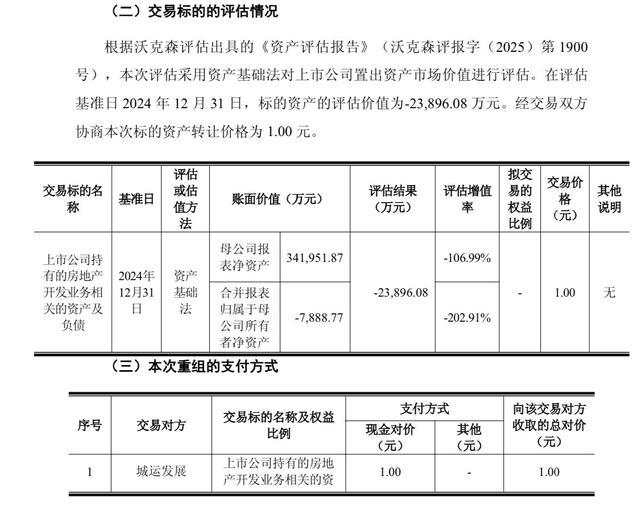
Core Viewpoint - Tianjin Jintou Urban Development Co., Ltd. plans to divest its real estate development business by transferring related assets and liabilities to Tianjin Urban Operation Development Co., Ltd. for a nominal price of 1 yuan, with the assessed value of the assets at approximately -239 million yuan as of December 31, 2024 [1][4][5]. Group 1: Company Overview - Tianjin Jintou Urban Development Co., Ltd. is a state-controlled listed company with a history dating back to 1981, primarily engaged in real estate development and sales [4]. - The company has accumulated significant experience in land assessment, product design, and operational delivery over the years [4]. - The divestiture aims to allow the company to focus on lighter assets and more stable operations, particularly in property management [4][5]. Group 2: Financial Implications - Following the transaction, the company expects a significant reduction in total assets and liabilities, while net assets and net profits are projected to increase substantially, improving asset quality and capital structure [8]. - The company reported a net profit of -54,255.02 million yuan for the first half of 2025, indicating a 100.29% increase compared to the previous period, while total revenue dropped by 92.62% [8]. Group 3: Industry Context - The real estate sector is undergoing significant adjustments, with several companies divesting from real estate development due to operational pressures [9][10]. - The market is experiencing a decline in new housing sales and investment, leading to increased financial strain on developers [10]. - Analysts suggest that the role of real estate in driving economic growth is shifting, with the industry transitioning from a primary growth driver to a supportive role in urban development and housing stability [10].


政策延续宽松导向,外资、险资“抢滩”布局核心资产
Sou Hu Cai Jing· 2025-10-27 11:26
Core Insights - The real estate industry in Q3 2025 is characterized by "policy support + trend bottoming," with increasing financial pressure on residential development, stable operations in commercial real estate, high debt pressure in industrial parks, and strong risk resistance in warehousing and logistics [2][3] Residential Development - The residential development sector continues to experience dual characteristics of "policy support + trend bottoming" in Q3 2025, with major cities like Beijing, Shanghai, and Shenzhen further relaxing purchase restrictions and optimizing housing fund policies [3] - The average net debt ratio increased from 81.40% in 2022 to 88.15% in Q2 2025, while EBITDA margin dropped from 13.41% to -4.44%, indicating significant financial stress [3][4] - The average sales gross margin decreased from 18.53% in 2022 to 12.01% in Q2 2025, reflecting ongoing challenges in profitability [4] Commercial Real Estate - Commercial real estate companies maintain relatively stable financial conditions, with a net debt ratio around 8% in Q2 2025 [4][6] - The leasing demand in Shanghai's office market has shown a notable recovery, with finance, consumer goods, and professional services being the top three sources of leasing demand [4][6] Industrial Parks - Industrial park enterprises face high debt and profitability pressures, with the average net debt ratio rising from 65.31% in 2022 to 90.56% in Q2 2025 [5][6] - The EBITDA margin remains high at 42.33%, but the diluted ROE decreased from 7.73% to -0.33%, indicating declining returns [5][6] Warehousing and Logistics - Warehousing and logistics companies demonstrate strong risk resistance, with the average net debt ratio increasing from 9.78% in 2022 to 19.48% in Q2 2025 [9][10] - The EBITDA margin remains positive, and companies are investing in smart logistics and cold chain logistics to enhance efficiency and service quality [9][10] Debt Market Dynamics - The total issuance of real estate debt has decreased, while the amount due for repayment has reached a new high, with a total repayment amount of 1394.30 billion yuan in Q3 2025, up 5.1% year-on-year [11] - The net financing amount has shown a "negative expansion" trend, with net financing below -200 billion yuan for three consecutive quarters [11] Foreign Investment and REITs - Foreign and domestic collaborations are accelerating in core asset layouts, with significant transactions recorded in the commercial real estate sector, totaling approximately 331.2 billion yuan in Q3 2025 [13] - The REITs market is evolving from a "single type" to a "diversified structure," with new categories like consumer REITs gaining traction and foreign institutional participation bringing new vitality and opportunities [15]

107股股东户数连续下降 (附股)
Zheng Quan Shi Bao Wang· 2025-10-27 09:49
Core Insights - The article highlights a trend of decreasing shareholder accounts among 666 companies, indicating a concentration of shares, with 107 companies experiencing a decline for more than three consecutive periods [1][2]. Group 1: Shareholder Account Trends - 107 companies have seen their shareholder accounts decrease for more than three consecutive periods, with some like *ST Zhongdi experiencing a decline for 16 periods, totaling a 26.41% drop [1]. - Other notable companies with significant declines include Fengshang Culture, which has seen a 44.86% drop over 10 periods, and Xinlian Electronics, Yungli Co., and ST Emergency also showing similar trends [1][2]. Group 2: Market Performance - Among the companies with decreasing shareholder accounts, 41 have seen their stock prices rise, while 65 have experienced declines, with notable gainers including Jingquanhua (up 56.63%), Xinbang Intelligent (up 31.44%), and Changshan Pharmaceutical (up 29.43%) [2]. - 12 companies outperformed the Shanghai Composite Index, with Jingquanhua, Xinbang Intelligent, and China Merchants Energy showing relative returns of 52.00%, 27.83%, and 25.35% respectively [2]. Group 3: Institutional Interest - In the past month, 7 companies with decreasing shareholder accounts have been subject to institutional research, with Meihua Medical, Jingbeifang, and Feilong Co. receiving the most attention from 72, 56, and 16 institutions respectively [2]. Group 4: Financial Performance - 34 companies have released their Q3 reports, with Xinlian Electronics reporting the highest year-on-year net profit growth of 421.43% [2].




金科股份高层大换血 资产处置高手郭伟“挂帅”
Xin Jing Bao· 2025-10-17 15:13
Core Viewpoint - Jinke Co., Ltd. has completed its bankruptcy restructuring plan involving a debt scale of 147 billion yuan and over 8,400 creditors, marking a new phase for the company with a newly elected board of directors and management team [2][3] Management Changes - The new management team includes Guo Wei as Chairman, President, and Deputy Secretary of the Party Committee, Wang Xiaoqing as Vice Chairman, and Zhou Da as Co-President, indicating a diverse and professional background in real estate development, asset management, and equity investment [3][4] - The board of directors consists of both independent and non-independent members, with a focus on strategic resource reallocation through partnerships with various investment entities [3][5] Strategic Direction - Jinke has set up four major business segments post-restructuring: investment management, development services, operational management, and special assets, aiming to innovate and find new growth opportunities [7] - The restructuring is seen as a necessary step to unload historical burdens and align the new management's capabilities with the company's focus on special asset management [7] Key Appointments - Ma Weihua has been appointed as Party Secretary and Honorary Chairman, while Feng Lun will serve as the Chairman of the Expert Advisory Committee, both bringing significant industry experience to support the company's strategic management [6][7] - The involvement of these key figures is expected to enhance the company's ability to convert external capital and resources into actual performance [6] Market Context - Jinke is positioned to become the first publicly listed real estate company in China to resolve over 100 billion yuan in debt through judicial restructuring, highlighting its unique market position [3][5] - The new management faces challenges in revitalizing existing assets and balancing traditional development with emerging operational management amidst a still-adjusting real estate market [7]

金科股份高层大换血,资产处置高手郭伟“挂帅”
Bei Ke Cai Jing· 2025-10-17 15:08
Core Viewpoint - Kins Technology Co., Ltd. has officially completed its twelfth board of directors election on October 16, marking a new phase after its bankruptcy restructuring plan involving a debt scale of 147 billion yuan and over 8,400 creditors [1][2]. Group 1: Management Changes - The new management team includes Guo Wei as Chairman, President, and Deputy Secretary of the Party Committee, Wang Xiaoqing as Vice Chairman, and Zhou Da as Co-President [1][4]. - The board consists of experienced professionals from various fields such as real estate development, asset management, and equity investment, indicating a diversified and specialized structure [5][9]. - Guo Wei, the new leader, has extensive experience in complex asset disposal, which will support the company's business development [6][9]. Group 2: Strategic Restructuring - Kins Technology is the first publicly listed real estate company in China to resolve over 100 billion yuan in debt through judicial restructuring [3]. - The new board and management team aim to implement a strategic transformation, focusing on four major business segments: investment management, development services, operational management, and special assets [9]. - The restructuring process involves collaboration with strategic investors, including Shanghai Pinqi and China Great Wall Asset, to reallocate resources effectively [6][9]. Group 3: Key Appointments - Ma Weihua has been appointed as the Party Secretary and Honorary Chairman, while Feng Lun will serve as the Chairman of the Expert Advisory Committee [8]. - Both Ma Weihua and Feng Lun bring significant industry experience and management capabilities, which are expected to guide the company's strategic direction and operational performance [8][9]. Group 4: Market Challenges - The new management faces the challenge of revitalizing existing assets and balancing traditional development with emerging operational management amidst a still-adjusting real estate market [9].
央企房地产行业ESG评价结果分析:环境与社会均好,气候披露需完善:A股央企ESG报告系列报告之四
Shenwan Hongyuan Securities· 2025-10-14 12:11
Investment Rating - The report does not explicitly state an investment rating for the industry, but it provides insights into the ESG performance of central enterprises in the real estate sector, indicating a mixed performance across various metrics [3][4]. Core Insights - The report evaluates the ESG performance of 10 central enterprises in the real estate sector, revealing that over half of the companies scored above 60 points, with social responsibility and governance aspects performing relatively well, while climate and environmental disclosures need improvement [10][23]. - The overall scores show significant variation, with three companies scoring below 60, three between 80-89 (including China Merchants Shekou, Poly Developments, and Joy City), and one company, China Merchants Jinling, scoring above 90 [10][23]. Summary by Sections 1. Overall Scores and Climate Disclosure - More than half of the companies scored above 60 points, indicating a need for improvement in climate disclosures [10]. - Companies with scores below 60: 3; scores between 80-89: 3; scores above 90: 1 [10]. 2. Environmental Performance - The environmental indicators scored relatively high, with most companies showing strong awareness of environmental protection [16]. - Five companies scored between 17-20 points, and four scored between 14-16 points, reflecting a commitment to resource utilization and emission reduction [16]. 3. Climate Performance - The climate indicators scored lower, with over half of the companies needing to enhance their climate disclosures [23]. - Three companies scored between 14-19 points, while five scored between 0-6 points, indicating a lack of emphasis on climate disclosures [23]. 4. Social Responsibility - The social indicators scored high, with five companies scoring between 23-29 points, demonstrating a strong commitment to social responsibility [29]. - Companies actively engaged in rural revitalization and public welfare initiatives, with detailed disclosures on consumer rights protection [29]. 5. Governance - The governance indicators scored high, with most companies having well-structured governance frameworks [41]. - Six companies scored between 17-22 points, indicating robust internal control and compliance management systems [41].




A股央企ESG报告系列报告之四:央企房地产行业ESG评价结果分析:环境与社会均好,气候披露需完善
Shenwan Hongyuan Securities· 2025-10-14 11:13
Investment Rating - The report gives a positive outlook on the central state-owned real estate industry, rating it as "Look Favorably" [3] Core Insights - The report evaluates the ESG performance of 10 central state-owned enterprises in the real estate sector, highlighting that over half of the companies scored above 60 points, with strong performance in social responsibility and governance, but needing improvement in climate and environmental disclosures [4][12] - The scoring results show a significant disparity, with three companies scoring below 60, three between 80-89 (including China Merchants Shekou, Poly Developments, and Dayuecheng), and one company, China Merchants Jinling, scoring above 90 [12] - The report emphasizes the importance of enhancing climate disclosures, as over half of the companies still need to improve in this area [27] Summary by Sections Overall Score Distribution - More than half of the companies scored above 60 points, indicating a relatively good performance in social responsibility and environmental aspects, while climate disclosures require further enhancement [12][27] Environmental Performance - Most central state-owned real estate companies show strong awareness of environmental protection, with five companies scoring between 17-20 points and four companies scoring between 14-16 points [18][22] - Companies have disclosed resource utilization and emission reduction measures, with high scores in "green low-carbon measures," "green buildings," and "green construction" [18][22] Climate Performance - The climate indicators received lower scores, with three companies scoring between 14-19 points and five companies scoring between 0-6 points, indicating a need for improved climate disclosures [27][32] - Only one company, China Merchants Jinling, fully disclosed its climate governance measures, while eight companies disclosed their climate response strategies, but only one did so completely [29][33] Social Responsibility - The social indicators scored relatively high, with five companies scoring between 23-29 points, demonstrating good performance in fulfilling social responsibilities, including rural revitalization and consumer rights protection [35][39] - Nine companies disclosed rural revitalization cases, and five companies reported measures for constructing affordable housing [39] Governance - The governance indicators also scored high, with most companies having well-structured governance frameworks. Six companies scored between 17-22 points, while four scored between 14-16 points [47][52] - All ten companies disclosed their governance structures, indicating a commitment to transparency and compliance [52][56]
旭辉变卖资产,拿到2.76亿港元“救命钱”
21世纪经济报道· 2025-10-02 15:07
Core Viewpoint - CIFI Holdings has taken a significant step towards asset monetization to alleviate debt pressure by selling 142 million shares of its property management subsidiary, Yongsheng Services, to LMR Multi-Strategy Master Fund Limited at a premium price, raising approximately HKD 276 million [1][2][4]. Group 1: Transaction Details - The sale involves 8.24% of Yongsheng Services' total shares at a price of HKD 1.94 per share, which is about 10% higher than the previous day's closing price [1][4]. - The proceeds from the sale will be used for restructuring offshore debts and liabilities, with a minimum transaction period of 364 days, extendable up to three years at LMR's discretion [2][4]. - LMR, managing over USD 12 billion in assets, views this transaction purely as a financial investment without seeking board representation or involvement in management decisions [4][6]. Group 2: Financial Implications - Yongsheng Services has a high dividend payout ratio, with a 70% payout in the first half of 2025, amounting to approximately RMB 150 million in dividends, and a commitment to maintain a minimum 50% payout over the next two years [4][6]. - The transaction structure includes provisions to ensure LMR receives a minimum annual return of 7%, while also preventing short-selling and securities lending of Yongsheng shares [6][7]. Group 3: Market Context - The sale is part of a broader trend in the real estate industry where companies are optimizing their debt structures through asset sales, with CIFI's offshore debt restructuring plan expected to reduce its total offshore debt by approximately USD 5.27 billion, or 66% of the total [6][9]. - The innovative transaction structure and premium sale price reflect international capital's recognition of the investment value in leading companies within China's property management sector, signaling positive market sentiment [7][9]. Group 4: Industry Trends - The article highlights various strategies employed by real estate companies to manage debt, including asset sales, debt-for-equity swaps, and innovative financing methods, indicating that the path to debt resolution varies significantly among firms based on their asset profiles and market conditions [9][12]. - The trend towards asset monetization and strategic transformation is becoming crucial for the survival of real estate companies, emphasizing the need to balance liquidity with long-term competitiveness [12][13].

不打折!旭辉2.76亿港元溢价出售永升服务8.24%股权
2 1 Shi Ji Jing Ji Bao Dao· 2025-09-30 11:29
Core Viewpoint - CIFI Holdings has initiated asset monetization to alleviate debt pressure following its offshore debt restructuring plan, selling a stake in its property management subsidiary, Yongsheng Services, to LMR Multi-Strategy Master Fund Limited at a premium price [1][2][5]. Group 1: Transaction Details - CIFI Holdings announced the sale of 142 million shares of Yongsheng Services, representing approximately 8.24% of its total share capital, at a price of HKD 1.94 per share, which is about 10% higher than the previous closing price, raising approximately HKD 276 million [1][2]. - The transaction is structured to provide LMR with a minimum annual return of 7%, with Yongsheng Services committing to a dividend payout ratio of no less than 50% over the next two years [2][3]. Group 2: Strategic Implications - The sale of Yongsheng Services shares is seen as a strategic move to avoid significant discounts on quality assets, thereby maintaining market confidence and providing crucial liquidity for debt restructuring [2][3]. - CIFI Holdings has previously executed an offshore debt restructuring plan, which is expected to reduce its offshore debt by approximately USD 5.27 billion, accounting for 66% of its total offshore debt [2]. Group 3: Market Context - The transaction reflects a broader trend in the real estate industry where companies are optimizing their debt structures through asset sales, with various strategies being employed across different firms [4][10]. - The introduction of international long-term capital is expected to enhance market confidence in Yongsheng Services, which is recognized for its high dividend characteristics, attracting financial investment [3][5].
总结与展望 | 2025年三季度中国房地产行业总结与展望(下)
克而瑞地产研究· 2025-09-29 08:58
Performance Summary - The overall performance of the real estate market continues to bottom out, with 31% of the top 100 real estate companies showing year-on-year growth in performance [3][13] - From January to August 2025, the cumulative sales amount of the top 100 real estate companies was 20,708.8 billion, a decrease of 13.1% year-on-year, indicating a low level of sales activity [5][6] - The number of companies in the top 100 with sales growth is 31, with 23 companies experiencing growth greater than 20% [13][14] Financing Summary - In the first three quarters of 2025, financing for real estate companies decreased by 30% year-on-year, with a total financing amount of 307.2 billion [18][26] - The cost of domestic bond financing decreased to 2.57%, while the cost of offshore bond financing was significantly higher at 8.95% [27][30] - Approximately 85% of new financing in 2025 was attributed to state-owned enterprises, highlighting a disparity in financing access among different types of companies [30] Market Outlook - The market is expected to continue its bottoming trend, with local policies being optimized to support recovery, particularly in first-tier and strong second-tier cities [17][32] - The introduction of public REITs is seen as a potential solution for real estate companies to transition from heavy asset models to lighter operational models, aiding in debt repayment and liquidity [33][36] - The debt maturity pressure is expected to increase in 2025, with a peak in the third quarter, necessitating proactive debt management strategies from real estate companies [32][36]