光威复材

Search documents
航空装备板块1月16日跌1.39%,洪都航空领跌,主力资金净流出10.28亿元
Zheng Xing Xing Ye Ri Bao· 2026-01-16 09:00
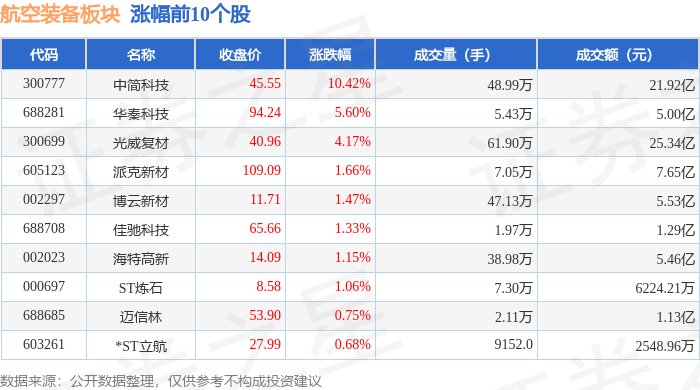
Core Viewpoint - The aviation equipment sector experienced a decline of 1.39% on January 16, with Hongdu Aviation leading the drop. The Shanghai Composite Index closed at 4101.91, down 0.26%, while the Shenzhen Component Index closed at 14281.08, down 0.18% [1]. Group 1: Stock Performance - Zhongjian Technology (300777) saw a significant increase of 10.42%, closing at 45.55 with a trading volume of 489,900 shares and a transaction value of 2.192 billion [1]. - Huayin Technology (688281) increased by 5.60%, closing at 94.24 with a trading volume of 54,300 shares and a transaction value of 500 million [1]. - Guangwei Composite (300699) rose by 4.17%, closing at 40.96 with a trading volume of 619,000 shares and a transaction value of 2.534 billion [1]. - Hongdu Aviation (600316) led the decline with a drop of 6.10%, closing at 39.10 with a trading volume of 320,700 shares and a transaction value of 1.276 billion [2]. - The overall aviation equipment sector saw a net outflow of 1.028 billion from major funds, while retail investors contributed a net inflow of 178 million [2][3]. Group 2: Fund Flow Analysis - Guangwei Composite (300699) had a net inflow of 187 million from major funds, but a net outflow of 105 million from speculative funds [3]. - Light Technology (002625) experienced a net inflow of 54.995 million from major funds and a net inflow of 28.857 million from speculative funds [3]. - The net inflow for Haite High-tech (002023) from major funds was 31.967 million, while it faced a net outflow of 60.784 million from retail investors [3].


我国量产地表超强材料,单丝直径不到头发丝十分之一
Xuan Gu Bao· 2026-01-15 15:18
Group 1 - The domestic T1000-grade high-performance carbon fiber has been developed, featuring 12,000 filaments per strand, with a weight of only 0.5 grams per meter and tensile strength exceeding 6,600 MPa, making it 7 to 8 times stronger than steel [1] - This breakthrough signifies a leap from T300 to T1000 in domestic carbon fiber production, addressing the "bottleneck" issue in high-end materials and providing strong momentum for the upgrade of high-end manufacturing during the 14th Five-Year Plan [1] Group 2 - The high-performance carbon fiber industry in China is at a critical transformation point, shifting from meeting domestic demand to participating in global high-end competition, with a projected capacity exceeding 250,000 tons by 2030, accounting for over 50% of global demand [2] - The usage of carbon fiber in the new energy vehicle sector is expected to increase from 5% to 20%, with the demand in this sector projected to represent 45% of total demand by 2030, making it the largest single application area [2] - The low-altitude economy in China is expected to exceed 1 trillion yuan by 2026, leading to a surge in carbon fiber demand from core carriers like eVTOL and drones [2] Group 3 - Relevant A-share concept stocks include Zhongjian Technology and Guangwei Composites [3]
深度|商业航天新材料全景图:新材料企业的机遇与投资逻辑(附20+报告)
材料汇· 2026-01-14 14:18
Core Insights - The global commercial aerospace market is projected to reach a size of $75-125 billion in 2024, with an expected growth to $140 billion by 2025. In China, the market is anticipated to reach 2.3 trillion RMB in 2024, growing by 22.9% year-on-year, and is expected to exceed 2.8 trillion RMB in 2025. Material technology is becoming a core factor determining the competitiveness of commercial aerospace companies [1] - The demand for materials in commercial aerospace differs significantly from traditional aerospace, with a focus on lightweight materials, high-temperature resistance, and reliability to reduce costs. The cost savings of approximately 20,000-30,000 RMB per kilogram of payload make lightweight materials a priority [1] Overview of Key New Materials in Commercial Aerospace - A total of 128 new materials have been identified as critical for commercial aerospace applications, categorized into various types including aluminum-lithium alloys, titanium alloys, stainless steel, high-temperature alloys, copper alloys, and composite materials [3][4] - Aluminum-lithium alloys (e.g., 2195, 2099) are used in rocket storage tanks and main structures, offering a weight reduction of 10-15% compared to traditional aluminum alloys, with a strength increase of 20% [4] - Titanium alloys (e.g., Ti-6Al-4V) are utilized in engine components and satellite structures, with a density of 4.5 g/cm³ and high-temperature resistance up to 600°C [4] - Carbon fiber composites (e.g., T300, T700) are essential for rocket fairings and satellite shells, providing a strength-to-weight ratio significantly higher than steel [4][5] Application of Carbon Fiber Composites - Carbon fiber composites (CFRP) are crucial in commercial aerospace, accounting for 15-20% of the manufacturing cost of medium-sized reusable rockets, with values exceeding 20 million RMB per unit [10] - In satellite manufacturing, carbon fiber costs represent 12-15% of total costs for low Earth orbit satellites, with values ranging from 8-12 million RMB, and over 25% for high Earth orbit satellites, exceeding 15 million RMB [10][11] - The T700 grade carbon fiber has a tensile strength of ≥4.9 GPa and is used in less critical components, while T800 and T1100 grades are used in more demanding applications, with T1100 achieving a tensile strength of 7.0 GPa [11] High-Temperature Materials and Refractory Metals - Ultra-high temperature materials are critical for rocket engine technology, with combustion chamber temperatures exceeding 3000°C and nozzle throat temperatures above 1650°C [15] - Ceramic matrix composites (C/C) and high-temperature alloys (e.g., nickel-based alloys) are essential for engine components, with domestic production rates for high-temperature alloys exceeding 95% [19][20] - Refractory metals (e.g., tungsten, molybdenum) are key materials for extreme temperature environments, with applications in rocket engine nozzles and fuel storage systems [23][24] Emerging and Sustainable Materials - Emerging materials such as self-healing composites and biodegradable polymers are being explored for their potential in reducing environmental impact and enhancing the longevity of aerospace components [8] - The use of recycled carbon fiber composites is being piloted, offering a cost reduction of 50% while maintaining 90% of the original strength [8]

PEEK材料概念下跌0.78% 7股主力资金净流出超亿元
Zheng Quan Shi Bao Wang· 2026-01-14 10:28
Market Performance - The PEEK materials concept declined by 0.78%, ranking among the top losers in the concept sector, with notable declines from companies like Prilite, Changying Precision, and Meihua Co. [1] - In contrast, 13 stocks within the sector experienced price increases, with Chaojie Co., Wanrun Co., and Hailide Co. leading the gains at 6.25%, 5.04%, and 4.78% respectively [1] Capital Flow - The PEEK materials concept saw a net outflow of 3.792 billion yuan in principal funds, with 40 stocks experiencing net outflows, and 7 stocks seeing outflows exceeding 100 million yuan [1] - Changying Precision led the outflows with a net outflow of 1.290 billion yuan, followed by Tianci Materials, Guangwei Composites, and Jinfat Technology with outflows of 431 million yuan, 375 million yuan, and 304 million yuan respectively [1] - Conversely, the stocks with the highest net inflows included Wanrun Co., Hailide Co., and Prilite, with net inflows of 65.954 million yuan, 34.272 million yuan, and 16.478 million yuan respectively [1] Stock Performance - The top stocks with significant net outflows in the PEEK materials sector included: - Changying Precision: -4.13% with a turnover rate of 10.30% and a net outflow of 1.289 billion yuan - Tianci Materials: -1.15% with a turnover rate of 5.77% and a net outflow of 431 million yuan - Guangwei Composites: -1.59% with a turnover rate of 8.26% and a net outflow of 375 million yuan [2] - Notable gainers in the sector included: - Chaojie Co.: +6.25% with a turnover rate of 15.08% and a net outflow of 200 million yuan - Hailide Co.: +4.78% with a turnover rate of 10.04% and a net inflow of 34.272 million yuan [2]


借力商业航天,材料迎来新机遇
Huajin Securities· 2026-01-14 08:03
Investment Rating - The industry investment rating is maintained as "Outperform the Market" [4] Core Insights - The commercial aerospace industry is entering a period of explosive growth, with significant improvements in low-orbit satellite constellation construction and launch capabilities. China plans to launch 12,992 commercial satellites to create a global internet satellite constellation [1] - The demand for liquid rocket engines is increasing due to the trend towards large-capacity and reusable rockets in commercial aerospace, leading to a substantial rise in the demand for liquid propellants [2] - The market for electronic specialty gases is projected to reach $6.023 billion globally by 2025, with a CAGR of 6.39% from 2022 to 2025 [2] - The carbon fiber industry is experiencing structural differentiation, with high-performance carbon fiber demand rising in aerospace, while the mid-to-low-end market faces oversupply and price wars [9] - Advanced structural ceramics and composite materials are critical for high-end equipment in aerospace and other key sectors, with ongoing technological advancements in China [9] Summary by Sections Commercial Aerospace Development - The commercial aerospace sector is witnessing rapid advancements, with the establishment of launch sites and the development of new rocket technologies [1] - The government is promoting the safe and healthy development of emerging industries, including commercial aerospace, through various action plans [1] Market Demand and Growth - The demand for liquid propellants and specialty gases is expected to grow significantly, driven by advancements in rocket technology and increased satellite production [2] - The electronic specialty gas market in China is projected to reach 23 billion yuan by 2024, with a CAGR of 10.31% from 2022 to 2024 [2] Material Applications - High-performance materials such as carbon fiber, advanced ceramics, and quartz glass fibers are increasingly used in commercial aerospace applications [9][11] - Companies like Jiufeng Energy and Guangwei Composites are leading in the domestic market for specialty gases and carbon fibers, respectively, with ongoing projects to meet the growing demand [2][9] Investment Recommendations - The report suggests focusing on companies involved in rocket fuel and satellite production, as well as those producing specialty fibers and advanced materials for aerospace applications [11]





券商首席被妈妈科普一天商业航天!万亿赛道为何火热?
Huan Qiu Wang· 2026-01-14 05:31
Core Viewpoint - The commercial aerospace sector in China's A-share market is experiencing significant growth driven by a combination of policy support, capital influx, and technological advancements, with the market expected to reach 2.8 trillion yuan by 2025, nearly a tenfold increase from 2022 [3]. Policy and Regulation - The 2025 government work report emphasizes the construction of a technology-driven nation, launching major national science and technology projects, and enhancing the infrastructure for major technological advancements [3]. - The establishment of the Commercial Aerospace Department by the National Space Administration aims to integrate commercial aerospace into the national development framework, focusing on core technology research and development [3]. - The Shanghai Stock Exchange has introduced guidelines to facilitate the listing of commercial rocket companies on the Sci-Tech Innovation Board, opening up domestic capital markets for these enterprises [3][4]. Capital Investment - The total financing in the commercial aerospace industry is projected to reach 18.6 billion yuan in 2025, marking a 32% year-on-year increase, with significant investments from various funds [4][5]. - The secondary market is witnessing heightened activity, with over 20 listed companies issuing risk warnings related to commercial aerospace concepts, yet capital continues to flow into the sector [4]. Technological Breakthroughs - 2025 is anticipated to be a pivotal year for reusable rockets in China, with multiple models expected to undergo test flights, potentially reducing launch costs significantly [5]. - The cost of rocket launches is projected to drop from 60,000-80,000 yuan per kilogram to below $10,000, approaching the levels of SpaceX's reusable rockets [5]. Industry Structure - The commercial aerospace industry is segmented into four core areas: rocket manufacturing and launching, satellite manufacturing and operation, application services, and core supporting industries [6][7]. - The rocket manufacturing sector is characterized by competition between state-owned enterprises and private companies, while satellite production is shifting towards more efficient, assembly-line methods [6]. - The application services market is expanding, with satellite communication technologies becoming more accessible to the general public, including features in smartphones and logistics solutions [7]. Market Potential - The space economy is projected to reach a trillion-dollar market size by 2035, with significant growth expected in both traditional space industries and downstream applications enabled by space technology [8].




科技和资源品成为今年A股投资的两条核心主线,聚焦石化ETF(159731)低位配置价值
Mei Ri Jing Ji Xin Wen· 2026-01-13 09:47
Group 1 - The core viewpoint of the article highlights the positive outlook for the petrochemical industry, with a focus on the ongoing capital inflow into the petrochemical ETF and the anticipated market trends for 2026 [1] - The petrochemical ETF (159731) has seen a net inflow of 57.72 million yuan over the past four days, indicating strong buying interest [1] - CITIC Securities expresses optimism for the cross-year market, emphasizing the importance of focusing on future industry hotspots, AI, and the rising prices of resource products [1] Group 2 - The petrochemical industry is currently at the bottom of its cycle, with expectations for improvement in supply-demand dynamics and profitability due to supply-side structural reforms [1] - The basic chemical industry accounts for 59.2% and the oil and petrochemical industry for 32.6% of the Shenwan primary industry distribution, indicating a significant concentration in these sectors [1] - The article suggests that technology and resource products will be the two core investment themes for A-shares this year, with frequent sector rotation and style switching anticipated [1]

国泰海通证券:中国航天发射创新高 军工市场迎发展新机遇
Xin Lang Cai Jing· 2026-01-13 08:58
Core Viewpoint - The military industry is poised for long-term growth due to recent global developments, including China's record space launches and the U.S. plans to significantly increase military spending, alongside the intensifying geopolitical competition among major powers [1][7]. Group 1: China's Aerospace Achievements - In 2025, China achieved a record of 92 space launches, sending over 300 satellites into orbit, marking a qualitative leap in both launch frequency and satellite deployment [2][8]. - Significant milestones include the Shenzhou 20 mission with a crew duration record of 204 days, the Shenzhou 21's rapid docking record of 3.5 hours, and the successful execution of a 16-day emergency launch protocol [2][8]. - Looking ahead to 2026, China plans to initiate various tests for its manned lunar landing project and the Chang'e 7 mission to search for water ice on the Moon [2][8]. Group 2: Global Military Dynamics - The U.S. military budget is proposed to increase from $1 trillion to $1.5 trillion for the fiscal year 2027, aimed at creating a "dream army" to address current global threats [3][9]. - The Pentagon plans to significantly boost the production of the "Patriot" missile system, increasing the annual output of the PAC-3 MSE missiles from approximately 600 to 2000 units [3][9]. - The U.S. Air Force has selected Northrop Grumman's new autonomous drone, "Reaper," as a leading candidate for collaborative combat aircraft projects [3][9]. Group 3: Military Sector Performance - The military sector showed strong performance in the week of January 5-9, 2026, with the defense and military index rising by 14.56%, outperforming the broader market by 10.74 percentage points [5][11]. - Notable stock performances include Galaxy Electronics (up 60.96%), Nanjing Panda (up 49.10%), and Zhenlei Technology (up 48.18%) [5][11]. - A significant breakthrough in domestic military technology was achieved with the successful first flight of the LQ-150 drone, which features a low-cost, multi-purpose flight control system [5][11]. Group 4: Investment Recommendations - The military sector is expected to accelerate its development during the 14th Five-Year Plan, with a focus on enhancing capabilities in aerospace and satellite internet [6][12]. - Key investment areas include assembly sectors like AVIC Shenyang Aircraft, component sectors like AVIC Optoelectronics, subsystem sectors like Aero Engine Corporation of China, and materials processing sectors like AVIC High-Tech [6][12].

200亿+,30万吨!碳纤维产能潮来袭
DT新材料· 2026-01-12 16:06
Core Viewpoint - The carbon fiber industry is expected to experience significant growth in 2025, driven by increased demand from aerospace and wind energy sectors, leading to a notable recovery in market performance and a shift from price wars to price increases among major players [4][5][6]. Market Performance - In 2025, China's apparent consumption of carbon fiber is projected to reach 91,900 tons, a year-on-year increase of 52.48%, while actual consumption is expected to be 96,400 tons, reflecting a staggering growth of 71.89% [4]. - The demand surge is primarily attributed to the aerospace sector and wind energy, with the latter's demand for carbon fiber reaching 48,900 tons, surpassing the global demand levels of 2024 [4]. Price Trends - Major carbon fiber manufacturers are initiating price hikes after nearly three years of price competition, with Toray announcing price increases of 10%-20% for its TORAYCA™ carbon fiber and related products [4][6]. - Jilin Chemical Fiber plans to raise prices for its wet-process carbon fibers by 5,000 yuan per ton and 10,000 yuan per ton, respectively, starting January 1, 2026, marking its second price increase in 2025 [4]. Industry Developments - The carbon fiber industry is witnessing a transition from "scale expansion" to "performance upgrade," driven by emerging fields such as commercial aerospace and humanoid robotics, which are increasing the demand for high-performance carbon fibers [5]. - A total investment exceeding 20 billion yuan is being directed towards carbon fiber-related projects, with over 300,000 tons of products involved in the carbon fiber industry chain [6]. Project Highlights - Jilin Province is initiating a carbon fiber high-tech industrial park project with a planned annual production capacity of 9,000 tons of T1000 carbon fiber and 50,000 hydrogen bottles [7]. - Wehai Guangwei Composite Materials is developing a project for high-performance carbon fiber additives with an investment of 31.5 million yuan, aiming for an annual production capacity of 5,700 tons [8]. - The Shaoxing Keqiao Baowan carbon fiber project is set to produce 120,000 tons of PAN-based carbon fiber raw silk, with a total investment of 3.198 billion yuan [10]. - China Petrochemical Shanghai Petrochemical is investing approximately 3.196 billion yuan to establish a 30,000-ton large tow carbon fiber project in Inner Mongolia [11]. Future Prospects - The carbon fiber industry is expected to continue its upward trajectory, supported by increasing demand, price recovery, and application expansion, which are the core driving forces behind its growth [6].


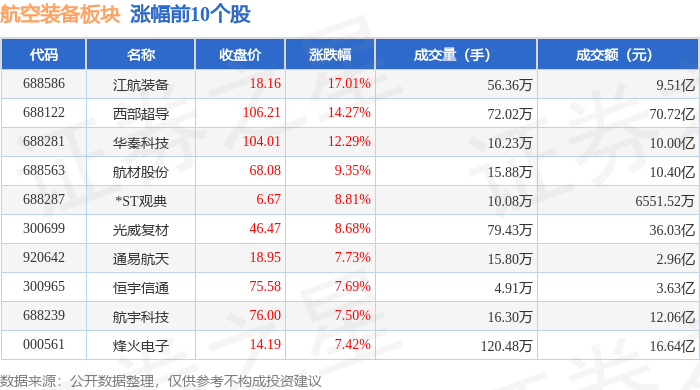
航空装备板块1月12日涨4.11%,江航装备领涨,主力资金净流出13.13亿元
Zheng Xing Xing Ye Ri Bao· 2026-01-12 09:10
Core Viewpoint - The aviation equipment sector experienced a significant increase of 4.11% on January 12, with Jianghang Equipment leading the gains, reflecting positive market sentiment in this industry [1]. Group 1: Market Performance - The Shanghai Composite Index closed at 4165.29, up by 1.09%, while the Shenzhen Component Index closed at 14366.91, up by 1.75% [1]. - Jianghang Equipment (688586) saw a closing price of 18.16, with a remarkable increase of 17.01% and a trading volume of 563,600 shares, amounting to a transaction value of 9.51 billion [1]. - Other notable performers included Xibu Superconductor (688122) with a closing price of 106.21, up by 14.27%, and Huamai Technology (688281) at 104.01, up by 12.29% [1]. Group 2: Fund Flow Analysis - The aviation equipment sector experienced a net outflow of 1.313 billion from institutional investors, while retail investors saw a net inflow of 852 million [2]. - The individual stock fund flow indicated that Guangwei Composite (300699) had a net inflow of 2.39 million from institutional investors, while it faced a net outflow of 28.2 million from retail investors [3]. - Zhongjian Technology (300777) reported a net inflow of 102 million from institutional investors, contrasting with a net outflow of 36.97 million from retail investors [3].