春秋航空

Search documents
马上评|明确航班“锁座”标准,终结付费选座争议
Xin Lang Cai Jing· 2026-01-30 06:14
国内航线多为波音737、空客A320、商飞C919这样的160座级载客量的单通道客机执飞。按照征求意见 稿,航班经济舱总座位数小于160(含),免费可选座位范围不低于经济舱总座位数的 70%。假定160 座级客机商务舱座位8个,就意味或有45个左右的经济舱座位航司有权锁座;且这45个座位并不包含12 个左右的安全出口座位,即运行保障性预留座位,这意味着作为增值服务性预留座位大概率为经济舱的 前7-8排。这一锁座比例是否合适,旅客的接受度如何,同样需要观察。 航班"锁座"将有明确标准。1月29日,中国航空运输协会发布关于《公共航空运输企业航班预留座位规 则(征求意见稿)》,首次系统规范航空公司经济舱座位预留的种类、范围、比例及信息告知等关键内 容。 简单来说,征求意见稿规定,国内航班不得开展现金选座服务,仅可使用积分/里程兑换增值服务性预 留座位;国内航班免费可选座位比例最低70%,国际及地区航班免费座位比例最低65%;航司需明确预 留座位释放时间,防止"最后一刻"才放座,且要以显著方式告知免费与预留座位范围等。 这样看来,航班付费选座争议或迎来终结。但需明确的是,征求意见稿仅是团体标准,并非行政法规, 因而无 ...
飞机锁座迎新规:国内航班不准许付费选座,免费可选座位比例最低70%
Bei Jing Shang Bao· 2026-01-29 13:08
Core Viewpoint - The new draft regulation on seat reservation for public air transport aims to standardize the practice of seat locking, ensuring transparency and protecting consumer rights by mandating minimum percentages of free seat selection for domestic and international flights [1][7]. Group 1: Regulation Details - The draft specifies that domestic flights must have at least 70% of economy class seats available for free selection, while international and regional flights must have at least 65% [1][4]. - The types of reserved seats are categorized into free selectable seats and reserved seats, with reserved seats further divided into operationally necessary and value-added service seats [3][4]. - Value-added service reserved seats are classified into rights-based and paid reservations, with the former available to frequent flyer program members and the latter only applicable to international and regional flights [4][5]. Group 2: Release and Information Disclosure - The draft outlines specific release times for reserved seats, requiring domestic flights to release seats online no later than three hours before departure and international flights to release them 48 hours prior [6]. - Airlines must clearly inform passengers about the categories of seats available, including free and reserved options, as well as the rules for redeeming points or paying for seat selection [6][7]. Group 3: Industry Impact - The regulation aims to enhance service quality and transparency in the airline industry, addressing widespread concerns about seat locking practices and ensuring a more standardized approach across different airlines [7][8]. - The involvement of various industry stakeholders in drafting the regulation indicates a collaborative effort to improve passenger experience and protect consumer rights [7][8].

国内航班免费可选座位最低要求占七成!曾有航司因锁座被约谈
Nan Fang Du Shi Bao· 2026-01-29 10:40
Core Viewpoint - The China Air Transport Association has released a draft standard for public consultation regarding the reservation of seats on flights, aiming to regulate the classification and information disclosure of economy class seats by airlines [1][2]. Group 1: Seat Classification and Regulations - Airlines are required to categorize economy class seats into "free selectable seats" and "reserved seats" [2]. - Reserved seats are further divided into operationally necessary reserved seats (for safety and service needs) and value-added reserved seats (including reward points/miles redemption and paid reservations for international and regional flights) [2]. - Domestic flights must ensure that at least 70% of economy class seats are free selectable, while international and regional flights must have a minimum of 65% [2]. Group 2: Information Disclosure and Transparency - Airlines must clearly inform passengers about the categories of free and reserved seats, redemption standards, paid selection prices (for international and regional flights), and the release time of reserved seats [2]. - A clear seat map must be provided to distinguish between "free selectable," "member selectable," "not selectable online," and "selected seats" to avoid ambiguity and misleading information [2]. Group 3: Consumer Complaints and Industry Response - Several airlines have faced scrutiny for locking certain desirable seats, leading to consumer complaints about unfair practices [3]. - The Jiangsu Consumer Protection Committee has conducted investigations and engaged with multiple airlines regarding the locking of seats that should be part of standard services [3]. - Airlines such as 吉祥航空 and 四川航空 have acknowledged the issues and are undertaking internal evaluations and corrective actions in response to the consumer protection committee's findings [3].



航班预留座位规则征求意见:国内航班不得付费选座,免费可选座位比例不低于70%
Xin Lang Cai Jing· 2026-01-29 10:24
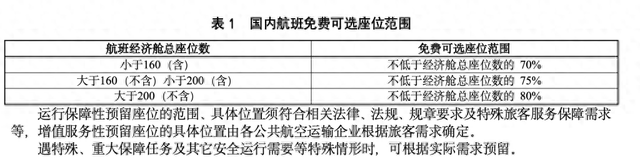
Core Viewpoint - The "Flight Seat Reservation" rules have been further clarified, establishing a framework for the classification and management of economy class seat reservations by airlines in China [1][5]. Group 1: Overview of the Draft Rules - The draft rules categorize economy class seats into "free selectable seats" and "reserved seats," with operational reserved seats mandated for safety and special passenger needs [1][2]. - The draft aims to standardize the types, scope, proportions, and information disclosure of seat reservations for domestic, international, and regional flights [1][6]. Group 2: Domestic Flight Seat Reservation Standards - For domestic flights, value-added reserved seats are limited to rights-based reservations, prohibiting paid seat selection [2][7]. - Free selectable seats must constitute at least 70% of the total economy class seats for flights with 160 or fewer seats, 75% for flights with 161 to 200 seats, and 80% for flights with more than 200 seats [2][3]. - Rights-based reserved seats must be available for online selection no later than three hours before the scheduled departure time [2][3]. Group 3: International and Regional Flight Seat Reservation Standards - International and regional flights must provide at least 65% of economy class seats for free selection [3][4]. - Reserved seats must be released at least six hours before departure for manual check-in and gradually released online starting 48 hours before departure [3][4]. - The draft specifies that seat maps must clearly indicate seat categories, including free selectable seats and paid options [4][6]. Group 4: Industry Context and Implications - The current paid seat selection service is prevalent in international flights, while domestic flights primarily offer free seats in the rear [4][5]. - The draft aims to address discrepancies in seat selection services among airlines, ensuring better protection of passenger rights and enhancing service experiences [5][6]. - The standard is designed to align domestic practices with international norms, reflecting a commitment to improving passenger service and transparency [6][7].
关于航班“锁座”,中国航协将有明确标准
Guan Cha Zhe Wang· 2026-01-29 09:53
Core Viewpoint - The China Air Transport Association has issued a draft for public consultation regarding the "Flight Seat Reservation Rules for Public Air Transport Enterprises," aiming to standardize seat reservation practices and enhance passenger rights in response to growing demand for personalized travel experiences [1][2]. Group 1: Overview of the New Rules - The new rules require that at least 70% of seats on domestic flights and 65% on international and regional flights be available for free selection by passengers [2]. - The draft aims to address discrepancies in seat selection services among airlines, ensuring a more uniform experience for travelers [1][2]. Group 2: Scope and Applicability - The rules apply to both domestic and international flights operated by public air transport enterprises within China, with foreign airlines encouraged to follow these guidelines [3]. Group 3: Seat Reservation Definitions - Free selectable seats are defined as those available for passengers to choose without additional charges [6]. - Reserved seats are those not open for selection due to safety, special passenger needs, or value-added services [8]. Group 4: General Principles - Safety is prioritized, with seat reservation and release practices needing to comply with safety regulations [18]. - The rules emphasize a passenger-centered approach, ensuring sufficient free seats and respecting diverse passenger needs [19]. Group 5: Seat Reservation Management - Airlines must establish a management system for seat reservations, detailing reasons, quantities, and rules for obtaining and releasing seats [5][21]. - For domestic flights, value-added reserved seats are limited to loyalty program members, and no paid seat selection is allowed [23]. Group 6: Release Rules - Domestic flights must release reserved seats for free selection no later than three hours before departure [27]. - For international flights, reserved seats should be released progressively starting 48 hours before departure, with specific rules for different seat categories [33]. Group 7: Information Disclosure - Airlines must clearly inform passengers about seat reservation options, including free and paid selections, and the rules governing these options [35]. - Seat maps must use clear icons to indicate different seat categories for both domestic and international flights [36][37].
航空机场板块1月29日跌0.49%,华夏航空领跌,主力资金净流出2.42亿元
Zheng Xing Xing Ye Ri Bao· 2026-01-29 09:03
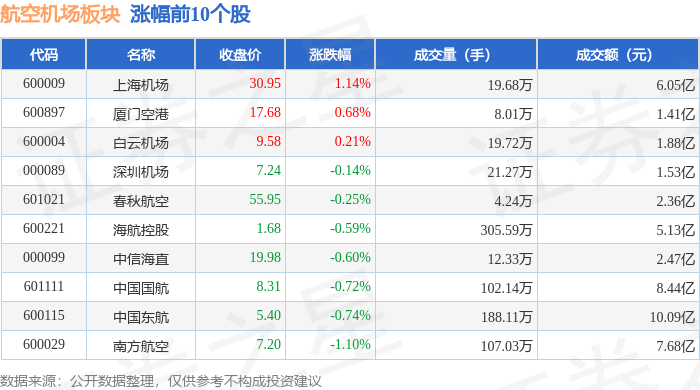
Market Overview - The aviation and airport sector declined by 0.49% on January 29, with Huaxia Airlines leading the drop [1] - The Shanghai Composite Index closed at 4157.98, up 0.16%, while the Shenzhen Component Index closed at 14300.08, down 0.3% [1] Stock Performance - Shanghai Airport (600009) closed at 30.95, up 1.14% with a trading volume of 196,800 shares and a turnover of 605 million yuan [1] - Xiamen Airport (600897) closed at 17.68, up 0.68% with a trading volume of 80,100 shares and a turnover of 141 million yuan [1] - Baiyun Airport (600004) closed at 9.58, up 0.21% with a trading volume of 197,200 shares and a turnover of 188 million yuan [1] - Shenzhen Airport (000089) closed at 7.24, down 0.14% with a trading volume of 212,700 shares and a turnover of 153 million yuan [1] - Spring Airlines (601021) closed at 55.95, down 0.25% with a trading volume of 42,400 shares and a turnover of 236 million yuan [1] - HNA Holding (600221) closed at 1.68, down 0.59% with a trading volume of 3,055,900 shares and a turnover of 513 million yuan [1] - China Southern Airlines (600029) closed at 7.20, down 1.10% with a trading volume of 1,070,300 shares and a turnover of 768 million yuan [1] Fund Flow Analysis - The aviation and airport sector experienced a net outflow of 242 million yuan from institutional investors, while retail investors saw a net inflow of 230 million yuan [3] - Major stocks like Shanghai Airport and Shenzhen Airport had varying net inflows and outflows from different investor types [4] - Shanghai Airport had a net inflow of 28.37 million yuan from institutional investors, while retail investors had a net outflow of 39.44 million yuan [4] - China Southern Airlines had a net outflow of 10.48 million yuan from institutional investors, but a net inflow of 22.85 million yuan from retail investors [4] ETF Performance - The Aerospace ETF (product code: 159227) tracked the National Aerospace Industry Index and saw a 3.00% increase over the last five days, with a net redemption of 78.67 million yuan [6] - The General Aviation ETF (product code: 159230) tracked the National General Aviation Industry Index and had a 2.17% increase, with a net redemption of 5.55 million yuan [7] - The Tourism ETF (product code: 562510) tracked the China Securities Tourism Theme Index and decreased by 4.77%, with a net inflow of 8.09 million yuan [7]




大摩闭门会:汽车、工业、交运、房地产行业更新
2026-01-29 02:43
Summary of Key Points from the Conference Call Industry Overview - **Industries Discussed**: Transportation, Real Estate, Automotive, and Industrial sectors were the main focus of the conference call [1][2]. Transportation Industry Insights - **Airline Industry Outlook**: The airline industry is experiencing an upward cycle, with supply-side disruptions continuing. Boeing and Airbus are slightly accelerating aircraft deliveries, but still slower than expected. New orders from Chinese airlines are primarily for deliveries post-2028 [3][4]. - **Engine Maintenance Impact**: Engine maintenance is expected to peak between 2026 and 2028, affecting capacity utilization. Airlines are managing capacity to maximize profits during peak seasons [5][6]. - **Spring Festival Travel**: Demand for travel during the Spring Festival is strong, with no significant drop in ticket prices expected. The first half of the travel period is anticipated to be robust, while the second half may see a slight decline in business travel due to overlapping events [6][7]. - **International Flight Pricing**: International flight prices are expected to rise due to less competition compared to domestic routes, with inflation pressures affecting foreign competitors [9][10]. - **Cost Factors**: Rising costs from international routes and engine maintenance are concerns, but low fuel prices and potential efficiency improvements may offset some of these pressures [10][11]. Real Estate Market Analysis - **Recent Trends**: There has been a slight improvement in second-hand home transactions in major cities like Shanghai and Beijing, with a notable reduction in the rate of price decline. However, this is attributed to seasonal factors and temporary policy adjustments rather than a sustainable recovery [21][23]. - **Policy Expectations**: The likelihood of significant stimulus policies for the real estate sector remains low, as the macroeconomic environment shows resilience and no immediate risks have emerged [25][26]. - **Price Forecasts**: Predictions indicate that national second-hand home prices may decline by 8% and 6% in the next two years following a 12% drop last year, with major cities potentially experiencing more significant declines [27][28]. Automotive Sector Insights - **Impact of Storage Price Increases**: The rising costs of storage components are significantly affecting vehicle production costs, with increases of $100 to $200 for fuel vehicles and $300 to $400 for electric vehicles expected by 2025 [49][50]. - **Cost Sharing Dynamics**: The burden of increased costs will depend on negotiations between automakers and suppliers, with potential for production cuts if supply issues arise [50][51]. - **Market Demand**: Current demand for vehicles remains weak, complicating the ability to raise prices despite increased production costs. Dealers, particularly for fuel vehicles, may benefit from tighter supply conditions [52][53]. Industrial Sector Outlook - **Demand Recovery**: The industrial sector is gradually recovering, driven by domestic upgrades and AI-related capital expenditures. However, demand varies significantly across sub-sectors [32][33]. - **Key Growth Areas**: The AIDC equipment sector is expected to see strong growth due to AI advancements, while sectors like chemicals and real estate-related industries are currently weak [34][35]. - **Investment Recommendations**: Companies like Dazhu Laser and Xianlead are highlighted as strong investment opportunities due to their positioning in growing markets [35][37]. Additional Insights - **Logistics and Express Delivery**: The express delivery sector is facing challenges with volume growth, but major players are still focused on maintaining market share. The potential for international expansion is seen as a growth driver [16][19]. - **Overall Market Sentiment**: The overall sentiment across industries remains cautious, with a focus on monitoring economic indicators and market dynamics closely [22][27]. This summary encapsulates the key insights and forecasts discussed during the conference call, providing a comprehensive overview of the current state and future expectations across the transportation, real estate, automotive, and industrial sectors.

摩根士丹利基金:2026年度投资策略会:多元视角,洞察2026年_纪要
摩根· 2026-01-29 02:43
Investment Rating - The report indicates a positive outlook for the financial sector in 2026, expecting a gradual return to a positive cycle driven by reduced risks and stabilized loan interest rates [6][9]. Core Insights - The financial sector is projected to benefit from a stabilization in loan interest rates, which will positively impact bank income growth and the overall health of the financial system [7][8]. - China's household financial assets have been growing at over 10%, with a notable increase of around 12% in the past two years, primarily driven by sustained savings rather than consumption, presenting stable growth opportunities in wealth management and insurance sectors [11][12]. - The report emphasizes the importance of AI and technology innovation in enhancing global competitiveness, with expectations of a significant increase in domestic production rates in the AI sector over the next 5 to 8 years [3][17]. Summary by Sections Financial Sector Outlook - The financial sector is expected to stabilize, benefiting from lower risks and a rebound in loan interest rates, which will support bank margins and insurance investment returns [6][9]. - The net interest margin for banks is anticipated to stabilize and slightly increase in 2026, indicating a positive trend for bank revenues [9]. Household Financial Assets - China's household financial assets have maintained a growth rate of over 10%, with a 12% increase in the last two years, indicating a strong potential for wealth management and insurance industries to grow at double-digit rates [11][12]. AI and Technology Innovation - China possesses significant advantages in AI, including talent, infrastructure, and data resources, which are expected to enhance productivity and competitiveness in the global market [17][19]. - The report highlights the potential for breakthroughs in various technology sectors, including biopharmaceuticals and advanced manufacturing, which are expected to contribute to China's economic growth [19]. Cross-Border Investment Strategies - Morgan Stanley has launched multiple QDII private products, offering customized active management strategies that differ from the predominantly passive QDII strategies in the industry [5]. Market Dynamics - The report notes a shift in the capital market environment towards lower risk and stable growth, with expectations of a "slow bull" market characterized by higher quality and stable growth in sectors like insurance and wealth management [13][15].
大摩闭门会:汽车、工业、交运、房地产行业更新 _纪要
2026-01-29 02:43
大摩闭门会:汽车、工业、交运、房地产行业更新 260128 摘要 航空业发动机维修维护高峰期预计在 2026-2028 年,春秋航空已受影 响。春运期间票价和需求健康,预计春节期间机票不会大幅降价。国际 航线票价优于国内,但成本通胀和维修费用上升构成压力,低油价和利 用小时提升可部分抵消。 快递行业管理层预计 2026 年件量增长接近 10%,高于市场悲观预期。 头部企业如中通和圆通追求高于行业平均的增速,反内卷政策延续,利 好头部企业集中份额,优化成本结构,极兔和圆通积极拓展国际市场。 房地产市场二手房成交量改善,但主要受短期因素影响,对可持续性持 保留态度。预计 2026 年房地产政策延续温和态势,大力度刺激政策可 能性较低,高库存弱情绪下,房价或延续量价齐低态势,全国二手房价 预计继续下降。 华润万象 2026-2027 年增速放缓担忧过度,第三方商场扩张可支撑利 润增长。若利润增速 10%,2026 年股息率 5.2%,2027 年接近 6%, 股价仍有上涨空间,建议持续关注。 工业行业整体需求复苏,设备需求进入上升周期,与数据中心、储能或 机器人相关公司增长强劲。看好 AIDC 设备相关板块,受益于 ...
航空机场板块1月28日跌2.33%,中国东航领跌,主力资金净流出9948.02万元
Zheng Xing Xing Ye Ri Bao· 2026-01-28 09:04
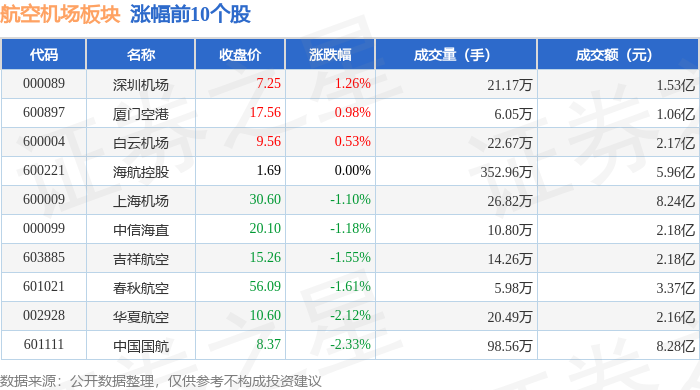
Core Viewpoint - The aviation and airport sector experienced a decline of 2.33% on January 28, with China Eastern Airlines leading the drop, while the Shanghai Composite Index rose by 0.27% and the Shenzhen Component Index increased by 0.09% [1][3]. Market Performance - The closing prices and performance of key stocks in the aviation and airport sector are as follows: - Shenzhen Airport: 7.25, +1.26%, volume 211,700, turnover 153 million [1] - Xiamen Airport: 17.56, +0.98%, volume 60,500, turnover 106 million [1] - Baiyun Airport: 9.56, +0.53%, volume 226,700, turnover 217 million [1] - China Eastern Airlines: 5.44, -5.88%, volume 2,833,500, turnover 1.571 billion [3] - China Southern Airlines: 7.28, -3.58%, volume 1,041,200, turnover 767 million [3] - China National Aviation: 8.37, -2.33%, volume 985,600, turnover 828 million [3] Capital Flow - The aviation and airport sector saw a net outflow of 99.48 million from institutional investors, while retail investors experienced a net outflow of 14.7 million, and speculative funds had a net inflow of 247 million [4]. - The capital flow for specific stocks includes: - China Eastern Airlines: net inflow from institutions 29.99 million, net outflow from retail -12.8 million [4] - Shenzhen Airport: net inflow from institutions 28.87 million, net outflow from retail -24.85 million [4] - China National Aviation: net inflow from speculative funds 48.49 million, net outflow from retail -49.32 million [4] ETF Performance - Aerospace ETF (Product Code: 159227) tracked the aerospace industry index, with a five-day decline of 2.64% and a net subscription of 85.38 million [6]. - General Aviation ETF (Product Code: 159230) tracked the general aviation industry index, with a five-day decline of 2.52% and a net redemption of -39.41 million [7]. - Tourism ETF (Product Code: 562510) tracked the tourism theme index, with a five-day decline of 4.37% and a net subscription of 7.42 million [7].