
水晶光电

Search documents
机构AI投资策略悄然转向
Zhong Guo Zheng Quan Bao· 2025-12-11 20:17
Core Insights - The AI application sector currently presents more narrative appeal and growth potential compared to the computing power layer, which has established a solid "value base" and clearer valuation logic [1] - Investment strategies are shifting towards AI applications, with fund managers increasing their focus on companies that can translate technology into profits, particularly in sectors like AI smartphones and AR glasses [1][2] - The end-side AI market is expected to see significant advancements, with new products emerging and a growing investment interest in hardware companies [2][3] Investment Trends - Fund managers are adjusting their portfolios to capitalize on the growth of AI applications, with notable increases in holdings of semiconductor stocks and consumer electronics [1][2] - Specific funds, such as Dongwu Fund, have significantly increased their positions in semiconductor companies while reducing exposure to certain optical module and PCB stocks [1] - The trend of investing in end-side AI applications is gaining momentum, with funds focusing on opportunities in areas like foldable screens, 3D printing, AI glasses, and robotics [2] Market Developments - Recent product launches in the end-side AI space include ByteDance's Doubao mobile assistant and Alibaba's Quark AI glasses, indicating a strong push into consumer-grade smart wearable devices [2] - Significant funding rounds have been reported in the end-side AI hardware sector, with companies like Thunder Innovation and Guangli Technology securing substantial investments [2] - Government initiatives, such as the State Council's plan for AI application proliferation by 2027, are expected to drive market growth and consumer adoption of smart devices [2][3] Future Outlook - The penetration of end-side AI devices is anticipated to increase, leading to performance growth for companies in the consumer electronics supply chain [3][4] - The investment focus is shifting from infrastructure (computing power) to applications, with a belief that AI applications will become a key investment theme by 2026 [3][4] - The integration of computing power and applications is expected to drive rapid ecosystem expansion, positioning 2026 as a pivotal year for end-side AI [4]
从“卖铲子”转向“挖金子” 谁已提前下注?
Zhong Guo Zheng Quan Bao· 2025-12-11 14:36
Core Insights - The investment focus is shifting from computing power to application stories, indicating a growing imagination space in AI applications compared to the established value base of computing power [1][2][7] - Venture capital is actively investing in next-generation AI hardware, while fund managers are positioning themselves to benefit from emerging AI products in the secondary market [1][2] Investment Strategies - Fund managers are adjusting their AI investment strategies as the structure of the supply chain stabilizes, with a focus on AI applications that are expected to see significant growth [2][4] - Specific funds, such as Dongwu Fund, have increased their holdings in semiconductor stocks while reducing exposure to certain AI-related stocks, indicating a strategic shift towards hardware that supports AI applications [2][3] Market Activity - The primary market is witnessing increased activity with new AI products being launched, such as the Doubao mobile assistant and Quark AI glasses, which are gaining traction in the consumer electronics market [5][6] - Significant funding rounds have been completed in the AI hardware sector, with companies like Thunder Innovation and Guangli Technology securing substantial investments, highlighting investor confidence in the sector [5][6] Future Outlook - The investment landscape for 2026 is expected to be driven by consumer electronics linked to AI applications, as the focus shifts from infrastructure to practical applications and commercialization [7] - The potential for AI applications to create clear business models and revenue growth points is recognized, with expectations for continued cross-industry investment opportunities [7]
从“卖铲子”转向“挖金子”,谁已提前下注?
Zhong Guo Zheng Quan Bao· 2025-12-11 14:33
Core Insights - The investment logic is shifting from focusing on hardware and infrastructure ("selling shovels") to prioritizing actual applications and commercialization ("mining gold") in the AI sector [1][7] - The AI application layer is seen as having greater potential for growth and innovation compared to the more stable and predictable computing power layer [1][2] Market Trends - In the primary market, venture capital is heavily investing in next-generation AI hardware companies, while in the secondary market, fund managers are positioning themselves to benefit from emerging AI products [1][2] - Fund managers are increasingly optimistic about AI applications, particularly with the rise of edge AI products, leading to a gradual increase in investments in this area [2][4] Fund Manager Strategies - For example, Dongwu Fund's manager significantly increased investments in semiconductors while reducing holdings in AI optical modules and PCBs, indicating a strategic shift towards hardware that supports AI applications [3] - Managers are focusing on mid-term opportunities in AI terminal applications, including foldable screens, 3D printing, AI glasses, and robotics [3][4] Primary Market Activity - The edge AI market is witnessing new developments, such as the launch of the Doubao mobile assistant and the Quark AI glasses, indicating a growing consumer interest in AI-integrated devices [5] - Significant funding rounds have been completed in the edge AI hardware sector, with record investments in companies like Thunderbird Innovation and Guangli Technology [5] Consumer Electronics Outlook - The Ministry of Industry and Information Technology has outlined plans for significant growth in consumer electronics, with expectations for AI devices to drive performance in related companies [6] - The investment focus for 2026 is anticipated to be on the consumer electronics chain driven by edge AI innovations, as the industry shifts towards application-based value creation [7]
各厂商纷纷布局端侧AI,关注产业链相关机会
Jianghai Securities· 2025-12-11 07:13
Investment Rating - The industry investment rating is maintained at "Overweight" [5] Core Insights - The report highlights the increasing significance of domestic AI chips in the electronics industry, with various companies launching innovative products such as AI glasses and mobile assistants [4][6] - The report emphasizes the rapid growth and adoption of AI edge devices, suggesting a focus on related companies like Alibaba, Xiaomi, Hengxuan Technology, and others [6] Summary by Sections Recent Industry Performance - The industry has shown relative returns of 0.82% over the past month, 10.46% over three months, and 30.55% over the past year compared to the CSI 300 index [3] Key Events - Alibaba launched the Quark AI glasses on November 27, 2025, featuring advanced technology and integration with various Alibaba services [5] - ByteDance introduced the Doubao mobile assistant on December 1, 2025, which can perform complex tasks like a human [5] - Huawei released the AI toy "Hanhai" on November 28, 2025, designed for emotional companionship [5] Investment Recommendations - The report suggests monitoring the growth of AI edge devices and related companies, indicating a positive outlook for the sector [6]
A股震荡修复,年末政策窗口引关注,500质量成长ETF(560500)盘中上涨0.51%
Xin Lang Cai Jing· 2025-12-11 02:36
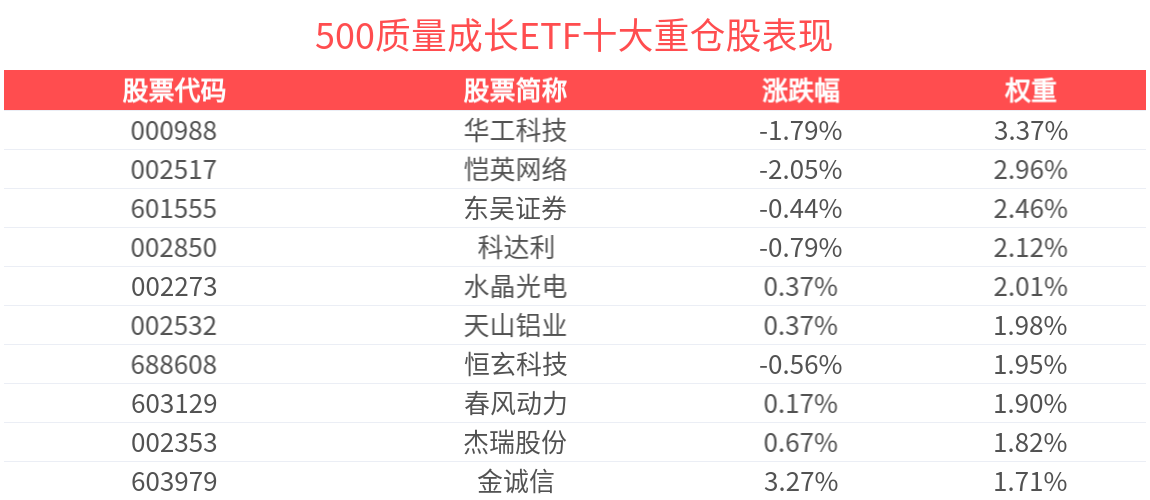
Core Viewpoint - The market is experiencing a recovery trend, with the CSI 500 Quality Growth Index showing a slight increase, and significant movements in individual stocks within the index, indicating potential investment opportunities in the sector [1]. Group 1: Market Performance - As of December 11, 2025, the CSI 500 Quality Growth Index rose by 0.23%, with notable individual stock performances including JieJia WeiChuang up by 7.02% and Sun Paper up by 3.50% [1]. - The CSI 500 Quality Growth ETF (560500) increased by 0.51%, reflecting positive market sentiment [1]. - The A-share market showed a general upward trend, with the All A Index rising by 0.72% and the ChiNext Index leading with a gain of 1.86% [1]. Group 2: ETF and Index Composition - The CSI 500 Quality Growth ETF closely tracks the CSI 500 Quality Growth Index, selecting 100 companies with high profitability, sustainable earnings, and strong cash flow [2]. - As of November 28, 2025, the top ten weighted stocks in the CSI 500 Quality Growth Index accounted for 21.53% of the index, with companies like Huagong Technology and Kaiying Network among the leaders [2]. Group 3: Future Outlook - The upcoming Central Political Bureau meeting and Central Economic Work Conference are expected to provide strategic guidance for 2026, focusing on technology independence, domestic demand expansion, and investment in human resources [1]. - The market is also anticipating the Federal Reserve's upcoming meeting, which may influence global capital flows [1].

科技竞赛打开估值上限——多行业联合人工智能12月报
2025-12-10 01:57
Summary of Key Points from Conference Call Records Industry Overview - The report focuses on the technology sector, particularly the AI and consumer electronics industries, with an emphasis on the impact of the US-China tech competition on valuations and growth prospects in 2026 [1][2][4]. Core Insights and Arguments - **Growth Projections for 2026**: The edge growth is expected to be robust, primarily driven by the Apple supply chain and robotics chain, with the Apple chain benefiting from foldable screens and new products, showing strong growth potential and lower valuations compared to competitors [1][2]. - **Valuation Trends**: Despite the current high valuations in the domestic tech sector, there remains upward potential when compared to the 1990s internet boom in the US. The overall valuation in the domestic tech sector is still seen as having room for growth [2][4]. - **AI Applications**: The AI sector is entering a phase of strong reasoning and native multimodal capabilities, with significant advancements in models like the kimi K2 thinking model, which has improved reasoning speed and tool usage capabilities at a lower training cost compared to OpenAI [1][6]. - **Consumer Electronics Innovations**: The consumer electronics industry is expected to see significant changes, particularly with Apple’s new foldable devices and the anticipated release of Meta's AI glasses, which are projected to reach over 20 million units in 2026. Companies like Luxshare Precision and Crystal Optoelectronics are recommended for investment [5][11]. Important but Overlooked Content - **AI Model Developments**: Recent advancements in AI models, such as Gemini 3 and DeepMind's Gemini 3 DeepThink, have set new benchmarks in reasoning and multimodal understanding, which could significantly influence the AI application landscape [7][9][13]. - **Investment Opportunities**: Companies involved in the AI supply chain, such as Luxshare Precision and Xinwei Communication, are highlighted as having strong potential due to their unique positions and expected improvements in profitability [5][11]. - **Future Trends in AI**: The report anticipates a strong push towards AI integration in various sectors, including industrial AI, military-commercial aerospace, and satellite internet, with a focus on companies like 聚水潭 and those in the financial office sector [3][11][19]. Conclusion - The technology and AI sectors are poised for significant growth in 2026, driven by innovations in consumer electronics and advancements in AI models. Investment opportunities are abundant, particularly in companies that are well-positioned within the evolving supply chains and technological advancements.




巨头联手进入,这一产业新生态有望开启丨每日研选
Shang Hai Zheng Quan Bao· 2025-12-10 00:46
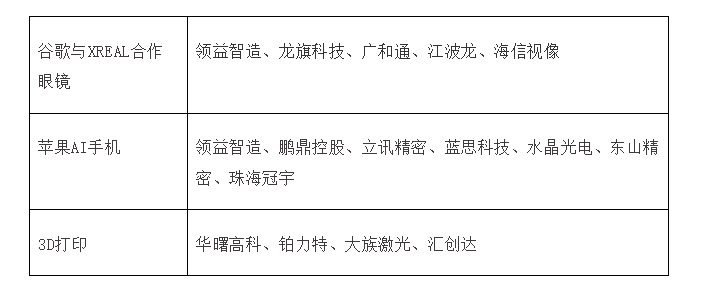
在技术创新与需求修复的共振下,消费电子板块正显现新的活跃信号。近日,谷歌与国内企业共同推出 全球首款Android XR平台的AI智能眼镜,或再次催化该板块。国内哪些产业链企业有望从中受益?请 看机构最新研判。 全年来看,消费电子板块在1-2月上涨,4月受美国加征关税影响有较大幅度回调,6-7月逐步进入上涨 趋势,8-9月加速上涨,10月以来高位震荡。估值方面,目前消费电子板块PE-TTM约38倍,相对电子行 业其他板块仍处于偏低状态,为后续行情演绎留出空间。 从基本面看,2025年以来消费电子复苏趋势持续巩固,技术创新成为板块景气度抬升的重要驱动力。一 方面,折叠屏手机新品密集发布,带动相关零部件需求回暖;另一方面,人工智能技术快速迭代,AI 基础设施需求维持高景气,同时,AI在终端侧的加速落地推动端侧硬件升级,端侧SoC、散热材料等零 部件赛道景气度高企。 与此同时,近期百度、阿里夸克相继发布眼镜产品后,理想汽车也正式发布其第一代AI眼镜理想 Livis。机构认为,此前的AI眼镜多为支付、导航、影音等手机生态的延伸,而此次Livis的发布为AI眼 镜的发展开辟了和手机厂商、互联网公司等不同的新路径,车机联 ...
AI眼镜赛道“群雄逐鹿” 行业投资机遇凸显
Zhong Guo Zheng Quan Bao· 2025-12-09 20:30
Core Insights - The AI glasses market is rapidly transitioning from conceptual exploration to productization and ecological competition, with a 9.81% increase in the AI glasses theme index since November 24, 2023, and 10 out of 12 trading days showing gains [1] - Major players including tech giants, automotive companies, and startups are entering the AI glasses sector, leading to a diversification of product forms and increasing acceptance among consumers [1][6] - The industry is expected to see significant investment opportunities as technological advancements drive market demand [1] Product Launches - On December 9, 2023, the AI glasses theme index rose by 0.33%, with notable stock increases from companies like Qian Zhao Guang Dian (up 11.40%) and Pu Ran Co. (up 9.58%) [2] - Google announced collaborations with Samsung, Gentle Monster, and Warby Parker to develop two types of AI glasses, with the first product expected to launch in 2026 [2] - Alibaba's Quark AI glasses S1 topped sales charts shortly after its release, featuring advanced AI capabilities for voice and photo queries [3] - Li Auto launched its first AI glasses, Livis, which weigh only 36 grams and offer 18.8 hours of battery life, focusing on vehicle control and AI interaction [3] Company Involvement - Several listed companies are actively engaged in the R&D and manufacturing of AI glasses components, with Yu Tong Optical planning to supply molded glass for AI glasses and other new consumer markets in 2024 [4] - Crystal Optoelectronics is focusing on AR near-eye displays and other optical components for AR glasses [4] - Longying Precision has been collaborating with Google for over ten years, indicating a strong relationship with major tech players [4] Market Projections - IDC forecasts that by 2026, global smart glasses shipments will exceed 23.687 million units, with China's market expected to surpass 4.915 million units, marking a significant growth phase [5] - Analysts suggest that 2025 could be a pivotal year for AI glasses, with rapid growth anticipated in 2026 as product forms and interaction methods evolve [6] Investment Opportunities - Analysts recommend focusing on two main investment themes: the potential sales boost from new AI glasses releases in 2025-2026 and the anticipated turning point for AR glasses products [6][7] - The entry of major companies into the AI glasses market is expected to accelerate industry development, with smart glasses poised to become a major consumer electronics category [6][7]




AI眼镜赛道“群雄逐鹿”行业投资机遇凸显
Zhong Guo Zheng Quan Bao· 2025-12-09 20:22
Core Insights - The AI glasses market is rapidly transitioning from conceptual exploration to productization and ecological competition, driven by major tech companies, automotive firms, and innovative startups entering the space [1] - The AI glasses theme index has seen a 9.81% increase since November 24, with 10 out of 12 trading days showing gains, indicating strong market interest and investment potential [1] Product Developments - Google announced collaborations with Samsung, Gentle Monster, and Warby Parker to develop two types of AI glasses, with the first product expected to launch in 2026 [2] - Alibaba's Quark AI glasses S1 achieved significant sales shortly after launch, integrating advanced AI capabilities for user interaction [2] - Li Auto released its first AI glasses, Livis, featuring a lightweight design and long battery life, emphasizing vehicle control and AI interaction [3] Industry Participation - Several listed companies are actively involved in the R&D and manufacturing of AI glasses components, with significant revenue expectations from new consumer markets [3] - Companies like Yutong Optical and Crystal Optoelectronics are focusing on optical applications and AR glasses, indicating a robust supply chain development [3] Market Projections - IDC forecasts that by 2026, the global smart glasses market will exceed 23.687 million units, with China alone expected to surpass 4.915 million units, marking a significant growth phase [4] - Analysts suggest that 2025 could be a pivotal year for AI glasses, with increasing investment opportunities in the AI application supply chain [4] Competitive Landscape - The AI glasses industry is characterized by diverse players, including internet giants, smartphone manufacturers, and AR startups, leading to a reshaping of the competitive landscape [5] - The evolution of AI technology is expected to enhance user interaction with AI glasses, making them a significant consumer electronics category, second only to smartphones [5] Future Outlook - The development of AI models is anticipated to allow for more intuitive user interactions with AI glasses, enhancing their appeal as personal devices [6] - Analysts recommend monitoring the release of new products and the anticipated sales growth in 2025-2026, which could catalyze the core supply chain [6]
2025年光学元件零组件行业词条报告
Tou Bao Yan Jiu Yuan· 2025-12-09 12:14
Investment Rating - The report rates the optical components industry with a positive outlook, indicating a robust growth trajectory and significant investment opportunities. Core Insights - The optical components industry is projected to grow from $8.5 billion in 2019 to $15 billion in 2024, with a compound annual growth rate (CAGR) of 12.03%. It is expected to further increase from $17.2 billion in 2025 to $26.366 billion by 2029, with a CAGR of 11.27% [4][42][49]. Industry Definition - Optical components are core devices used to alter light paths, control spectra, or complete optoelectronic energy conversion. They include lenses, prisms, gratings, mirrors, filters, optical fibers, lasers, LEDs, photodiodes, and micro-nano diffraction elements. These components are essential for applications in barcode scanning, motion optics, photography, autonomous driving LiDAR, high-end cameras, AR/VR, and more [5][4]. Industry Characteristics - The industry is characterized by high-precision manufacturing, multidisciplinary integration, and a coexistence of customization and small-batch production. The manufacturing process requires extreme precision, often within nanometers, and involves advanced techniques such as ultra-precision diamond turning and ion beam polishing [9][10][11][12]. Development History - The optical components industry has evolved from manual grinding of spherical lenses in the early 1900s to a highly automated and precise manufacturing process today. The industry has transitioned through phases of industrialization, precision, and now to intelligent manufacturing, with significant contributions from countries like Germany, Japan, and China [14][15][16]. Industry Chain Analysis - The optical components industry chain consists of upstream raw material and equipment suppliers, midstream optical component manufacturers, and downstream end-users and system integrators. The industry exhibits a collaborative culture that binds materials, design, manufacturing, and application [17][18]. Market Dynamics - The market is experiencing a healthy differentiation in profits, with upstream materials accounting for over 30% of BOM costs. Leading companies like Schott maintain high gross margins, while some midstream manufacturers face negative margins due to intense competition [19][24][25]. Future Trends - The industry is expected to see a shift towards high-value segments driven by AI and high-speed optical communication. Companies that can integrate technology and respond quickly to market demands will likely gain a competitive edge [61][62][63].

