美的集团

Search documents
港股大幅走高!恒指涨近3%,恒生科技指数飙升4%,科技、黄金、有色全线爆发
Jin Rong Jie· 2026-02-23 03:21
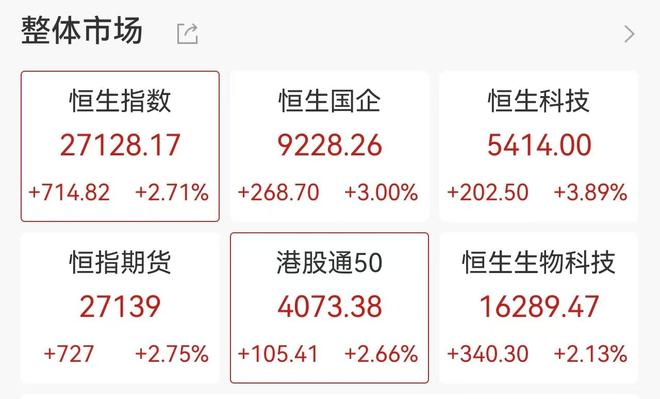
Market Overview - The Hong Kong stock market opened strong and continued to rise, with the Hang Seng Index up nearly 3%, the Hang Seng Tech Index up nearly 4%, and the Hang Seng China Enterprises Index up over 3% [1] - The A50 futures also saw an increase, expanding to over 1.5% [1] Sector Performance - Technology stocks led the market rally, with Meituan rising over 7%, JD Group and BYD up over 5%, and SMIC up nearly 5% [2][3] - Other notable gainers included Huahong Semiconductor, Li Auto, Sunny Optical Technology, and Leap Motor, all rising over 4% [2][3] Individual Stock Highlights - Meituan-W: Current price 86.750, up 7.43% [4] - JD Group-SW: Current price 109.100, up 5.11% [4] - BYD: Current price 100.300, up 5.08% [4] - SMIC: Current price 70.950, up 4.80% [4] - Huahong Semiconductor: Current price 98.350, up 4.46% [4] - Li Auto-W: Current price 73.150, up 4.35% [4] - Alibaba-W: Current price 152.700, up 3.81% [4] Precious Metals and Commodities - The precious metals sector saw significant gains, with spot gold surpassing $5160 per ounce, up over 1%, and spot silver rising over 3% [5] - Chinese gold stocks also surged, with China Gold International up over 7% and Zijin Mining up over 4% [5] Other Sector Movements - The non-ferrous metals sector performed strongly, with China Daye Non-Ferrous Metals up over 9% and Jiangxi Copper up over 6% [5] - The optical communication sector saw collective gains, with Yangtze Optical Fibre up over 18% [5] Investment Insights - Galaxy Securities indicated that the technology sector remains a long-term investment focus, with reduced valuation pressure and potential for rebound due to advancements in AI [6] - Huatai Securities suggested monitoring three key areas: semiconductor hardware, consumer sectors like dining and innovative pharmaceuticals, and electrical equipment benefiting from system upgrades [6] - Significant stock buybacks by industry leaders have instilled confidence in the Hong Kong market, with total buyback amounts exceeding 25.4 billion HKD since 2026 [6]

2025年中国房间空气调节器产量为26697.5万台 累计增长0.7%
Chan Ye Xin Xi Wang· 2026-02-23 01:43
上市企业:格力电器(000651),美的集团(000333),海尔智家(600690),海信家电(000921),TCL科 技(000100),哈空调(600202) 相关报告:智研咨询发布的《2026-2032年中国空调行业市场现状分析及发展前景研判报告》 数据来源:国家统计局,智研咨询整理 知前沿,问智研。智研咨询是中国一流产业咨询机构,十数年持续深耕产业研究领域,提供深度产业研 究报告、商业计划书、可行性研究报告及定制服务等一站式产业咨询服务。专业的角度、品质化的服 务、敏锐的市场洞察力,专注于提供完善的产业解决方案,为您的投资决策赋能。 根据国家统计局数据显示:2025年12月中国房间空气调节器产量为2163万台,同比下降9.6%;2025年1- 12月中国房间空气调节器累计产量为26697.5万台,累计增长0.7%。 2020-2025年中国房间空气调节器产量统计图 ...

研判2026!中国烘鞋器行业发展背景、产业链、市场规模、竞争格局、发展趋势:场景拓展与全球化推动,行业市场规模持续上涨[图]
Chan Ye Xin Xi Wang· 2026-02-23 01:32
Core Insights - The shoe dryer industry has experienced steady growth driven by three core factors: population expansion, increased awareness, and demand upgrades [1][7] - The market for shoe dryers in China is projected to reach 1 billion yuan by 2025, with a year-on-year increase of 25.0% [1][8] Market Overview - Shoe dryers, also known as drying machines, are small appliances designed for drying shoes, featuring functions such as drying, sterilization, and deodorization [3] - The primary consumer base for shoe dryers is concentrated in humid southern regions of China, with expanding demand from outdoor workers and sports enthusiasts [1][7] - The shift from low-cost homogenization to high-end differentiation in product structure is a key driver of industry growth [1] Economic Factors - The growth in disposable income and consumer spending in China is a significant factor driving the expansion of the shoe dryer market [4] - From 2020 to 2025, China's per capita disposable income is expected to rise from 32,189 yuan to 43,377 yuan, while per capita consumption expenditure is projected to increase from 21,210 yuan to 29,476 yuan [4][5] Industry Chain - The shoe dryer industry supply chain includes upstream raw materials like engineering plastics and metals, midstream manufacturing, and downstream sales channels such as e-commerce platforms and physical stores [6] - By 2025, major online sales channels for shoe dryers will be Taobao/Tmall and JD.com, accounting for 60% of the market share [6] Competitive Landscape - The shoe dryer industry is transitioning from homogeneous competition to segmented competition, with traditional appliance brands entering the market [9] - Key players in the industry include Chengdu Rainbow Electric Group, Zhejiang Superman Technology, and Guangdong Zhigao Air Conditioning [9][10] Development Trends - The integration of IoT and AI technologies is driving the smart development of shoe dryers, enhancing user experience through features like automatic moisture detection and remote control via mobile apps [11] - The application of shoe dryers is expanding beyond households to include schools, gyms, and hotels, addressing collective living and public health needs [12] - Environmental sustainability is becoming a core competitive advantage, with companies adopting energy-efficient technologies and eco-friendly materials [13]




制造业“硬实力”遇上服务业“软实力”,会激荡出怎样的能量? 广东给出答案:融则强 合则胜
Xin Lang Cai Jing· 2026-02-22 01:29
Core Insights - Guangdong is focusing on the "coordinated development of manufacturing and service industries" at the high-quality development conference, signaling a strong push for industrial transformation through deep integration of these sectors [1][2]. Manufacturing Industry - Guangdong's manufacturing base is robust, with the super high-definition video display industry cluster recently surpassing 1 trillion yuan in revenue, marking it as the first in the nation to achieve this milestone [2]. - By 2025, the added value of high-tech manufacturing in Guangdong is expected to account for 34.7% of the industrial output, while equipment manufacturing will represent 59.6%, exceeding national averages by 17.6 and 22.8 percentage points respectively [2]. - The province is home to ten trillion-yuan industrial clusters, including electronics, textiles, and new energy, which are crucial for supporting its economic backbone [2]. Service Industry - The modern service industry is positioned as a core engine for high-quality development, with its added value projected to reach 8.5 trillion yuan by 2025, making up 58.3% of GDP [3]. - There is a notable gap in the proportion of productive service industries compared to developed economies, indicating a need for Guangdong to transition from being a "world factory" to a "global service hub" [3][4]. Policy and Strategy - The Guangdong government has initiated measures to promote deep integration between manufacturing and productive services, focusing on 12 dimensions to create a systematic framework for collaboration [4][5]. - The province aims to establish 100 clusters for productive services by 2027, moving from isolated breakthroughs to comprehensive collaboration across regions [4]. Innovation and R&D - Guangdong leads the nation in innovation capabilities, with significant investments in R&D and a high number of high-tech enterprises [6]. - The province has implemented reforms to facilitate the transformation of scientific achievements into practical applications, significantly reducing costs for SMEs [6]. Case Studies - Zhijing Technology is transforming the garment industry in Guangzhou by integrating digital technology into the entire manufacturing process, enhancing efficiency and collaboration among small and medium-sized enterprises [10][11]. - Shugen Internet is pioneering digital maintenance services in the shipbuilding sector, creating a new industrial model that combines manufacturing with high-end services [12][14].
广东给出答案:融则强 合则胜
Xin Lang Cai Jing· 2026-02-22 00:25
Core Viewpoint - Guangdong is focusing on the "coordinated development of manufacturing and service industries" to drive industrial transformation and enhance economic growth, as highlighted in the recent high-quality development conference [1][2]. Group 1: Manufacturing Strength - Guangdong's super high-definition video display industry cluster has achieved over 1 trillion yuan in revenue, marking it as the first in the country to reach this milestone [2]. - The province is home to ten trillion-level industrial clusters, including new-generation electronic information and advanced materials, which are crucial for supporting its economic backbone [2]. - By 2025, the added value of high-tech manufacturing in Guangdong is expected to account for 34.7% of industrial output, significantly higher than the national average [2]. Group 2: Service Industry Integration - The integration of manufacturing and modern service industries is seen as a strategic necessity for Guangdong to maintain its economic leadership [3]. - The province aims to increase the service industry's added value to 8.5 trillion yuan by 2025, representing 58.3% of GDP, while addressing the current gap in productive service sectors compared to developed economies [3][4]. - Guangdong's government has initiated measures to promote deep integration between manufacturing and seven key service sectors, including technology and design [5]. Group 3: Innovation and R&D - Guangdong leads the nation in innovation capabilities, with significant investments in R&D and a high number of high-tech enterprises [6]. - The province has implemented reforms to facilitate the conversion of scientific achievements into practical applications, reducing costs for small and medium-sized enterprises [6]. - Major companies like Huawei are making substantial advancements in AI and digital technologies, enhancing Guangdong's competitive edge in the global market [7]. Group 4: Case Studies - Zhijing Technology is transforming the garment industry in Guangzhou by integrating digital technologies into the entire manufacturing process, showcasing a successful model of manufacturing and service integration [10][11]. - Shugen Internet is pioneering digital maintenance services in the shipbuilding sector, creating a new industrial model that combines manufacturing with high-end services [12][14].
美国1750亿美元关税退税,对A股的影响(附50股)
Sou Hu Cai Jing· 2026-02-21 11:41
Group 1 - The core point of the article is that the recent US Supreme Court ruling on the $175 billion tariff refund has significant implications for both China and the A-share market, despite the refund being an internal US matter [2][6][28] - The $175 billion in tariffs was primarily collected from imports, including a 10% tariff on Chinese goods, and is now being refunded to US importers [8][10] - The refund will indirectly benefit Chinese companies as US importers, who have been financially strained by tariffs, will use the refunded money to pay off debts to Chinese suppliers and resume orders [12][14][28] Group 2 - The immediate impact on the A-share market is expected to be positive, with a potential "opening red" for A-shares as market sentiment improves following the ruling [40][46] - The ruling is seen as a signal that the previous high tariffs on Chinese goods may not be a permanent state, which could lead to a more favorable environment for Chinese exports [20][48] - Structural opportunities in the A-share market are identified, focusing on five main lines: export-oriented sectors, domestic substitution, strategic resources, domestic consumption, and new energy [51][62][88] Group 3 - Export-oriented sectors, particularly those with high exposure to the US market, are expected to benefit directly from the tariff refunds, with companies like Midea Group and Haier expected to see improved performance [52][72][73] - Domestic substitution and self-sufficiency in sectors like semiconductors and military equipment are highlighted as long-term strategic focuses, with companies like SMIC and AVIC Shenyang Aircraft being key players [53][78][86] - Strategic resources such as rare earths and gold are also expected to see price support due to ongoing global supply chain disruptions, benefiting companies like Northern Rare Earth and Shandong Gold [56][87]




海尔智家股价震荡调整,行业转型与估值承压
Jing Ji Guan Cha Wang· 2026-02-21 08:45
Company Performance - Haier Smart Home reported a revenue of 234.05 billion yuan for the first three quarters of 2025, representing a year-on-year growth of 9.98% [2] - The net profit attributable to shareholders reached 17.37 billion yuan, with a year-on-year increase of 14.68% [2] - Despite a net inflow of 2.10 million yuan on February 13, there were instances of net outflow, such as 8.06 million yuan on February 10, indicating mixed market sentiment [2] Industry Policy and Environment - The home appliance industry is undergoing a structural transformation, with a forecasted shift to a "weak recovery + structural growth" phase by 2026, driven by emerging fields like smart home technology and AI displays [3] - Haier Smart Home faces challenges related to "narrative premium loss," as its business remains heavily focused on traditional appliances like refrigerators and washing machines, with a TTM P/E ratio of approximately 10.4 times [3] - Competitors like Midea Group have achieved higher valuations by transitioning towards technology narratives [3] Company Strategy - To address market volatility, Haier Smart Home is implementing share buybacks and increasing its cash dividend payout ratio to 50% for the 2025-2026 fiscal years [4] - The company is strategically focusing on the smart home ecosystem and advancing the listing processes for its subsidiaries, Kaos and Haier New Energy, to explore new growth opportunities [4]

烧了540亿,机器人进入“吃鸡游戏”拐点
Xin Lang Cai Jing· 2026-02-21 06:56
Core Insights - The 2026 Spring Festival Gala showcased a strong presence of robots, indicating a shift in the robotics industry towards a survival-of-the-fittest competition, moving from market expansion to a "battle royale" scenario focused on practical applications [1][6][10] Industry Overview - The number of humanoid robot companies in China is projected to increase from over 120 in 2023 to over 320 by 2025, with industry financing exceeding 58 billion yuan [2] - In 2025, the financing amount for robots is expected to reach 38 billion yuan [3] - In January 2026 alone, the financing amount reached 16 billion yuan, indicating a robust investment climate [4] Competitive Landscape - The "Hundred Machines Battle" has transitioned from concept to reality, with notable companies like Yushu Technology and ZhiYuan Robotics leading the charge, while new entrants like UniX AI are rapidly emerging [5] - Major tech firms such as Tencent, Baidu, and JD.com are now investing in the robotics sector, intensifying competition [5] - The Spring Festival Gala served as a platform for companies to gain exposure, with estimates suggesting that each company spent nearly 100 million yuan for a few minutes of airtime [6] Market Dynamics - The global shipment of humanoid robots is expected to reach 18,000 units in 2025, a staggering increase of 508% year-on-year, with Yushu Technology and ZhiYuan Robotics capturing nearly 60% of the market share [7] - The industry is entering a phase of consolidation, with predictions that over 230 companies will significantly reduce in number as competition intensifies [8] Investment Trends - The investment landscape is shifting, with a 31.7% decrease in the number of financing events but a 46.8% increase in average financing amounts, indicating a focus on companies with clear market applications [12] - Companies are increasingly required to demonstrate practical applications of their robots to attract investment [13] Technological Advancements - Companies like UniX AI are innovating with new robot models designed for real-world applications, emphasizing the importance of practical functionality [14] - The cost of humanoid robots currently ranges from 300,000 to 800,000 yuan, posing challenges for widespread adoption [15] - The Chinese robotics industry benefits from a robust supply chain, which is expected to drive down costs significantly in the coming years [16][19] Future Outlook - The integration of advanced manufacturing capabilities and the development of core components are expected to enhance the competitiveness of Chinese robotics firms [17][18] - Predictions suggest that the price of humanoid robots could drop to several thousand yuan within the next few years, facilitating broader market penetration [19] - The industry faces challenges related to data scarcity for training robots, but companies are exploring innovative solutions to overcome these hurdles [20]

2025年中国家用电冰箱(家用冷冻冷藏箱)产量为10924.4万台 累计增长1.6%
Chan Ye Xin Xi Wang· 2026-02-21 02:53
Core Viewpoint - The report highlights the growth trends in China's home refrigerator market, projecting a production increase in the coming years, with specific data on production volumes and growth rates [1]. Industry Overview - According to the National Bureau of Statistics, the production of home refrigerators in China reached 10.01 million units in December 2025, marking a year-on-year growth of 5.7% [1]. - The cumulative production of home refrigerators for the entire year of 2025 was 109.244 million units, reflecting a cumulative growth of 1.6% [1]. Market Analysis - The report titled "2026-2032 China Ultra-Low Temperature Refrigerator Industry Market In-Depth Analysis and Future Trend Forecast" by Zhiyan Consulting provides insights into the market dynamics and future trends of the ultra-low temperature refrigerator segment [1]. - Zhiyan Consulting is recognized as a leading industry consulting firm in China, specializing in comprehensive industry research reports and tailored consulting services [1].

掌握10万亿美元资产,美国犹太资本巨头,已全面渗透中国
Sou Hu Cai Jing· 2026-02-20 10:23
Core Viewpoint - BlackRock, the world's largest asset management company, has established a significant presence in the Chinese market, managing assets worth $300 billion through a complex financial network [2]. Group 1: Investment Strategy and Market Entry - BlackRock made its initial investment in China in 2006 by acquiring a stake in China Bank Fund, marking the beginning of its strategic entry into the market [4]. - Following the removal of foreign ownership limits in April 2020, BlackRock quickly submitted an application to establish a wholly-owned public fund company in August 2020 [4]. - By June 2021, BlackRock became the first foreign institution allowed to set up a wholly-owned public fund in China, showcasing its first-mover advantage [6]. Group 2: Investment Holdings and Influence - As of the end of 2024, BlackRock indirectly holds stakes in over 1,200 Chinese listed companies through more than 200 fund products, creating a network that spans critical sectors of the Chinese economy [10]. - In the electric vehicle sector, BlackRock is the second-largest institutional shareholder of CATL and holds approximately 6.2% of BYD's H-shares, along with significant stakes in other new energy vehicle companies [10][12]. - BlackRock's investments extend across the entire electric vehicle supply chain, from battery manufacturing to vehicle production and charging infrastructure [12]. Group 3: Regulatory Environment and Challenges - A 2024 report from the U.S. Congress highlighted that BlackRock invested billions in several Chinese companies under U.S. sanctions, prompting calls for legislative action to limit such investments [20]. - In response to foreign capital penetration, Chinese regulatory bodies have begun to enhance oversight, particularly concerning investments in critical information infrastructure and data resources [22]. - New regulations introduced in March 2024 emphasize compliance for foreign financial institutions, with a focus on preventing circumvention of regulations through complex financial structures [24]. Group 4: Future Outlook and Strategic Developments - By the third quarter of 2025, BlackRock's asset management scale in China reached $1.225 trillion, reflecting a 12% year-on-year growth despite regulatory pressures [28]. - BlackRock's ongoing expansion in China signifies a broader trend of foreign capital navigating the balance between openness and security in the financial landscape [30].