Epic Games

Search documents
Video game maker Electronic Arts to be taken private in record $55bn mega-deal
The Guardian· 2025-09-29 13:39
Core Insights - Electronic Arts (EA) is being acquired for $55 billion, marking the largest leveraged buyout attempt in history [1] - The acquisition involves Silver Lake Partners, Saudi Arabia's PIF, and Affinity Partners, with EA's stockholders set to receive $210 per share [1] - This deal will take EA private, ending its 36-year history as a publicly traded company [2] Company Background - EA was founded by William "Trip" Hawkins, a former Apple employee, and went public seven years later, with its shares initially trading at a split-adjusted $0.52 [2] - The current CEO, Andrew Wilson, has been leading the company since 2013 [3] Previous Transactions - Silver Lake has a history of significant technology acquisitions, including the $1.9 billion buyout of Skype in 2009 and a $24.9 billion buyout of Dell in 2013 [4] - Dell returned to the stock market in 2018 after restructuring as a private company [4] Financial Performance - EA's annual revenues have stagnated over the past three fiscal years, ranging from $7.4 billion to $7.6 billion [5] - The company faces increased competition from mobile game makers like Epic Games and was previously rivaled by Activision Blizzard, which was acquired by Microsoft for nearly $69 billion in 2023 [6] Operational Changes - Going private may allow EA to restructure its operations without the pressures of meeting quarterly financial targets [5] - Historically, companies taken private often undergo cost-cutting measures, including layoffs, although there is no indication this will occur with EA following recent workforce reductions [7]



Google Tells Supreme Court Changes to App Store Would Cause ‘Irreparable Harm'
PYMNTS.com· 2025-09-26 00:39
Core Viewpoint - Google is seeking to pause a lower court's ruling that mandates changes to its app store policies, claiming that these changes would cause "irreparable harm" to its Android ecosystem [1]. Group 1: Legal Context - The lower court's ruling, stemming from an antitrust case filed by Epic Games, requires Google Play store to eliminate restrictions that prevent developers from establishing their own marketplaces and billing systems [2]. - The order from the lower court is scheduled to take effect on October 22 [2]. - A jury found in December 2023 that Google holds a monopoly in the Android app distribution and payments market [4]. Group 2: Implications of the Ruling - The ruling would prohibit Google from paying developers for exclusive use of its app store, prevent it from stopping developers from informing consumers about direct app downloads, and require it to allow rival app stores access to its catalog [5]. - Google argued that the ruling would significantly harm user safety, limit choice, and undermine innovation within the Android ecosystem [7]. Group 3: Company Response - Google has sought to overturn the ruling but lost an appeal in July [5]. - The company contended that it was unfairly restricted from informing a jury about its competition with Apple's App Store and argued that the case should have been adjudicated by a judge instead of a jury [6].

X @Bloomberg
Bloomberg· 2025-09-25 18:50
Google asked the US Supreme Court to pause a lower court’s order requiring an overhaul of the technology giant’s app store policies in an antitrust case filed by Fortnite-maker Epic Games https://t.co/COGXnXhr01 ...
Google asks US Supreme Court to freeze app store injunction in Epic Games case
Reuters· 2025-09-25 13:19
Core Points - Google is urging the U.S. Supreme Court to halt significant parts of a judge's order that would require major changes to its Play app store as it prepares to appeal a decision in an ongoing lawsuit [1] Group 1 - Google is seeking to prevent the implementation of a judge's order that could alter its app store operations significantly [1] - The company is in the process of appealing a decision related to a lawsuit that may impact its business model [1]

“虚幻五引擎正在毁掉游戏未来”
Hu Xiu· 2025-09-21 10:40
Core Viewpoint - EA aims for "Battlefield 6" to run smoothly without relying on DLSS technology, emphasizing high performance without additional optimizations [1][2][3] Group 1: Game Performance and Technology - The goal for "Battlefield 6" is to maintain performance standards without enabling DLSS, while still allowing players the option to use it if desired [2] - The game will not feature ray tracing at launch, nor will there be plans to implement it shortly after release [2] - Current gaming trends show that many single-player games struggle to achieve a minimum of 60 frames per second without using upscaling technologies, raising skepticism about EA's claims [3][4] Group 2: Industry Trends and Criticism - There is a growing criticism of Unreal Engine 5 games for poor optimization, with developers often focusing on high-end graphics without adequately addressing performance on lower-end devices [6][7][30] - The performance issues in Unreal Engine 5 games have led to a backlash from players, with many expressing frustration over the disparity between graphical fidelity and performance requirements [28][35] - Epic Games' CEO Tim Sweeney acknowledged the optimization challenges faced by developers, attributing them to a late focus on performance improvements [34][38] Group 3: Historical Context and Comparisons - The gaming community has noted that older titles, such as "Star Wars Battlefront 1/2," achieved impressive graphics without the current reliance on advanced technologies, raising questions about the current development direction [12][14] - The departure of experienced developers from studios has contributed to a decline in the quality of new titles, as newer teams struggle to master existing engines and IPs [14][15] - The ongoing debate about the effectiveness of Unreal Engine 5 highlights the need for better optimization practices from the outset of game development [43][48]

MoffettNathanson founder: Here's what's next for Apple
Youtube· 2025-09-19 19:25
Core Viewpoint - Analysts have upgraded Apple's stock to neutral and raised the price target by approximately $100, indicating that significant worst-case scenario risks have been mitigated [1] Risk Assessment - The two major risks that have been alleviated include tariffs and the Google antitrust case. Apple was particularly vulnerable to tariffs due to its role as a manufacturer and importer, but side deals have helped avoid the worst outcomes [2][3] - The Google antitrust case posed a risk to the payments Apple receives from Google, which account for 25% of its operating income. However, recent developments suggest that while these payments are deemed illegal, they will remain unaffected, thus removing a significant risk [3] Stock Valuation - Despite the upgrade from sell to neutral, analysts still consider Apple to be overvalued, trading at about 37 times earnings, which is a 24% premium to the S&P 500 and a 49% premium when excluding the MAG 7 [4][8] - The company is growing at a rate slower than the market, which raises concerns about sustaining its high valuation unless growth can be accelerated meaningfully [8][9] Innovation and Ecosystem - While Apple generates about half of its revenue from phones, the company has been recognized for its innovation, particularly in the app environment and the App Store, rather than in hardware alone [5][6] - The strength of the Apple ecosystem is highlighted as a key factor in customer loyalty, despite concerns about the company's slower growth compared to the market [7][10] Service Revenue Risks - A recent legal loss to Epic Games allows customers to process payments outside of the Apple ecosystem, which could impact the growth rate of Apple's services revenue, a crucial component of its business model [11][12]

中美 “融资天花板” 企业大PK,没上市也能狂揽千亿!
Sou Hu Cai Jing· 2025-09-17 10:00
Core Insights - The trend of non-listed companies achieving rapid growth through substantial financing has become prominent in global capital markets, particularly in China and the United States [2] - The financing trajectories of leading non-listed companies reflect the economic structure differences between the two countries and reveal global investors' strategic bets on future industry growth [2] Group 1: China's Financing Leaders - The top 20 non-listed companies in China have collectively surpassed 1 trillion RMB in financing, showcasing significant financial strength [3] - Honor Terminal leads with over 250 billion RMB in financing, evolving into a tech brand focused on young consumers and covering mobile phones and IoT devices [3] - Ant Group, a leading fintech platform, has raised 137.05 billion RMB, integrating deeply into daily life and commercial transactions [3] - Other notable companies include Hengfeng Bank (100 billion RMB), Dalian Xindameng (60 billion RMB), and ByteDance (48.85 billion RMB), each contributing to diverse sectors such as finance, real estate, and technology [4][5] Group 2: Characteristics of China's Financing Kings - The leading companies are primarily focused on financial technology, new energy vehicles, and semiconductor manufacturing, aligning with national strategic priorities [8] - Most companies have established a strong domestic market presence, leveraging China's vast population and consumption advantages for rapid growth [9] - Nearly half of the top 20 companies originated from industry giants, benefiting from their parent companies' resources, which enhances their financing capabilities [10][11] - The financing sources include both strategic investments from national funds and market capital, reflecting a unique "production-finance integration" model in China [12] Group 3: U.S. Financing Leaders - The top 20 non-listed companies in the U.S. have collectively raised over 290 billion USD, with a strong presence of tech startups from Silicon Valley [13] - OpenAI leads the U.S. financing landscape, followed by other AI-focused companies like Anthropic and xAI, highlighting the dominance of AI innovation [13][18] - Other significant players include Cruise Automation (17.38 billion USD) and Databricks (14.897 billion USD), showcasing advancements in autonomous driving and big data services [14] Group 4: Characteristics of U.S. Financing Kings - AI and cutting-edge technology dominate the U.S. financing landscape, with the top three companies being AI-focused [18] - Many U.S. companies are founder-driven, often led by prominent entrepreneurs, which helps attract significant capital support [19] - The investment landscape is characterized by high-density venture capital involvement, with major VC firms and tech giants actively investing in innovative startups [20][21] Group 5: Comparative Insights - The financing paths of China's leading companies reflect a blend of national policy guidance and market capital needs, emphasizing a dual-driven model [27] - In contrast, U.S. companies focus on breakthrough technologies and global market expansion, showcasing a strong inclination towards technological exploration [27] - Both countries' financing leaders prioritize technology as a core development direction, but differ in their market strategies and alignment with national goals [27]

WSJ’s Tim Higgins: Apple is facing a situation similar to the one Microsoft faced a generation ago
CNBC Television· 2025-09-16 13:21
App Store & Legal Challenges - The App Store faces legal and regulatory challenges from competitors [1] - Apple's App Store facilitates a trillion dollars annually [3] - Epic Games' founder Tim Sweeney stated that taking on Apple and Google cost his company over 1 billion dollars in lost sales and legal fees [13] - Apple's legal strategy involves pushing boundaries, giving them a competitive edge due to rivals' limited resources [12] Competitive Landscape & AI - The tech industry's history involves creating new tech titans on the backs of the old [8] - Investors are concerned that Apple is behind in AI [17] - There's a bet in Silicon Valley that a new device will displace the iPhone in the AI era [18] - The industry is in an AI dominance race, and there are concerns Apple may have lost focus [16] Apple's Stance & Strategy - Apple believes it is right and defends its user-centric approach [11] - Apple has a special relationship with the White House through Tim Cook, but doesn't engage in government relations like Microsoft [15] - Apple argues that companies attacking it aren't paying their fair share [15]
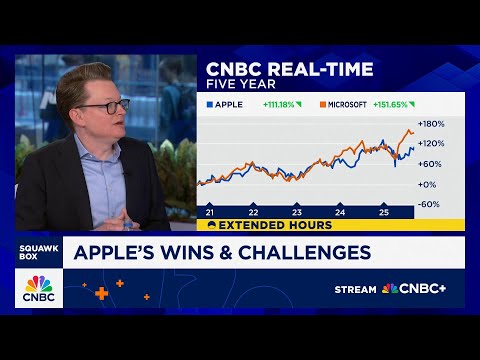
WSJ's Tim Higgins: Apple is facing a situation similar to the one Microsoft faced a generation ago
Youtube· 2025-09-16 13:21
Core Perspective - The article discusses the ongoing legal and regulatory challenges faced by Apple, particularly regarding the App Store, and suggests that these distractions could hinder Apple's competitiveness in the AI era [1][16]. Group 1: Legal and Regulatory Challenges - Apple has been involved in significant legal battles with competitors like Spotify, Facebook, and Epic Games, who argue that Apple exerts too much control and takes excessive fees from the App Store [4][5]. - The App Store generates approximately $1 trillion annually, creating a new economy where various companies have emerged as billionaires due to their success on the platform [3][5]. - The author compares Apple's current situation to Microsoft's past antitrust issues, suggesting that Apple risks losing focus on innovation while engaged in these legal disputes [9][10]. Group 2: Competitive Landscape - The article highlights that the companies challenging Apple are not small startups but established billion-dollar entities that have benefited from the App Store [5][6]. - There is a historical context where new tech titans often rise at the expense of older companies, as seen with Netflix's dominance over cable providers [8]. - The ongoing competition in the tech industry is characterized by a race for AI dominance, with concerns that Apple may be falling behind in this critical area [16][17]. Group 3: Strategic Implications - Apple's strategy has traditionally involved a strong legal defense, which some believe has given it a competitive edge, but this approach may also be contributing to its current challenges [12][14]. - The company has been criticized for not engaging more proactively with regulators and legislators, unlike Microsoft, which has cultivated relationships in Washington [13][15]. - Investors are increasingly worried that Apple's focus on legal battles may detract from its ability to innovate in AI, especially as competitors like Meta push forward with new technologies [17][19].

巨头Baillie Gifford旗舰基金掌舵人最新分享:如何辨识有韧性的公司及创始人
聪明投资者· 2025-09-15 07:04
Core Viewpoint - The article emphasizes that in an era of uncertainty, only resilient companies that can survive challenges will ultimately succeed [10][6]. Group 1: Investment Strategy - Scottish Mortgage Trust (SMT) manages approximately £15.1 billion (about $19.3 billion) in assets, with around 25% allocated to private companies [5]. - SMT's portfolio includes leading global companies such as MercadoLibre, Amazon, Meta, Pinduoduo, and TSMC, as well as innovative private firms like SpaceX and ByteDance [6]. - Despite facing challenges like rising interest rates and geopolitical uncertainties, SMT has maintained an annualized return of about 12% over the past decade [6]. Group 2: Resilience in Companies - Tom Slater highlights that true long-term winners are not those that appear risk-free but those that demonstrate resilience and adaptability during crises [7]. - Companies like Netflix, which have shown the ability to adapt and innovate, exemplify the characteristics of resilient firms [8]. - Resilience is defined as having the ability to "create climate," allowing companies to thrive even in challenging environments [28]. Group 3: Financial Characteristics of Resilient Companies - Key financial traits of resilient companies include manageable debt levels, sufficient gross margins to absorb sales fluctuations, and consistent cash flow generation [24]. - The article discusses Shopify as an example of a company that has transitioned to a model where it retains about 20% of revenue after covering operational costs, enhancing its flexibility [26]. - Meta and Cloudflare are also cited as examples of companies that have improved their operational efficiency and profitability, positioning them favorably in the market [27]. Group 4: Future Trends and Predictions - The article stresses the importance of focusing on predictable trends, such as advancements in artificial intelligence, cheaper electric vehicle batteries, and stronger cloud computing capabilities [34]. - Companies that align with these long-term themes and demonstrate resilience are more likely to survive and prosper in an uncertain future [34].